

Luffu Link: When Family Health Becomes a Shared Data Stream

When Family Health Becomes a Shared Data Stream
The most consequential feature of a health wearable may no longer be what it measures, but whom it allows to watch. Luffu Link, the AI-powered wristband introduced by Fitbit’s founders, positions health tracking as a family system rather than a solitary pursuit. Its promise is seductive: less uncertainty about the people you love, gathered into a shared technological frame.
Dezeen’s September 4, 2026 report describes a metallic, double-barrelled body, a minimalist strap and three finishes: onyx black, halo gold and sterling blue. The stated ambition is to “bring your family’s health and safety together.” Those details establish the proposition, not its clinical reliability or privacy safeguards. The available source summary does not establish exactly which measurements, permissions or AI interventions the system supports.
Nevertheless, the design question is already urgent. Does making care collective also make observation compulsory? The strongest argument for Luffu Link and the strongest argument against it begin in the same place: families are networks of dependence, not collections of autonomous consumers.
PRO: Care Is Already Shared. Its Tools Should Catch Up.
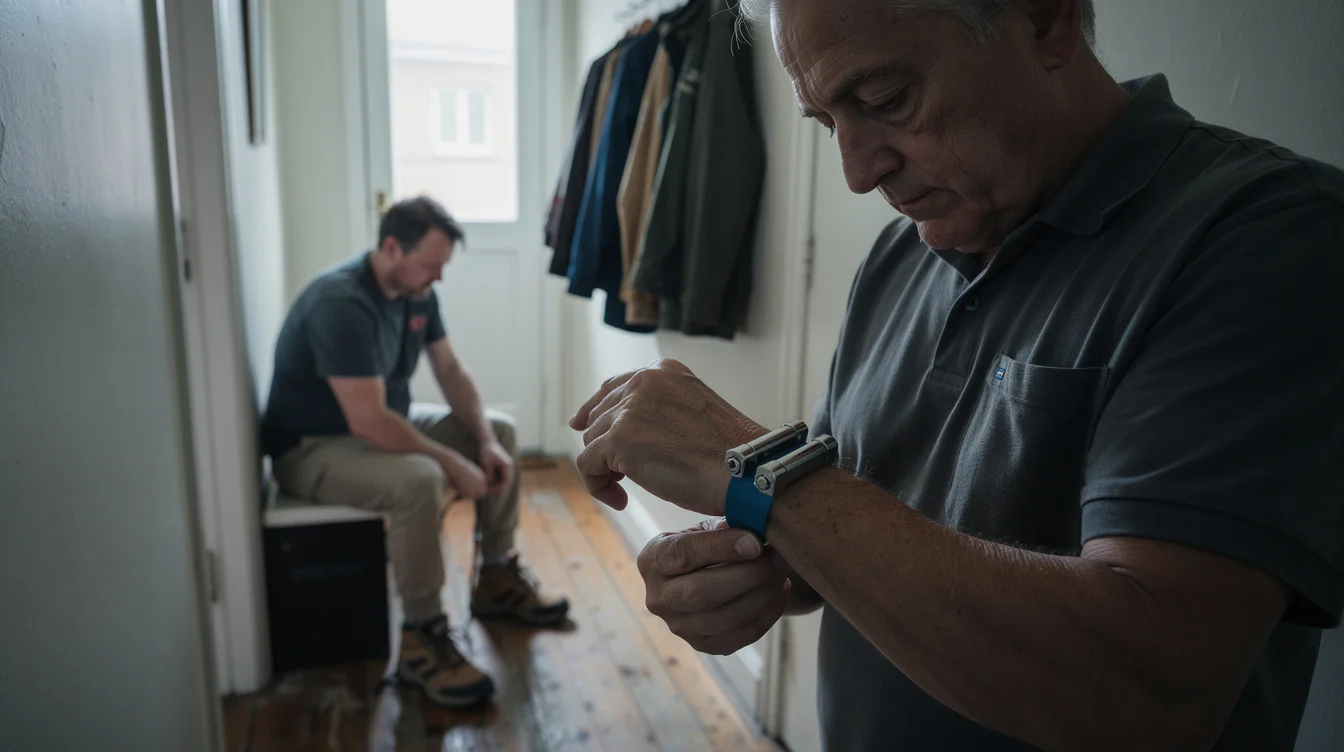
The individual fitness dashboard has always offered an impoverished picture of health. It imagines a person with sufficient time, mobility and control to optimise themselves. Actual households contain recovering patients, exhausted carers, children and relatives whose changing needs rearrange everyone else’s day. A wearable designed around that interdependence addresses something the step-counting industry has largely treated as background noise.
Consider an adult supporting a parent who lives elsewhere. Today, reassurance may depend on repeated telephone calls, fragmented messages and recollections assembled after something has gone wrong. A carefully permissioned family system could provide an agreed signal between conversations: enough information to suggest a check-in, without demanding that the parent perform wellness on the phone. This is a possible use case, not a verified description of Luffu Link’s functions.
There are precedents for abandoning the strictly individual account. Apple’s Health Sharing allows selected health information to be shared with trusted people; Dexcom Follow enables remote viewing of shared glucose information within its supported ecosystem. These products are not interchangeable with Luffu Link, but they demonstrate that health information can have legitimate recipients beyond its subject.
Sharing is not inherently surrender. When initiated by the person being supported, it can distribute responsibility and reduce the administrative burden of repeatedly explaining a condition. The ethical opportunity is not a family scoreboard. It is a less exhausting infrastructure for asking and offering help.
PRO: Good Design Could Make Support Less Intrusive
Luffu Link’s understated physical form matters. A metallic double-barrelled body and restrained strap place it closer to everyday accessories than conspicuous medical equipment. Onyx black, halo gold and sterling blue offer aesthetic choices rather than a single institutional identity. That cannot establish comfort, accessibility or accuracy, but it can change the social experience of wearing something associated with vulnerability. As with personal climate control in fashion and furniture, the challenge is to integrate bodily support into objects people want to live with.
Yves Béhar’s work on the original Jawbone UP helped frame sensing technology as something worn through ordinary life. Luffu Link’s family proposition pushes that design challenge beyond the wrist: how can an object participate in care without making illness the wearer’s defining characteristic?
The more important interface may be the one relatives encounter. In Mark Weiser and John Seely Brown’s concept of calm technology, information moves between the periphery and the centre of attention instead of demanding permanent focus. Applied here, that principle argues for selective summaries and carefully justified interruptions, not an animated feed of everyone’s bodily activity.
Imagine a household agreeing that a recovering relative shares only a limited, relevant signal for two weeks, with the arrangement expiring automatically. Or a wearer receiving an AI-generated summary first and choosing whether to forward it. Neither capability is established by the supplied report; both are concrete design standards against which such a product should be judged.
The positive case is therefore ambitious but specific: family health tracking could replace some intrusive checking with bounded, wearer-directed support. Convenience becomes valuable when it gives people time and discretion back.
CONTRA: The Family Is Not a Consent Form
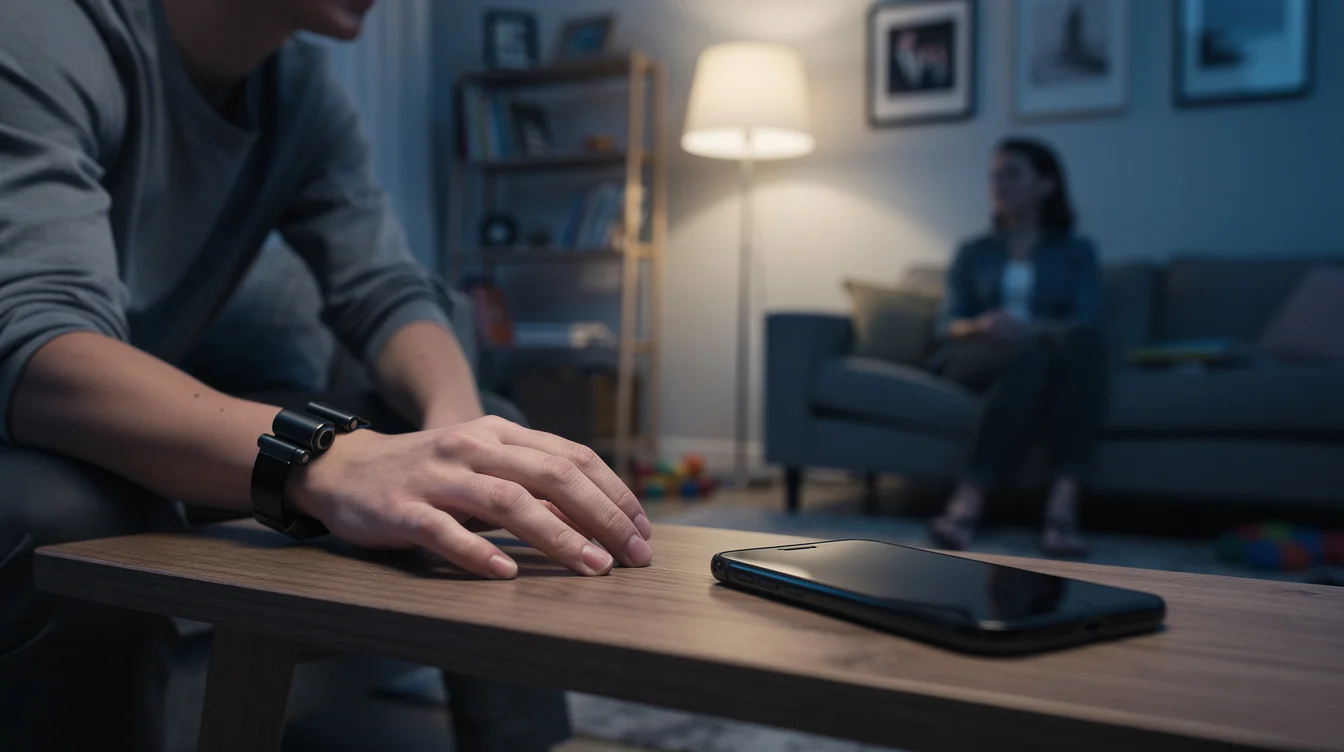
The danger begins when “shared” becomes a euphemism for access granted to whoever buys the devices. Families contain unequal power: parents and children, financially dependent partners, adult children managing an older relative’s affairs. A button marked “agree” cannot settle those relationships. Refusing to share may be technically possible while socially punished as selfishness, secrecy or evidence that something is wrong.
A teenager may welcome help managing a health condition while rejecting broader scrutiny of daily routines. An older adult may want assistance without having every deviation interpreted by an anxious child. A partner in a controlling relationship may face demands to prove where they were or why their activity changed. A product need not include location tracking for bodily patterns to become material for interrogation.
Helen Nissenbaum’s account of contextual integrity offers a sharper framework than the familiar public-versus-private binary. Privacy depends on information flowing appropriately between particular people, for particular purposes. Sharing a specific measurement during recovery does not logically authorise indefinite access to other indicators of daily life.
That makes granular permissions, expiry dates and visible access records foundational rather than decorative. Consent must also change as children mature and circumstances shift. Withdrawal should not automatically become a dramatic family notification.
A system that makes sharing effortless but refusal conspicuous has already taken a side. It has prioritised the observer’s reassurance over the wearer’s autonomy. No elegant finish can resolve that political choice.
CONTRA: AI Can Turn Uncertainty Into Household Authority
The second danger is interpretive. A sensor produces measurements; software turns them into categories; relatives turn those categories into stories. Add AI, and a tentative pattern can arrive dressed as a fluent explanation. A household may hear “possible change” as “something is wrong,” particularly when the interface presents its conclusions with visual confidence. The stakes differ, but AI-generated fiction in home listings raises a related question: when does persuasive presentation start substituting for evidence?
This is not an allegation about a documented Luffu Link failure. The supplied source does not establish its validation, error rates or precise AI functions. It is a demand that those questions precede enthusiasm. What happens when measurements are missing? Can the system distinguish unreliable input from meaningful change? Does its language communicate uncertainty, and who receives that uncertainty first?
Anthony Dunne and Fiona Raby’s speculative design practice is useful here because it asks what social arrangements a supposedly helpful object makes normal. The troubling scenario is not simply an inaccurate notification. It is a home in which the dashboard outranks the person: “You say you feel fine, but the system disagrees.”
Security and commercial governance deepen the problem. Where information is stored, how long it remains, which providers process it and whether it contributes to model training are substantive design questions. Attractive hardware tells us none of this.
Family health technology should be judged by how safely it permits absence. A flat battery, a removed wristband or a decision to stop sharing must not automatically become evidence of neglect. If the family cannot tolerate an unmeasured afternoon, the system has not merely supported care. It has rewritten its terms.
FAQ: Family Health Tracking and Its Limits
What is Luffu Link?
Luffu Link is an AI-powered wristband introduced by Fitbit’s founders and reported by Dezeen as part of a family-focused health and safety proposition. Its described design has a metallic double-barrelled body, a minimalist strap and onyx black, halo gold or sterling blue finishes.
Does family health tracking replace medical care?
No. Shared wearable information may support conversations and coordination, but it should not be treated as a diagnosis or substitute for professional assessment. The supplied Luffu Link source summary does not establish clinical validation or specific medical capabilities.
What would meaningful consent look like?
Each wearer should control which information is shared, with whom and for how long. Permissions should be easy to understand, review and withdraw. Children require age-appropriate participation and changing controls as they mature; family pressure cannot be solved by a checkbox alone.
What should families check before adopting a shared wearable?
Check the actual measurements, evidence supporting health claims, recipient controls, deletion options, retention periods and third-party access. Ask how AI uses the information and handles uncertainty. Agree on boundaries before switching sharing on, including the right to take an unexplained break.
If reassurance depends on uninterrupted access to someone else’s body, are we designing better care—or making privacy a family offence?
Get the Mainifesto weekly — curated design debates, speculative ideas and the week's best articles every Saturday.
Editorial Perspectives
Questions and counterpoints developed by the Mainifesto editorial desk to extend the discussion.
Perspective 1
I’m in favour of shared family health tracking: a useful signal reaching the right person can matter more than another beautifully finished wearable. But Luffu Link needs to earn that usefulness through sensor reliability, repairable hardware and permissions you can actually understand—not just a reassuring dashboard.
Perspective 2
I’m against making continuous health sharing part of the family contract; consent means little when refusing access starts an argument at home. Add uneven connectivity and different legal protections across borders, and the promise of reassurance becomes a system that flags people for being unreachable.
Perspective 3
Why should better care require a permanent stream—or another device destined for a drawer when its battery dies? I’d love to see Luffu Link work with hardware families already own and share only what someone chooses to flag as needing help. That’s a future worth building, not just more tracking.
Perspective 4
A family dashboard is a portrait assembled by software: someone decides which signals count and what gets coloured red. I’m fascinated by that as a new medium for connection, but an AI interpretation shouldn’t become the family’s official version of how you feel. You still need room to say, ‘That’s not what’s happening to me.’
Perspective 5
I’d start the design review with the permission model, not the interface: can access expire, vary by person and be withdrawn without broadcasting a warning? If switching it off sends everyone an alert, the system has technically allowed privacy while socially punishing it. Could a quiet pause be treated as normal operation rather than a failure state?