The Cost of Not Renovating Parliament
The Cost of Not Renovating Parliament
The most expensive architectural decision is sometimes the one presented as doing nothing. At the Palace of Westminster, postponing renovation allows politicians to avoid an immediate confrontation with relocation, construction expenditure and public irritation. But the building does not pause while Parliament deliberates. Services continue ageing. Maintenance remains necessary. The possibility of a catastrophic failure persists.
According to Dezeen’s report published on 12 November 2026, a new report warns that renovation delays are exposing the Palace to the risk of a “Notre Dame-like” fire. That comparison should not be mistaken for a prediction of when a fire will occur, or a claim that the two buildings have identical vulnerabilities. It is a warning about the scale of loss that political hesitation can leave unresolved.
The relevant comparison is not renovation versus no expenditure. It is planned intervention versus the accumulating expense and risk of postponement. Continued occupation is an operational choice, not a neutral baseline. Parliament should have to justify it with the same financial discipline demanded of a construction contract. Instead of asking only what restoration will cost, the political system must ask what another year of deferral buys—and what liabilities it leaves behind.
A Gothic Masterpiece Is Also a Working Machine
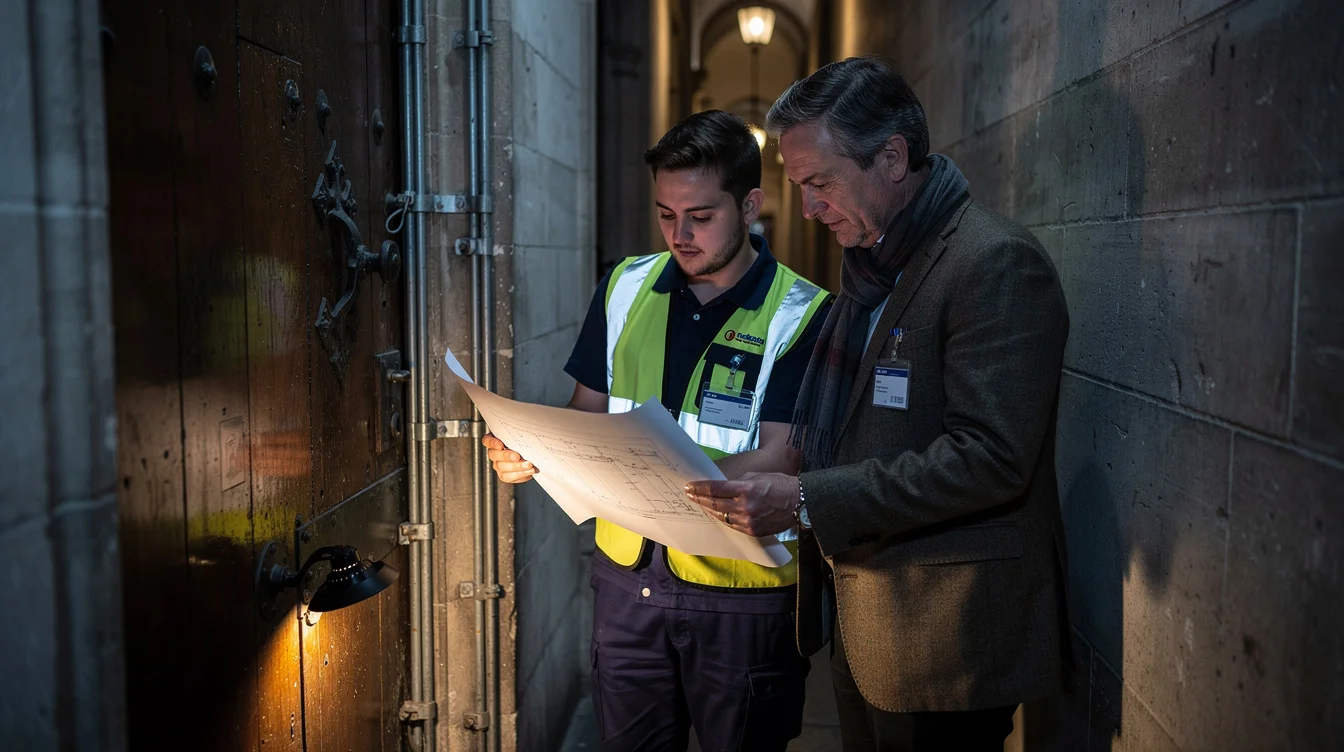
Charles Barry and Augustus Welby Northmore Pugin’s nineteenth-century Palace is an unusually powerful piece of political architecture. Its Gothic vocabulary makes government appear rooted, continuous and almost geological. Yet beneath that symbolism is a working building: a complicated arrangement of circulation routes, service spaces, occupied rooms and systems that must support contemporary parliamentary life.
The distinction matters because conservation debates too often concentrate on visible fabric. Stonework and decorative interiors photograph well. Electrical distribution, fire compartmentation and access for maintenance rarely do. Nevertheless, these less glamorous systems determine whether a historic interior can remain safely occupied. Protecting heritage means renewing the infrastructure that protects it, not merely preserving its appearance. As debates over how much of a historic school to preserve also suggest, conservation requires choices about what a building should carry forward, not simply what should remain untouched.
Westminster has already demonstrated that substantial intervention is possible. The restoration of the Elizabeth Tower, completed in 2022, required scaffolding, specialist craft and an extended interruption to familiar routines. It was not a rehearsal for every difficulty of renovating the wider Palace, but it punctures the notion that continuity requires leaving historic architecture untouched.
The deeper contradiction is institutional. Parliament expects infrastructure providers and public bodies to manage foreseeable hazards. Its own accommodation should not receive a special exemption because the disruption would inconvenience the people authorising the work. A building’s political importance increases the obligation to maintain it; it does not excuse delay.
Put the Price of Waiting on the Balance Sheet
A credible appraisal must compare options over the same period and against the same safety requirements. The programme involving the smallest initial payment is not necessarily the cheapest. Keeping a complex building occupied during construction can require temporary services, segregated work areas, repeated mobilisation and restrictive working hours. Each may be defensible. None is free.
Equally, moving Parliament out would carry substantial costs: temporary chambers, secure accommodation, broadcasting facilities, accessible circulation and the logistics of moving people and parliamentary functions. Those expenses should be exposed rather than minimised. The argument for relocation becomes stronger when it survives an honest comparison, not when its advocates pretend that decanting an institution is simple.
The decision should therefore include a published annual account of deferral. That account should distinguish essential maintenance from spending that could become redundant, explain how delay changes construction assumptions, and identify risks that remain despite interim measures. Forecast ranges and uncertainty belong in the document; suspiciously precise promises do not.
Historic projects demonstrate why uncertainty cannot simply be wished away. The restoration of Manchester Town Hall, Alfred Waterhouse’s Victorian civic landmark, has exposed the difficulty of budgeting for intricate historic fabric. The lesson is not to abandon ambitious restoration. It is to commission investigations early, publish assumptions and maintain realistic contingencies. Waiting does not make hidden conditions more legible unless someone is actively investigating them.
Notre-Dame Is a Warning, Not a Procurement Strategy
The 2019 fire at Notre-Dame in Paris destroyed its spire and much of its roof. Its reopening in December 2024 showed the extraordinary capacity of craftspeople, engineers and public institutions to reconstruct a wounded monument. It should not be romanticised into evidence that catastrophe is an effective route to restoration.
Emergency mobilisation comes after irreversible loss. Rebuilding can recover form, use and meaning, but it cannot make every destroyed historic material original again. Nor can a financial model adequately capture the human consequences of a major fire in an occupied public building. That is why a low-frequency, high-consequence event cannot be dismissed merely because its precise probability is difficult to establish.
There is also an important complication: restoration work can itself introduce hazards. Hot works, temporary electrical installations and changes to access require rigorous control. Vacating Westminster would not magically make it fireproof. It could, however, permit a different organisation of construction, investigation and protection from that available in a continuously occupied parliamentary workplace.
The warning should trigger a comparison of independently assessed safety cases, not a competition in apocalyptic rhetoric. Which occupation strategy makes risks easier to control? What protections operate during each construction phase? Who can stop unsafe work? These questions are more useful than repeating the image of a burning landmark until it becomes background noise.
Move the Institution to Save Its Architecture
The assumption that Parliament must remain continuously inside the Palace deserves architectural scrutiny. A legislature is a constitutional institution before it is a particular room. Its procedures, public accountability and capacity to meet matter more than the uninterrupted occupation of familiar benches.
Germany offers a useful, if imperfect, comparison. Parliamentary government operated in Bonn before the Bundestag moved to Berlin in 1999, occupying the Reichstag transformed by Foster + Partners. That history is not a ready-made relocation plan for Westminster. It demonstrates something more fundamental: democratic legitimacy can survive geographical change, and the adaptation of an inherited political building can make room for new architectural priorities.
Temporary accommodation should consequently be treated as a serious civic design commission, not an embarrassing backstage operation. It would need secure working conditions, public access, reliable broadcasting and equitable provision for disabled users. Procurement should test reuse and adaptability so that expenditure creates a useful afterlife rather than an expensive disposable set. Site selection should also consider existing communities and uses—a concern that becomes still more consequential when building an entirely new capital.
There are risks here too. Temporary arrangements can become permanent through inertia, while ambitious briefs can expand beyond necessity. Clear limits on scope and an explicit exit strategy are essential. But these are problems to design and govern, not reasons to pretend that staying put has no consequences. The Palace should serve parliamentary democracy; parliamentary democracy should not be held hostage by its address.
Make Delay a Decision Someone Must Own
The immediate response to this warning should be a time-bound decision process with named responsibility. Independent technical advice should inform the choice of occupation strategy. Cost comparisons should show the consequences of different start dates. Interim safety measures should have identifiable owners, review dates and funding rather than being treated as an indefinite substitute for renewal.
Political scrutiny must also separate genuine investigation from procedural stalling. A survey that resolves an important uncertainty can justify time spent. Reopening an already examined question without new evidence is different. The former improves a decision; the latter can protect decision-makers from having to make one.
There is a carbon argument for discipline as well. Retaining and upgrading a major existing building can preserve embodied material value, but renovation is not automatically low-carbon. Temporary accommodation, replacement services and repeated short-term interventions all need assessment. A coordinated programme should test where repair, reuse and durable installation outperform successive provisional fixes.
Fiscal caution is not the avoidance of a large invoice. It is the responsible management of the whole liability. Westminster’s restoration should be challenged on scope, procurement and value. But postponement deserves equally aggressive scrutiny. A political system that meticulously debates the cost of scaffolding while leaving the cost of delay obscure is not protecting the public purse. It is presenting an incomplete account.
FAQ
Why is the Palace of Westminster being compared with Notre-Dame?
Dezeen reports that a new report warns of a “Notre Dame-like” fire risk amid renovation delays. The comparison highlights the potential severity of a heritage fire; it does not establish identical conditions or predict an imminent disaster.
Would moving Parliament out necessarily make renovation cheaper?
Not necessarily. Relocation requires secure, accessible temporary facilities. However, it could reduce construction constraints associated with occupation. The options need comparison across their full duration, including temporary works, maintenance and risk.
Can interim safety measures replace a comprehensive renovation?
Interim measures can manage particular hazards, but their adequacy depends on technical assessment. They should have defined purposes and review dates, rather than becoming an open-ended justification for postponing essential work.
How should politicians account for the cost of delay?
They should publish comparable scenarios showing maintenance expenditure, temporary measures, programme changes and residual risks. Each decision to defer should identify who accepts responsibility and what evidence supports continued occupation.
If remaining at Westminster carries costs and risks of its own, why should leaving temporarily require more political justification than staying?
Get the Mainifesto weekly — curated design debates, speculative ideas and the week's best articles every Saturday.
Editorial Perspectives
Questions and counterpoints developed by the Mainifesto editorial desk to extend the discussion.
Perspective 1
If one of our hotels had a fire warning, keeping the doors open wouldn’t count as the zero-cost option. Put temporary relocation beside the full cost of staying—maintenance, disruption, safety—and judge both by whether people can actually do their jobs.
Perspective 2
Working around an occupied historic building can make repairs slower and more invasive; continuity is not automatically conservation. Moving out needs a serious plan, but so does staying—and neither should become an excuse to turn a working parliament into a luxury heritage showcase.
Perspective 3
Leaving requires more justification because it creates a visible bill and an identifiable decision-maker; staying lets responsibility dissolve across committees and budget cycles. Compare the two as operational systems, including what happens when something fails, rather than treating the current address as a free resource.
Perspective 4
Westminster’s present palace is itself a response to the fire of 1834, which makes this reverence for uninterrupted occupation rather selective. Parliament seems to confuse the continuity of an institution with the continuity of its seating arrangements. A temporary departure need not diminish its authority; neglect dressed as fidelity certainly can.