When Birds Turn Hostile Architecture Into Building Material
When Birds Turn Hostile Architecture Into Building Material
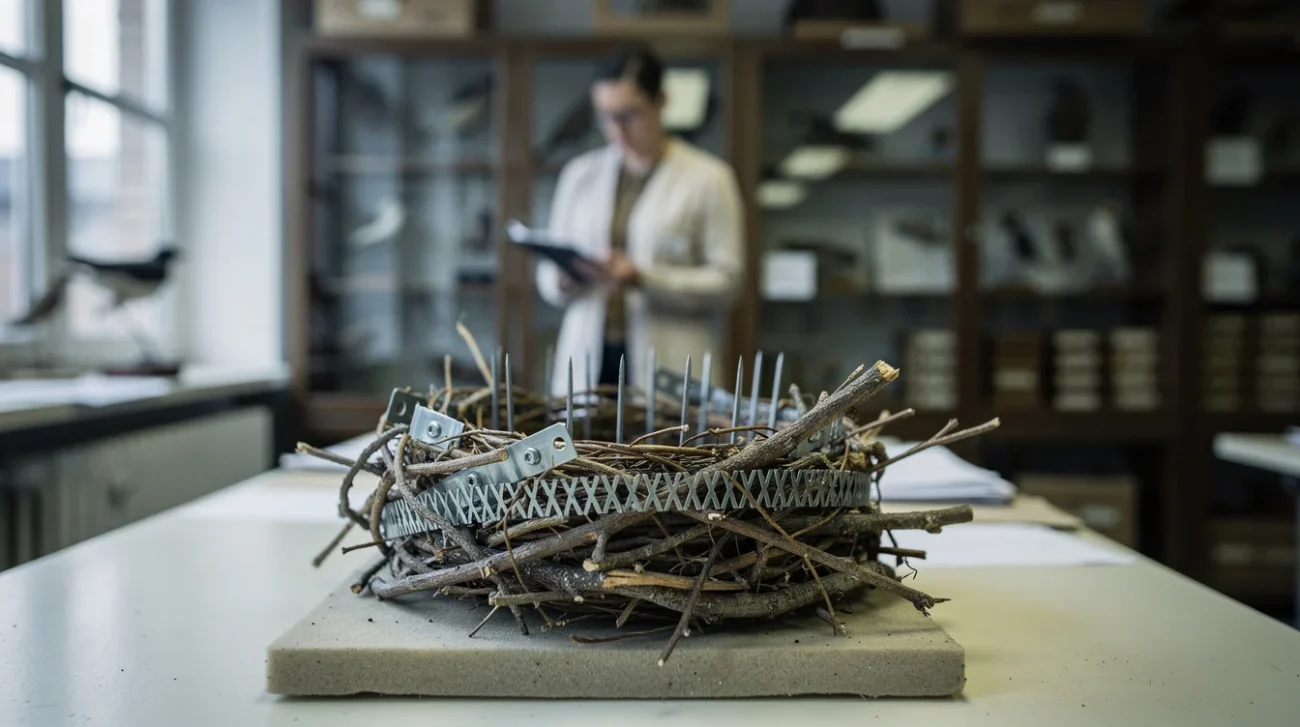
The device is supposed to end the conversation. A strip of metal spikes, fixed to a cornice or window ledge, tells birds that this piece of architecture is unavailable. Then a bird takes the strip away and builds with it. The boundary becomes a component. The instrument of eviction becomes part of a home.
This is not a speculative designer’s rendering. Research published in 2023 by a team including biologist Auke-Florian Hiemstra documented nests incorporating anti-bird spikes, with examples made by carrion crows and Eurasian magpies. One particularly striking magpie nest, found in a tree in Antwerp, incorporated extensive lengths of the deterrent material. The city’s hardware had acquired an unauthorized second life.
Designboom’s account brings these nests into conversation with experimental, 3D-printed nesting scaffolds: one material appropriated against its intended use, another offered as an invitation. Together, they expose an uncomfortable distinction. Making something for an animal is not the same as allowing that animal to participate in architecture. The first can remain an exercise in human control. The second requires accepting that the occupant may reject the brief, change the location, or dismantle the specification.
The Spike Has Not Necessarily Changed Its Job
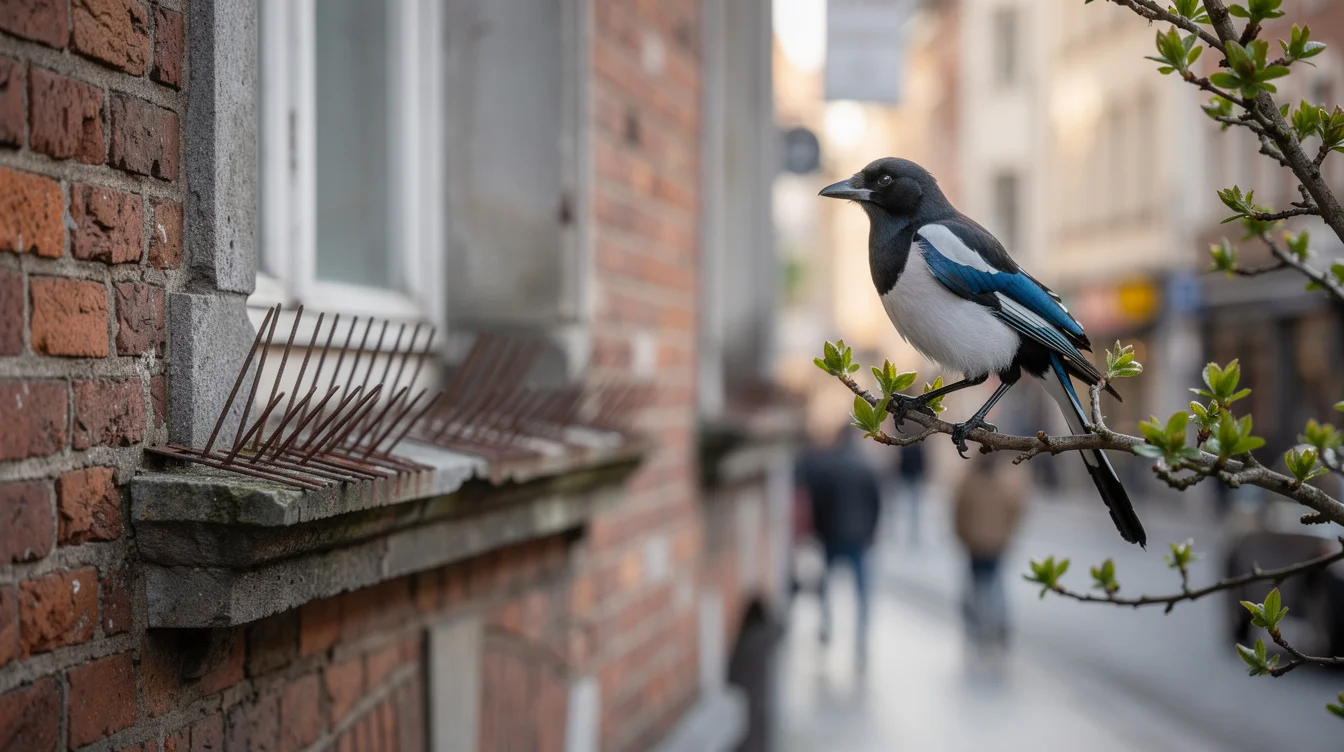
The easy interpretation is that birds have defeated hostile architecture through clever recycling. The more interesting possibility is that they have retained some of its hostility while redirecting it. Magpies ordinarily build substantial nests with a protective roof, often incorporating thorny branches. In the documented spike nests, the placement of deterrent strips suggests that sharp, manufactured components may sometimes serve a comparable defensive role.
That distinction matters. The spikes are not necessarily becoming benign. They may still discourage access, but now potentially on behalf of the nest’s occupants rather than a building’s maintenance regime. Researchers have proposed protection against nest predators as an explanation; the observation should not be inflated into proof of improved breeding success or a fully understood behavioral strategy.
Nor should opportunistic material use become evidence that birds understand human intentions. The architectural reversal is legible to us without requiring a feathered theory of property. A useful object has crossed a boundary between systems of use.
The provocation is not that birds have become architects by discovering our products. Birds already build through sophisticated, species-specific behaviors. The provocation is that our supposedly decisive exclusion device can enter their construction repertoire, where its manufacturer no longer determines its meaning.
Resourcefulness Is Not Permission to Pollute
There is a dangerous comfort in celebrating these nests as circular design. If birds can make homes from our defensive hardware, perhaps urban nature will simply adapt to whatever we leave behind. That conclusion turns survival into an excuse for negligence.
Human-made nesting materials can carry serious costs. String and plastic filaments can entangle birds; synthetic debris can alter the physical conditions within a nest. Metal spikes introduce obvious concerns about injury and handling, even where particular arrangements appear structurally useful. A photograph of a completed nest does not establish that its materials are safe, or reveal the outcomes of unsuccessful construction attempts.
The work of Hiemstra and other researchers studying anthropogenic nesting materials matters precisely because it treats these objects as evidence rather than decorative curiosities. What was collected? Where was it positioned? Which species used it? What consequences followed? Those questions are more valuable than another breathless declaration that nature always finds a way.
Architecture should read the spike nest as an audit of its own material landscape. Every loose strip, discarded tie and exposed adhesive becomes part of a wider field of possible encounters. A product’s environmental life includes uses its designer neither intended nor approved. That does not make every appropriation desirable; it makes foreseeable harm harder to dismiss. The broader need to look beyond a material itself also underlies the argument that a timber city needs more than a supply of wood.
The Scaffold Offers Help—and Writes a Script
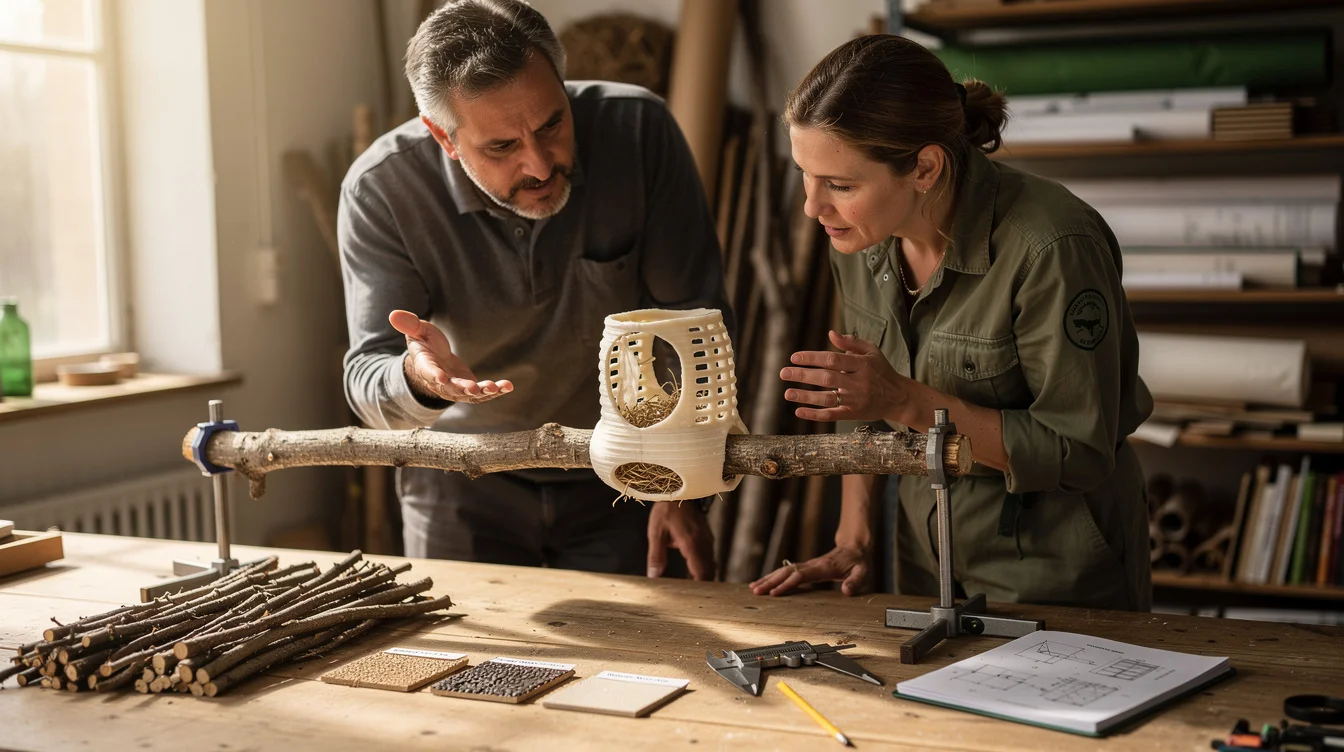
Purpose-made nesting scaffolds appear to offer the opposite relationship. Rather than forcing birds to salvage the city’s refusals, designers provide a starting structure. The 3D-printed experiments highlighted alongside debris-built nests suggest a construction process in which a fabricated support and animal-added material can coexist.
But an invitation still contains instructions. A scaffold establishes dimensions, attachment points and a location. Its geometry favors certain bodies and building behaviors. The choice of printing material raises questions about weathering, heat, surface grip and durability. A designer can make an elegant support without making a useful nesting site.
Neri Oxman and the Mediated Matter group’s Silk Pavilion, developed at MIT in 2013, provides a relevant comparison, although it involved silkworms rather than birds. A digitally fabricated framework was supplemented by silk deposited by living organisms. It made visible a productive relationship between computational construction and biological behavior. It also left the initial framework and experimental conditions under human direction.
For nesting scaffolds, the strongest design gesture may therefore be incompleteness: room for birds to add, rearrange or ignore material. Yet even that is only a proposition until observed over time. An occupied prototype is evidence of use, not automatic evidence of welfare. Successful breeding, exposure to predators and continuing suitability demand separate attention.
Design for Refusal, Not Just Occupancy
Multispecies architecture becomes more demanding when animal choices are allowed to contradict the presentation image. A swift may ignore a nesting cavity. A bird may favor an inconvenient ledge over a carefully positioned support. A structure intended for one species may attract another. These are not necessarily defects in animal behavior. They may reveal defects in the designer’s assumptions. Human amenities expose a similar gap between presentation and use: a beautiful public toilet still has to be easy to find.
Animal-Aided Design, developed by Thomas Hauck and Wolfgang Weisser, offers a useful methodological reference. It brings the requirements of selected animal species into planning from the outset, considering their life cycles rather than treating habitat as decorative compensation added at the end. A nesting opportunity alone cannot substitute for food, shelter and the other conditions needed to persist.
Architect Joyce Hwang’s Bat Tower offers another relevant shift in architectural attention. By treating bat habitat as a design subject, her work challenges the assumption that nonhuman occupants belong outside architectural practice. The lesson is not to copy one object’s form, but to make animal requirements consequential to the brief.
Even these approaches need room for revision. Monitoring should be capable of changing a scheme, not merely validating it. If animals repeatedly choose another location, that pattern deserves investigation. Where feasible, architecture should accommodate the choice rather than endlessly redirect the chooser toward its designated address.
Who Gets to Decide Where a Nest Belongs?
None of this requires pretending that every nest can remain everywhere. Airport safety, food preparation, ventilation equipment and building maintenance create real conflicts. Species also differ, and conservation priorities cannot be reduced to an indiscriminate welcome. The question is whether exclusion is a justified response to a specific risk or simply the default expression of property management.
A credible multispecies brief would distinguish those situations. It would identify genuinely sensitive locations, preserve alternatives nearby and involve appropriate ecological expertise before intervention. It would consider maintenance access and legal protections, including restrictions on disturbing active nests where applicable. It would also budget for observation after installation, because habitat does not stop changing when the architect leaves.
Most provocatively, it would accept a degree of unplanned occupation. That might mean tolerating nesting material in a safe recess, modifying a cleaning schedule or retaining a useful cavity during renovation. These decisions lack the photogenic novelty of a printed scaffold, but they may transfer more practical freedom to animals.
The spike nest is a trigger, not a solution. It reveals that architectural intent is never absolute once a building enters the living world. The next step is not to manufacture more dramatic deterrents, or more charming approved habitats. It is to design a city whose terms of occupation can actually be revised.
FAQ
Do birds really build nests with anti-bird spikes?
Yes. Research published in 2023 documented carrion crow and Eurasian magpie nests incorporating anti-bird spikes. The findings establish this material use in particular cases, not that it is common across bird populations.
Why might magpies put spikes in their nests?
Magpies often use thorny material in their nest roofs. Researchers have suggested that manufactured spikes could similarly help deter nest predators. Their placement supports that possibility, but a protective benefit should not be assumed without further evidence.
Are 3D-printed nesting scaffolds better than conventional nest boxes?
Not inherently. Suitability depends on the target species, location, geometry, material and surrounding habitat. Printing allows customized structures, but neither fabrication novelty nor initial occupation demonstrates safety, breeding success or superiority to established alternatives.
How can architects accommodate animals’ choices?
They can provide varied, species-appropriate opportunities, protect supporting habitat and monitor actual use. Crucially, they can revise maintenance and design decisions when animals select safe but unplanned locations, rather than automatically removing them.
If a bird chooses the ledge we prohibited over the scaffold we provided, should the next redesign change the bird’s options—or our rules?
Watch the Mainifesto Short
Get the Mainifesto weekly — curated design debates, speculative ideas and the week's best articles every Saturday.
Editorial Perspectives
Questions and counterpoints developed by the Mainifesto editorial desk to extend the discussion.
Perspective 1
The bird has performed a rather literal détournement: the device of exclusion becomes building material. Before offering it another approved habitat, we might question architecture’s tiresome assumption that every occupant must follow the programme.
Perspective 2
If birds keep choosing the ledge, the scaffold isn’t doing its job, however good it looked in the presentation. I’d allow nesting where cleaning and maintenance are manageable, then redesign the genuinely troublesome spots—there’s no sense paying for deterrents that double as nest supplies.