The Dorm Room Is Becoming a Brand. Who Can Keep Up?
The Dorm Room Is Becoming a Brand. Who Can Afford to Keep Up?
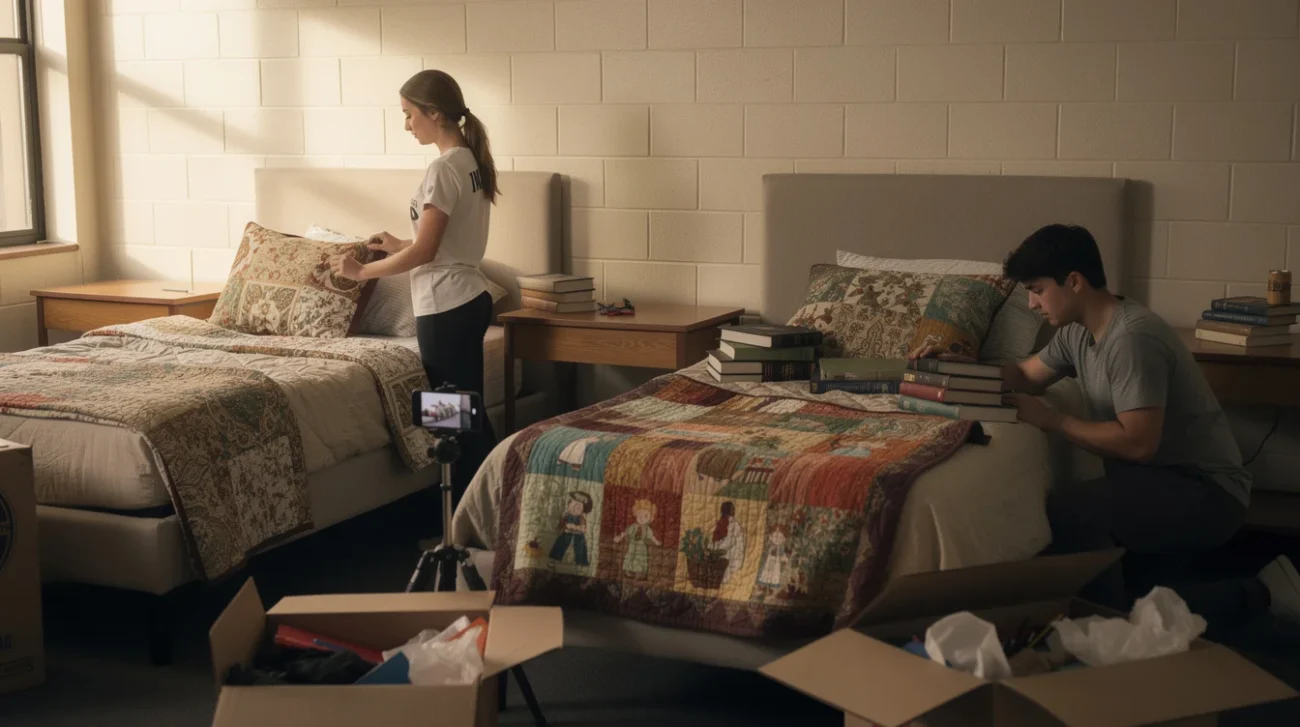
A twin XL bed, a desk, a wardrobe: the American dorm room begins as an institutional inventory. Online, it can end as a miniature hospitality concept, complete with upholstered headboards, coordinated bedding and lighting calibrated for the reveal. The room is still temporary. Its image is expected to look remarkably resolved.
Dwell’s historical account of American college housing offers a useful starting point: universities shape student identity through housing, and students reshape that housing in return. Social media adds another audience to this old negotiation. The question is not whether students deserve beautiful rooms. It is whether beauty remains a freedom when belonging appears to require a shopping list.
PRO: Personalisation Is a Claim to Space

The standard-issue dorm is not a neutral backdrop. Its furniture decides where students work, sleep and store their lives; its rules determine what can be attached, moved or concealed. Against that prescription, even a quilt brought from home can be an assertion of authority. A student who chooses saturated colour over institutional beige is not necessarily auditioning for an audience. They may simply be making an unfamiliar place habitable.
College housing has long carried ideas about how students should live. Thomas Jefferson’s University of Virginia Lawn placed student rooms within an architectural composition organised around learning and community. Alvar Aalto’s Baker House at MIT, completed in 1949, used a winding plan to give many rooms oblique views toward the Charles River. These projects differ enormously, but neither treats accommodation as merely a container for beds.
Students deserve some of that design agency themselves. A clip-on reading lamp can protect a roommate’s sleep. A washable rug can soften an unforgiving floor. Personalisation becomes valuable when it answers an actual body, routine or attachment—not just a visual brief.
PRO: A Shared Room Can Teach Real Design
Designing for two people in one small room is a more demanding exercise than assembling a photogenic shopping basket. It requires circulation, storage, lighting and competing preferences to work together. Consider a roommate who studies late and another who wakes early: separate task lights and an agreed desk arrangement accomplish more than matching duvet covers ever could.
The useful precedent is not the boutique hotel but the adaptable interior. Charles and Ray Eames demonstrated how industrial components, everyday objects and personal collections could coexist without becoming visually uniform. A dorm can borrow that attitude without buying an Eames chair. Identical university desks can support radically different arrangements of books, photographs and practical equipment.
A negotiated room also makes consent tangible. Perhaps each student controls the wall above their bed, while the shared floor must remain clear. Perhaps one person contributes a secondhand lamp and the other a small rug. Successful coordination need not mean aesthetic agreement; it can mean making disagreement comfortable. That is an education in living with others, not a failure of the room’s concept.
PRO: Visibility Can Spread Ingenuity, Not Just Products
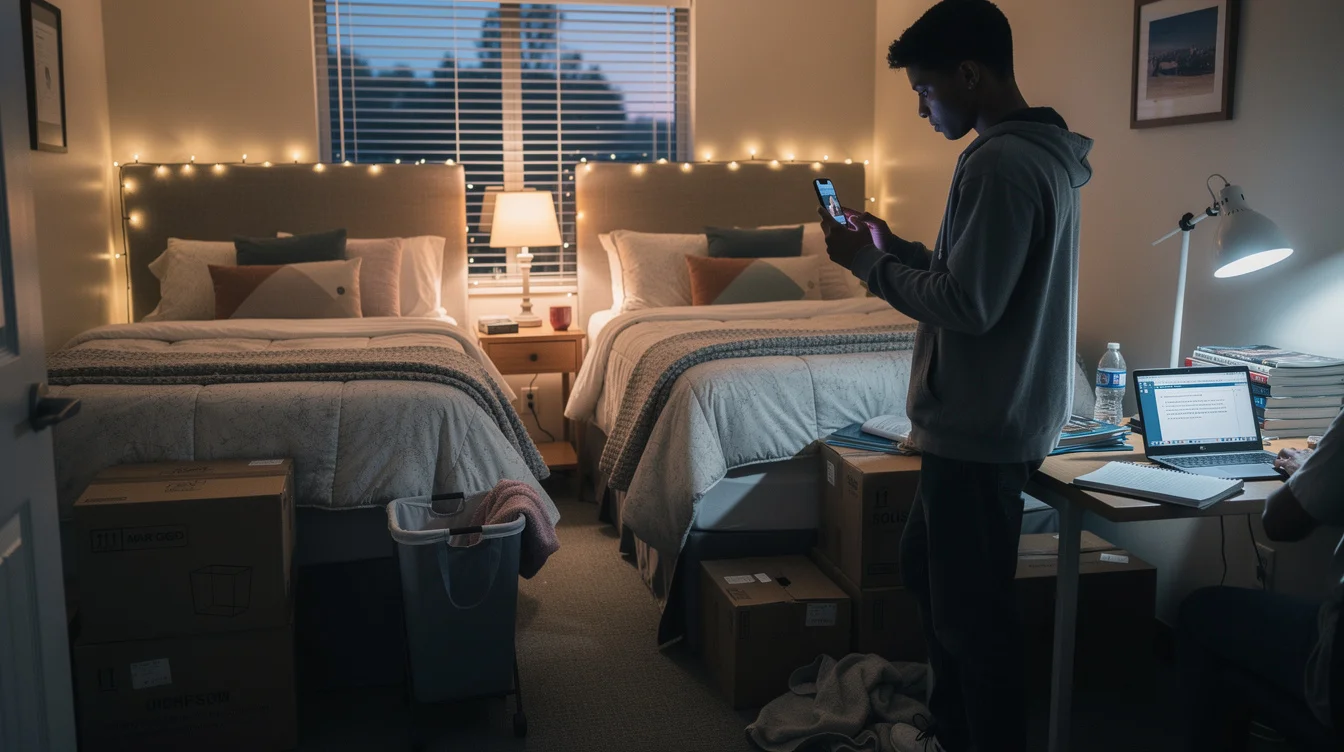
A dorm tour can be a useful piece of peer-to-peer design publishing. Someone arriving with little knowledge of compact living can learn how under-bed boxes work, why a desk lamp matters or how to organise a wardrobe without drilling into university property. The camera does not inherently turn these lessons into luxury advertising.
Accessible retail systems such as IKEA’s storage ranges make some spatial ideas relatively easy to repeat. More importantly, student move-out collections, campus reuse schemes and secondhand marketplaces can circulate furnishings already suited to small rooms. A tour that identifies what was borrowed, repaired or found offers a different kind of aspiration: resourcefulness rather than purchasing power.
There is expressive value here, too. Family textiles, queer art, religious objects and reminders of home can make an institutional room legible to its occupant. Sharing those choices can help another student imagine a place for themselves. The strongest defence of dorm room design is therefore not that shopping builds confidence. It is that students should be able to author their surroundings—and exchange that knowledge publicly.
CONTRA: The Common Room Was Never Economically Common
A university-issued bed can create an illusion of equality. Everyone receives broadly similar hardware, but students arrive with radically different capacities to transform it. One has access to a car, storage space and family labour. Another arrives by plane with two suitcases. A third is working during move-in week. The resulting room records logistics and wealth as much as taste.
The influencer-ready makeover obscures those inputs. An upholstered headboard is not only an object: it must be purchased, transported, fitted, cleaned and eventually stored or discarded. Add coordinated bedding, a bedside unit and decorative lighting, and the apparent simplicity of the finished photograph conceals a substantial chain of expenditure.
Retailers such as Dormify make the coordinated dorm an explicit shopping category. The commercial logic is clear: turn an awkward temporary room into a complete, purchasable identity. But a coherent product range can also establish an implied minimum. Once the bed requires a backdrop and the desk requires styling, ordinary provision starts to look like deficiency. The university supplies a place to sleep; the market sells evidence that you belong there.
CONTRA: Coordination Can Become a Roommate Tax
“Let’s match” sounds generous until one roommate sets the price. An agreed colour scheme can gradually acquire mandatory purchases: the same duvet, complementary lamps, a particular rug. Refusing may then feel less like exercising a budget than rejecting the relationship. The room becomes a spending negotiation disguised as a friendship test.
Imagine one student proposing a hotel-like scheme with paired headboards while the other intends to use bedding from home. Neither preference is inherently wrong. The imbalance emerges when the more expensive proposal is treated as the shared plan and the cheaper one as an obstacle. Equal contributions are not necessarily equitable when disposable incomes differ.
Photography introduces another territorial claim. A roommate’s laundry, medication or family photographs may sit inside someone else’s frame. Asking them to remove those objects for a reveal converts shared housing into a set, with one resident acting as creative director. A sensible agreement must therefore cover more than furniture: who can film, what remains private and whether either person can veto publication. Paying to occupy a room does not make you an unpaid participant in your roommate’s content.
CONTRA: The Reveal Rewards Completion Over Living
The finished-room photograph favours a peculiar version of student life: no unfinished assignments, no drying towel, no evidence that possessions accumulate unpredictably. Platform visibility can reward a space for being immediately legible rather than genuinely useful. A room that reads as “coastal,” “preppy” or “minimalist” is easier to package than one accommodating two complicated people.
This is where the dorm begins to behave like a brand. Its palette must remain recognisable; mismatched objects become interruptions; purchases maintain the image. Yet temporary housing is especially poorly suited to this demand for completion. Room dimensions change, roommates separate and bulky additions may have nowhere to go during summer. The environmental cost lies not in decoration itself but in treating an entire room as a short-lived collection.
Universities should respond with better baseline interiors, clear furniture dimensions, lending libraries and accessible reuse storage—not lectures about student vanity. Creators can disclose gifted products and explain what a reveal leaves out. The dividing line is straightforward: personalisation expands the ways a student can live; branding narrows them to the ways a room can be seen. A good dorm should tolerate a life that exceeds its image.
FAQ
How can students personalise a dorm without overspending?
Begin with the furniture already provided and the objects you already own. Prioritise useful lighting, comfortable bedding and storage that fits measured spaces. Check campus reuse programmes before purchasing decorative additions, and leave some decisions until you have actually lived in the room.
Should roommates buy matching furnishings?
Only if both genuinely want to and can comfortably afford it. Agree on a spending ceiling before discussing products. Independent bed areas and jointly negotiated shared space can work better than a compulsory whole-room scheme.
What should roommates agree before posting a dorm tour?
Obtain permission to show the other person’s belongings and living area. Keep identifying details, schedules and sensitive possessions out of frame. Consent to one photograph should not be treated as permanent permission to film the room.
Can students change university furniture or add their own?
Policies vary by institution and building. Check rules covering furniture removal, bed lofting, wall fixings, electrical appliances and fire safety before buying anything. A popular online hack is not proof that an installation is safe or permitted.
When a shared dorm becomes a public-facing identity, who should set its standards: the students living in it, the university providing it or the audience watching?
Get the Mainifesto weekly — curated design debates, speculative ideas and the week's best articles every Saturday.
Editorial Perspectives
Questions and counterpoints developed by the Mainifesto editorial desk to extend the discussion.
Perspective 1
I’m all for students giving a dorm room a recognisable identity, even one they want to share online. But set the budget with your roommate before buying anything: a room that photographs well still needs two usable desks, decent storage and somewhere to sleep.
Perspective 2
Turning a dorm into a brand makes belonging look like something you have to purchase. Shared rooms should have space for mismatched possessions and different histories, not an aesthetic that lets the roommate with more money erase the other.
Perspective 3
The university should set standards for safety and habitability; the residents should agree on spending, decoration and filming. An audience gets no vote, and agreeing to share a room is not agreeing to appear in someone’s content.