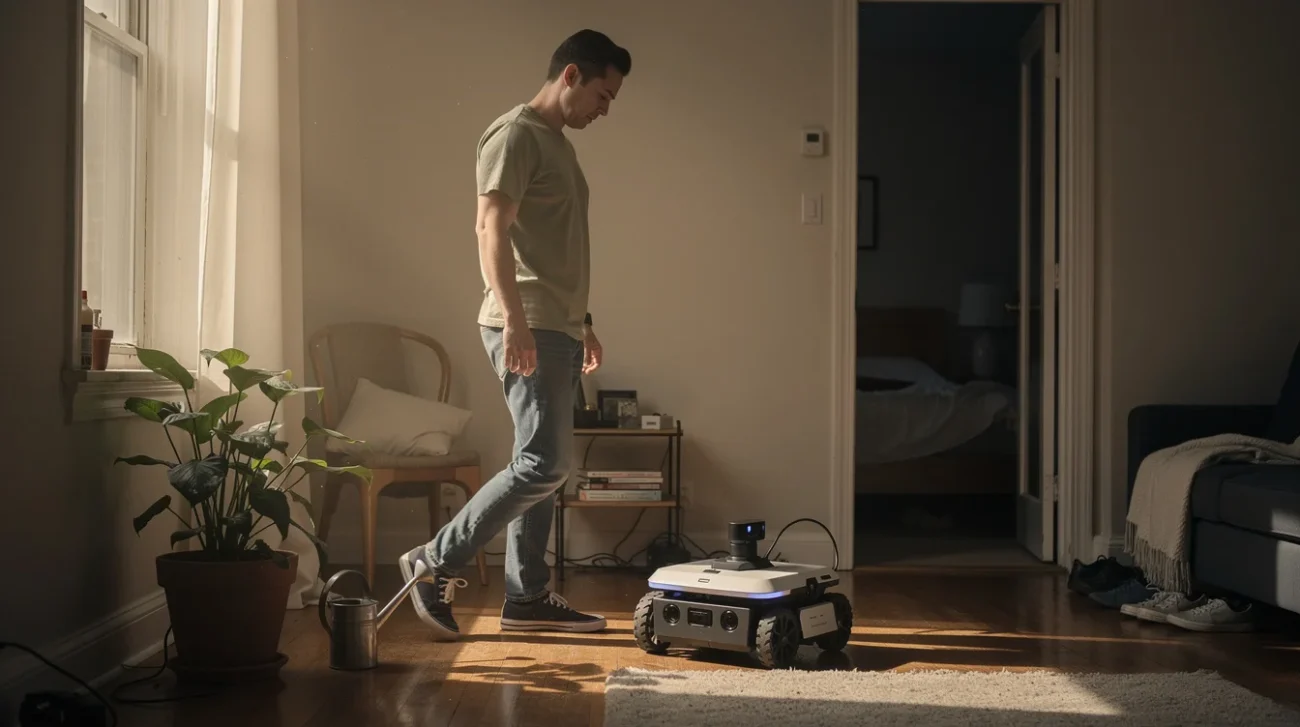

Personal Climate Control Is Reshaping Design

Climate is leaving the building
Rick Owens’ inflatable Adidas tracksuits, unveiled during Paris Men’s Fashion Week in a record-breaking heatwave, are not a gimmick so much as a warning shot. Tiny built-in fans circulate air around the body while ballooning Tyvek shells create an artificial microclimate, turning clothing into a wearable comfort machine. The implication is not subtle: the old promise that architecture would shelter us from weather is breaking down, and design is shifting inward, onto the body itself.
This is a radical inversion of modern environmental design. For more than a century, architecture has tried to tame heat, cold, glare, and humidity through insulation, HVAC, shading, and mass. Now the most charged experiments are happening in fashion, soft goods, and responsive objects—because they can move faster than buildings, and because climate anxiety has made the body the most immediately vulnerable site of all. The future of comfort is no longer a room; it is an accessory, a garment, a portable shell.
That future is already being prototyped by designers across disciplines. Kazuko Hoshino’s experimental cooling textiles, Nike’s self-lacing and adaptive apparel, and fashion’s recurring fascination with inflated silhouettes all point to the same proposition: if buildings cannot always guarantee thermal stability, products will. Meanwhile, artists and designers working with daylight-reactive materials, from thermochromic pigments to photo-responsive installations, are recasting atmosphere as something you wear, carry, and trigger with your movement. Environmental design is becoming intimate, distributed, and radically personal.
The body becomes the primary climate device

Once the body is treated as the central environmental unit, a huge amount of design theory collapses and reorganizes. The office no longer needs to be uniformly cold if an employee can regulate their own heat load. The apartment no longer needs to mimic a sealed suburban comfort bubble if couches, blankets, lamps, and garments can generate precise zones of thermal relief. Even public space changes character when climate control is no longer a building-wide contract but a private negotiation.
This is where the inflatable tracksuit matters. It takes an industrial logic—fans, airflow, plastic membranes, performance materials—and shrinks it to the scale of a torso. The result is part athletic wear, part personal appliance, part sci-fi prosthetic. Tyvek, familiar from construction sites and protective envelopes, is a perfect symbol for the moment: a material that already sits between shelter and skin, now pulled directly into fashion. The suit says that comfort can be manufactured at the edge of the epidermis.
Designers have been here before, but usually as critique. Hussein Chalayan’s transformable garments made displacement and survival visible. The Dutch collective Studio Drift has used kinetic systems and responsive light to suggest that objects can behave like weather. The difference now is that the market is catching up with the metaphor. Personal climate control is no longer only artistic speculation; it is becoming a product category. And once it becomes a category, it becomes an inequality machine. For workplaces, that shift also reframes temperature as a spatial and managerial question, not just an energy one, as explored in Cooling Offices Is Now a Design Problem.
Furniture will start behaving like apparel
If fashion absorbs climate, furniture will not stay passive. Sofas, chairs, beds, and partitions are already being redesigned as softer, more adaptive systems that can tune temperature, light, and privacy at the scale of a seated body. The best precedents are not the overdesigned “smart home” objects promised by gadget brands; they are the quiet, often radical experiments in micro-environment creation. Think of Kengo Kuma’s porous material thinking translated into domestic objects, or of the ergonomic cocooning that has long driven chair design from Verner Panton to contemporary lounge systems.
The next generation of furniture will likely be less about style than thermal zoning. A chair may warm the spine without heating the room. A desk lamp may modulate circadian light while also reducing glare around a face. A bedroom canopy may become a breathable, filtered envelope rather than a decorative drape. The logic is familiar from hospitals, laboratories, and data centers: protect the occupied zone, ignore the rest. What is changing is that this logic is migrating into consumer life, where it will be sold as wellness, focus, and luxury.
That is the seductive part. A personal climate chair sounds efficient, elegant, even humane. But it also redefines domesticity as a series of isolated thermal bubbles, each calibrated for a single occupant. This is not communal comfort; it is comfort as segmentation. The house becomes a field of competing atmospheres, and the designer’s task shifts from composing rooms to managing gradients, leaks, and overlaps.
Daylight-responsive objects will rewrite atmosphere
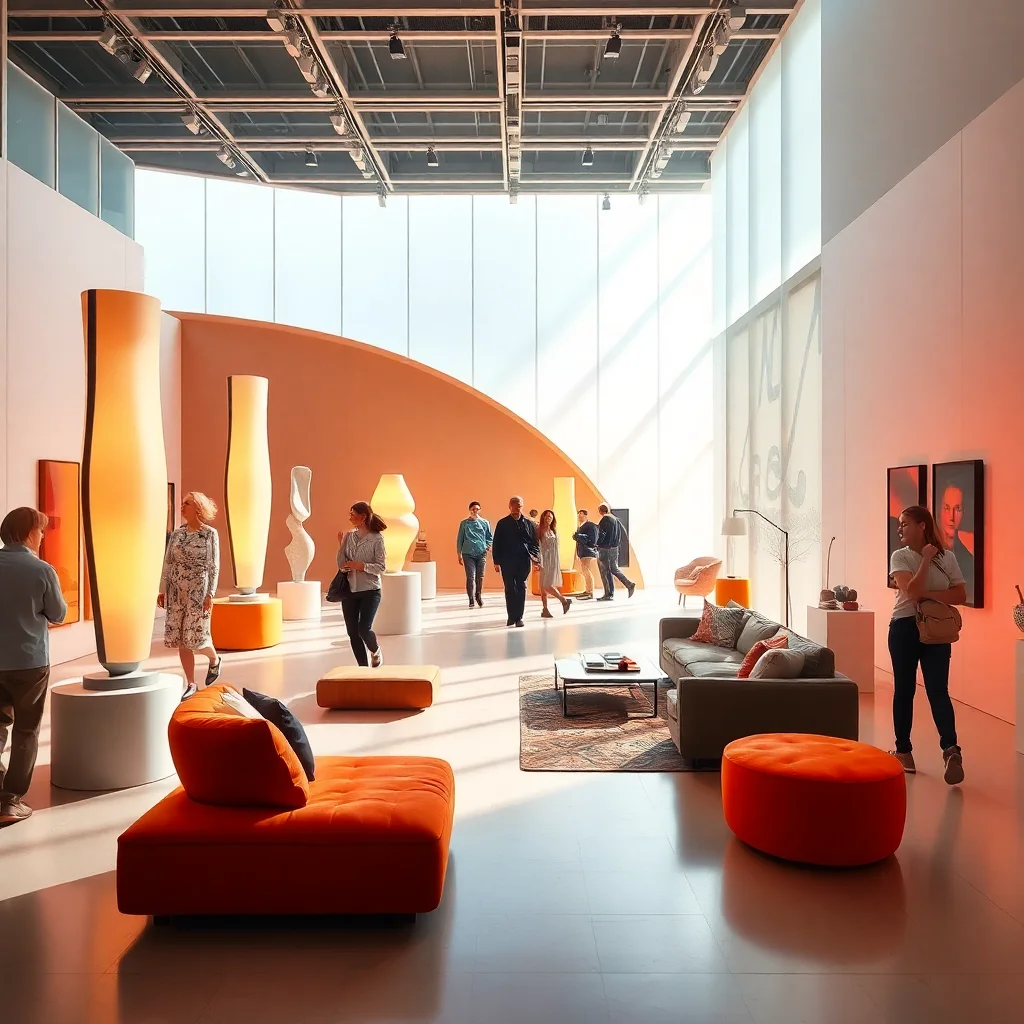
Environmental design is not only about temperature. Light is the other great battleground, and here too the trend is toward bodily-scale responsiveness. Daylight-reactive sculptures, color-shifting textiles, and surfaces that change under UV exposure are showing how objects can behave like living interfaces between the sun and the user. These are not passive finishes; they are sensors, filters, and signals.
Artists such as Olafur Eliasson have spent decades making weather perceptible as a designed condition, while studios working with dichroic films, thermochromic inks, and electrochromic glass have pushed the idea that atmosphere can be modulated materially. In interiors, the line between object and microclimate dissolves: a curtain can become a daylight algorithm, a tabletop can reflect heat differently across the day, a sculptural screen can announce its own thermal load. The room stops being a stable container and becomes a reactive field.
This matters because climate is increasingly experienced as volatility rather than average conditions. People do not simply need more cooling; they need things that can adapt hour by hour, season by season, and in response to sudden extremes. The future belongs to objects that notice the world. In that sense, the wearable fan suit and the daylight-reactive sculpture are cousins: both are attempts to make environmental change legible at human scale.
PRO: portable comfort is adaptive, efficient, and humane
The case for personal climate control is compelling. It can reduce the absurd energy waste of overcooling entire buildings when only a fraction of occupants need relief. It can help vulnerable people—elderly residents, outdoor workers, commuters, residents in overheated cities—manage heat stress without waiting for infrastructure to catch up. It can also make design more responsive to real bodies rather than abstract standards that have always privileged the average, the able-bodied, and the office-dwelling.
There is an ethical argument here too. Fixed climate systems often fail precisely where they are needed most: in informal housing, temporary shelters, dense transit corridors, and cities with aging grids. Wearable or localized climate tools can be deployed faster than new towers, new ducts, or new district systems. They can also encourage smarter building design, where architecture is not expected to do everything and can instead support lower-energy, more porous, more adaptive environments. For a broader look at how heat governance shapes cities, see The Politics of Air-Conditioning and Urban Heat.
For designers, this opens a productive field. Fashion can become technical without becoming clinical. Furniture can become responsive without becoming bureaucratic. Urban design can focus on shading, hydration, rest, and wind, while portable devices carry the rest. In the best version of this future, climate control becomes distributed and humane: less wasteful, more precise, more attuned to bodies that differ in heat tolerance, metabolic rate, mobility, and need.
CONTRA: the most intimate climate is also the most unequal
But the darker reading is stronger. When comfort moves from buildings to bodies, it also moves from public obligation to private purchasing power. The wealthy will buy wearable cooling, temperature-sensitive interiors, adaptive textiles, and algorithmic shades. Everyone else will improvise with cheap fans, frozen water bottles, and unbearable spaces. Personal climate control can become the premium layer on top of a failing civic system, not the solution to it.
This is the politics of atmospheric inequality. A city where some people can carry their own cool while others sweat through overheated buses, schools, and apartments is not a more advanced city; it is a more stratified one. The same goes for office culture. If employers can justify mediocre building performance because staff can wear climate gadgets, then the burden of adaptation is quietly privatized. Efficiency becomes an excuse for neglect.
There is also a cultural cost. Architecture’s historical ambition was collective: to create shared conditions, shared thresholds, and shared rituals of enclosure. If we reduce environmental design to individualized envelopes, we risk turning the city into a swarm of thermal privileges. The urban commons disappears into a marketplace of microclimates. The question is not whether these devices work—they do, or soon will. The question is who gets to wear the weather.
What architecture must do next
The answer is not to reject personal climate technologies. That would be nostalgic and ineffective. Instead, architecture and product design must reassert a public role by setting the terms under which these devices exist. Buildings should be designed as climate supports, not totalizing machines: shaded, ventilated, breathable, programmable, and generous enough to reduce dependence on artificial comfort. Furniture should work with occupants’ bodies without turning every seat into a luxury appliance. Cities should prioritize cool corridors, water, reflective surfaces, and resting zones so that personal devices are optional, not mandatory.
That means designers need to stop treating the body as a loophole and start treating it as evidence. If people are reaching for inflatable tracksuits and reactive materials, they are telling us that our current environmental systems are too slow, too blunt, and too centralized. The challenge is to respond without surrendering the public realm to a patchwork of privately owned atmospheres. In domestic settings, this debate increasingly overlaps with the way homes are turned into monitored, datafied environments, a shift examined in When Your Home Becomes a Risk Object.
The future of design will be judged on whether it can make comfort portable without making citizenship portable too. That is the real stakes of this moment: not whether we can build better shelters, but whether we can still build shared worlds when climate itself has become a personalized service.
FAQ
What is personal climate control? Personal climate control refers to devices, garments, or furnishings that regulate temperature, airflow, or light around an individual rather than conditioning an entire room or building.
Why does Rick Owens’ inflatable Adidas suit matter? Because it turns fashion into a prototype for wearable environmental infrastructure, showing that cooling can be embedded in clothing as a direct response to extreme heat.
How could this affect architecture? It may reduce the expectation that buildings must do all the thermal work, pushing architects toward more porous, passive, and support-oriented designs while products handle localized comfort.
What is the biggest risk? The biggest risk is inequality: personal climate control may become a premium privilege that lets wealthy users buy comfort while public spaces and low-income environments remain unsafe.
Get the Mainifesto weekly — curated design debates, speculative ideas and the week's best articles every Saturday.
Editorial Perspectives
Questions and counterpoints developed by the Mainifesto editorial desk to extend the discussion.
Perspective 1
The idea of wearable cooling is interesting, but I’m more interested in what it costs to manufacture at scale and how long these systems actually last. If personal comfort becomes a premium product, cities will quietly stop investing in passive design, and that’s a bad trade even before you look at the energy math.
Perspective 2
This shifts the problem from building envelopes to bodies, which is technically clever but also unsettling. If comfort can be individualized, then who maintains the baseline climate commons—streets, transit, public interiors—so that people aren’t forced into buying their own weather?
Perspective 3
This is what happens when adaptation gets privatized: the people with access to wearable cooling stay mobile, and everyone else gets left in the heat. A city’s shared climate can’t be the responsibility of consumers; it has to sit with utilities, planners, and regulators, or inequality just gets baked into the design.
Perspective 4
I’m not ضد personal climate tools, but they shouldn’t be an excuse to give up on fixing buildings and streets. The future I want is modular comfort that buys time while cities retrofit shade, ventilation, and cooling as public infrastructure—not just as something you wear if you can afford it.