AI Architecture Images: When Speculation Becomes Evidence
When AI Makes Unbuilt Architecture Look Like Historical Evidence
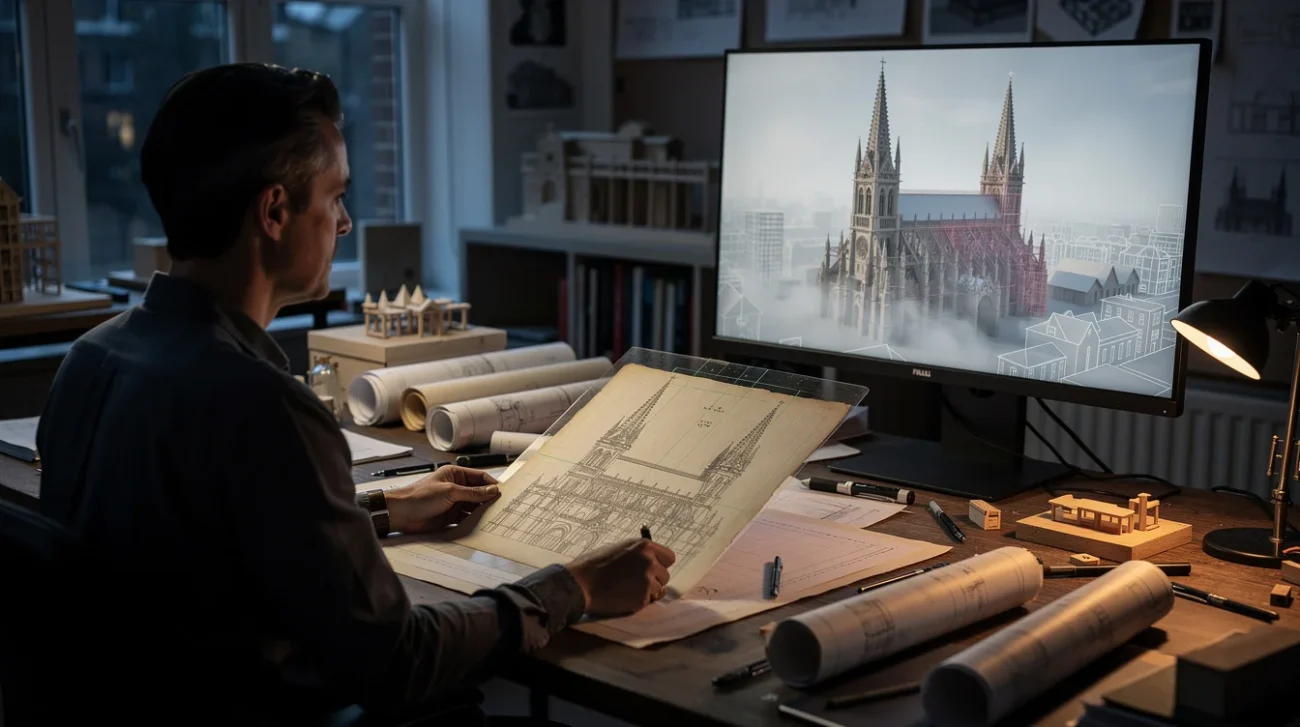
An architectural drawing admits that it is a proposition. A photorealistic image is less forthcoming. Give an unrealised building weathered stone, convincing shadows and a few indifferent pedestrians, and a design that never left the archive begins to resemble something a camera once witnessed. This is the productive danger of AI architectural visualisation: it can make architectural history legible while quietly changing the status of what we see.
The projects highlighted in ArchDaily’s account make that tension concrete. Christopher Wren’s Warrant Design for St. Paul’s Cathedral, approved in 1675, differs substantially from the cathedral subsequently built. Thomas Willson’s proposed pyramid necropolis for Primrose Hill imagined millions of burials inside a monument that would dominate London. Neither deserves to remain an archival footnote. Neither should acquire a counterfeit photographic past.
PRO: The Archive Should Not Require an Architecture Degree
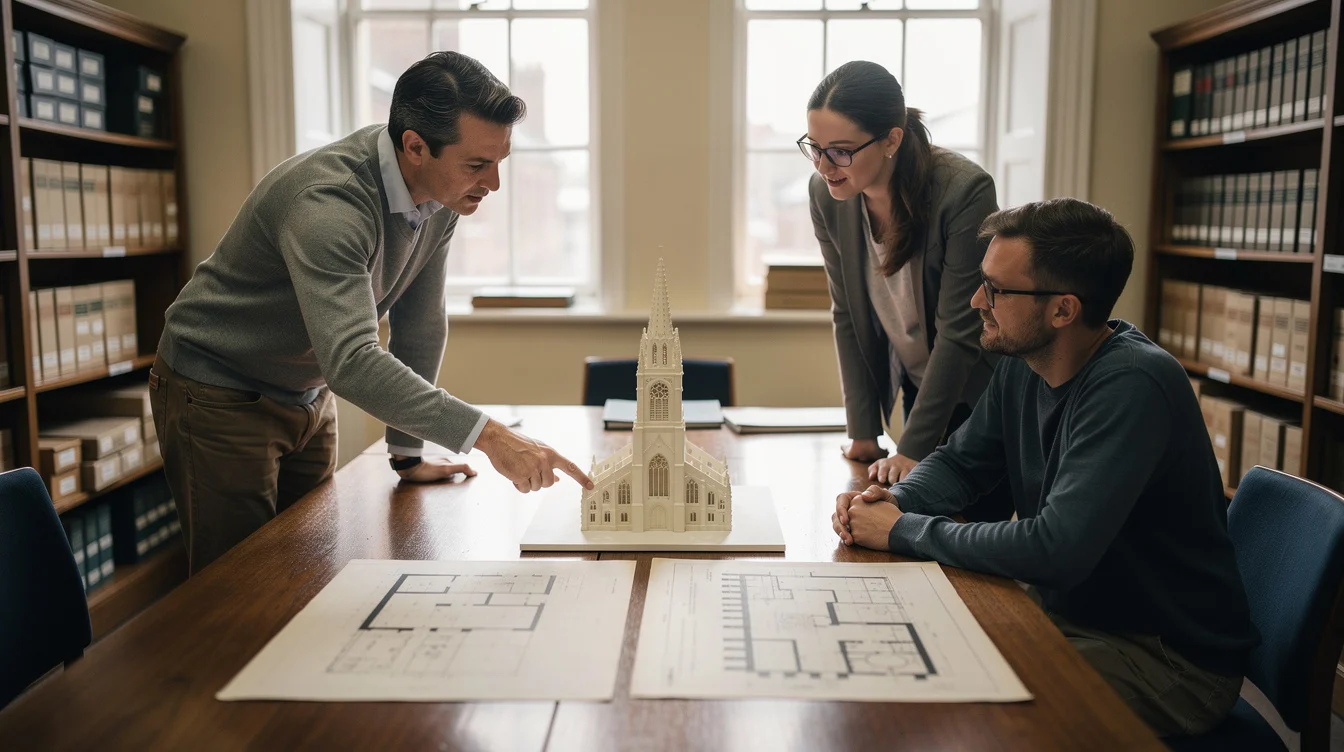
Architectural archives are public memory stored in a specialist language. Plans, sections and elevations reward trained eyes; everyone else must work harder to understand height, enclosure, circulation and scale. An intelligently constructed visualisation can bridge that gap. It can turn the difference between Wren’s spire-topped Warrant Design and the cathedral’s eventual dome from a textual observation into an immediate spatial argument.
That matters because the completed building tends to monopolise the story. Once a familiar monument becomes a city’s emblem, earlier alternatives start to look like preliminary mistakes rather than consequential decisions. Showing an unrealised proposal restores contingency: the skyline was negotiated, revised and constructed, not destined. Wren’s changes during construction become central to understanding design rather than inconvenient deviations from an original image.
Willson’s pyramid offers a different opportunity. An elevation can communicate its outline, but a carefully qualified view from Primrose Hill could help audiences discuss the relationship between burial infrastructure, monumental ambition and the inhabited city. The point is not to admire a spectacular silhouette. It is to ask what accommodating millions of dead within one enormous structure would mean for land, access and civic identity.
Accessibility is not the enemy of scholarship. Refusing visual interpretation because it involves judgement risks protecting the archive’s exclusivity rather than its accuracy.
PRO: A Reconstruction Can Show Its Own Reasoning
The strongest case for AI is not that it produces one definitive view cheaply. It is that, within a researcher-led process, it can help communicate several interpretations instead of allowing a single rendering to masquerade as the answer. Where evidence leaves a roof treatment, surface finish or neighbouring plot unresolved, an exhibition could display alternatives with the relevant drawing beside them. Uncertainty would become something visitors can inspect.
Consider Étienne-Louis Boullée’s unbuilt Cenotaph for Newton. Its surviving drawings already use light and darkness to construct an architectural experience. A contemporary visualisation could explore that intended effect while identifying which spatial relationships come from the drawings and which lighting conditions are modern interpretive choices. The distinction would deepen the encounter rather than spoil it.
A useful display might offer three linked views: a transcription of documented geometry, a deliberately simplified spatial model, and an atmospheric interpretation. Visitors could move between them without mistaking the final image for newly discovered evidence. For Wren’s proposal, the model should follow the relevant surviving representations, not merely ask a generator for a plausible seventeenth-century cathedral.
This is where institutional investment belongs: in source checking, geometric verification and explanatory design. AI can contribute to the presentation, but it cannot authenticate its own reconstruction. The public benefit comes from a better interface to research, not from outsourcing historical judgement to a convincing picture.
CONTRA: Realism Smuggles In an Entire Undocumented World
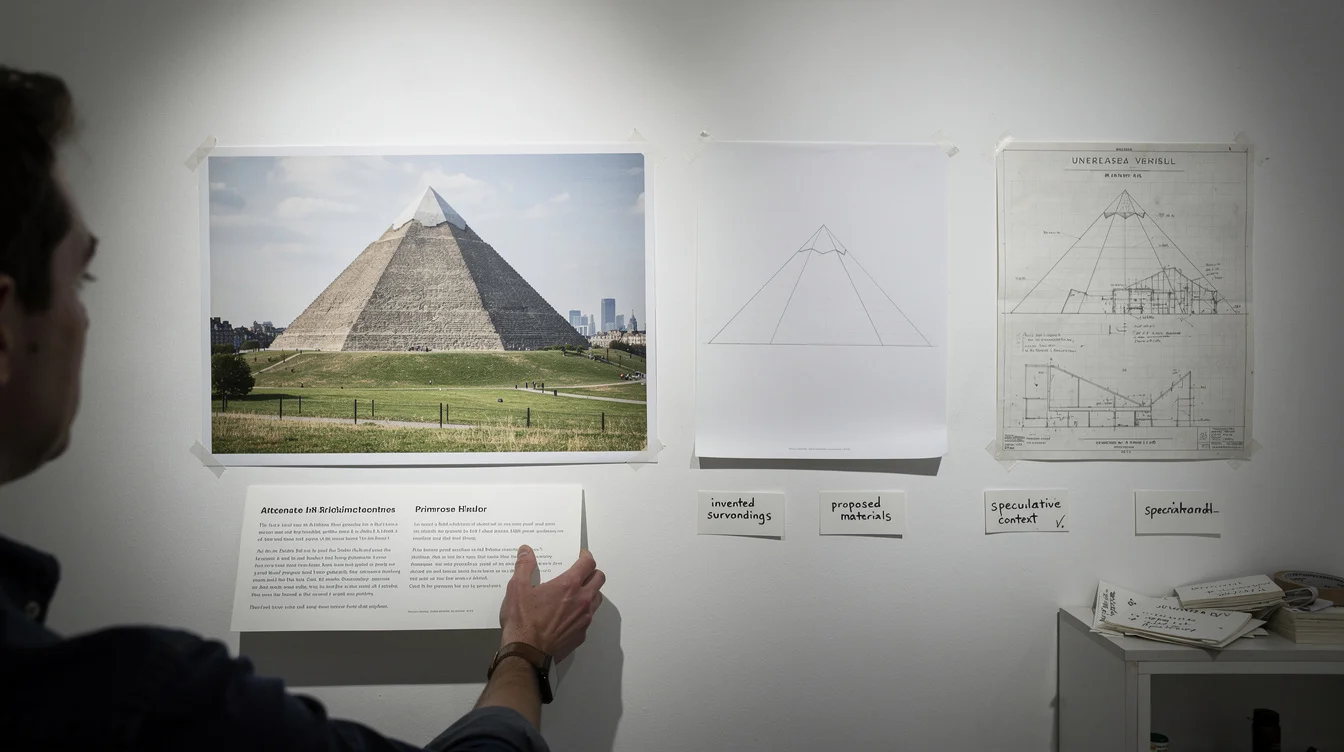
The objection is not simply that AI sometimes invents a window. It is that photorealism demands a continuous world where the archive often supplies fragments. A drawing may establish an elevation without settling the precise stone, jointing, weathering, construction tolerances or appearance from an undocumented viewpoint. The image must either leave those questions visibly open or answer them. Generative systems are exceptionally good at making the answers look unremarkable.
Wren’s Warrant Design is especially vulnerable to contamination by familiarity. A system drawing on the visual conventions associated with St. Paul’s could introduce details resembling the completed cathedral. Those details would feel credible precisely because viewers recognise the building that superseded the proposal. The rendering could therefore erase the distinction it was meant to explain.
Surroundings introduce another layer of invention. What does a London street contain in the chosen year? How high are adjoining buildings? Which routes are visible? Clothing, smoke, paving and vegetation all make historical claims, even when the image-maker treats them as atmosphere. A picturesque background can be as misleading as an invented façade.
Willson’s pyramid on present-day Primrose Hill would be an explicit counterfactual. The same pyramid placed in a supposedly historical panorama would require a separate reconstruction of London. Rendering the monument and reconstructing its setting are different research tasks. Combining them without disclosure makes the image appear better evidenced than it is.
CONTRA: Captions Are Too Fragile to Carry the Truth Alone
A responsible caption helps, but images travel without their captions. They are cropped into presentations, reposted on social platforms and extracted from exhibition reviews. An atmospheric reconstruction can eventually circulate as an “old view” of a building that never existed. The problem does not require deliberate deception; it requires only an image whose visual authority survives while its qualifications disappear.
The London Charter and the Seville Principles offer relevant precedents for documenting computer-based heritage visualisation. They were not devised as fixes for generative AI, but their emphasis on intellectual transparency remains essential. Audiences should be able to distinguish the evidence, the interpretation and the decisions that connect them. A generic “AI-generated” label identifies a production method, not the reliability of a cornice.
Publishers should demand a compact evidence record for each image: the proposal and version represented, the source drawings consulted, the geometry checked, the material assumptions made, and the elements invented for atmosphere. Surviving evidence may itself be incomplete or contradictory. “Documented” must mean supported by a specified source, not unquestionably settled.
The image also needs a durable visual distinction. Documented forms might be rendered in detail while conjectural surroundings remain diagrammatic; an adjacent uncertainty view could use patterns and labels rather than colour alone. These choices sacrifice seamlessness. Good. If historical honesty makes the picture less cinematic, the picture should lose.
The Editorial Line: Publish the Interpretation, Not a Fake Memory
The choice is not between dusty drawings and seductive lies. It is between visualisation that exposes its argument and visualisation that conceals it. Museums, magazines and design studios should commission historical reconstructions as research-led interpretations, with an explicit distinction between an unrealised proposal and the world imagined around it.
For Wren, that means preserving the identity of the approved 1675 scheme rather than producing a vaguely plausible alternative St. Paul’s. For Willson, it means separating the proposed pyramid from assumptions about its materials, urban setting and operation. Atmospheric imagery can accompany this work, but it should never become the only view offered. The more persuasive the rendering, the greater its obligation to reveal what it does not know.
FAQ
Can AI images be evidence of unbuilt architecture?
They can communicate an interpretation of surviving evidence, but they are not independent proof of what a designer intended. Historical claims must remain traceable to drawings, models, texts or other identified sources.
Why does Wren’s Warrant Design need particular care?
The spire-topped proposal approved in 1675 was reworked as construction progressed. A reconstruction must distinguish that proposal from the completed St. Paul’s Cathedral, rather than importing familiar features from the later building.
What should an architectural reconstruction disclose?
It should identify the scheme and version, its source material, verified geometry, interpretive decisions and invented elements. Materials, lighting, people, vegetation and neighbouring buildings deserve scrutiny alongside the principal structure.
Is an “AI-generated” label enough?
No. It explains how an image was produced, not which parts are supported by evidence. Pair a visible interpretation label with accessible documentation and an in-image distinction between documented and conjectural elements.
If a reconstruction becomes less beautiful when it honestly displays its uncertainty, should architectural culture learn to prefer the less beautiful image?
Watch the Mainifesto Short
Get the Mainifesto weekly — curated design debates, speculative ideas and the week's best articles every Saturday.
Editorial Perspectives
Questions and counterpoints developed by the Mainifesto editorial desk to extend the discussion.
Perspective 1
Yes—we should learn to prefer the less beautiful reconstruction if it makes the limits of our knowledge visible. In a parametric model, an assumed dimension can change the whole geometry; why should an image of Wren’s unbuilt cathedral hide that dependency?
Perspective 2
No—making an image less beautiful isn’t a reliable way to make it more honest. In manufacturing, a polished render can sit beside a tolerance drawing; architectural reconstructions need equally clear source notes and uncertainty overlays, not an aesthetic penalty.
Perspective 3
I want to see the cathedral that never existed—that’s a genuinely exciting use of this medium. But a speculative image needs its status attached to the image itself, because the caption is often the first thing lost when it circulates.
Perspective 4
The bigger question is who gets to turn a reconstruction into the accepted record. In cities where archives have been destroyed or access is restricted, a convincing image can give one institution’s guess more authority than residents’ accounts; visible uncertainty needs to travel with the file, not sit in a report nobody reads.