Does Outdoor Play Need an AI Interface?

A phone that tells children to put down their phones sounds like a design joke. Freckle is making it a product proposition. According to Dezeen’s reporting, the start-up has developed an AI-powered children’s mobile phone with design studio Body Shop, aimed at seven- to 13-year-olds. Its stated ambition is exploration: encouraging children to get outside and observe the natural world, while offering a break from parental restrictions and surveillance.
That ambition deserves attention, not automatic applause. Freckle enters a childhood already crowded with instructions, assessments and managed experiences. The question is not simply whether a device can send children outdoors. It is whether the interface expands their freedom once they arrive—or quietly becomes another authority telling them what counts as an interesting afternoon.
PRO: A Prompt Can Open a Door
The strongest case for AI outdoor play begins with an unfashionable admission: not every child knows how to begin. An unfamiliar park can feel less like possibility than a blank page. A small invitation—find two leaves with different edges, notice where rainwater collects, listen for a sound beyond the traffic—can turn an undifferentiated setting into somewhere worth investigating. These are examples of possible prompts, not verified Freckle features.
There is a substantial design lineage behind that approach. Seymour Papert’s work with Logo treated computers as tools for children to think with, rather than machines that simply delivered instructions. The relevant distinction is agency: does a digital encounter help a child formulate a question, test an idea and change direction? Or does it only reward completion? Outdoor technology should face the same test.
Seek by iNaturalist provides a useful contemporary comparison. Its image-recognition approach gives users a possible route from looking at an organism to learning its name. Identification is not ecological understanding, and automated suggestions can be wrong. Still, a name can become an opening: why does this plant grow beside the drain but not beneath the tree? A good interface does not replace attention. It gives attention somewhere to start.
PRO: Design the Invitation, Then Get Out of the Way

For children who struggle with open-ended situations, a little structure can support rather than suppress independence. A child entering a new neighbourhood might welcome a starting task; another might prefer to invent a game immediately. Neither response should become a universal model of childhood. Freckle’s broad age range makes this particularly important: a seven-year-old’s reading ability, confidence and outdoor permissions may differ sharply from a thirteen-year-old’s.
The Exploratorium’s Tinkering Studio offers a useful reference outside phone design. Its activities and materials create entry points into experimentation without requiring every participant to produce an identical result. An outdoor interface could follow that principle: offer multiple beginnings, accept unexpected outcomes and avoid presenting a single correct adventure. It should make refusal easy, too.
The decisive design work may therefore be subtraction. No streak to preserve. No leaderboard for curiosity. No conversational pressure to keep reporting back. A brief interaction followed by a long, deliberate silence would be a more convincing achievement than endless personalised engagement.
Freckle’s promise also invites scrutiny of parental control. A device that supports communication without turning every outing into an adult dashboard could offer a meaningful alternative to surveillance-led product design. That remains a criterion, not a verified description of its data practices. The pro argument is conditional but serious: a phone can be useful if success means the child eventually forgets to consult it.
CONTRA: Childhood Is Not an Unfinished User Journey
The opposing case starts where the product pitch becomes most seductive. If a child needs help noticing a leaf, perhaps an interface can help. But if every moment of uncertainty becomes an opportunity for an AI suggestion, childhood loses something harder to package: the experience of deciding what to do when nobody supplies the next step.
Boredom is not automatically beneficial, and leaving children unsupported is not an educational philosophy. Nevertheless, an unfilled interval gives children room to initiate, negotiate and invent. A stick becomes a measuring instrument, then a sword, then the border of an imaginary country. No identification task captures that movement between physical observation and fiction. Its value lies partly in its lack of a predetermined destination.
Architect Simon Nicholson’s theory of loose parts, published in 1971, offers a sharper model of creative provision than another intelligent guide. Environments become more inventive when people can manipulate their components: sand, water, timber offcuts, fabric, objects that do not dictate a single use. The design task is to increase possibilities, not continually suggest which possibility to select.
An AI can generate open-ended prompts, certainly. But even a generous prompt selects a frame. “Find a species” privileges classification; “complete an adventure” privileges achievement. Self-directed play needs permission to be pointless, repetitive, socially complicated and illegible to the system observing it.
CONTRA: The Missing Interface May Be a Safe Street
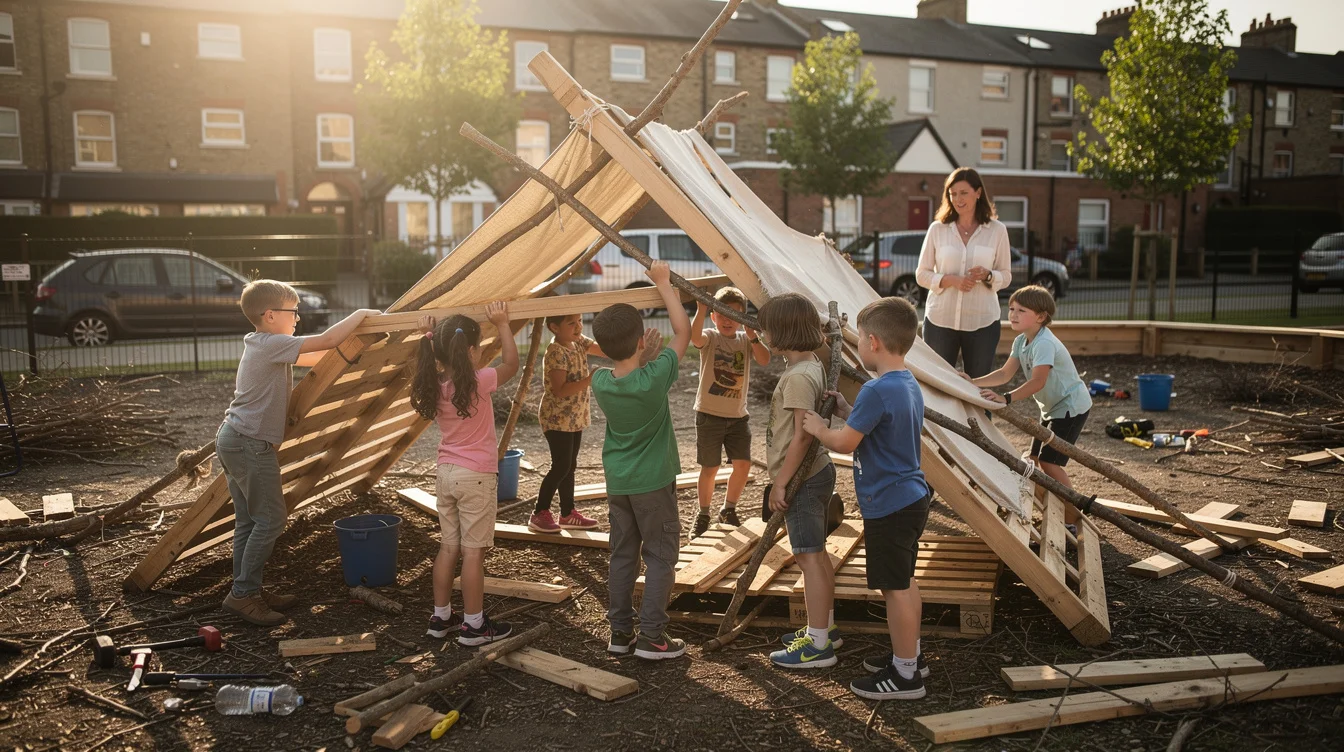
Freckle also risks joining a familiar technological manoeuvre: treating a spatial and political problem as a product opportunity. Children’s outdoor freedom depends on traffic, accessible green space, toilets, welcoming public places and adults willing to tolerate their presence. A phone cannot negotiate away a dangerous junction. Nor does a nature prompt create shade in a treeless neighbourhood.
The adventure-playground tradition makes the alternative concrete. The playground opened at Emdrup in Copenhagen in 1943, associated with landscape architect Carl Theodor Sørensen, gave children materials and space for making. Its lesson is not that adults should disappear. It is that adults can support play by shaping conditions rather than scripting each action. Contemporary playworkers continue to confront that distinction between provision and interference.
Then there is the interface’s hidden infrastructure. Before celebrating any children’s AI product as freedom from surveillance, buyers need clear answers about location collection, image processing, retention, training use and parental access. The supplied source summary does not establish Freckle’s arrangements. Nor does it establish how the system handles mistaken identifications or unsafe advice. A fluent answer must never become permission to taste a berry.
The contra argument is therefore not nostalgic hostility to electronics. It is a demand for proportion. Investing in a safer route to the park may enable more independent discovery than designing a cleverer companion for the journey. The phone should have to prove what it adds—not require childhood to justify what it does without one.
FAQ: AI, Outdoor Learning and Independent Play
What is the Freckle children’s phone?
Freckle is an AI-powered mobile phone developed by the start-up with design studio Body Shop for children aged seven to 13. As described by Dezeen, it centres exploration and engagement with the natural world. That positioning alone does not establish its effectiveness, safety or privacy protections.
Can digital prompts support outdoor learning?
Yes, they can provide a starting point for observation, comparison and questioning. Their value depends on what follows: sustained engagement with the environment is more meaningful than completing a screen-based checklist. Prompts should be optional, age-appropriate and easy to abandon when a child discovers a different interest.
Why protect boredom and self-directed play?
Unstructured time gives children opportunities to generate ideas, negotiate rules and change their own goals. Boredom does not guarantee creativity, but automatically filling every pause removes opportunities to practise initiative. Adults can provide safe surroundings and varied materials without prescribing the activity.
What should parents check before choosing an AI outdoor device?
Look for clear explanations of data collection, location sharing, retention and deletion, alongside age-appropriate safeguards and limits on AI advice. Ask whether core functions work without persistent tracking. Examine the physical environment as well: no device substitutes for suitable supervision, safe routes or accessible places to play.
If a device helps a child step outside but keeps suggesting what to notice, has it expanded their freedom—or merely moved the instructions outdoors?
Get the Mainifesto weekly — curated design debates, speculative ideas and the week's best articles every Saturday.
Editorial Perspectives
Questions and counterpoints developed by the Mainifesto editorial desk to extend the discussion.
Perspective 1
I’m for it: a well-timed prompt can make a familiar courtyard feel like unexplored territory. The interesting design problem is whether the interface can gradually withdraw as the child starts asking their own questions—could success mean needing it less?
Perspective 2
I’m not convinced outdoor play needs another dedicated device, with a battery to age and a casing to survive drops. Before calling this freedom, show me that children keep exploring after the prompts stop, not just that they spend more minutes outside.
Perspective 3
There’s something exciting about a device that turns a walk into a strange little field expedition. But who decides what counts as worth noticing? I’d want room for children to ignore the suggested bird and invent a whole mythology around a broken fence.
Perspective 4
Why assume every child needs to own one? A repairable device borrowed from a library could be a brilliant starting point for outdoor adventures, without making discovery another reason to manufacture a short-lived personal gadget.
Perspective 5
A prompt to explore means little if the pavement ends at a six-lane road or the nearest park is gated. Judge this phone alongside the streets children actually get to use; it might help them notice more, but it cannot give them permission or safe passage.