
Gaudí Without Gravity? The Test for AI Design Education
Gaudí Without Gravity? The Test for AI Design Education
Gaudí is an irresistible reference for artificial intelligence: branching columns, swelling surfaces, architecture apparently grown rather than assembled. He is also a devastating test of its educational ambitions. Remove the relationship between form, force and construction, and what remains is not Gaudí’s method. It is Gaudí-flavoured imagery.
An initiative presented by Archademy.ai, developed in partnership with the Antoni Gaudí Foundation, brings that distinction into focus. As described by ArchDaily, it combines practical training in advanced AI tools, including ComfyUI and Flux.2, with an architectural project evaluated by an international jury. That combination creates an opportunity—and an obligation—to ask what students should actually prove.
The source description establishes the initiative’s framework, not a detailed assessment rubric. The argument here is therefore not a verdict on its teaching. It is a test for the educational model it represents: should AI design education reward visual fluency, or demonstrable relationships between geometry, materials and buildability?
PRO: Visual Fluency Is a Design Skill, Not a Guilty Pleasure
The strongest case for AI in architectural education is not that it makes everyone an architect. It is that it can make early design exploration less dependent on rendering proficiency. A student who struggles to communicate an unfamiliar spatial idea can explore multiple expressions before committing to a developed model. Used critically, that is an expansion of the sketchbook, not an abandonment of architecture.
Architecture has never advanced through calculation alone. Zaha Hadid’s paintings for The Peak competition in Hong Kong were instruments of spatial discovery, not construction documents. Their distortions made an architectural proposition visible before conventional representation could comfortably contain it. It would be intellectually lazy to celebrate that speculative freedom in painting while rejecting it automatically in machine-assisted imagery.
A Gaudí-focused assignment could exploit this freedom productively. Students might investigate how a branching support changes the perceived scale of a room, how perforated surfaces distribute daylight, or how a repeated geometric unit becomes an apparently organic interior. Generating alternatives could help them distinguish a spatial ambition from a decorative preference.
The assessment should reward discernment rather than abundance. Fifty variations are not fifty ideas. Ask students to select three genuinely different propositions, identify what each makes possible, and explain which architectural question the next iteration will address. This is a way of designing against the algorithm, rather than letting its output set the agenda. Visual fluency becomes educational when students can argue with their own images.
PRO: AI Can Make the Design Process More Legible
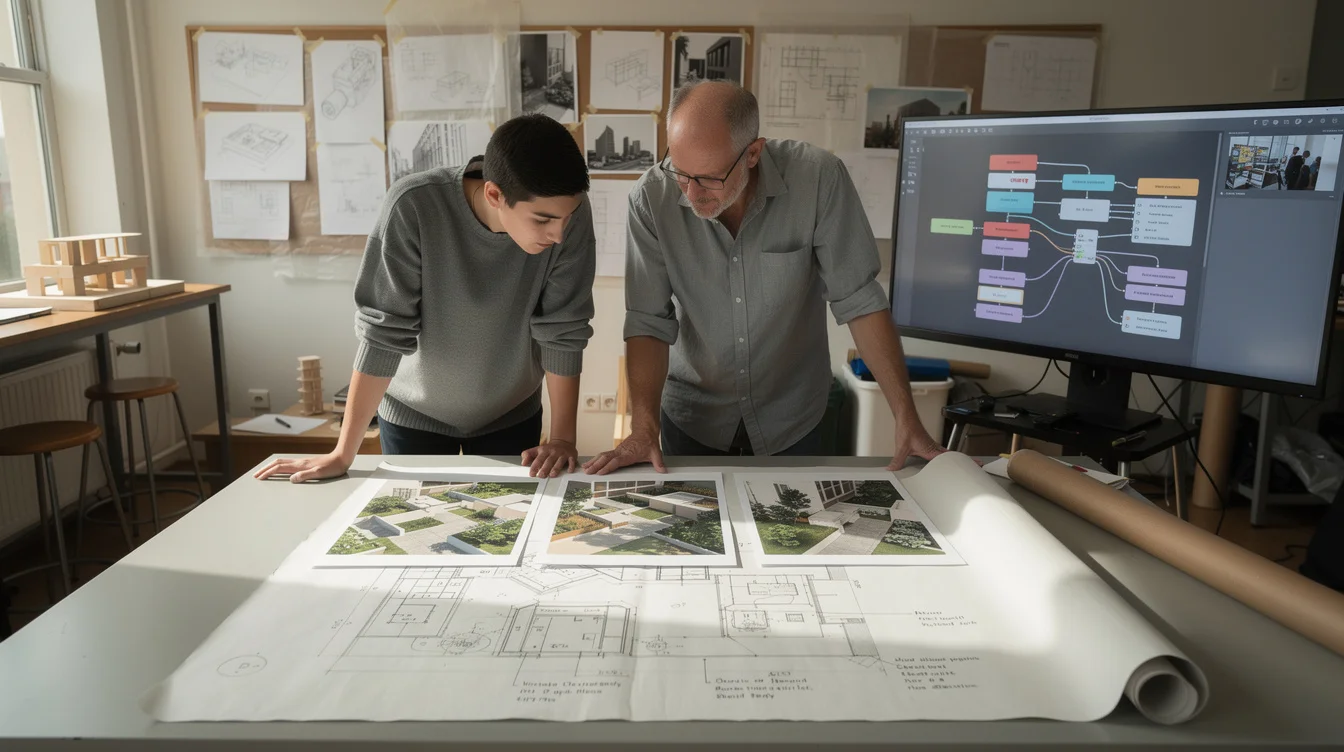
A course linked to a competition also offers a useful deadline and an audience beyond the classroom. An international jury can expose a proposal to competing interpretations of spatial quality, cultural relevance and experimentation. The opportunity is not simply to produce a polished final board; it is to make the journey to that board discussable.
ComfyUI’s node-based workflows suggest one practical approach. Students could submit selected workflow records alongside their images, explaining how inputs, settings and interventions changed the result. Such records would not prove structural competence. They could, however, reveal whether a student directed a process or merely accepted an attractive accident.
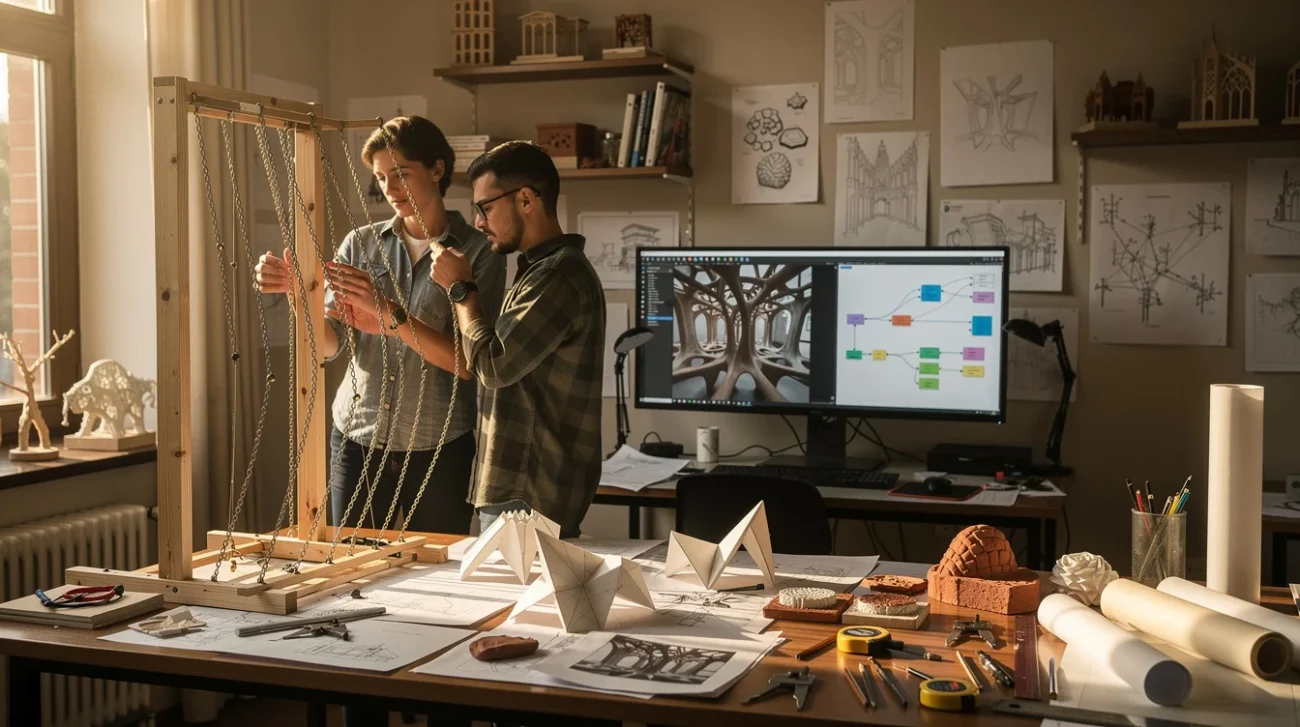
That distinction connects AI teaching to a much older design tradition. Antoni Gaudí’s physical models and Frei Otto’s experiments with suspended nets and soap films made certain aspects of form-finding observable. Their experimental apparatus was not a guarantee of a finished building, but it provided something to inspect, question and repeat. AI workflows can support a comparable culture of explicit experimentation, provided nobody mistakes image generation for physical simulation.
A productive submission might pair a generated courtyard with a plan drawn by the student, a daylight hypothesis and a short account of a rejected alternative. The image initiates an investigation; subsequent representations challenge it. On this side of the argument, visual fluency deserves serious assessment because it helps students articulate possibilities that technical testing can then refine.
CONTRA: A Convincing Image Can Conceal an Empty Proposition
The counterargument begins exactly where the image becomes persuasive. An apparently continuous vault may have no coherent thickness. A branching column may terminate in a ceiling without a credible connection. A sunlit opening may sever the very surface supposedly carrying the roof. Photographic plausibility can disguise contradictions more effectively than an obviously tentative sketch.
Gaudí makes an especially demanding reference because his formal invention was entangled with structural reasoning. His hanging-model investigations for the church at Colònia Güell used weighted suspended elements to explore equilibrium. Inverting an appropriate tension form helps identify a compression form for the corresponding loading assumptions. It does not automatically solve every load case, but it establishes a reason for geometry beyond resemblance.
Likewise, the ruled surfaces associated with the Sagrada Família demonstrate that visually complex architecture can emerge from geometrically describable operations. Calling a generated surface “organic” tells us almost nothing about whether it can be set out, supported or assembled. This also raises a question about who controls a monument’s digital interpretation: which aspects of its architectural intelligence survive the translation into imagery?
This is where AI design education risks rewarding the wrong achievement. A student can become expert at producing the signs of structural intelligence without acquiring its substance. A competition board may look researched because it contains arches, ribs and branching supports. Unless the jury can ask what carries what, and why, the exercise risks becoming an examination in architectural camouflage. Nature-inspired appearance is not evidence of nature-informed performance.
CONTRA: Buildability Must Be Demonstrated, Not Implied
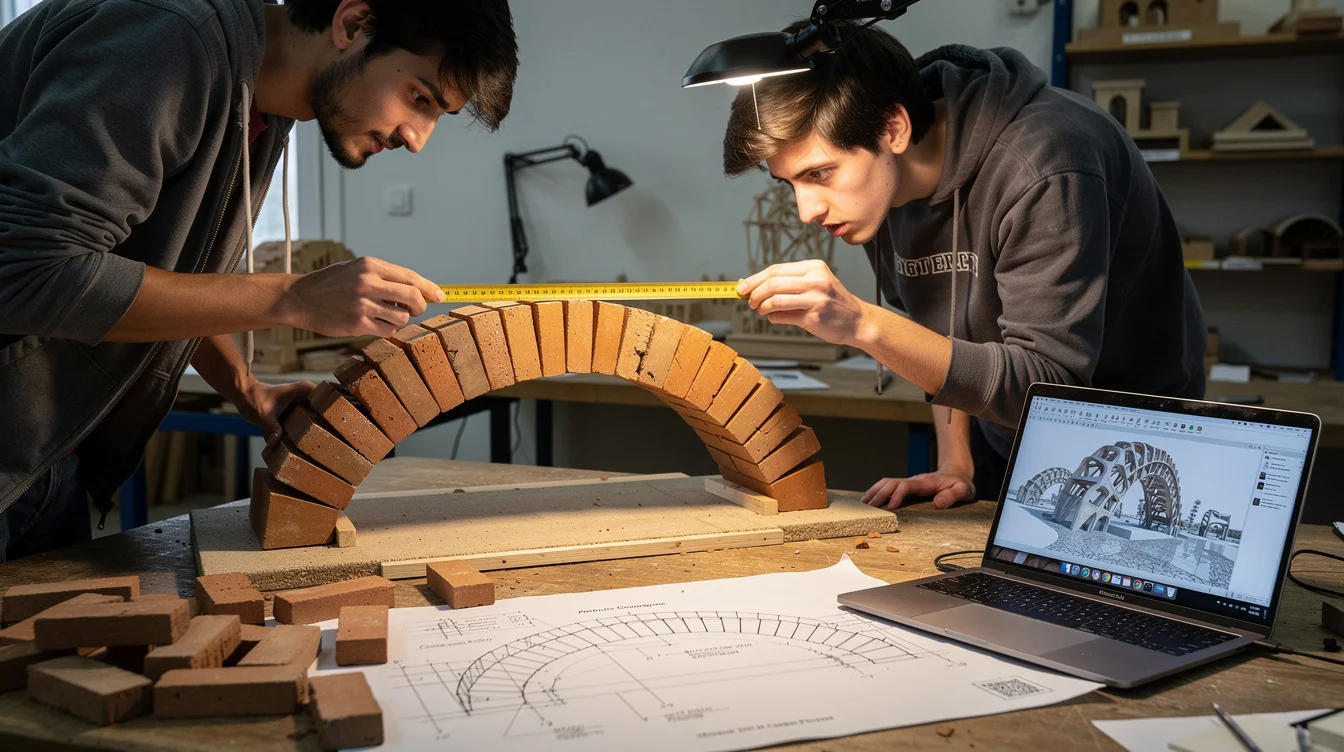
The answer is not to demand construction-ready engineering from every introductory course. It is to demand evidence proportionate to the project’s claims. If a student presents a compression shell, the submission should identify its supports, assumed loading and structural idealisation. If the proposal depends on timber bending, it should address grain direction, achievable curvature and connections. “AI-generated” cannot be an exemption from material behaviour.
Eladio Dieste’s reinforced-brick structures offer a useful corrective to purely visual complexity: geometry, masonry and construction technique work together. The Armadillo Vault by the Block Research Group and collaborators offers another reference, showing how an expressive stone assembly can be tied to compression-based geometry and precise fabrication. Neither should become another style preset. Both demonstrate the kind of relationship students should learn to explain.
A stronger jury format would require a coordinated plan and section, a basic load-path diagram, a material strategy and one developed assembly detail. A small physical test or an appropriately supervised digital analysis could interrogate the project’s central claim. Students should state assumptions and failures, not bury them beneath a final rendering.
The decisive test is revision: when evidence contradicts the preferred image, does the design change? Give equal review time to visual ambition and technical reasoning, but make unresolved contradictions count. Architecture education should protect experimentation without teaching that consequences are someone else’s problem. Gaudí’s legacy warrants nothing less.
FAQ: What Should AI Design Education Actually Assess?
What does the Archademy.ai initiative combine?
According to the supplied ArchDaily description, the initiative was developed in partnership with the Antoni Gaudí Foundation and combines practical AI training, including tools such as ComfyUI and Flux.2, with an architectural project evaluated by an international jury. That description does not establish the detailed judging criteria.
Why is Gaudí a challenging reference for AI-generated architecture?
His work connects expressive form with geometry, structural investigation, material choices and making. Images can reproduce the appearance of that connection without demonstrating it. A meaningful Gaudí-inspired exercise should therefore investigate how a proposal works, not simply whether it looks organic.
Can AI-generated images demonstrate structural feasibility?
Not on their own. Images can communicate a structural intention, but feasibility requires additional evidence: consistent geometry, material properties, loads, support conditions and suitable analysis or testing. An apparently credible column or vault is not a verified structural system.
What would a balanced student submission include?
It would combine selected visual explorations with a documented design process, coordinated drawings, a load-path explanation, a material strategy and a detail or test appropriate to the course level. Crucially, it would show how technical findings changed the initial proposal.
If an AI-generated project captures Gaudí’s visual daring but cannot explain how it stands, what exactly should an architecture jury reward?
Watch the Mainifesto Short
Get the Mainifesto weekly — curated design debates, speculative ideas and the week's best articles every Saturday.
Editorial Perspectives
Questions and counterpoints developed by the Mainifesto editorial desk to extend the discussion.
Perspective 1
I’m for AI in design education: let students reach beyond what they already know how to build. A jury can reward that imaginative leap without pretending it’s resolved architecture, then ask students to test it against gravity, material waste and repair.
Perspective 2
If nobody can explain how it stands, I wouldn’t award it an architecture prize. Gaudí’s daring involved structural investigation; a seductive image that ignores local skills, supply chains and construction costs skips the work that makes architecture possible.
Perspective 3
Show me a load path, a plausible joint and what happens when the geometry meets fabrication tolerances. I don’t need construction drawings from a student concept, but I do need evidence that the form can survive something more demanding than another render.