
Beyond Human-Centred Design: Is Kelp Really Reciprocal?
Beyond Human-Centred Design—but Still Taking From Nature?
A kelp sculpture can unsettle the hierarchy between humans and other life. It can also reproduce that hierarchy in an exceptionally beautiful form. This is the productive contradiction running through Julia Lohmann’s work: organisms become collaborators in design thinking while remaining materials that humans collect, process and display.
As designboom’s account connects her leather-covered cow benches with her towering kelp sculptures, a consistent question emerges: what makes one living body acceptable as upholstery and another compelling as a vision of ecological change? Lohmann makes that question difficult to avoid. But difficulty is not proof of reciprocity. The decisive test is not whether a material renews itself, but whether the relationships sustaining it survive our demand.
PRO: A Material Can Change the Designer’s Position
Lohmann’s work deserves more than the familiar designation of a sustainable alternative. Her Cowbenches, from 2004, used leather-covered forms recalling the animals behind the material. Rather than allowing upholstery to erase its origin, the benches brought the absent animal back into the encounter. They exposed a convention that product design usually conceals: a finished object arrives stripped of the ecological and ethical relationships that made it possible.
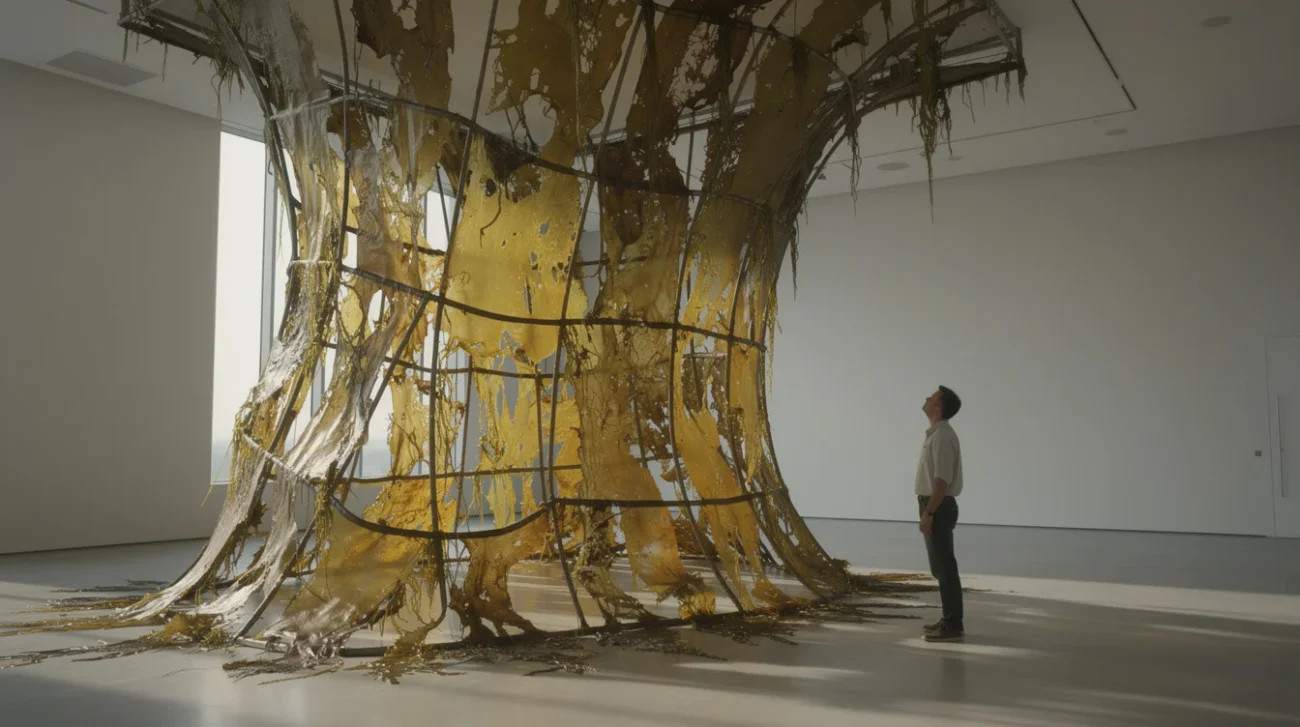
Her seaweed work extends that investigation into a different material territory. Oki Naganode, developed during her 2013 residency at London’s Victoria and Albert Museum, brought dried seaweed into a large, skeletal sculptural structure. Its translucent surfaces refuse the blank consistency expected of industrial sheet materials. Variation becomes part of the proposition rather than a defect to eliminate.
This matters because design briefs normally make organisms answer human specifications. The material must be uniform, available and obedient. Working with kelp’s irregularity can reverse part of that relationship: the designer must respond to what the organism permits. That is not ecological equality, but it is a meaningful departure from treating matter as an infinitely compliant input.
PRO: Experiment Can Build Collective Knowledge
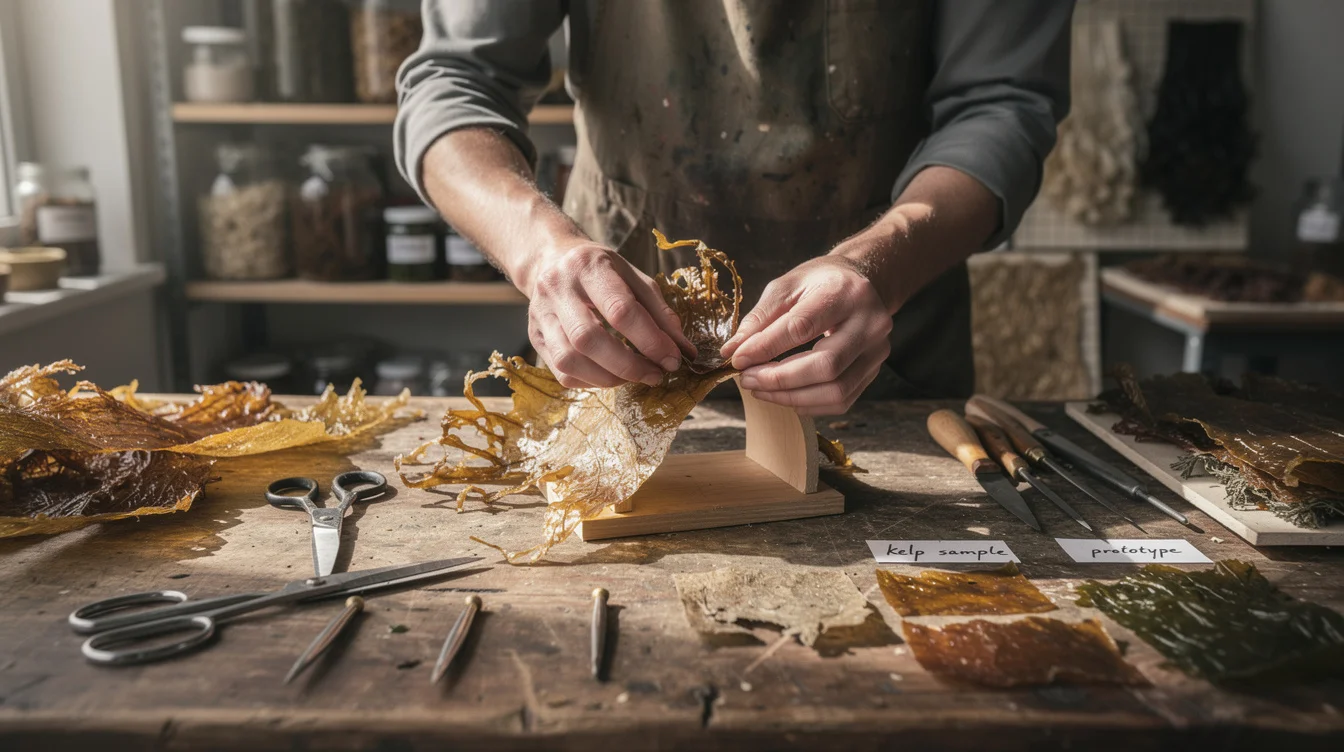
Lohmann’s Department of Seaweed, established during that V&A residency, offers a more consequential model than the isolated signature object. Conceived as a platform for exploring seaweed through design, it makes material knowledge a subject of exchange. The valuable output is not necessarily another sculpture. It can be a shared understanding of what seaweed can do, where it fails and which applications should never proceed.
A genuinely reciprocal version of this approach would connect studio experiments to marine ecologists, harvesters and coastal communities before commercial specifications harden. A designer might discover that accepting seasonal colour variation avoids a bleaching stage, or that smaller components accommodate available fronds without incentivising the collection of larger specimens. These are proposed design decisions, not claims about Lohmann’s documented production.
There are useful parallels elsewhere. Atelier LUMA’s bioregional research in Arles treats material development as a question of territory, expertise and available resources rather than merely selecting a fashionable feedstock. The lesson is methodological: start with the place and its relationships, not a product category seeking a green replacement. Reciprocity begins when local knowledge can change—or cancel—the brief.
PRO: Use Could Support Stewardship Rather Than Volume
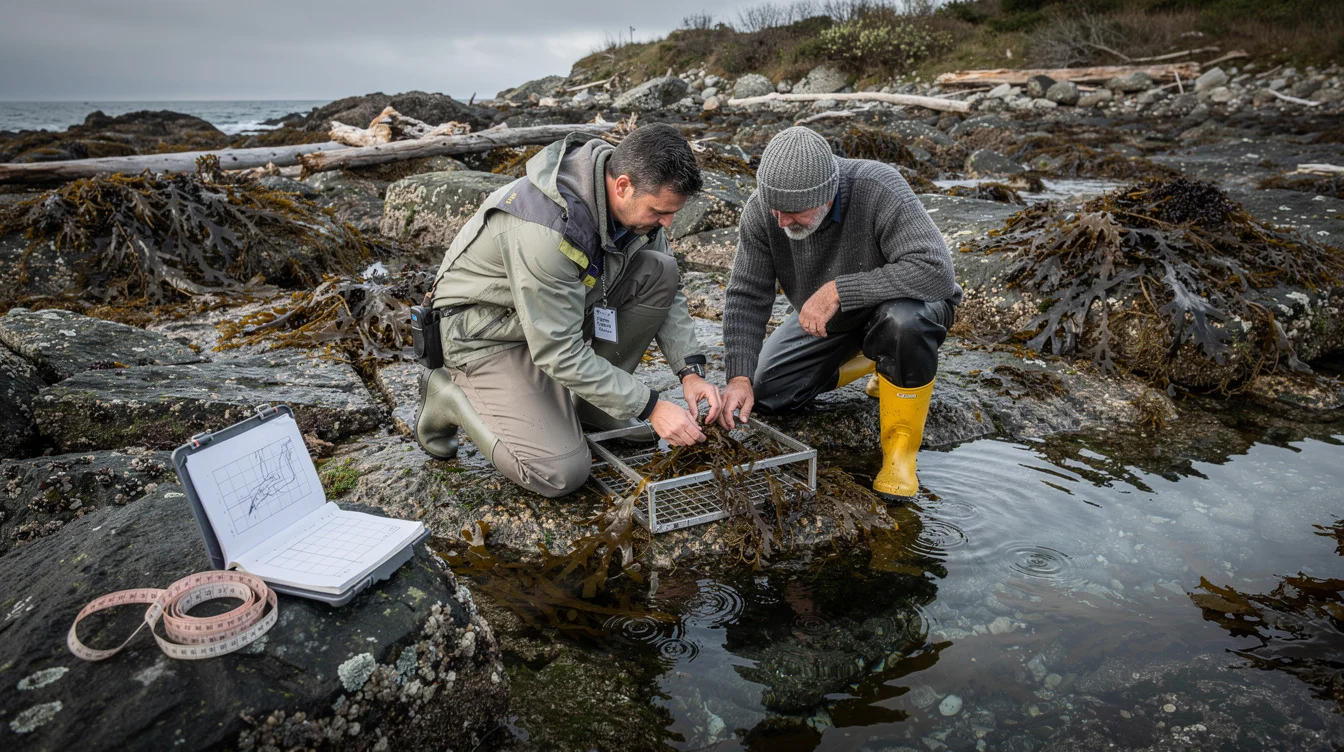
There is no ecological law saying that every human use of another organism must destroy its conditions of existence. Carefully governed harvesting and cultivation can coexist with functioning ecosystems. Seaweed farming also does not inherently require the arable land or freshwater irrigation associated with many terrestrial fibre crops. Those advantages are real, provided they remain the beginning of an assessment rather than its conclusion.
GreenWave’s promotion of regenerative ocean farming offers a useful comparison: kelp is considered alongside shellfish and marine livelihoods, not simply as a substitute for plastic. Nevertheless, any environmental benefit depends on location, species, cultivation methods and management. A positive farming model cannot automatically certify every product made from its harvest.
For design, the strongest opportunity may be a deliberately bounded economy: durable objects, modest material volumes, repairable construction and prices that fund monitoring rather than expansion. A commission could pay separately for ecological surveys and community governance, including during periods when harvesting stops. Under those conditions, value would no longer depend entirely on how many kilograms leave the water. Design could finance restraint instead of rewarding extraction alone.
CONTRA: Renewable Is Not the Same as Available
The counterargument begins where the exhibition ends: at the shore. Kelp forests are not underwater warehouses. Depending on species and location, they provide habitat, modify water movement and support food webs. Detached seaweed can also feed beach ecosystems. Calling a material fast-growing tells us little about how much can be removed, from which habitat, in which season, without undermining those relationships.
Even apparently gentle rules need scrutiny. Leaving a holdfast intact is not a universal harvesting prescription; recovery depends on species, growth structures and cutting method. Collecting beach-cast seaweed is not automatically impact-free either. Material that looks abandoned may already be feeding invertebrates or contributing to dune systems. The category of waste often reveals human impatience more clearly than ecological redundancy.
Farmed kelp avoids some pressures associated with wild harvesting, but introduces its own questions about farm density, shading, local genetic diversity, disease and competing uses of coastal waters. None of this invalidates Lohmann’s experiments. It does invalidate the promotional shortcut by which a compelling kelp object becomes evidence that an entire material economy is benign.
CONTRA: Collaboration Can Become a Comforting Metaphor
Design increasingly describes organisms as collaborators. The phrase can sharpen attention, but it can also disguise an unequal arrangement. Kelp does not negotiate the order, set the delivery date or veto the exhibition. Its resistance is physical: tearing, shrinking, decomposing. Learning to manipulate those behaviours more effectively does not necessarily redistribute power.
Compare the language around mycelium materials, including those developed by Ecovative. Fungal growth enables a different manufacturing process, but a biological process still requires assessment of feedstocks, energy, additives and end-of-life conditions. Seaweed deserves the same scrutiny. Its marine origin cannot answer questions about washing, drying, softening treatments, finishes, transport or the supports that hold an object together.
Nor does visual fragility guarantee environmental gentleness. A translucent sculpture may require careful conservation, replacement components or controlled display conditions. Conversely, a less photogenic object might last longer with fewer interventions. Without a documented material inventory and a defined function, these comparisons remain open. The danger is an aesthetic of ecological intimacy that receives credit for relationships the supply chain has not actually established. Representation can provoke change; it cannot substitute for evidence.
CONTRA: Reciprocity Must Have the Power to Stop Production
The hardest test is institutional, not sculptural. Who sets the harvesting limit? Who measures cumulative pressure when several buyers source from the same coast? Who loses income when monitoring shows decline? If the answer is always the harvester while the brand keeps its launch schedule, the relationship remains extractive, however carefully the catalogue describes it.
A credible reciprocal material practice would document species and source, establish a site-specific ecological baseline, and agree seasonal or spatial restrictions with relevant scientific and local expertise. It would monitor effects beyond the target organism and define stop rules before procurement begins. Where Indigenous rights and knowledge are involved, legitimate consent and decision-making authority cannot be reduced to consultation after the design is finished.
These demands expose the limit of the luxury prototype: small scale can shelter experimentation from pressures that emerge with commercial success. Lohmann’s sculptures should therefore be read as provocations, not ecological certificates. Their strongest legacy would be a procurement culture willing to refuse unlimited growth. A material becomes meaningfully reciprocal only when the beings and communities sustaining it can impose constraints that the buyer must obey—even when that means producing nothing.
FAQ: Kelp, Extraction and Reciprocal Design
Is kelp inherently more sustainable than leather or plastic? No. Kelp has promising characteristics, but comparisons depend on sourcing, processing, durability and function. A sculpture, an upholstered bench and a packaging component provide different services; their impacts cannot be ranked responsibly by material name alone.
What would responsible kelp harvesting require? Species-specific methods, site-specific limits, appropriate seasonal restrictions and monitoring of recovery and wider ecosystem effects. Rules must account for other harvesters and environmental stress. Neither leaving holdfasts nor collecting only stranded seaweed guarantees negligible impact.
How is reciprocal design different from renewable design? Renewable design uses resources capable of replenishment. Reciprocal design additionally asks who benefits, who decides and what ecological relationships are maintained. It needs enforceable responsibilities, funding for stewardship and the ability to reduce or halt extraction.
Can a sculpture contribute to ecological change without scaling up? Yes. It can change teaching, material expectations and procurement practices without becoming a mass-market product. Lohmann’s work is particularly valuable as an invitation to investigate relationships that conventional product design hides, rather than as a mandate to manufacture everything from seaweed.
If a genuinely reciprocal relationship with kelp required fewer products, irregular supplies and occasional years of no harvesting, would the design industry still embrace it?
Watch the Mainifesto Short
Get the Mainifesto weekly — curated design debates, speculative ideas and the week's best articles every Saturday.
Editorial Perspectives
Questions and counterpoints developed by the Mainifesto editorial desk to extend the discussion.
Perspective 1
I’m for a design practice that lets the kelp forest dictate the calendar; restoration teaches you that keeping something alive matters more than delivering something new. But fewer objects cannot simply mean higher prices for collectors—that would turn ecological restraint into another luxury market.
Perspective 2
I’m not convinced kelp offers a credible alternative for industrial design if production depends on irregular supplies and years without harvesting. Show me yields, processing impacts and what factories would substitute during shortages; a compelling sculpture doesn’t settle those questions.
Perspective 3
The industry might embrace a year without harvesting, provided it could sell the absence as an exclusive collection. Penelope understood the power of undoing a day’s work; design still struggles to imagine restraint without turning it into a signature.
Perspective 4
I’d be excited by an exhibition that stayed with the kelp forest through a no-harvest year, using live images and sound rather than shipping more objects. But a sensor feed isn’t reciprocity either: who has the authority to stop extraction when the data clashes with a commission deadline?