

The Small Car Returns—but Who Gets the Space It Saves?

The small car is back. The more difficult question is whether the city gets anything back with it. In Wallpaper’s account of its debut at the 2026 Paris Motor Show, the Smart #2 EV returns the brand to compact proportions after its expansion into larger vehicles. That makes it more than a nostalgic product story. It reopens an argument that automotive design has spent years avoiding: how much city should one private vehicle be allowed to occupy?
The original Smart, launched in 1998 through the unlikely convergence of Swatch’s mobility ambitions and Mercedes-Benz’s engineering, made smallness desirable rather than apologetic. The #2’s return to that territory challenges the industry’s equation of size with status. But a smaller object is not automatically a better urban system. There are two competing ways to collect its spatial dividend: reward compact cars within today’s parking arrangements, or change those arrangements so that the dividend becomes public space.
PRO: Make Occupying Less Space Worth Something
A city that charges broadly the same parking price for a compact two-seater and a large SUV sends a remarkably clear design brief: take as much room as you can. Manufacturers respond with bigger products, while buyers receive little everyday reward for choosing restraint. The Smart #2 offers an opportunity to reverse that signal. Smaller vehicles should pay less for scarce kerb space, provided the discount sits inside a parking system that still charges properly for occupation.
This is not an argument for free parking with a smaller bonnet. It is an argument for pricing a material externality. Length matters in parallel parking; width affects manoeuvring and how comfortably neighbouring spaces can be used. Vehicle mass raises separate concerns about road safety and resource use, while tyre pollution remains a challenge beyond the tailpipe. A credible scheme would distinguish these variables rather than pretending that an electric drivetrain cancels all of them.
Paris’s higher visitor-parking tariffs for heavier vehicles, introduced in 2024, establish a useful political precedent: a city can refuse to treat every private car as an equivalent claim on public land. A footprint-based approach would take the argument in another direction. Instead of merely penalising excess, it would make spatial restraint a visible purchasing advantage. Design changes faster when its benefits appear on the bill.
PRO: Use the Existing System to Change the Product
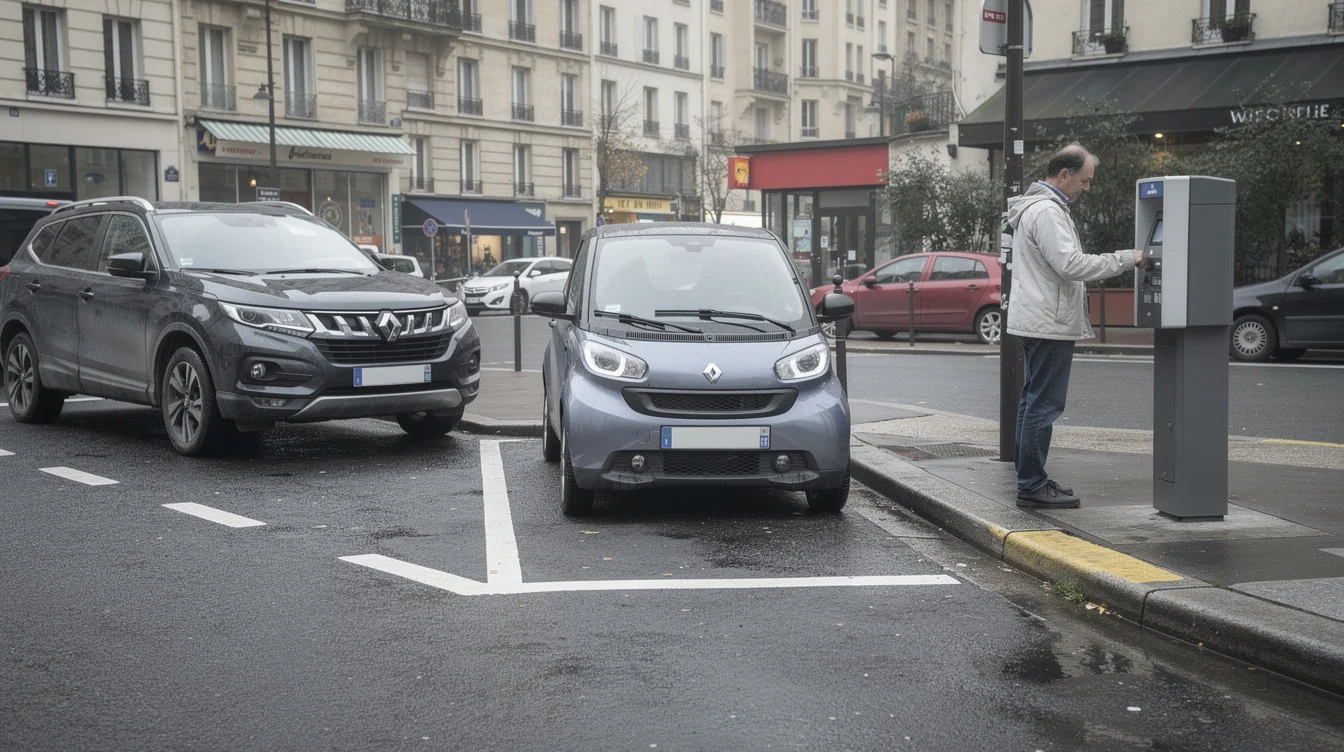
Japan’s kei-car category demonstrates how regulation can give small vehicles a durable market identity. Its dimensional and performance limits have encouraged manufacturers to compete in packaging, visibility and interior ingenuity rather than simply increasing the envelope. Kei rules are not a ready-made European parking policy, and their ownership advantages vary by location. The relevant lesson is that smallness survives when institutions support it, not merely when designers celebrate it.
San Francisco’s SFpark programme offers another useful component: parking prices can respond to demand rather than remain an arbitrary flat charge. A city could combine demand-responsive pricing with a modest footprint adjustment. Busy locations would remain expensive, but a compact vehicle would cost less than a much larger one. The point would be to shift the composition of a limited vehicle population, not make driving the cheapest way into the centre.
Implementation also matters. Any smaller bays should come from restriping existing parking, not narrowing pavements or consuming cycle space. Accessible bays require generous transfer space regardless of vehicle size. Car-club permits could favour compact models where appropriate while retaining larger accessible and utility vehicles. Residents with limited transport alternatives should not be expected to replace a functioning car overnight. The strongest PRO case is pragmatic: cities can discourage automotive inflation now, without waiting for a complete reconstruction of streets or travel habits.
CONTRA: A Smaller Car Can Still Preserve a Bad Allocation
The objection is not that compact cars are useless. It is that rewarding them can become an elegant way to leave the underlying distribution of land untouched. A smaller car parked inside an unchanged bay does not produce a wider pavement. Its unused clearance remains part of the parking arrangement, unavailable for a wheelchair route, a café terrace or a continuous cycle lane. The apparent saving exists at product scale; the public benefit requires a decision at street scale. As with a better throwaway cup that remains disposable, improving the object can leave the underlying system intact.
Even flexible parking can deliver the wrong outcome. If compact vehicles allow more cars to fit along a block, the city may simply increase parking capacity. A technical efficiency then reinforces the activity it was supposed to moderate. Cheaper parking can also make driving more attractive relative to walking, cycling or public transport. A compact electric car has a smaller footprint than an SUV, but it still takes space that a person on foot does not.
The original Smart’s clever packaging is instructive precisely because it was so persuasive. It suggested that excellent industrial design could reconcile private motoring with urban density. But no arrangement of seats and wheels determines who owns the space outside the door. The kerb is a political allocation, not a residual dimension in a vehicle specification.
CONTRA: Bank the Saving as Public Space
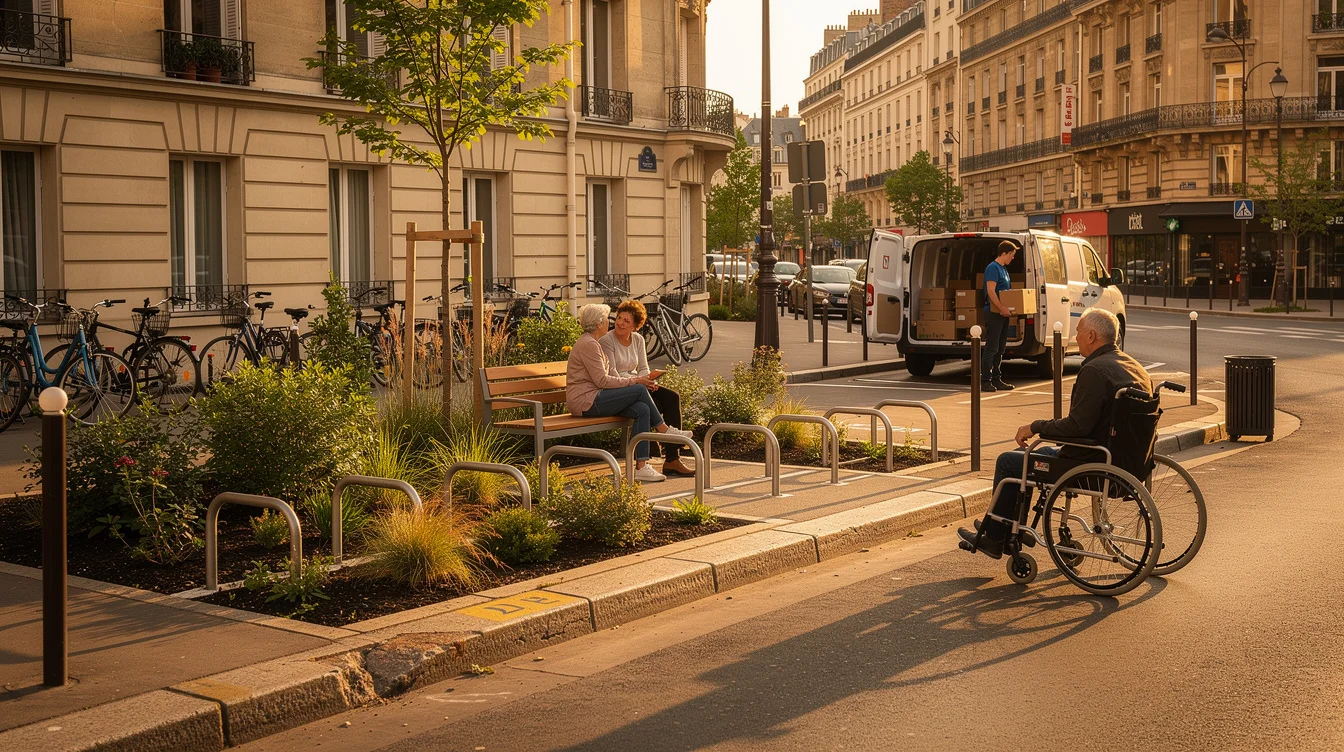
Consider Park(ing) Day, which grew from Rebar’s temporary occupation of a San Francisco parking space in 2005. Its radical move was not to park a better car. It was to demonstrate that the rectangle could support another kind of life. The subsequent spread of parklets made the same proposition more durable: space assigned to stationary vehicles could become seating, planting and social infrastructure. The decisive design act was changing the use.
Barcelona’s superblocks pursue that argument at a larger scale, reorganising traffic so that selected streets can prioritise walking, play and neighbourhood activity. Freiburg’s Vauban district offers a different reference, with much residential parking concentrated in peripheral garages and everyday routes designed around other modes. Neither model depends on waiting for every household to buy a smaller vehicle. Both treat the street network as something to allocate deliberately.
For the Smart #2, this implies a tougher municipal bargain. Compact vehicles can be preferred within a shrinking parking supply, but smaller dimensions should not justify extra bays. Cities could publish a kerb-space budget and commit selected parking areas to wider footways, cycle parking or rain gardens, with essential loading and accessible access protected. Any compact-car incentive would then serve a transition rather than become a permanent entitlement. The real measure of success is not how many small cars fit, but how much useful city emerges around them.
FAQ: Small Cars and the Right to the Kerb
Why does the Smart #2 matter beyond automotive design?
Its return to compact proportions challenges the assumption that every new vehicle generation should become larger. It also exposes a policy gap: cities rarely translate a car’s reduced footprint into a guaranteed public-space benefit.
Should smaller cars receive cheaper parking?
A footprint-based discount can discourage oversized vehicles, but it should sit within demand-sensitive pricing and a limited parking supply. Free or heavily subsidised parking risks encouraging additional car journeys rather than rewarding restraint.
Does a smaller car automatically leave more room for pedestrians?
No. In a fixed parking bay, the unused space generally stays inside the parking allocation. Pedestrians benefit only when cities redesign or remove bays and turn the recovered area into connected, usable walking space.
How can cities reclaim parking without excluding people who need cars?
Protect accessible bays, passenger drop-off and essential loading while improving public transport and step-free routes. Evaluate access needs separately from ordinary vehicle storage, and phase changes so that alternatives exist before parking is removed.
The Smart #2 can make restraint desirable again. Only public policy can make its spatial benefits collective. If a smaller car occupies less of the city, should its owner receive the dividend—or should everyone else get the space?
Watch the Mainifesto Short
Get the Mainifesto weekly — curated design debates, speculative ideas and the week's best articles every Saturday.
Editorial Perspectives
Questions and counterpoints developed by the Mainifesto editorial desk to extend the discussion.
Perspective 1
Yes, charge smaller cars less for parking: taking up less public land should cost less. But resize the bays too, or the city is handing out discounts without recovering a single metre of kerb.
Perspective 2
I’d put the space saved into wider footways and cycle lanes, not cheaper parking for owners. Why optimise the dimensions of the vehicle if we leave the allocation of the street untouched?
Perspective 3
After years of Gulliver-sized SUVs, a small car looks almost like an act of civic virtue. It isn’t: buying less metal shouldn’t buy you a moral claim on the pavement outside everyone else’s door.