A Better Throwaway Cup Is Still a Throwaway Cup
The most seductive thing about a better disposable is that it asks us to change almost nothing. Order the coffee. Take the cup. Walk away. Somewhere between the counter and the bin, an ingenious fold is supposed to make the transaction feel different.
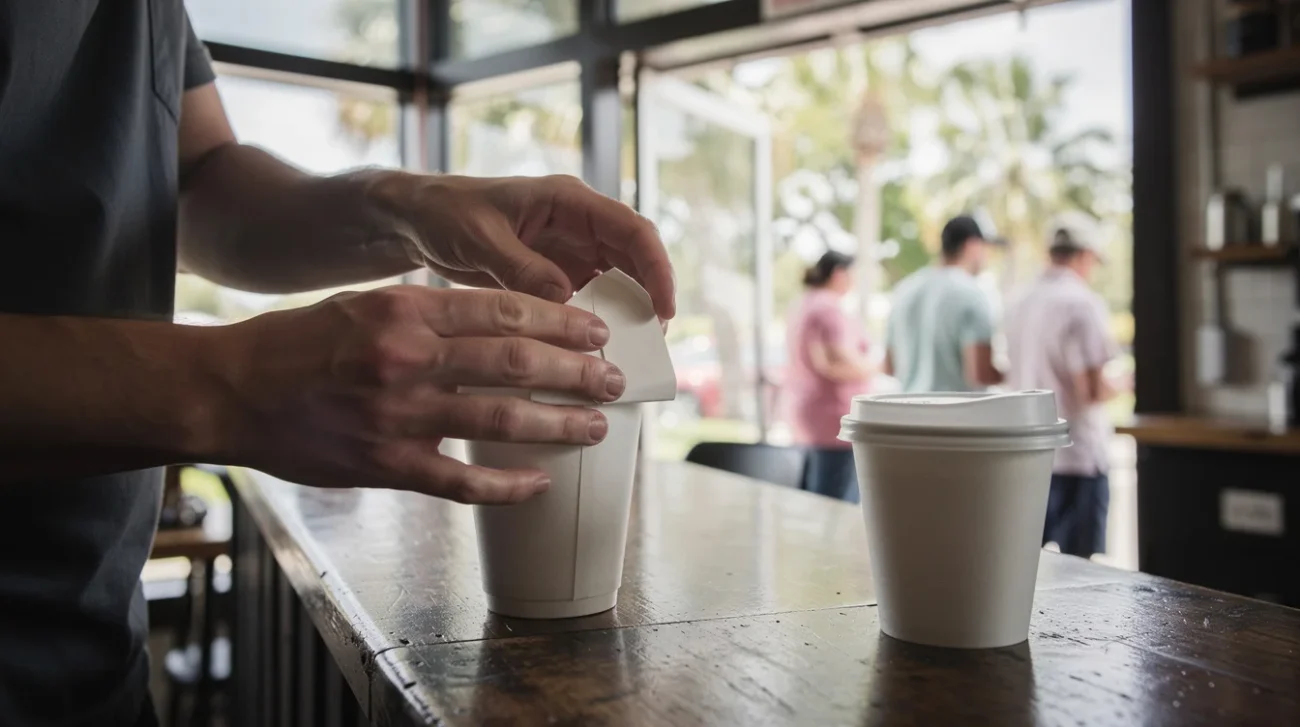
Florida-based Nothing has developed hot and cold paper takeaway cups whose elongated sides fold down to form lids. According to Dezeen’s 2 October 2026 report, the company has spent the past two years developing two versions of its proprietary cups, using a water-based coating intended to allow home composting. The proposition is immediately legible: eliminate a separate component, make the remaining object easier to deal with after use.
That is a legitimate product-design intervention. It is not yet evidence of an environmental revolution. Nothing’s folding-lid paper cups deserve scrutiny precisely because the idea is good enough to be persuasive. They expose the distinction that sustainable packaging marketing routinely blurs: reducing the burden of a disposable object is not the same as reducing our dependence on disposable objects.
Removing a lid is not the same as removing its material
A conventional takeaway drink often involves a cup and a separate lid, sometimes supplemented by a sleeve, straw or stopper. Nothing integrates the closure into the cup wall. That could eliminate separate plastic lids where those are currently used, reduce component handling and remove the familiar problem of matching the right lid to the right cup.
But a closure made from extended paper walls still uses material. The relevant comparison is not a new cup against an old cup; it is the complete new package against the complete old package. How much additional paperboard does the folding closure require? Does it need reinforcement? Does the hot version still need a sleeve? Can the cold version work without an additional straw?
Consider an explicitly hypothetical comparison: removing a three-gram lid while adding two grams of coated board saves one gram per drink. Adding four grams instead increases total packaging mass, although reducing plastic might still have value. Neither calculation alone establishes the climate result.
Dieter Rams’s principle of “less, but better” is a useful provocation here, not a verdict. Fewer separate parts can be better design. Whether they mean less resource use has to be measured. This is the point at which design inspiration must become evidence.
The strongest case is at the counter

The redesign’s most credible immediate advantages may be operational. A busy café does not merely buy packaging; it stores, separates, assembles and replenishes it. An integrated lid could remove one stock item for each corresponding cup size and eliminate a separate lid-fitting step. Whether folding is faster than fitting needs an actual service trial.
Imagine a railway-station kiosk during the morning rush. Its counter is cramped, staff work quickly, and customers carry drinks onto moving trains. Here, a successful folding closure could reduce misplaced lids and simplify handover. But if staff need several attempts to close it, or passengers experience more leaks, the elegant material story begins to unravel.
The testing should be relentlessly ordinary: one-handed carrying, squeezing, tipping, prolonged contact with a hot drink, and condensation on a cold one. It should include rejected cups and drinks remade after spills, not just packaging delivered to the café.
A sensible pilot would compare complete packaging weight per successfully served drink, assembly time, storage volume and failure rates. Nothing’s concept earns its strongest argument if it reduces waste without producing workarounds. A fold that prompts staff to add tape, another cup or an extra sleeve is not simplification; it is complexity pushed out of the drawing.
Home composting is a destination, not a material adjective
The source report describes a water-based coating that allows at-home composting. That claim needs to remain a claim until the relevant evidence is available. “Water-based” describes a formulation characteristic; it does not, by itself, establish what the dried coating contains or how the finished cup behaves in compost.
Credible substantiation would address the whole article: board, coating, inks and any adhesives. It would identify test conditions, timescales and evidence of safe breakdown, rather than merely showing that paper becomes soft or fragments. Certification schemes such as TÜV Austria’s OK compost HOME illustrate the distinction between a verifiable home-composting claim and an appealing phrase. The supplied source context does not establish that Nothing holds such certification.
Then comes the awkward part: the customer must actually have somewhere suitable to compost it. An apartment resident buying iced coffee on a commute may have neither a garden nor access to a shared compost system. A street bin does not acquire composting conditions because the object inside it is compostable.
Design can make a disposal route possible. It cannot make that route happen. Compostability also does not mean a cup will harmlessly disappear as litter, in seawater or in landfill.
The bin is part of the product
Packaging design traditionally stops at the object’s edge. Environmental performance does not. It extends into signage, collection contracts, sorting equipment and the habits of someone trying to catch a bus.
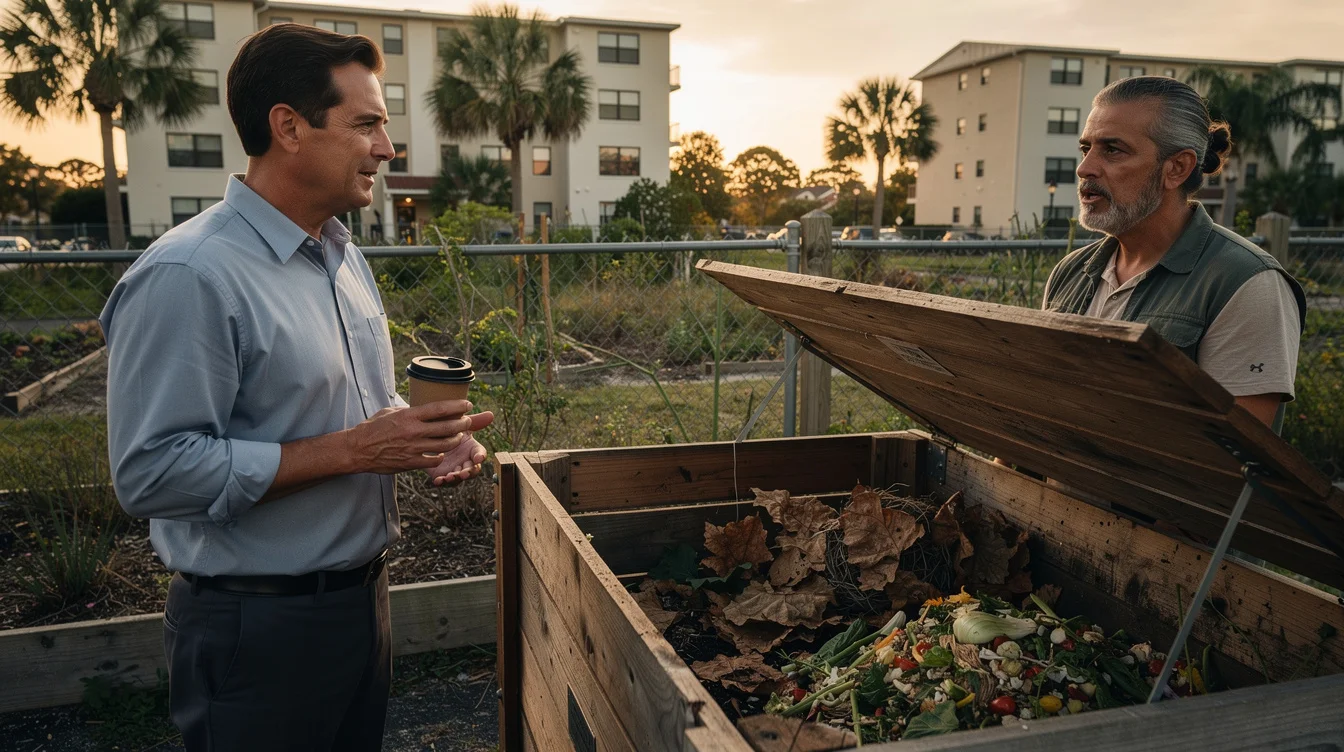
A garden café connected to a managed compost operation offers a plausible testing ground, provided that operation accepts the cups and can process them under suitable conditions. Staff could explain the system, separate the waste and observe the result. Thinking of cafés as neighbourhood materials utilities makes that infrastructure part of the design brief. A takeaway chain selling identical cups across districts with different waste rules faces a much harder problem.
Seattle’s food-service packaging requirements offer a useful reference: packaging choices sit within local collection arrangements, rather than functioning as free-floating green credentials. Even then, acceptance by a particular processor matters. Home-compostable packaging is not automatically welcome in every municipal organics stream, and compostability does not automatically establish recyclability.
Nothing and its café customers should therefore publish disposal instructions that name the route, not just the aspiration. If local facilities do not accept the cup, that limitation should be visible. “Check locally” may be accurate, but it also reveals who is being asked to finish the design work: the person holding a sticky empty cup.
Compare it with a system, not only another cup
The flattering benchmark for an improved disposable is a worse disposable. The more demanding benchmark is a service that avoids issuing a new cup for every drink.
Germany’s RECUP deposit-return network makes that alternative concrete. Its reusable cups circulate through participating businesses, shifting the design challenge from making waste less troublesome to making return convenient. Earlier initiatives such as CupClub likewise treated the cup as part of a collection and washing service, not merely an object sold once.
Reuse is not environmentally superior by declaration. Manufacturing impacts, washing, transport, loss rates and actual reuse counts all affect the result. A durable cup that disappears after a handful of uses can undermine the system built around it. Claims about a universal break-even number should be treated with suspicion.
But the right response is to improve circulation, not quietly remove it from the comparison. A university campus, office complex or venue with predictable return points can test a pooled cup service alongside Nothing’s disposable. Measure actual returns and cleaning requirements against the complete single-use alternative. In settings where return infrastructure is absent or impractical, the folding-lid cup may offer meaningful incremental gains. Where return is straightforward, it risks becoming an attractive excuse not to build the better system.
Reward the reduction, refuse the alibi
Nothing should not be criticised for solving a bounded problem. Separate lids are a real component, and eliminating them can be worthwhile. Nor should cafés wait for a flawless circular economy before reducing the impacts of the packaging they use today.
But the environmental claim must fit the evidence. Publish the material breakdown for both versions. Compare each against a functionally equivalent cup-and-lid combination. Disclose compostability testing and applicable certification. Run service trials that count failures. Establish where discarded cups actually go. A life-cycle assessment should make its assumptions about electricity, transport and disposal visible, with alternative scenarios rather than one flattering outcome.
Most importantly, do not count the removal of separate plastic lids as proof that the takeaway model itself has become sustainable. The redesign still requires feedstock, manufacturing, distribution and a destination after one brief use. Composting, when it happens, does not recover the cup intact for another coffee.
The proper ambition is less disposable packaging overall, with better disposables where they remain necessary. Reverse that hierarchy and design becomes a lubricant for the very consumption pattern it claims to challenge. Nothing’s folded lid could be a useful improvement. It should not become a lid on the larger argument.
FAQ
What are Nothing’s folding-lid paper cups?
They are hot and cold takeaway cups developed by Florida-based Nothing. Extended sections of the cup walls fold down to form integrated lids, replacing a separate closure. The company describes their water-based coating as enabling home composting.
Do integrated lids necessarily reduce packaging waste?
No. They remove a separate component, but the extended cup walls require material too. A fair comparison measures the complete package, including any sleeves or straws, and accounts for leaks, rejected cups and other failures.
Can these cups go into any compost or recycling bin?
Do not assume so. Check substantiated manufacturer instructions and the receiving service’s acceptance rules. Home compostability, industrial compostability and recyclability are different properties. A water-based coating alone does not prove any of them.
Are reusable cups always the better option?
Not automatically. Their performance depends on repeated use, efficient washing, transport and low loss rates. Well-run return systems can reduce dependence on single-use packaging, but comparisons should use actual operating data rather than idealised reuse counts.
When a redesign makes throwing something away less damaging, does it help us move beyond disposability—or make us more comfortable staying there?
Watch the Mainifesto Short
Get the Mainifesto weekly — curated design debates, speculative ideas and the week's best articles every Saturday.
Editorial Perspectives
Questions and counterpoints developed by the Mainifesto editorial desk to extend the discussion.
Perspective 1
The folding lid is a clever move; the trouble starts when that cleverness becomes a story about consumption fixing itself. “Home compostable” sounds wonderfully empowering, but whose home has the space, time, and conditions to make that promise real?
Perspective 2
Integrating the lid could remove a component and simplify packing, which is worth taking seriously. But I’d want the material weight, coating chemistry, production scrap, and leak-test results before calling it a waste reduction—not just a tidier bill of materials.
Perspective 3
Modern design has spent a century making mass consumption look like progress; a folding paper lid hardly breaks that tradition. The more interesting design problem is the return system, but that offers a less photogenic object.
Perspective 4
I’d like to see the cup tested as one part of a café system, alongside washing capacity, return rates, and actual composting access. Could the same ingenuity that makes the lid fold help make reuse the easiest option, rather than leave disposal as the default?