Beyond the Tailpipe: Can a Car Clean Up Its Own Tyres?
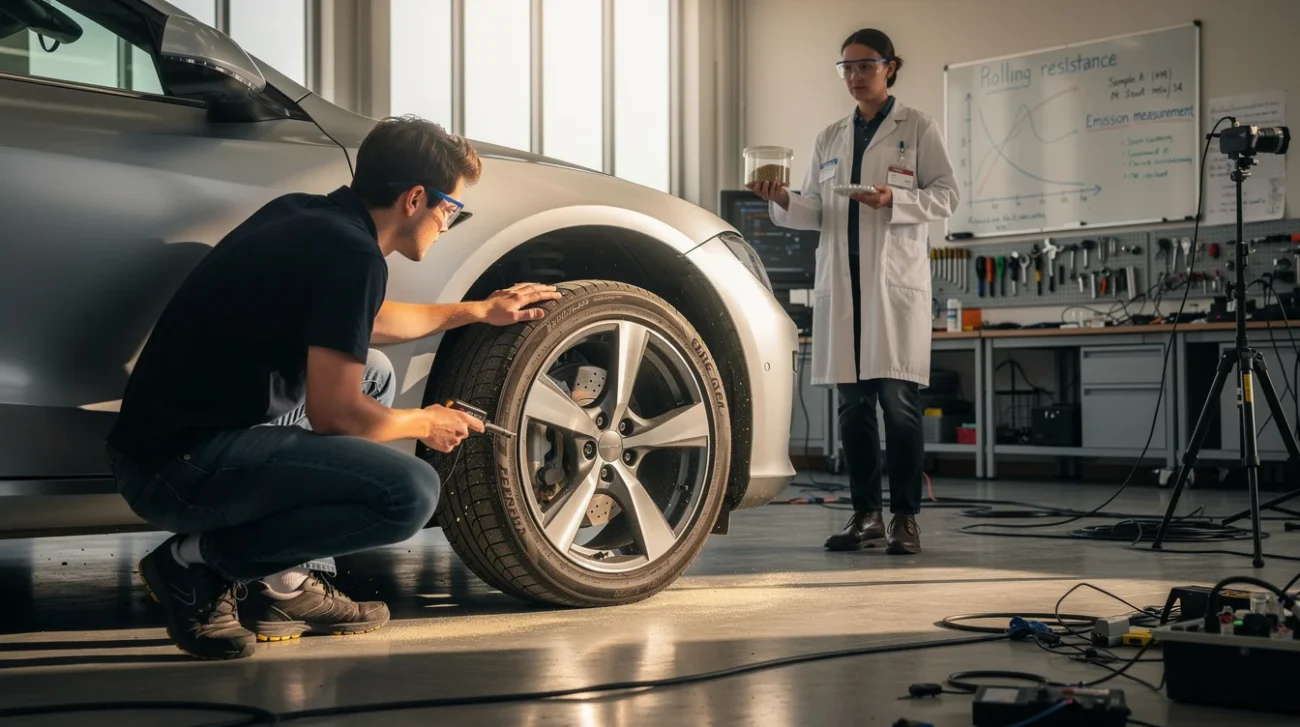
The electric car has become an expert at looking clean. Remove the exhaust pipe, smooth the bodywork, photograph it against an immaculate landscape: the environmental argument appears settled. Yet every journey still involves rubber grinding against road. Electrification changes the powertrain; it does not abolish friction.
TU/ecomotive’s VENTRA concept interrupts that convenient picture. According to designboom’s report, the Dutch student-built electric vehicle captures tyre particles close to where they are released and reuses some of that material inside the cabin. Instead of treating pollution as something that happens elsewhere, the prototype brings the problem back into the product.
That is a strong design provocation. It is not, by itself, proof of environmental success. A car that incorporates its own waste is not necessarily a car that releases substantially less pollution. The distinction depends on how much material is captured, which particles escape, and whether the recovered fraction stays safely contained throughout its next life.
VENTRA deserves attention because it makes an overlooked emission visible. It deserves scrutiny because circularity becomes marketing remarkably quickly when an attractive second use substitutes for a measured reduction.
The exhaust disappeared. The emissions did not.
Tyre wear is not simply a cloud of pure rubber. Contact between tyres and road generates particles that can contain both tyre material and road-derived substances. Their size, composition and destination vary: some become airborne, while others settle nearby or travel through drainage systems into waterways. A roadside gutter is part of the vehicle’s environmental footprint, whether the manufacturer photographs it or not.
Battery-electric vehicles still produce this pollution. Greater vehicle mass can increase tyre wear under comparable conditions, but weight is not the only variable: tyre formulation, acceleration, alignment, road surface and driving behaviour also matter. Regenerative braking can reduce friction-brake use; it cannot remove the tyre’s contact with the road. Treating every electric vehicle as equally problematic would be as lazy as calling every one clean.
The issue also extends beyond particle mass. Research has linked 6PPD-quinone, a transformation product of a widely used tyre antioxidant, to acute mortality in coho salmon. That does not establish the toxicity of VENTRA’s recovered material, but it demolishes the assumption that tyre dust is an innocent raw ingredient.
The European Union’s Euro 7 framework brings tyre abrasion into vehicle-pollution regulation. The policy signal is overdue: environmental accountability cannot stop at the tailpipe.
VENTRA makes the car confront its own residue
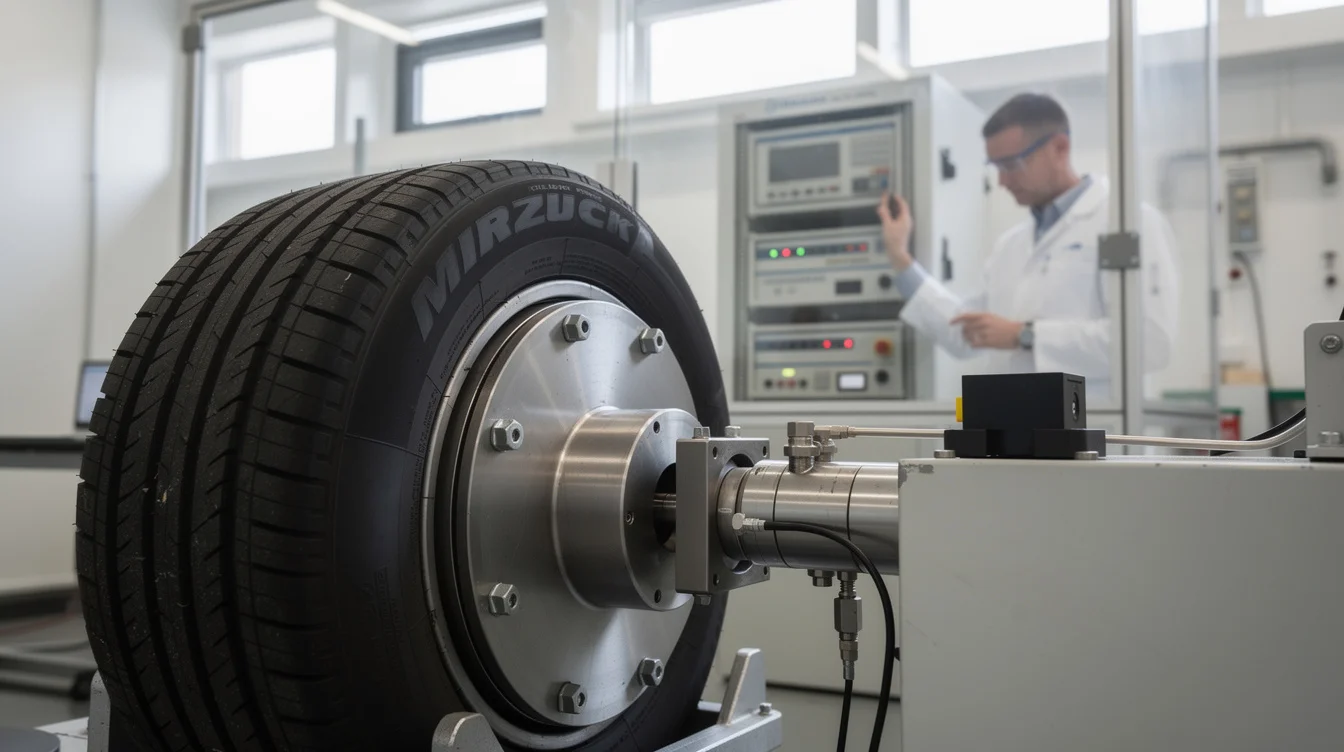
VENTRA’s most interesting move is spatial. Capturing particles near their release point targets the moment before they disperse into air, soil and water. Once pollution is scattered across a city, collecting it becomes an expensive exercise in chasing consequences. Designing interception into the vehicle could be more direct.
The approach belongs to a wider field rather than a solitary breakthrough. The Tyre Collective, a UK cleantech company, has developed electrostatic technology intended to capture tyre-wear particles near the wheel. Its work makes the same essential proposition: the wheel area should become an emissions-control zone, not merely a styling opportunity.
TU/ecomotive has also explored environmental intervention through ZEM, an earlier concept featuring direct-air-capture technology. VENTRA shifts the discussion towards a pollutant generated by the act of driving itself. That is a sharper confrontation with the car’s material behaviour.
However, the source context supplied for VENTRA establishes the concept’s capture-and-reuse strategy, not an independently verified performance record. It provides no capture percentage, particle-size breakdown or long-term containment evidence. Those omissions are not proof that the system fails. They are the boundary between what can currently be celebrated as a design proposition and what can responsibly be claimed as pollution reduction.
The decisive number is what escapes
A jar of collected dust makes an excellent exhibition object. It makes a poor denominator. To judge VENTRA, we need to know how much tyre-derived material was generated during the same test, how much the device retained, and how much escaped through every relevant route.
Capture efficiency must describe a defined test, not decorate a press release. Does the figure concern total particle mass, particle number, or a particular airborne size fraction? A collector could retain relatively large fragments while missing smaller particles. Equally, a device focused on airborne emissions might offer a real benefit without capturing most of the total wear mass. The claim must match the measurement.
Testing should include wet roads, dry roads, cornering, different speeds, worn tyres and partly filled collectors. Performance on a clean laboratory rig is useful, but a wheel arch experiences water spray, grit, vibration and impacts. A device that works beautifully until its collection chamber fills is not a complete solution.
There is also a whole-vehicle calculation. Added mass, aerodynamic drag, power demand and replacement components carry environmental costs. The relevant comparison is an otherwise comparable vehicle without the system, tested over equivalent use. Captured material matters only alongside the emissions and resource use required to capture it.
A second life inside the cabin needs a safety case
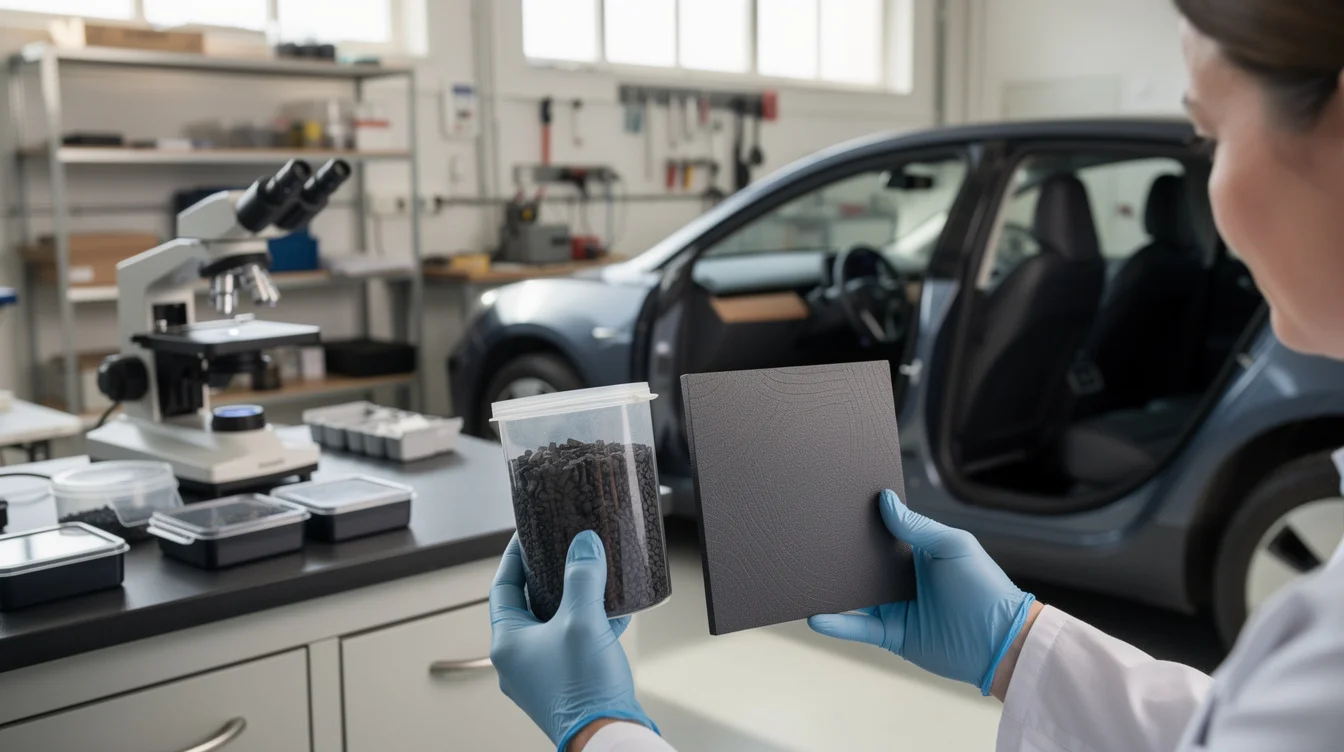
Reusing captured particles inside the cabin gives VENTRA its strongest narrative twist: the vehicle’s residue becomes part of its interior. It also raises a difficult question. Why should material intercepted as pollution automatically become desirable around passengers?
Recovered tyre material is not a standardised feedstock merely because it has been collected. Its composition may vary with tyre chemistry, road contamination and collection conditions. Incorporation into a bound composite could reduce opportunities for release, but that is a hypothesis to test through the actual material system, not a guarantee supplied by the word recycled.
Designers should ask about abrasion during cleaning, emissions under cabin heat, ageing under sunlight, and particle release when components are repaired or shredded. Collection chambers also need safe servicing procedures. Preventing roadside dispersal while exposing maintenance workers to loose dust would relocate the problem rather than resolve it.
William McDonough and Michael Braungart’s Cradle to Cradle framework offers a useful challenge here: circulation is not enough without attention to material health. A residue-filled cabin component is convincing only if its composition, durability and next destination are understood. If safe reuse cannot be demonstrated, controlled treatment or disposal may be more responsible than a photogenic interior application.
Prevention must remain the design brief
The danger is not that capture technology exists. The danger is that it becomes permission to leave the causes of wear untouched. A heavier vehicle could advertise a collector while shedding more material overall than a lighter alternative without one. Both capture performance and baseline wear therefore belong on the same scorecard. As with redesigning a throwaway cup without ending disposability, improving the response to waste is not the same as preventing it.
Prevention offers less theatrical but essential design work: lower vehicle mass, appropriate tyre dimensions, durable formulations, correct inflation and alignment, and acceleration control that avoids unnecessary wheel slip. Each involves trade-offs. A tyre still needs dependable grip, including in the wet; reducing abrasion cannot justify compromising road safety.
Gordon Murray’s lightweight vehicle projects demonstrate how mass reduction can organise an entire product rather than appear as a late efficiency adjustment. At the urban scale, Jan Gehl’s people-centred approach points towards an even less marketable answer for car manufacturers: fewer car kilometres. Walking, cycling and public transport can reduce the amount of tyre wear that passenger cars generate in the first place.
Capture should address residual pollution after prevention, not compete with prevention for attention. VENTRA’s strongest legacy would be to establish that hierarchy: generate less, intercept what remains, verify containment, and reuse only where the evidence supports it. Anything less risks turning an environmental liability into an interior-design story.
FAQ: What tyre capture can—and cannot—promise
What does TU/ecomotive’s VENTRA concept do?
According to the supplied designboom source context, the Dutch student-built electric car captures tyre particles near where they are released and reuses some inside the cabin. That establishes its design strategy, but not a verified capture efficiency or a demonstrated long-term safety outcome.
Do electric vehicles eliminate tyre pollution?
No. Electric vehicles eliminate tailpipe exhaust during driving, but their tyres still wear against the road. Vehicle mass, tyre design, driving behaviour and road conditions affect wear. Regenerative braking can reduce friction-brake emissions, which are a separate source of non-exhaust pollution.
Is it safe to reuse captured tyre particles in interiors?
Safety cannot be assumed. It depends on the collected material’s composition, how it is bound into a component, and what happens during heat exposure, abrasion, ageing and disposal. Testing must address passenger exposure, worker handling and possible release at the end of the component’s life.
How should a tyre-particle collector be evaluated?
Measure capture against total material generated under defined conditions, report performance across particle sizes, and test realistic weather and driving scenarios. Include servicing, containment, energy use and added mass. Compare the result with both an equivalent vehicle without capture and credible wear-prevention alternatives.
If a car can collect some of its own tyre pollution, should we reward that ingenuity—or demand that it first prove how much less pollution it could have created?
Watch the Mainifesto Short
Get the Mainifesto weekly — curated design debates, speculative ideas and the week's best articles every Saturday.
Editorial Perspectives
Questions and counterpoints developed by the Mainifesto editorial desk to extend the discussion.
Perspective 1
Turning tyre dust into cabin material makes an invisible pollutant tangible—that’s a compelling piece of design storytelling. But I’d want the capture rate beside the material sample, or the story risks doing more work than the technology.
Perspective 2
I’d give VENTRA credit for the idea, then ask what it costs to run and maintain over the car’s life. If lighter weight or different tyres prevent more pollution for less money, start there; collection should earn its place as an extra.
Perspective 3
Prove the reduction first: a car collecting some tyre dust is not the same as a transport system producing less of it. Test it on rough roads and under weak maintenance regimes, then show who handles the captured material when the cabin is scrapped. Otherwise, you may just be moving pollution between places and people.