
Can a Drone Show Carry the Weight of a Memorial?
Can a Drone Show Carry the Weight of a Memorial?
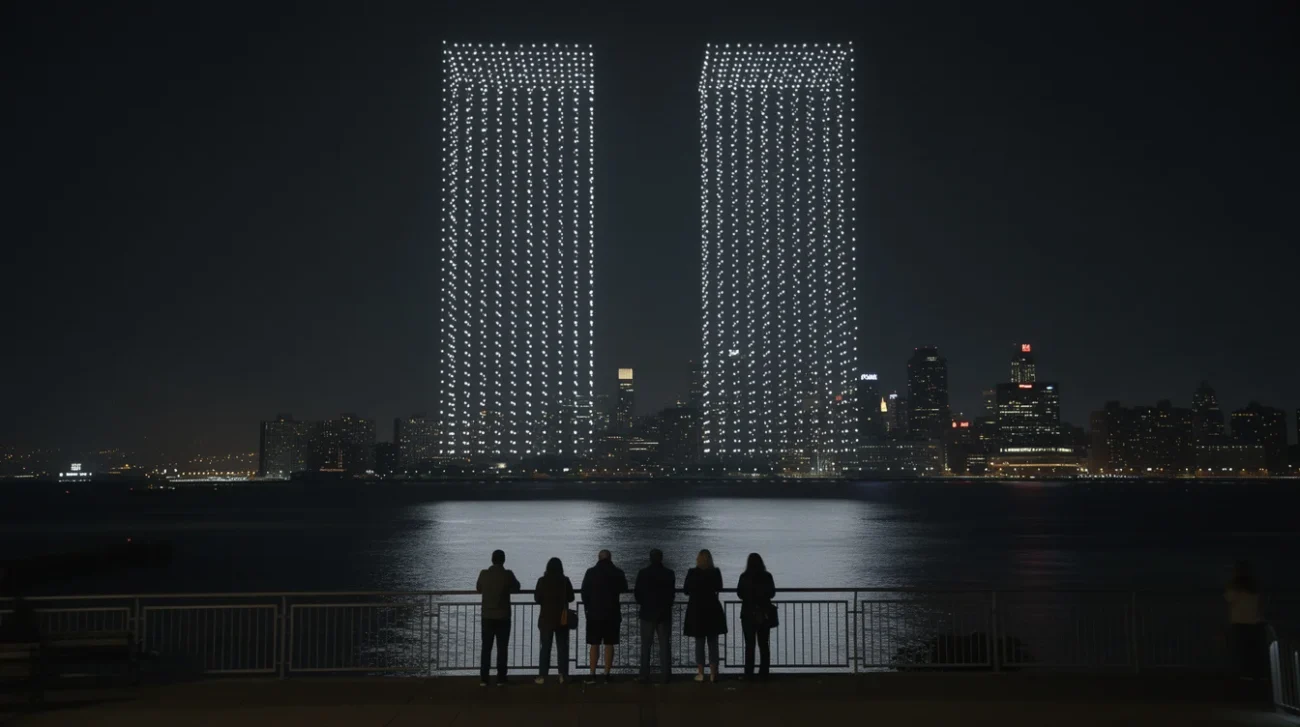
A skyline is easy to recognise. A life is not. That difference sits at the centre of Drift and Shigeru Ban’s reconstruction of the Twin Towers using illuminated drones over New York Harbor. According to Dezeen’s report, the installation, titled 2,977 Lights Over New York Harbor, took place on 9 September 2026, ahead of the 25th anniversary of 9/11, under creative director Addison Mehr. Its proposition is devastatingly simple: individual lights become an absent architecture.
But its numerical language needs care. The figure 2,977 counts victims of the September 11 attacks across all three locations, excluding the hijackers; it is not exclusively a World Trade Center death toll. That distinction matters when individual people become the units of a monumental image. The design question is not whether drones can produce something moving. They can. It is whether the image serves remembrance, or remembrance becomes the justification for the image.
PRO: Disappearance Can Be the Memorial’s Material
A temporary monument need not be a lesser monument. In this case, impermanence gives the medium its strongest argument. Rebuilding the towers in masonry would suggest restitution, as though sufficient construction could reverse history. Reconstituting them in airborne light makes that fantasy impossible. The architecture remains visibly contingent: points suspended in darkness, held together without walls, floors or inhabitable space. It offers recognition without pretending to offer repair.
New York already understands this language through Tribute in Light, the annual installation of twin beams associated with artists Julian LaVerdiere and Paul Myoda and a wider collaborative team. Those beams do not reproduce every architectural detail. They establish a vertical absence that can be encountered from streets, bridges and apartment windows. The drone reconstruction takes a more figurative route, but shares the insight that light can mark a loss without occupying it permanently.
Drift’s earlier Franchise Freedom, a flying sculpture inspired by flocking behaviour, demonstrated how coordinated drones can appear collective without becoming entirely solid. In a memorial, that tension has unusual potential. The eye can oscillate between a single point and an encompassing form. A tower becomes legible, then dissolves back into separate lights. The technology’s justification lies in that unstable relationship, not simply in its ability to draw a familiar silhouette.
PRO: A Shared Image Can Open a Public Ritual
Monumental scale also has a democratic argument. A memorial encountered across a harbour need not require a ticket, an appointment or the confidence to enter an institution. Visibility can extend commemoration beyond a designated precinct. Someone returning from work may encounter it without planning to participate. A distant viewer can remain distant. That freedom matters because grief does not always want the intimacy that memorial architecture prescribes.
The model is not only architectural. Since 1987, the AIDS Memorial Quilt has shown how individual commemorations can assemble into a public statement larger than any single participant. Its panels preserve names, fabrics and personal references while their accumulation reveals the scale of loss. A drone formation cannot match that biographical richness, but the comparison establishes a useful principle: collectivity need not automatically erase individuality.
Ban’s presence also brings a relevant ethical reference. His Paper Log Houses and other disaster-relief work challenge architecture’s habit of equating dignity with permanence and expense. That record does not certify the drone installation’s success, but it makes temporary form a serious proposition rather than a novelty. The strongest defence of this memorial is therefore not that it innovates. It is that a time-limited, widely visible gathering of lights might provide a shared interval in which a city acknowledges something it cannot rebuild.
CONTRA: One Light Is Not Yet One Person
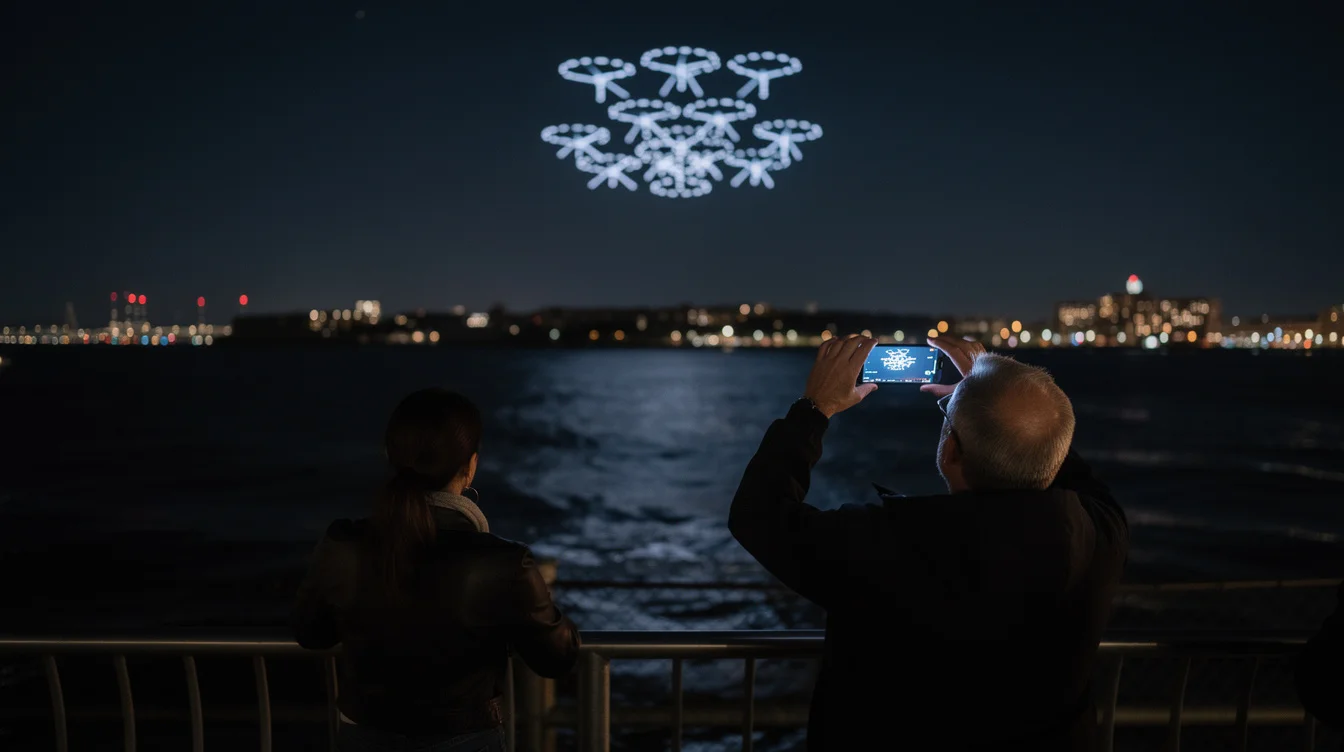
The same abstraction that makes the installation readable at a distance can make its commemorative claim dangerously thin. A light may represent a person, but representation is not recognition. Without names, histories or a publicly understandable way of connecting an individual to a point, the viewer encounters a count. The aerial image can communicate magnitude while telling us almost nothing about those whose deaths give that magnitude meaning.
Michael Arad and Peter Walker’s National September 11 Memorial offers a revealing counterexample. Its vast voids operate at the scale of the lost towers, but the names around their edges bring visitors back to individuals. Their arrangement through meaningful adjacencies incorporates relationships among victims, informed by requests from relatives. The monument does not ask one device to do everything: the void addresses collective absence; the inscriptions support specific remembrance.
Maya Lin’s Vietnam Veterans Memorial likewise makes the individual name inseparable from the larger field of loss. Visitors search, touch and take rubbings. These are actions, not just views. The drone memorial’s challenge is therefore practical, not sentimental. Can someone locate the person they came to remember? Can they encounter a story rather than a silhouette? The supplied account does not establish such mechanisms. Without them, the assertion that each light represents a life remains a powerful explanation attached to an image, rather than an experience the design itself delivers.
CONTRA: The Skyline Can Become the Main Character
A reconstruction of the towers inevitably privileges one of the world’s most recognisable urban images. That recognition is emotionally potent, but it can shift attention from murdered people to lost buildings, and from the diversity of the attacks’ victims to Manhattan’s silhouette. The mismatch between an all-sites death toll and a World Trade Center image sharpens the problem. A single icon risks absorbing histories that took place at the Pentagon and near Shanksville, Pennsylvania. This is also a question of how design shapes America’s national identity: which stories become visible, and which remain outside the frame?
Drone choreography also arrives with an established visual grammar: product launches, sporting ceremonies and municipal celebrations. Memorial use does not make that grammar disappear. The crisp reveal, the best camera position and the shareable wide shot can become tacit design priorities. A successful image is not necessarily a successful setting for mourning. A photograph rewards instant comprehension; grief often requires uncertainty, repetition and the permission to look away.
Jochen Gerz and Esther Shalev-Gerz’s Monument Against Fascism in Hamburg-Harburg provides a harder model of disappearance. Its inscribed column was progressively lowered into the ground, refusing the expectation that a monument should remain a reassuring object. That project suggests what a drone memorial should be judged against: not technical virtuosity, but what responsibility remains with the public after the object vanishes. Family consultation, intelligible individual commemoration and ways to remember beyond the display are not optional interpretive extras. They are the infrastructure that could keep spectacle from becoming the whole event.
FAQ
What was 2,977 Lights Over New York Harbor?
According to Dezeen’s report, it was an illuminated-drone installation by Drift and Shigeru Ban, under creative director Addison Mehr, staged on 9 September 2026 ahead of the 25th anniversary of 9/11. The drones recreated the form of the Twin Towers.
Does 2,977 refer only to people killed at the World Trade Center?
No. It is the total number of victims killed in the September 11 attacks at the World Trade Center, the Pentagon and near Shanksville, excluding the hijackers. Using that total within a towers-only image raises questions about how the different locations are represented.
Can a temporary installation function as a serious memorial?
Yes. Tribute in Light demonstrates how an ephemeral installation can sustain a public commemorative ritual. Permanence is not the decisive criterion; the quality of participation, the specificity of remembrance and the relationship with affected communities matter more.
What distinguishes memorial design from visual spectacle?
Memorial design must accommodate people who are remembering specific lives, not merely watching an event. Names, accessible interpretation, consultation and opportunities for reflection can support that purpose. Spectacle becomes a problem when the image eclipses those obligations.
If a memorial gives us back the skyline but cannot help us encounter the people who are missing, what exactly has it restored?
Get the Mainifesto weekly — curated design debates, speculative ideas and the week's best articles every Saturday.
Editorial Perspectives
Questions and counterpoints developed by the Mainifesto editorial desk to extend the discussion.
Perspective 1
I’m for it: restoring the skyline gives people a shared place to look, pause and remember, and that’s a real public benefit. Give visitors a clear way to encounter names and personal histories alongside it; don’t ask the light show to do every job a memorial needs to do.
Perspective 2
I’m against this version of remembrance: it restores the city’s silhouette while leaving the missing people abstract. Calvino could make an imaginary city reveal its inhabitants; these illuminated towers risk doing the reverse, giving us an image so complete we stop asking who isn’t there.
Perspective 3
In the studio, I learn about an object by returning to it, noticing what my hands missed the day before. I wonder what someone can return to after the drones land, especially once the clip stops circulating. A brief light can hold grief, but there needs to be room for the person who isn’t ready to leave when the show ends.