
The Climate Action Test Cities Cannot Design Around

Architecture has become exceptionally fluent in the visual language of climate action. Cities publish glossy transition plans, commission carbon-neutral masterplans and unveil renderings of tree-lined boulevards where traffic once ruled. The frameworks are often intelligent. The images are persuasive. The question is whether either is changing the atmosphere.
The C40 network has given cities a powerful common vocabulary for answering that question. Its Climate Action Planning Framework asks member cities to align local plans with the Paris Agreement, establish emissions inventories, set science-based targets and map a route to net zero. This is essential administrative infrastructure. But it is not evidence of delivery.
A closer look at emissions trajectories exposes a smaller group of cities that have turned those mechanisms into measurable reductions. That distinction matters. A city can have a climate plan, a climate office and a climate-branded district while its buildings, roads and energy systems continue to produce more carbon than they did before. The climate crisis does not award points for strategic elegance.
The plan is not the proof
C40 frameworks are valuable precisely because they make comparison possible. A city that measures emissions by sector can identify whether buildings, transport, waste or industry is responsible for its failure. A city that sets an interim 2030 target can be judged before the political comfort of 2050 arrives. Yet frameworks also create an opportunity for performance theatre: the appearance of rigor without the inconvenience of enforcement.
Net-zero pledges are particularly vulnerable to this problem. They can conceal delayed action, optimistic assumptions about renewable energy, or an overreliance on future technologies and offsetting. A development may advertise operational efficiency while its construction emissions remain uncounted. A transport strategy may promise modal shift while road expansion continues at the metropolitan edge. A municipal building may meet an impressive standard while the wider housing stock deteriorates.
There is also a basic problem of scale. Mayors can regulate parking, building codes and public transport, but they often cannot control electricity markets, aviation, freight logistics or the emissions embedded in imported materials. That does not make local action irrelevant. It makes accounting more important. Without transparent boundaries and consistent inventories, a city can appear cleaner simply by moving carbon elsewhere.
Where the difficult choices become visible

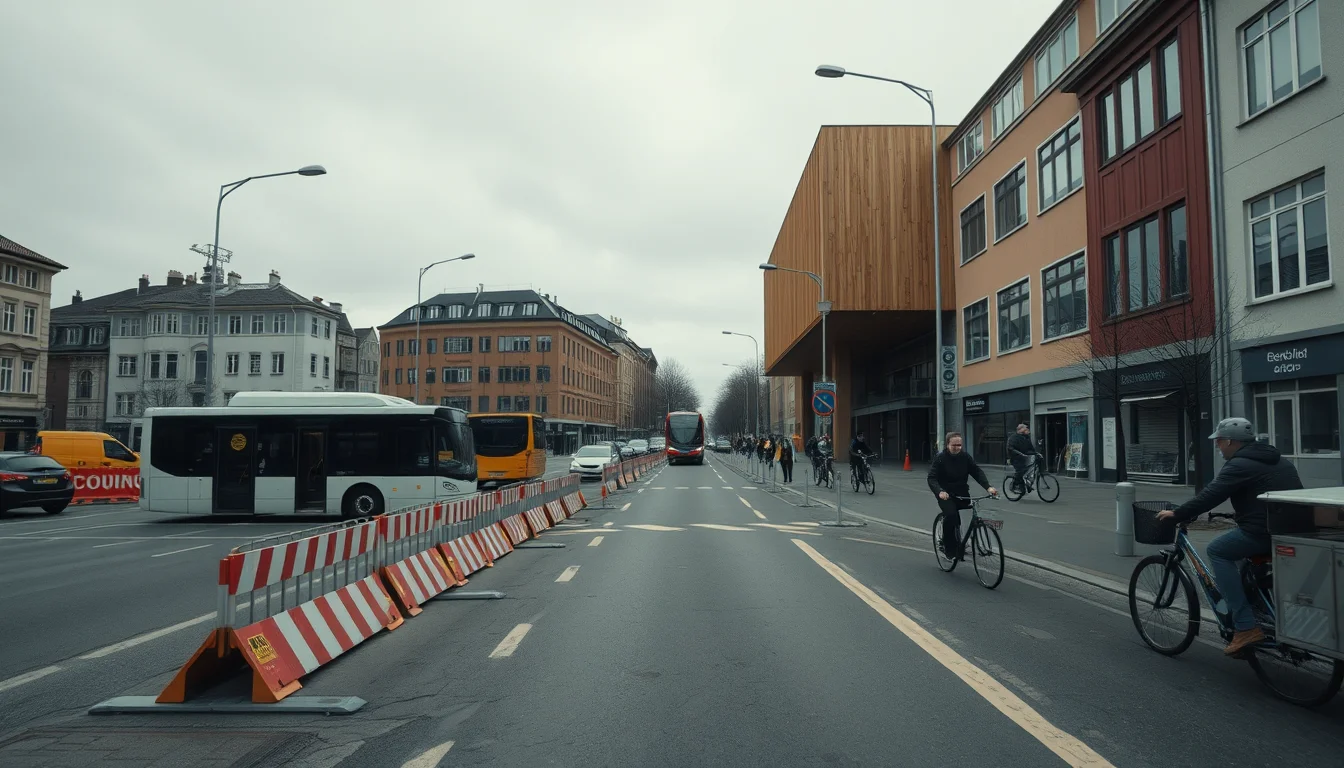
The cities making credible progress tend to be less interested in the appearance of transformation than in the politics of systems. Copenhagen’s cycling infrastructure is not a piece of urban decoration; it is a long-term redistribution of street space, investment and legitimacy. Its network works because it connects everyday destinations, survives political cycles and is supported by traffic restrictions that make driving less dominant.
Oslo’s car-free city-centre programme offers another instructive case. The removal of parking spaces and the reallocation of road space to walking, cycling and public life created predictable opposition. That opposition was not evidence that the strategy was misguided. It was evidence that the strategy was real. Climate action begins to count when it changes who gets access to the city and on what terms.
London’s Ultra Low Emission Zone likewise demonstrates that emissions policy is a financial and political instrument, not merely a design exercise. Cameras, charges, exemptions and enforcement matter as much as the graphic identity of the programme. The policy has generated fierce debate, but that debate is precisely where climate planning leaves the presentation board and enters the contested economy of daily mobility.
Paris has used projects such as the transformation of Rue de Rivoli and the expansion of school streets to challenge the inherited assumption that every urban corridor must optimise automobile throughput. Barcelona’s superblocks, while unevenly implemented, similarly treat air quality, noise and public space as matters of infrastructure. Their significance lies less in the image of a pleasant plaza than in the decision to remove capacity from one system in order to support another.
Architecture’s favourite escape routes
Design culture often prefers the object because the object is easier to photograph. The net-zero tower, the mass-timber pavilion and the planted roof offer visible proof of intention. But the decisive carbon choices are usually less photogenic: whether an existing building is retained, whether a new road is funded, whether social housing is insulated, whether a heat network is connected to a low-carbon source, and whether a city will charge for activities that impose public costs.
Consider embodied carbon. Reusing a concrete frame can avoid substantial emissions, but it may complicate the brief, reduce saleable floor area or frustrate a developer’s preferred image of novelty. The retrofit projects of architects such as Lacaton & Vassal have made a compelling argument for architecture that refuses to consume the site, but the lesson is political as much as architectural. Existing residents must be protected, finance must reward refurbishment and building regulations must stop treating demolition as the default route to compliance.
The same applies to energy. A heat pump installed in a poorly insulated building is not a complete transition. A highly efficient building connected to a fossil-heavy grid is not a sufficient answer. Stockholm’s district-heating system and Copenhagen’s long investment in district energy demonstrate the importance of networks, procurement and municipal continuity. These are not singular design gestures. They are patient pieces of civic machinery.
Even the language of resilience can become evasive. A floodable park is useful, but it cannot substitute for difficult decisions about where new development is permitted, who pays for retreat and how vulnerable communities are protected. The principles explored in designing for the day the landscape moves are therefore relevant: adaptation must address changing ground conditions and social vulnerability, not merely add a resilient-looking feature to a plan. Green roofs help manage heat and rain, but they do not absolve a city from reducing emissions at source. Adaptation is essential; it must not become a substitute for mitigation.
Measure the budget, not the mood
The most consequential shift would be from climate plans as narratives to climate budgets as constraints. Every major project should disclose its operational and embodied emissions, its effect on transport demand and its relationship to the city’s remaining carbon budget. Public authorities should publish annual progress in a format that residents can understand: tonnes reduced, homes retrofitted, kilometres of transit delivered, fossil-fuel systems retired and funds spent.
This is where architecture practices, developers and design institutions should become more demanding. A rendering cannot demonstrate a reduction. A certification label cannot replace a post-occupancy audit. A competition brief that asks for “sustainable innovation” without specifying carbon limits is not ambitious; it is vague. The winning scheme should be the one that meets a measured target while delivering housing, accessibility and public value.
Data also needs interpretation. The pandemic produced temporary emissions declines in many cities, but an exceptional interruption in travel is not a climate strategy. Weather, economic shocks, boundary changes and population growth can all distort the record. Credible comparison requires consistent baselines and an honest account of uncertainty. Cities should report what is falling, what is flat, what is rising and why.
Most importantly, emissions data must be tied to authority. If a transport department can ignore the climate budget, or a planning committee can approve carbon-intensive growth without consequence, measurement becomes an annual ritual. Targets need procurement rules, zoning powers, building standards, transport pricing and capital investment behind them. Otherwise the dashboard is merely a more sophisticated form of wallpaper.
The real climate aesthetic is accountability
C40 cities do not need more evidence that climate planning is possible. They need a sharper public test of whether planning is producing reductions. The strongest examples suggest a demanding formula: reliable inventories, near-term targets, durable infrastructure and the willingness to make unpopular trade-offs. No single city has solved the problem, and no city can claim that a portfolio of green projects cancels out continued fossil dependence.
For architects, this is not a retreat from design. It is a larger brief. Design determines how much material is used, how streets distribute power, how buildings consume energy and how public investment becomes visible. But it operates inside decisions about land value, taxation, ownership and political risk. The profession cannot render its way past those forces; it can either help expose them or help disguise them.
The climate plan should therefore be treated as a contract, not a catalogue. It must tell residents what changes, who pays, which industries lose privilege and when the results will be independently checked. Cities that make those commitments may produce less frictionless imagery, but they will produce something more valuable: evidence.
The question for every C40 city is no longer whether it has designed a climate future, but whether its budgets, streets and building stock prove that the future has already begun.
Watch the Mainifesto Short
Get the Mainifesto weekly — curated design debates, speculative ideas and the week's best articles every Saturday.
Editorial Perspectives
Questions and counterpoints developed by the Mainifesto editorial desk to extend the discussion.
Perspective 1
A climate plan is only credible when it survives the cost plan. I’m less interested in another net-zero target than in whether the budget can fund better envelopes, lower-carbon heat and decent public transport without pushing housing out of reach.
Perspective 2
Cities should be judged by what people actually experience and what the emissions data can verify, not by the elegance of the strategy deck. If a greener building is expensive, uncomfortable or badly connected, it will not earn public support—or deliver the return its backers were promised.
Perspective 3
Ambition is cheap; measured reduction is the test. But emissions cannot be separated from procurement, energy sovereignty, informal growth and the supply chains cities pretend they do not control, so the scoreboard must expose those systems rather than reward polished municipal targets.