
Waste Wool Meets the Building Code
A facade does not become circular because its raw material once belonged to a sheep. It becomes a credible building product when someone can explain how it behaves around a window fire, after repeated wet winters and when a contractor replaces a damaged panel. That is the productive provocation behind Harvard University’s waste wool cladding: the exhibition is not the destination. It is where the difficult questions should begin.
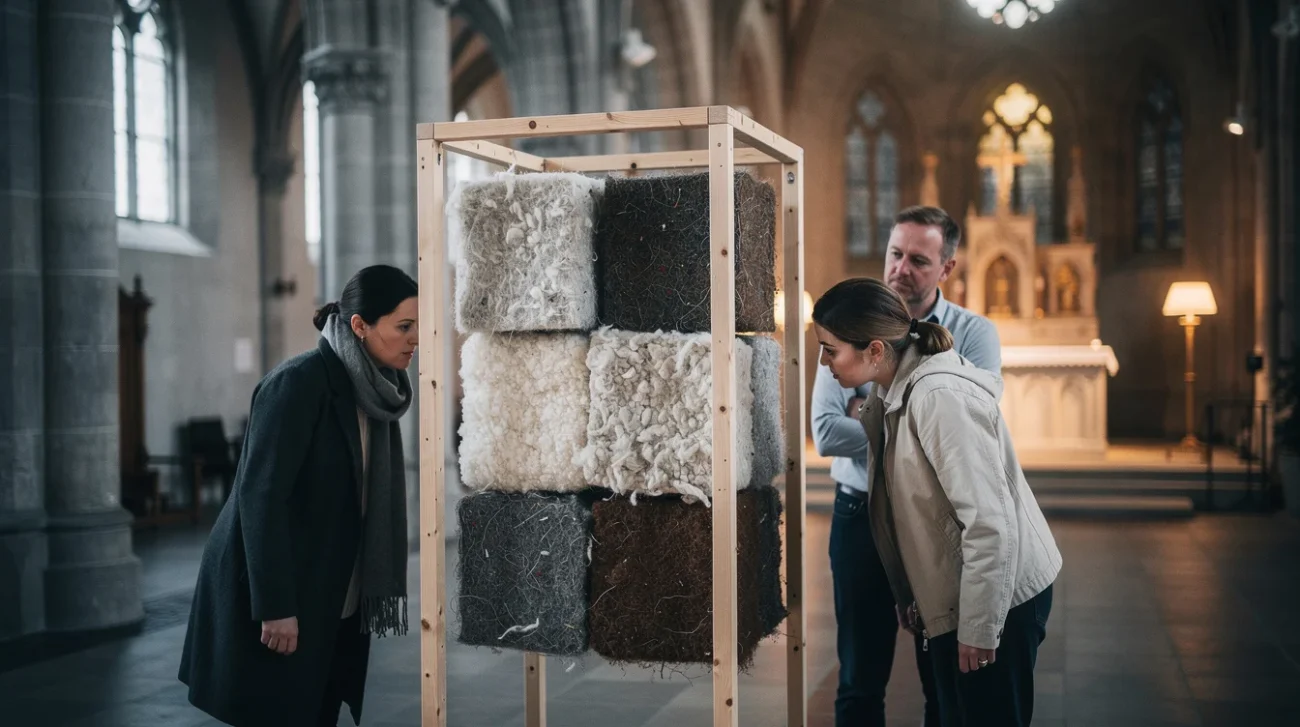
According to Dezeen’s September 27 report, Harvard’s Grinham Research Group has developed insulating cladding tiles from waste wool. Its installation, Upcycling Wool Ecologies, presents the tiles on a timber frame inside Oslo’s Sofienberg Church for the Oslo Architecture Triennale. The proposition is compelling: redirect an agricultural waste stream towards improving existing buildings rather than manufacturing another disposable architectural surface.
But the supplied source account does not establish the tiles’ composition, fire classification, weathering performance or installed price. That absence is not evidence of failure. It marks the distance between what an exhibition communicates and what a building owner must know before signing a specification.
The exhibition is a proposition, not a product passport
Architecture exhibitions are unusually good at making unfamiliar materials desirable. They are less good at displaying maintenance obligations. In Oslo, a timber frame makes wool tiles legible as an architectural assembly. It does not, by itself, demonstrate the complete wall behind that assembly: drainage, insulation continuity, cavity barriers, flashings, fixings and connections to the existing building.
The first commercial task is to define what the tile actually does. Is it exposed weather protection, insulation behind another rainscreen, or a multifunctional outer layer? Those roles demand different evidence. Calling something “insulating cladding” cannot substitute for declaring its intended use, limitations and contribution to the wall’s thermal performance.
A useful precedent is the transformation of 530 dwellings at Grand Parc Bordeaux by Lacaton & Vassal, Frédéric Druot and Christophe Hutin. Its significance here is not material similarity. It is that retrofit value emerges from an integrated system: envelope, construction sequence and occupied homes. A wool tile must similarly work beyond the sample board.
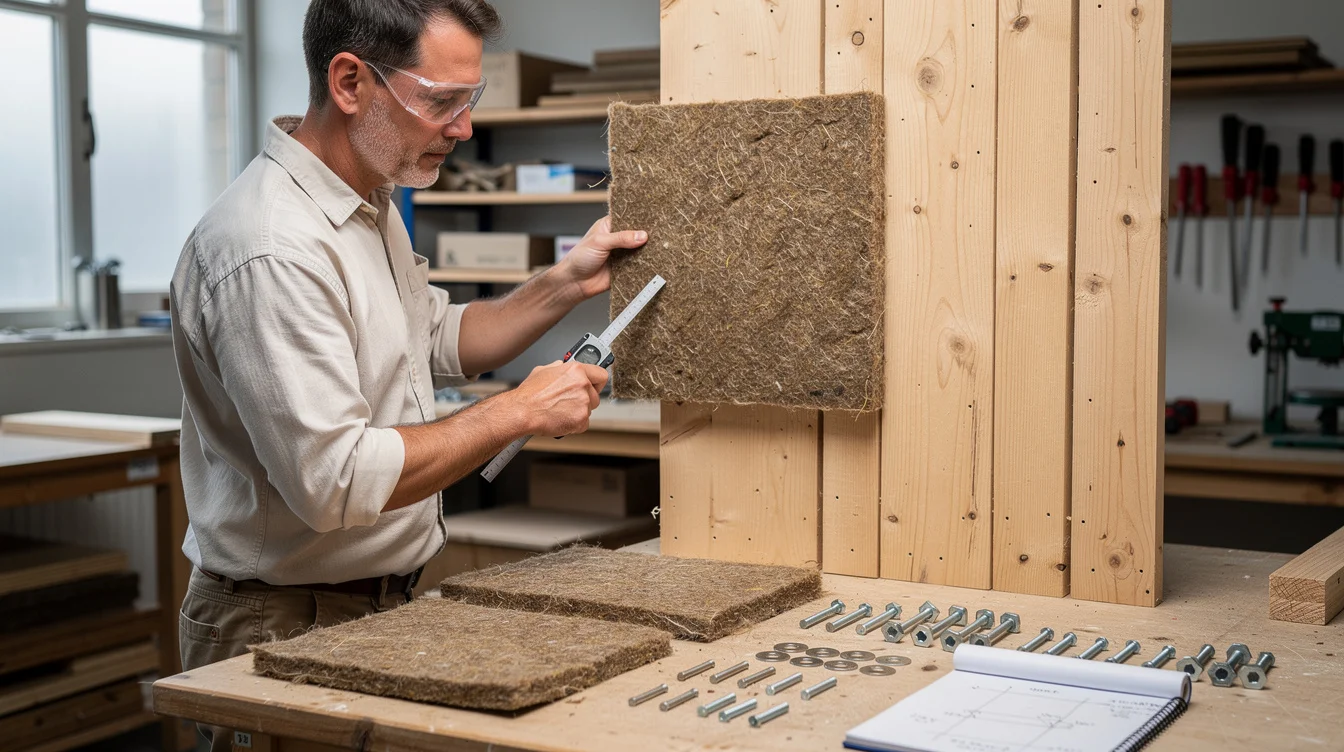
The necessary starting document would identify fibre preparation, density, thickness, any binders or treatments, manufacturing tolerances and fastening method. Agricultural variability must be translated into repeatable production. Otherwise, the tested specimen and the delivered batch could be materially different products.
Fire performance belongs to the wall, not the sheep
Wool’s tendency to char and its comparatively difficult ignition are frequently offered as reassurance. Neither provides a facade classification. Processing, density, additives, backing layers and mounting conditions can change behaviour. A wool-based composite cannot borrow a safety verdict from a loose fibre.
For a European route, declared reaction-to-fire performance under EN 13501-1 would be an obvious evidence requirement, supported by the tests appropriate to the proposed classification and intended mounting. Depending on that route, these can include EN 13823, the single burning item test. Smoke production and flaming droplets matter alongside flame spread. Reaction to fire must also not be confused with the fire resistance of a complete wall.
Assembly behaviour is a separate question. Cavities, membranes, timber supports, openings and fire stops can determine how fire moves. Where applicable, facade-system testing such as BS 8414, assessed against relevant criteria, may form part of the evidence. It is not a universal permission slip: restrictions on combustible materials for particular building types or heights can still govern the specification.
The Grenfell Tower fire and subsequent scrutiny of facade regulation make the ethical position unavoidable. A circular-material claim cannot compensate for an unclear fire-safety case. Harvard’s tiles deserve assessment as a defined assembly for a defined building category, not promotion through general claims about natural fibres.
Moisture is where the circular story gets complicated
Wool can absorb and release water vapour. That potentially useful behaviour is not the same as resisting wind-driven rain. A material that buffers indoor humidity may still require substantial protection when placed outside. The Oslo installation, located indoors, cannot demonstrate exposure performance simply by existing through a Scandinavian autumn.
Evidence should distinguish vapour sorption from liquid-water uptake, and quantify drying, dimensional movement and thermal conductivity under relevant moisture conditions. A dry laboratory conductivity value is insufficient if service moisture substantially changes performance. The wall also needs a declared thermal resistance at its specified thickness, with the effect of joints and support brackets addressed in the overall calculation.
Consider a proposed retrofit to a rain-exposed masonry apartment block in Bergen. Rain entering around a window may wet both the new material and the old wall. Whether that moisture drains or becomes trapped depends on the complete construction. Transient hygrothermal modelling using a framework such as EN 15026 should therefore precede, not replace, monitored mock-ups.
Those mock-ups should include corners, window heads and a splash-prone base. Wetting-and-drying cycles, and freeze–thaw exposure where relevant, would test actual vulnerabilities. If the tile requires a coating or protective outer skin, that is not a conceptual defeat. It is a different product proposition, with different costs and environmental consequences.
Durability means designing the unglamorous details
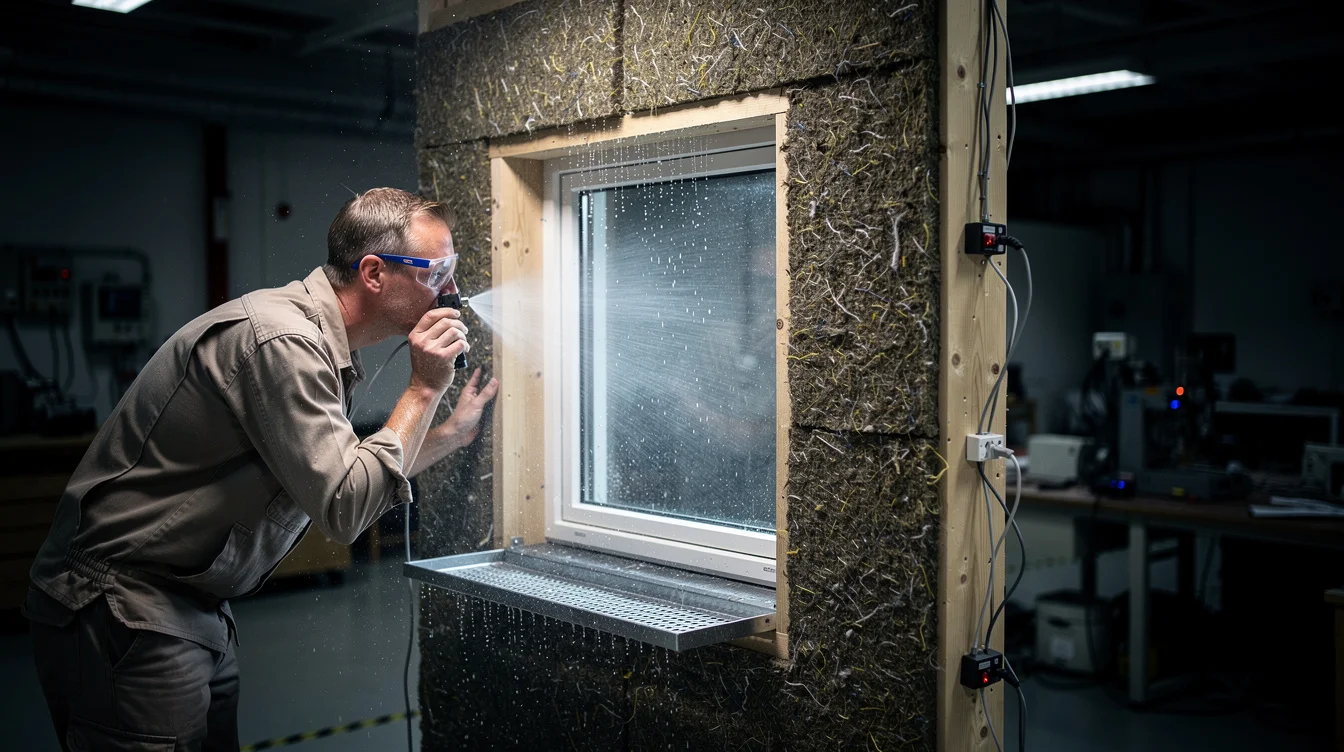
The next test is whether the facade remains serviceable rather than merely intact. Depending on its final formulation and exposure, a wool tile may need assessment for ultraviolet degradation, biological growth, insect attack, surface shedding and changes in fastening strength. None of these should be assumed to occur; none should be dismissed because the feedstock is natural.
Mechanical evidence would need to cover wind suction, fixing pull-through, impact and movement under changing temperature and humidity. For a retrofit, the existing substrate is another variable. Anchoring into sound concrete is not equivalent to fixing through weathered render into uncertain masonry. Surveys and site pull-out tests may become part of the installation method.
Long-running development work on the University of Stuttgart’s bio-based ArboSkin pavilion illustrates a broader lesson: a striking demonstrator establishes architectural possibility, not universal suitability. Each material system still needs an explicit service environment and maintenance strategy.
For wool, that strategy should show how an individual tile is removed, how damaged edges are handled and whether replacements remain compatible across production batches. Accelerated ageing can help identify failure mechanisms, but outdoor exposure and monitored pilot buildings are needed to connect those results to service life. Repairability is a drawing and a procedure, not an adjective.
Cheap feedstock does not mean a cheap facade
Waste wool may have little value at the farm gate. Collection, sorting, scouring, drying, treatment, forming and quality assurance still cost money. So do transport, breakage allowances and storage conditions. If those operations are missing from the price, the material is not inexpensive; its accounting is unfinished.
Owners need comparative installed costs per square metre for assemblies delivering equivalent thermal performance and meeting the same project requirements. One comparator might be mineral-wool insulation behind a ventilated rainscreen; another could be an external wall insulation system where suitable. Comparing a wool tile with only the insulation component of a conventional facade would conceal most of the decision.
A credible pilot should record labour hours, fixing quantities, cutting waste, installation speed and weather-related delays. It should also capture scaffolding, substrate repairs, window interfaces and resident disruption. These are central to the economics of occupied retrofit, not incidental overheads.
The Dutch Energiesprong approach offers a relevant reference: industrialised retrofit seeks value through coordinated envelope delivery and performance commitments, rather than a miraculous cheap ingredient. Wool developers should adopt that system-level discipline. A slightly more expensive tile could still compete if it genuinely eliminates another layer or reduces installation time. That advantage must be demonstrated on site, not inferred from the prototype’s simplicity.
Circularity needs a contract as well as a concept
The environmental case deserves the same scrutiny. An environmental product declaration based on an appropriate framework, such as EN 15804, would help disclose manufacturing impacts and assumptions. It would not automatically establish superiority. Comparisons must align thermal function, service life, replacement frequency and end-of-life scenarios.
Waste status also requires explanation. What wool is being diverted, what happens to it today, and what alternative uses exist? Washing energy, wastewater treatment, transport and any additives belong inside the assessment. Biogenic carbon storage must not be presented as permanent sequestration if the product will eventually decompose or burn.
Nor does wool content guarantee compostability. Binders, coatings, treatments and contamination during use may constrain recovery. A credible take-back offer needs a funded operator, collection arrangements and an identified processing route. Mechanically separable components would make that promise easier to honour.
The next persuasive exhibition would therefore be a dossier beside a weathered test wall: declared properties, applicable approvals, exposure results, installation records and an intelligible warranty. Initial deployment could focus on building types and locations supported by the evidence rather than claiming immediate suitability for every retrofit. Harvard’s provocation is valuable precisely because it opens this agenda. The industry should demand proof without reserving innovation exclusively for incumbent manufacturers.
FAQ
Are Harvard’s waste-wool tiles ready to specify?
The supplied report establishes a research development and exhibition installation, not commercial readiness. A project team would need technical documentation, applicable compliance evidence, installation instructions and confirmation of supply before specifying them.
Does wool’s natural fire behaviour make the cladding safe?
No general fibre property establishes facade safety. The finished product and its intended assembly need appropriate assessment, and local restrictions may limit where combustible components can be used.
Can wool cladding improve a building’s insulation?
Potentially, but the benefit must be quantified through declared thermal properties, thickness and whole-wall calculations. Moisture, joints and thermal bridges can affect the installed result.
What would make waste-wool cladding economically competitive?
Repeatable manufacturing, efficient installation, predictable maintenance and credible service life could make it competitive. Owners need equivalent-performance assembly comparisons, not a price advantage based solely on cheap raw wool.
Should public retrofit programmes fund the testing that could make waste-wool facades viable, or should developers carry that risk before asking building owners to believe?
Watch the Mainifesto Short
Get the Mainifesto weekly — curated design debates, speculative ideas and the week's best articles every Saturday.
Editorial Perspectives
Questions and counterpoints developed by the Mainifesto editorial desk to extend the discussion.
Perspective 1
I’d support public funding for independent fire and weathering tests, provided the results are published, including the failures. But retrofit owners need installed costs, maintenance requirements and a credible warranty before waste wool belongs in a tender, not just a promising sample.
Perspective 2
Who collects the wool, who processes it, and who pays when a panel needs replacing? Public programmes can fund shared testing infrastructure, but developers should carry the risk of their own product: a Harvard result does not establish a reliable supply chain or local code approval.
Perspective 3
Architecture has been promising redemption through new materials since the nineteenth century; calling one circular does not exempt it from the specification. Let public money fund knowledge anyone can use, not the promotion of a proprietary facade. The interesting achievement would be waste wool becoming unremarkable: certified, repairable and affordable.