What If a Moon Base Could Rebuild Its Own Walls?
What If a Moon Base Could Rebuild Its Own Walls?
The most consequential machine in a future Moon settlement might not be the printer that builds its first wall. It might be the machine that processes that wall after it breaks. Architecture beyond Earth needs a different founding image: not a pristine dome against a black sky, but a maintenance yard, stocked with recovered fragments and replacement components.
Research reported by designboom offers a tangible starting point: a 3D-printing method that fuses simulated lunar dust into bricks without adhesives. That is a material experiment, not a working lunar construction industry. Its significance nevertheless extends beyond the familiar promise of making buildings from whatever lies underfoot. If mineral feedstock can become a building component without an added adhesive, could damaged components eventually become feedstock again?
That second conversion—not the first printed brick—should become a defining test of lunar architecture. The proposal here is speculative: a construction system designed from the outset to inspect, dismantle, recover and remanufacture its protective envelope. A base would not magically heal. It would possess an organised capacity to keep repairing itself.
A Brick Is Evidence, Not a Habitat
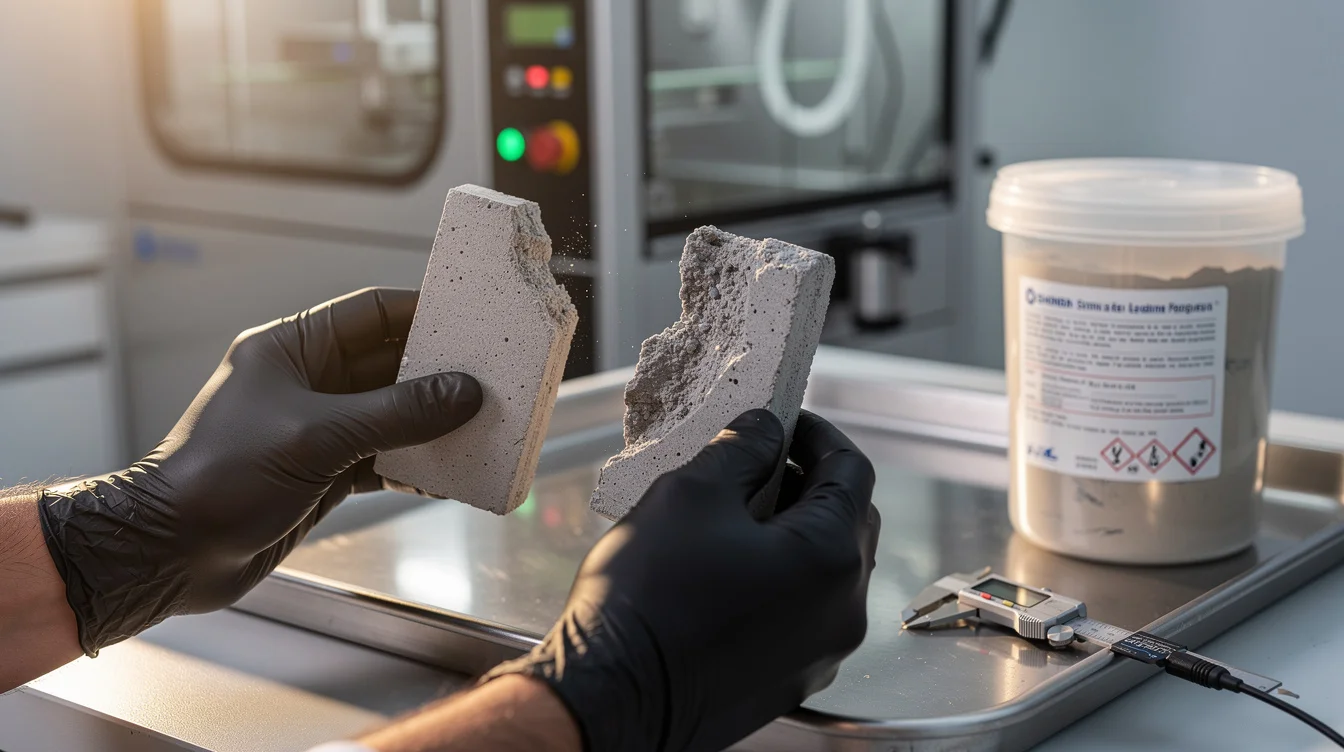
The distinction between simulated moon dust and actual lunar regolith matters. A simulant is an experimental substitute, not a complete reproduction of material encountered at every lunar landing site. Composition, particle geometry and processing history affect how powders behave. Results obtained on Earth also do not establish performance in lunar gravity, vacuum or repeated thermal cycling.
Nor does an adhesive-free brick demonstrate an airtight room. A printed mineral component might contribute to an external protective shell while a separate pressure vessel keeps astronauts alive. Structural strength, impact behaviour, thermal performance and safe attachment would each require testing. Treating all these functions as solved by a photograph of a brick is architectural wishful thinking. The same caution applies to architectural images that turn speculation into apparent evidence.
There is a useful precedent in the lunar-base concept developed by Foster + Partners with the European Space Agency, publicised in 2013. Its proposed printed regolith shell protected an inflatable inhabited structure. That project involved a different, binder-based construction approach; it should not be confused with the adhesive-free research. Its enduring lesson is architectural rather than chemical: the inhabited enclosure and the locally manufactured protective layer need not be the same thing. Separating them could make repeated repair substantially more plausible.
Design the Wall Around Its Next Failure
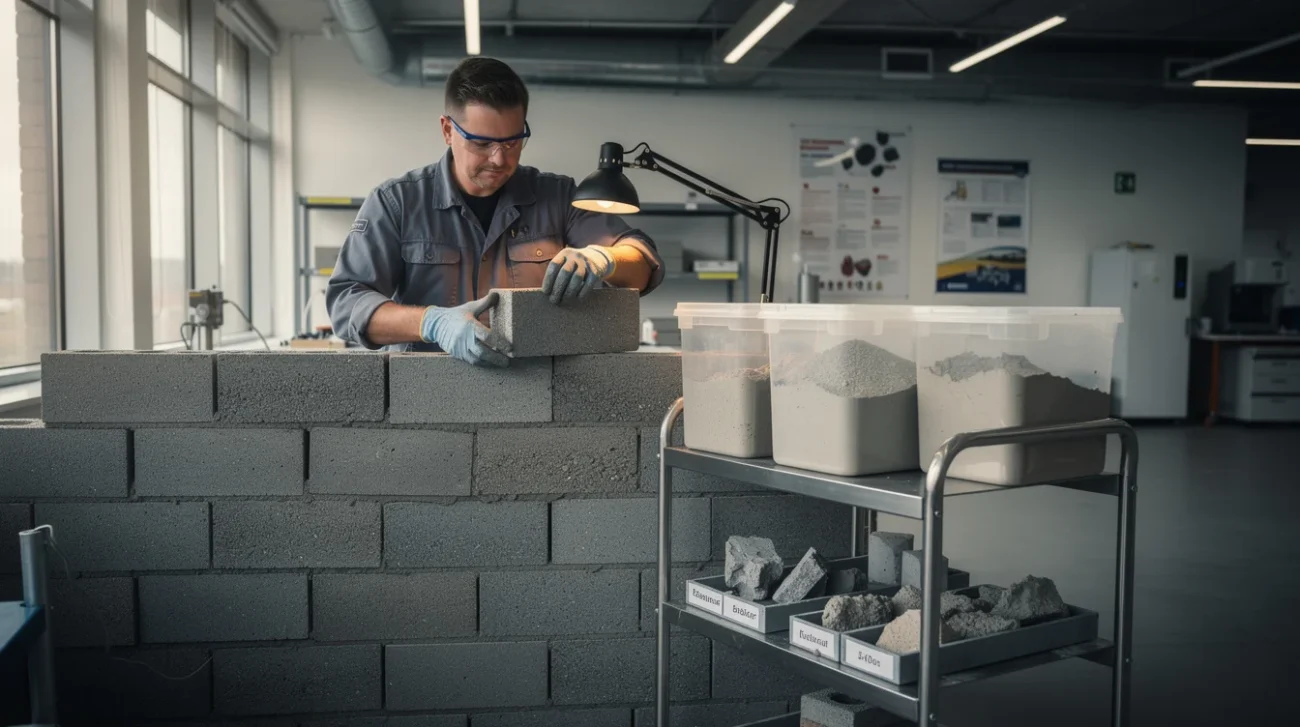
Imagine a future habitat surrounded by modular regolith-based shielding blocks, mechanically retained outside an independently sealed pressure vessel. Inspection identifies a cracked block. A handling robot removes it, installs a previously qualified replacement and transports the damaged component to a processing station. There, suitable fragments are crushed, classified and blended into a controlled feedstock for subsequent fabrication.
That sequence is a design brief, not a demonstrated capability of the reported research. Its difficulties should determine the architecture. Blocks need accessible lifting features. Connections must remain operable despite abrasive dust. Replacement routes cannot depend on dismantling half the shell. Inspection equipment needs access to the surfaces and interfaces where failure matters.
This is where the seductive freedom of additive manufacturing meets a less fashionable discipline: standardisation. An endlessly varied, digitally optimised shell could be harder to repair than a family of interchangeable units. NASA’s MMPACT work and ICON’s Project Olympus place local-resource construction within a wider development agenda, but no programme name removes the need to prove the maintenance sequence.
A credible concept would therefore show more than a printer in motion. It would show the storage rack, removal tool, inspection station and rejected-component bin. Those objects reveal whether the architecture has been designed for habitation or merely for presentation.
Local Dust Does Not Mean Local Independence
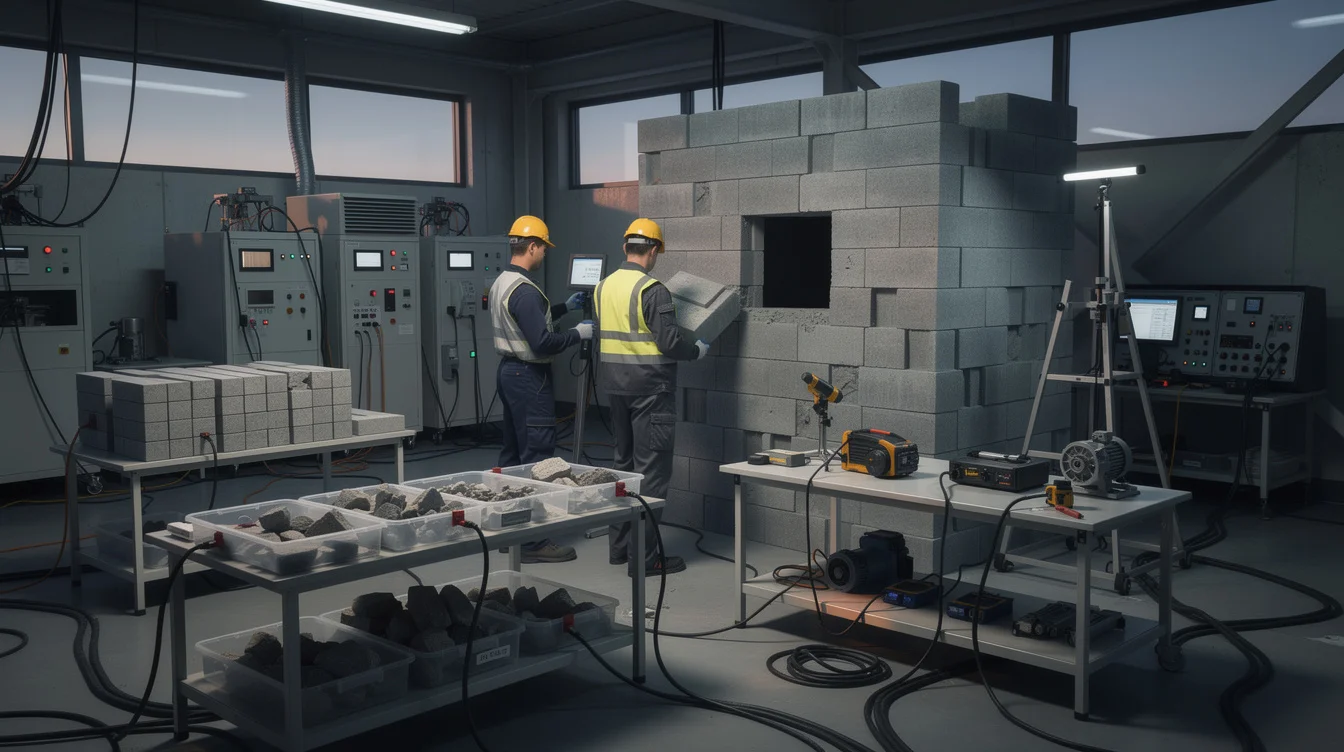
Using lunar material could reduce the mass of construction feedstock launched from Earth. That is valuable. It is not the same as eliminating dependence on Earth. A machine processing local dust may still require imported motors, electronics, bearings, seals and specialised fabrication equipment. Its power supply may depend on imported solar arrays, storage systems or other generation hardware.
A locally made wall can remain the product of an overwhelmingly Earth-made industrial system. Any serious claim of independence must expose that dependency rather than hide it behind the abundance of regolith.
Energy is particularly easy to erase from a rendering. Fusing mineral particles requires heat; recovering damaged blocks adds handling, size reduction, sorting and quality control. Power availability varies with site and operational conditions. An energy-intensive remanufacturing cycle might be sensible during one operating window and irresponsible during another, especially when it competes with life support.
The International Space Station offers a sober reference. Its maintenance strategy includes replacing modular hardware and relying on logistics from Earth. A lunar base would need its own version of that operational honesty. Spare processing heads and replacement electronics may matter more to continuity than another tonne of available dust. The architectural question is not simply what can be made locally, but what stops being made when one imported component fails.
Recycling Must Survive a Second Generation
Adhesive-free processing removes one potential source of added material from the brick-making step. It does not guarantee an indefinitely recyclable product. Crushing and reheating can change particle-size distributions and material behaviour. Recovered fragments may contain contamination from handling equipment or neighbouring assemblies. Material lost as dust still counts as a loss.
The relevant experiment is therefore not just whether a first-generation brick meets a strength target. It is whether second-, third- and later-generation components remain within a defined performance range after controlled recovery and reprocessing. Researchers would need to track retained mass, energy demand, dimensional accuracy and failure behaviour across those cycles. A replacement block should be qualified before installation, not trusted because its ancestor worked.
Earthbound circular-design projects offer a conceptual reference, not proof of lunar feasibility. Rotor’s work on building-component reuse, for example, foregrounds dismantling, sorting and the practical value of recovered elements. A lunar construction system should adopt that logistical seriousness while recognising the radically different environment.
It should also avoid recycling theatre. If a sound block can be reused directly, pulverising it merely to demonstrate a manufacturing loop would waste effort. The preferred sequence should be continued use, component reuse and only then remanufacture, wherever safety allows.
Judge the Base by How Long It Can Keep Repairing
Future habitat competitions should demand a maintenance demonstration alongside the heroic exterior image. Give each proposal the same damaged shielding area, constrained energy allocation and delayed resupply scenario. Then ask how it restores protection without compromising the inhabited enclosure.
Compare the fraction of recovered material that becomes qualified replacement components, rather than merely material collected. Count astronaut hours, robotic interventions, processing energy and imported consumables per repair. Record how many replacement cycles the system can complete before a critical spare is exhausted. Include rejected parts: yield is an operational fact, not an embarrassment to crop out.
A particularly revealing test would disable one major fabrication subsystem. Could the base install stockpiled components, switch to another tool or temporarily protect the affected area? A construction system that cannot tolerate its own breakdown is not autonomous; it is another vulnerable appliance. This is the same resilience question posed by designing buildings to work offline: what remains functional when a supporting system becomes unavailable?
This changes the meaning of architectural ambition. The strongest lunar proposal may be less seamless, less sculptural and more visibly assembled than current imagery suggests. It may reserve valuable space for workshops and duplicate unglamorous equipment. That is not a retreat from design. It is design accepting responsibility for time. The milestone is not a wall made from the Moon. It is a habitat that can restore its protection repeatedly—and state exactly which Earth-supplied resources make that possible.
FAQ
Can a Moon base already rebuild its own walls?
No. The reported research concerns adhesive-free bricks made from simulated lunar dust. An integrated lunar system that detects damage, recovers components and manufactures qualified replacements remains a speculative next step, requiring substantial testing.
Would printed lunar bricks keep a habitat airtight?
Not on the evidence described. An external regolith-based shell could provide protection around a separate pressure vessel. Airtightness, connections, structural behaviour and safe repair procedures would require their own engineering and validation.
Can fused lunar-material bricks be recycled indefinitely?
That has not been established. Repeated crushing and thermal processing could alter feedstock properties, introduce contamination and lose material. Multi-generation tests would need to measure recovery yield, energy use and the performance of replacement components.
What would demonstrate meaningful independence from Earth?
A useful measure would be the duration and number of safe repair cycles achievable without resupply, under stated damage and power conditions. That assessment must include machinery failures, spare parts, consumables, quality control and energy infrastructure—not just locally sourced material.
If a Moon base can remake its bricks but cannot repair the machine that makes them, how independent should we allow its designers to call it?
Watch the Mainifesto Short
Get the Mainifesto weekly — curated design debates, speculative ideas and the week's best articles every Saturday.
Editorial Perspectives
Questions and counterpoints developed by the Mainifesto editorial desk to extend the discussion.
Perspective 1
Making bricks locally is a manufacturing gain, not proof of independence. Show me the machine’s service life, power demand and spare-parts inventory before showing me another beautiful regolith wall.
Perspective 2
Call it locally supplied, not independent. If a failed controller means waiting for an Earth launch, whoever controls that launch schedule still has a say in whether your settlement survives.