Ēclos and the Evidence Behind Safer Surface Fabrication

A Beautiful Surface Should Not Hide the Cost to Its Makers
The waterfall end has become architectural surfaces’ favourite alibi. A slab turns a corner, its veining continues downwards, and the craft know-how behind production disappears into an image of effortless luxury. But somebody must cut that corner, shape that edge and finish that joint. The photograph rarely tells us what they breathed.
Cosentino’s Ēclos offers a reason to bring that missing person back into the frame. In Dezeen’s November 19, 2026 presentation, the Spanish brand’s latest mineral surface is described as emulating natural stone, enabling three-dimensional compositions and being free of crystalline silica. Those propositions belong in the same conversation. Creative freedom is not genuinely progressive if its occupational costs remain someone else’s problem.
Eliminating crystalline silica would be a meaningful material intervention. It would not, by itself, establish that every fabrication process is safe. The source summary provides a composition claim, not the analytical reports or workplace exposure measurements needed to evaluate its practical reach. Designers should neither dismiss the advance nor promote it beyond the evidence. They should make that evidence a condition of specification.
A Composition Claim Is a Starting Point, Not a Clearance Certificate

Crystalline silica matters because inhaling its respirable dust can cause silicosis, an irreversible lung disease, and increase the risk of lung cancer. Cutting, grinding and polishing silica-containing materials can generate particles small enough to penetrate deep into the lungs. A surface’s showroom appearance tells us nothing about that exposure.
Yet “free of crystalline silica” still needs a technical definition. Does it mean no crystalline silica intentionally added, or none detected in the finished material? Which crystalline forms were assessed? What was the detection limit? Were representative production batches tested, and does the claim cover every colour and formulation being specified? A laboratory result stating “not detected” is meaningful only alongside the method and its sensitivity.
Designers should request the current safety data sheet, the manufacturer’s technical definition of the claim and supporting analysis from a suitably accredited laboratory. X-ray diffraction is an established technique for identifying crystalline phases, but merely naming a technique does not demonstrate adequate sampling or sensitivity.
The distinction is not pedantry. A safety data sheet communicates hazards and handling requirements; it is not a certificate proving zero exposure. Equally, a bulk-material analysis answers a different question from an air sample collected beside a worker’s breathing zone. Composition describes the slab. Exposure describes what happens to the person processing it.
Test the Edge Designers Actually Draw
The relevant test is not whether an untouched slab looks harmless in a laboratory. It is what happens when a fabricator makes the geometry that sold the product. Ēclos is presented through refined edges, corners and waterfall ends. Those details should become the brief for exposure assessment.
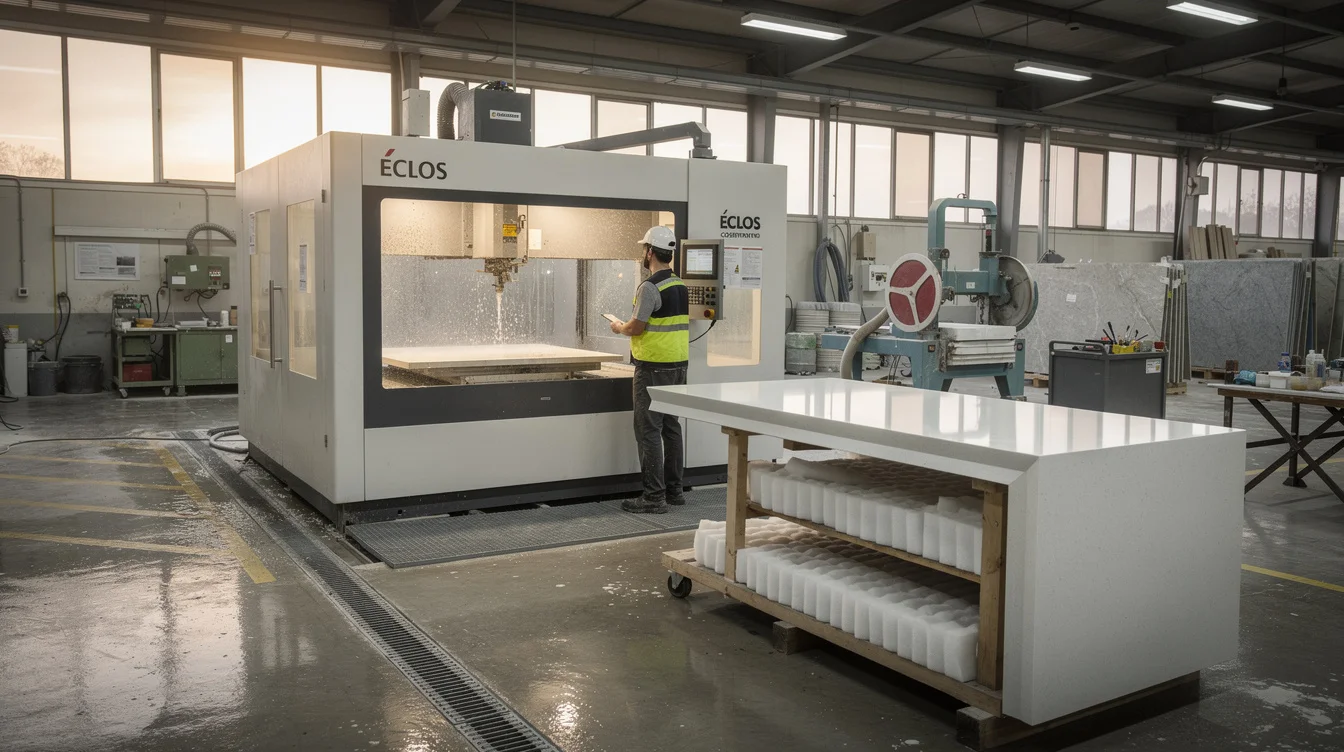
Consider a kitchen island with mitred returns, an undermounted sink and a tap opening. Its production may involve sawing, drilling, edge finishing and adhesive work, followed by installation adjustments. A controlled straight-cut demonstration cannot stand in for every one of those operations. Nor can a factory’s enclosed, automated equipment automatically represent a smaller workshop’s handheld tools.
Ask for task-based measurements and personal breathing-zone sampling under documented conditions. Reports should identify the tools, abrasives, operating speeds, water delivery, extraction, work duration and ventilation. They should distinguish short, dusty tasks from shift-average exposure and explain which particle fractions and substances were measured.
Mies van der Rohe and Lilly Reich’s Barcelona Pavilion made stone’s visual arrangement part of architectural experience. That reference is useful here not as a claim about contemporary product safety, but as a reminder that material effects are deliberately constructed. When designers obsess over vein alignment yet ignore the machining sequence, their celebrated attention to detail stops precisely where another person’s risk begins.
Removing One Hazard Does Not Make Dust Innocent
A genuinely crystalline-silica-free formulation could remove a major hazard associated with traditional silica-containing surfaces. That deserves recognition. But substitution must be assessed as substitution, not treated as a magic eraser.
What other mineral constituents become airborne during machining? Is there a binder, and what does its safety documentation say about the intended processing conditions? Which adhesives, sealants and cleaning products enter the workflow? These are questions to investigate, not allegations that Ēclos contains a particular hazardous substance. The supplied source does not establish its complete formulation or the composition of processing emissions.
Respirable and inhalable dust still require assessment even when crystalline silica is absent. Applicable exposure limits vary by jurisdiction and substance; meeting one silica-related criterion does not settle the rest. A responsible assessment should explain why its analytical scope matches the material and the work.
Australia’s prohibition on the manufacture, supply, processing and installation of certain engineered-stone products, which began in July 2024, makes the stakes unmistakable. Its regulatory definitions should not be flattened into a worldwide verdict on every mineral surface. The larger lesson is that a successful design category can fail catastrophically when polished consumer imagery outruns protection for its makers. New formulations must improve the evidence, not merely refresh the vocabulary.
The Workshop Is Part of the Product
There is no useful safety claim without operating conditions. Wet cutting, effective local exhaust ventilation, enclosure and suitable cleaning practices can reduce exposure. They must also be maintained, checked and matched to the task. Water that misses the cutting interface is not an adequate control simply because a machine is described as wet-operated.
Designers should therefore ask to see the fabrication guidance alongside the exposure data. Does the manufacturer prohibit particular operations? What controls are required for edge finishing and drilling? How should slurry be collected before it dries into dust? What is the procedure when an installer discovers that a wall is not square and a component needs adjustment?
Dry sweeping and compressed-air cleaning can return settled dust to the air. Housekeeping belongs in the assessment, as do maintenance and waste handling. Respiratory protection, where required, needs appropriate selection, fit testing and a managed programme; a masked worker in a promotional photograph proves none of those things.
Carlo Scarpa’s work offers a useful rebuke to superficial detailing: junctions are architectural decisions, not residual problems. Apply that seriousness to fabrication. A pre-resolved junction that avoids uncontrolled site grinding may be a more consequential design achievement than another impossibly thin-looking edge. Safety should inform the drawing before the purchase order reaches the workshop. As with designing out surplus, prevention begins with decisions made before production.
Make Evidence a Deliverable, Not a Courtesy
The specification is where concern either acquires force or evaporates. Before approving Ēclos—or a competing surface with comparable claims—the design team should request a dated evidence package linking the exact product to its composition analysis, processing instructions and relevant exposure assessments. Commercial confidentiality may justify protecting a recipe; it should not prevent communication of hazards and safe-use requirements.
Comparative claims need comparable conditions. If a material is described as safer than a conventional engineered surface, ask whether the same tasks, tools, controls and measurement methods were used. A favourable result from enclosed wet processing cannot fairly be contrasted with uncontrolled dry grinding. Ask who commissioned the work, who conducted it and whether the full methodology is available.
Approval should also involve the actual fabricator. Can that workshop deliver the specified geometry using the documented controls? Who pays for additional extraction, off-site preparation or a changed installation sequence? A safety requirement without an allocated budget risks becoming an instruction to improvise.
The provocative position is also the practical one: an unverified safety story should not earn a specification premium. Cosentino’s composition claim opens an important opportunity. The design profession should reward it with serious scrutiny rather than automatic endorsement. The next frontier of architectural surface quality is not simply a more convincing imitation of stone. It is a traceable account of how the finished object can be made without quietly transferring preventable harm to its makers.
FAQ: What Designers Should Ask Before Specifying
Does crystalline-silica-free mean dust-free?
No. Cutting and grinding can generate dust from other constituents. Removing crystalline silica can eliminate an important hazard, but the remaining dust and any associated processing chemicals still need assessment and appropriate controls.
What evidence should designers request for Ēclos?
Request the current safety data sheet, the technical definition of the composition claim, representative laboratory analysis with detection limits, fabrication instructions and task-specific exposure reports. Confirm that the documents apply to the exact formulation and intended operations, rather than assuming that one report covers an entire range.
Is independent laboratory testing enough to establish a safer workplace?
No. Independent composition testing helps substantiate what is in the material. Workplace exposure monitoring establishes what workers encounter under particular conditions. Both matter, alongside effective controls, training, maintenance and compliance with applicable occupational-health requirements.
Can design decisions reduce fabrication risks?
Yes. Resolving dimensions early, coordinating joints with fabricators and minimising last-minute site cutting can reduce opportunities for uncontrolled exposure. Designers should have competent fabrication and occupational-hygiene professionals assess the proposed workflow rather than assume that simpler geometry guarantees safety.
If a surface arrives with a flawless visual story but incomplete evidence about the people who cut it, should it qualify as a premium design product at all?
Watch the Mainifesto Short
Get the Mainifesto weekly — curated design debates, speculative ideas and the week's best articles every Saturday.
Editorial Perspectives
Questions and counterpoints developed by the Mainifesto editorial desk to extend the discussion.
Perspective 1
If I’m paying a premium, I want fabrication guidance and credible exposure data alongside the samples. A crystalline-silica-free claim may be a step forward, but it doesn’t tell me what controls the workshop needs or what they’ll cost.
Perspective 2
A surface can look beautifully calm under light while its production remains out of view. I’d want to know what happens when it’s cut and finished before making it the centrepiece of a space.
Perspective 3
I’m interested in material innovation, but the launch narrative can’t do the work of exposure testing. Show us what was measured during fabrication, under which conditions, and by whom—then the premium story gets interesting.
Perspective 4
No—not if the evidence stops at the slab’s composition. A premium claim should hold up in the subcontracted workshop, not just the manufacturer’s test facility, with clear exposure data and controls that fabricators can actually implement.