
When Unworn Trainers Become Furniture, What Counts as Waste?
When Unworn Trainers Become Furniture, What Counts as Waste?
A trainer that has never touched a pavement is already becoming a cushion. That is the productive absurdity behind the collaboration between Japanese furniture brand Karimoku New Standard and sportswear company ASICS: material from unused footwear gets another assignment before its first one has begun. The result is not simply an inventive seating story. It is an uncomfortable portrait of what contemporary manufacturing has learned to regard as normal.
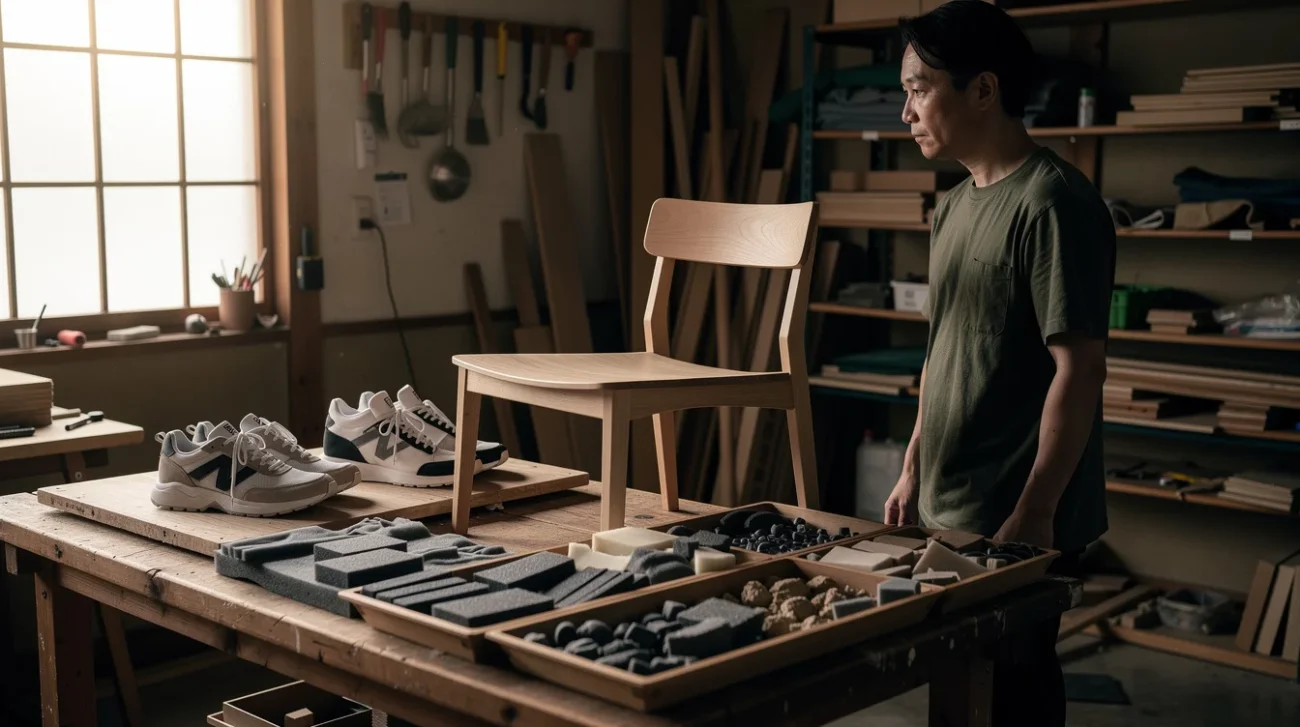
According to Dezeen’s report of 18 October 2026, the globally released KNS x ASICS Collaboration uses upcycled foam from deadstock and sample ASICS trainers as cushioning for two seating designs. The footwear would otherwise have been discarded. That distinction matters: these are not exhausted running shoes collected after years of service. They are unused products caught between development, inventory and disposal.
The collaboration deserves credit for finding a useful destination for surplus. It does not, on the evidence supplied, establish a solution to surplus production. Both statements can be true. Design criticism becomes useful precisely when it refuses to let the first substitute for the second. A comfortable seat can be a good product and still leave the most consequential question standing: why was its feedstock unwanted footwear in the first place?
Unused Is Not the Same as Unnecessary
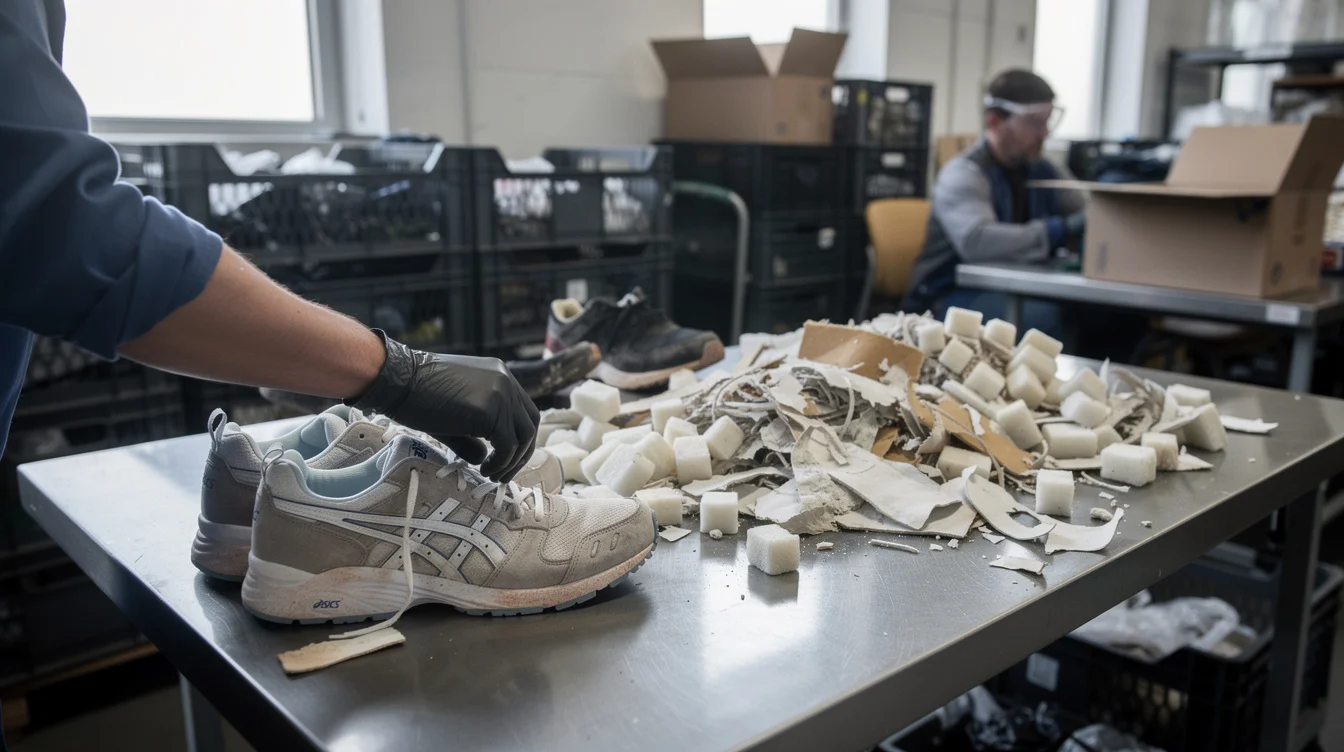
Calling this material waste describes its destination within a business system, not an intrinsic condition. Foam does not become physically worthless because a sample is rejected or stock remains unsold. Equally, an unused trainer is not automatically a wearable, saleable shoe. Development samples may be incomplete, unsuitable for use or produced in sizes and quantities that make redistribution impractical. Deadstock presents a different set of possibilities. The categories should not be bundled together merely because both can enter a shredder.
The supplied source summary does not explain why each stream became surplus, whether footwear reuse was assessed, or how much usable foam is recovered. Those are not peripheral details. If a complete, safe pair could serve its original purpose, preserving that function would generally deserve consideration before dismantling it. If a sample cannot reasonably be worn, recovering its material may be the more useful route.
Nike Grind offers a relevant precedent: it processes manufacturing scrap and end-of-life footwear into materials for further applications. Its significance here is the distinction between inputs, not a blanket endorsement of every output. Factory offcuts, rejected samples and worn-out shoes carry different histories. A credible circular-design story needs a material biography, not just a recycled-content label.
A Cushion Is a Destination, Not Yet a Loop
Putting recovered footwear foam into seating makes intuitive sense. Both applications need cushioning, and furniture can offer a substantial period of use. But functional similarity does not prove environmental superiority. The relevant comparison is not crushed trainers versus an imaginary world without waste. It is this cushion versus a conventional cushion providing comparable comfort, durability and service.
That comparison requires information about processing energy, transport, material yield and any additional ingredients. If binders or other additives are used, their contribution matters too. The source summary does not identify the foam chemistry or cushion formulation, so claims about recyclability, emissions or toxicity would be premature. Nor does it establish how much conventional cushioning material the recovered foam replaces.
Emeco’s 111 Navy Chair, developed with Coca-Cola using recycled PET, is a useful reference because it makes the transition from packaging to furniture explicit. Yet every such transition raises a second question: what happens after the furniture’s useful life? For the KNS and ASICS seating, can the cushion be removed without damaging the seat? Can it be replaced, collected and processed again? These are questions to investigate, not features to assume. One successful transfer between industries is material recovery; a repeatable route through successive lives is a much stronger claim.
The Missing Metric Is Avoided Surplus
The decisive test sits upstream of the finished furniture. Does ASICS pair this recovery route with measures that reduce the creation of unwanted footwear? The supplied reporting establishes an outlet for deadstock and samples. It does not establish a surplus-prevention programme connected to the collaboration. That is an evidence gap, not proof that no prevention efforts exist elsewhere in the company.
Useful disclosure would separate development samples from unsold finished goods and production rejects. Each calls for different interventions. Digital prototyping may reduce some physical development rounds, although fit and performance still need physical testing. Better demand forecasting and smaller production commitments may address inventory risk. Quality improvements may reduce rejects. None is interchangeable with a recycling partnership.
Companies should report surplus in absolute quantities and relative to production. A declining surplus rate can coexist with growing total waste if overall output expands. Equally, rising recovery volumes might indicate better collection rather than worsening overproduction. Without both sets of numbers, the same celebratory graph could tell opposite stories. The related question of whether IKEA can sell second-hand without selling more highlights the same tension between circular services and continued growth.
Formafantasma’s Ore Streams, which examined electronic waste through furniture and research, offers a useful critical model: the object can expose the system rather than close the discussion. Here, the strongest exhibit would be a seat accompanied by evidence that fewer trainers are becoming feedstock.
Design for the Day the Feedstock Disappears
There is a commercial tension in making surplus desirable. Once recovered material acquires a distinctive appearance, procurement specification or marketing value, someone starts depending on its availability. That does not mean this collaboration encourages ASICS to overproduce; the supplied evidence supports no such allegation. It does mean a responsible partnership should explain what happens if prevention succeeds and its particular waste stream shrinks.
The answer should not be to preserve the waste. A cushion system could be designed to accept suitable alternative recovered materials, subject to performance testing. Supply agreements could accommodate declining volumes. Public success measures could reward avoided surplus alongside material recovery. The ideal circular product is not entitled to an endless supply of somebody else’s mistake.
Longevity must also be designed rather than narrated. Jasper Morrison and Naoto Fukasawa’s Super Normal provides a useful counterweight to novelty-driven sustainability: furniture earns its place through everyday usefulness, not just an arresting origin story. For these seats, replaceable cushioning, maintainable upholstery and durable construction would matter more over time than the initial surprise of their ingredients. Those qualities require verification for the actual products. The trainer story may sell the first encounter; comfort, repair and restraint must justify the following years.
Rescue the Material, Refuse the Alibi
The KNS x ASICS Collaboration is worth taking seriously precisely because it is more specific than a vague promise to “go circular”. It identifies an unwanted input and gives recovered foam a practical job. Furniture needs cushioning. Some footwear cannot fulfil its original purpose. Connecting those facts can be useful industrial work.
But the collaboration should be judged on two separate scorecards. The first concerns the destination: recovery yield, actual substitution of conventional material, durability, repairability and the cushion’s next disposal route. The second concerns production: why the surplus arose, what interventions address those causes and whether unwanted volumes decline. A strong result on one scorecard cannot cancel an empty box on the other.
This is where design media must become less easily upholstered. A photograph of an elegant seat cannot substantiate a prevention claim. Neither can the moral glow of the word “upcycled”. The more compelling future announcement would combine successful seating with a falling supply of discarded footwear, even if that complicated the collection’s production.
Call this a material rescue. Ask it to become evidence of a changing manufacturing system. That is not withholding praise. It is refusing to spend the entire critical budget on a transformation that begins after the surplus already exists.
FAQ
What material does the KNS x ASICS Collaboration reuse?
It uses upcycled foam from unused ASICS footwear, including deadstock and samples, as cushioning for two seating designs. The supplied source does not specify the foam chemistry, recovery yield or proportion of recovered material in each cushion.
Why distinguish unused trainers from worn-out shoes?
Unused footwear raises questions about development, inventory and production before consumer use begins. Worn-out shoes raise end-of-use collection questions. Both can merit recovery, but the interventions needed to prevent their becoming waste differ.
Does turning footwear foam into furniture make it circular?
It demonstrates a recovery route, not necessarily a closed loop. A stronger circularity claim needs evidence about material substitution, useful life, repair and what happens to the cushioning when the furniture is discarded.
Is there evidence that this collaboration prevents surplus?
The supplied source establishes reuse of surplus, not measures to prevent its creation. Assessing prevention would require additional disclosure about surplus causes, production changes and quantities over time. That reporting gap does not establish that ASICS has no wider initiatives.
If a collaboration makes waste valuable, should we celebrate the furniture it produces—or judge its success by how quickly its original feedstock disappears?
Watch the Mainifesto Short
Get the Mainifesto weekly — curated design debates, speculative ideas and the week's best articles every Saturday.
Editorial Perspectives
Questions and counterpoints developed by the Mainifesto editorial desk to extend the discussion.
Perspective 1
Trainer foam becoming seating is exactly the kind of material crossover we should explore—but the exciting part would be designing this supply stream out of existence. Show us less surplus per pair of trainers, and give the furniture a future that doesn’t depend on footwear factories staying wasteful.
Perspective 2
There’s a touch of alchemy here: call it surplus in the factory, then give it a designer label and suddenly it’s treasure. Celebrate the chair if it’s good, but don’t mistake a Cinderella story for evidence that fewer unwanted trainers are being made.
Perspective 3
Design has been turning industrial leftovers into respectable objects for generations; the material substitution alone is hardly a breakthrough. A little Baudrillard would help here: are we buying useful seating, or the sign of ecological virtue? Publish the surplus figures alongside the furniture photographs.
Perspective 4
I’d want to sit on it, inspect the joints, and know what happens when the foam wears out. Giving a leftover material a use is worthwhile, but only if the object deserves the years we’re asking someone to keep it.