
After the Encore: Can a Pop-Up City Really Be Green?
After the Encore: Can a Pop-Up City Earn Its Green Credentials?
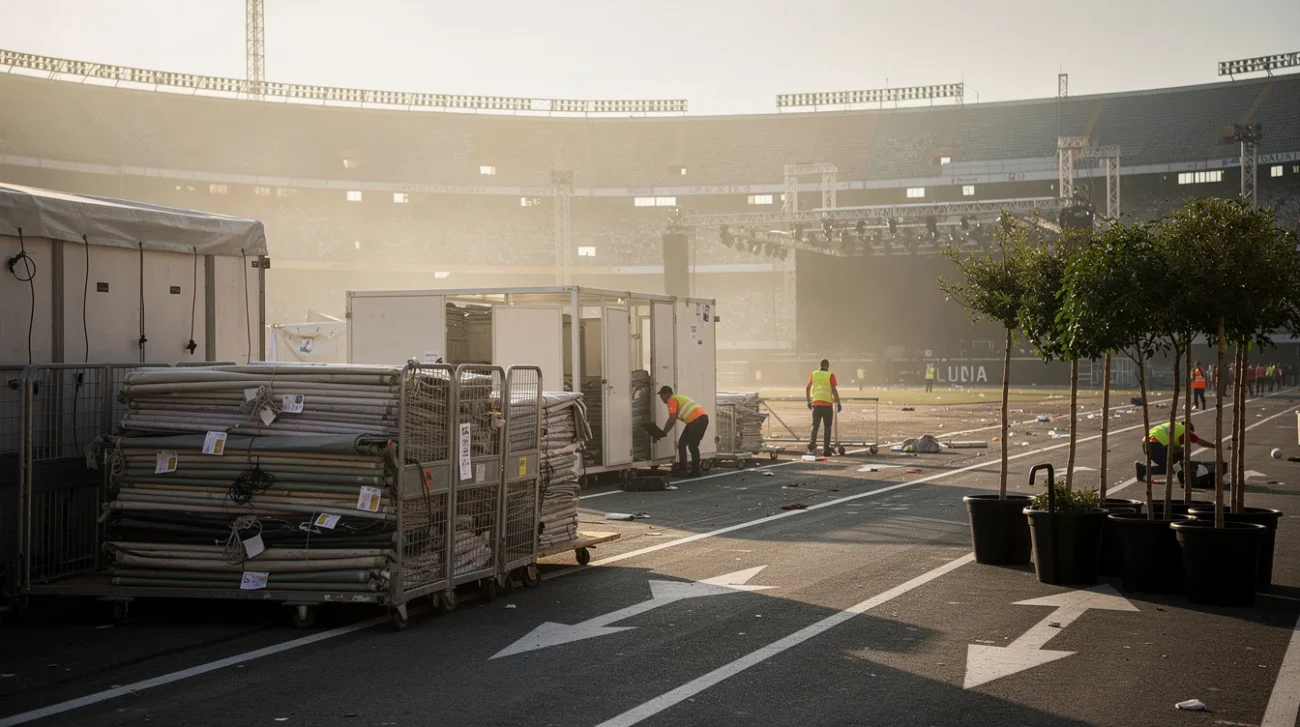
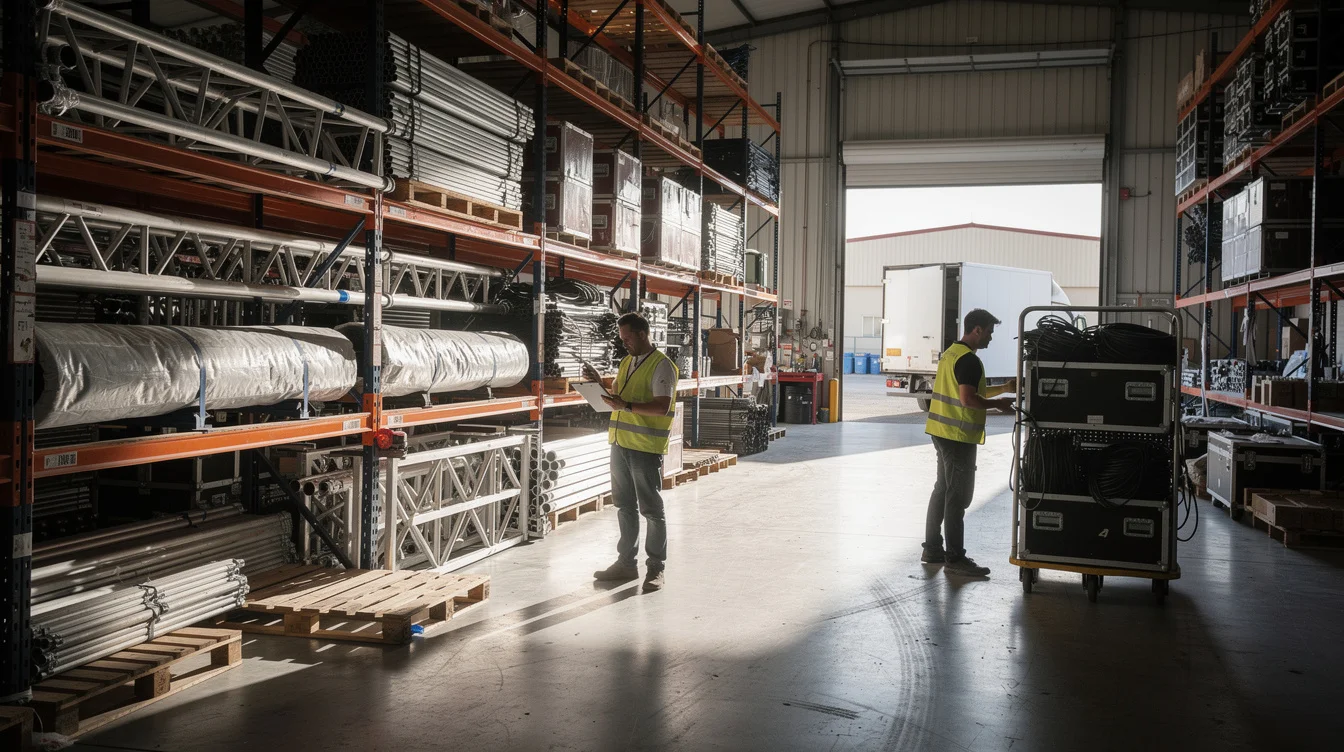
The most revealing photograph of a concert might be taken a week after the audience leaves. Not the aerial shot of a luminous stage, but the loading bay: fabric bundled into cages, structural members stacked on trailers, trees waiting for collection. That is where temporary concert architecture stops being an image and becomes an environmental proposition.
According to designboom’s account, Bjarke Ingels Group’s temporary city for Shakira transforms Madrid’s Iberdrola Music venue with reusable structures, temporary pavilions, recycled fabrics and 500 trees. It is an arresting inventory. It is not, by itself, proof of reduced environmental impact.
The distinction matters because stadium-scale entertainment increasingly borrows the language of urbanism. A concert becomes a district; a hospitality enclosure becomes a pavilion; landscaping becomes a miniature landscape strategy. Architecture gives the spectacle civic ambition. It should also give it civic accountability.
The real design brief begins after the encore. Where do the structures go? Who pays to store them? What condition are they in when they arrive? And which future event has actually committed to using them?
Reusable Is a Capability, Not a Result
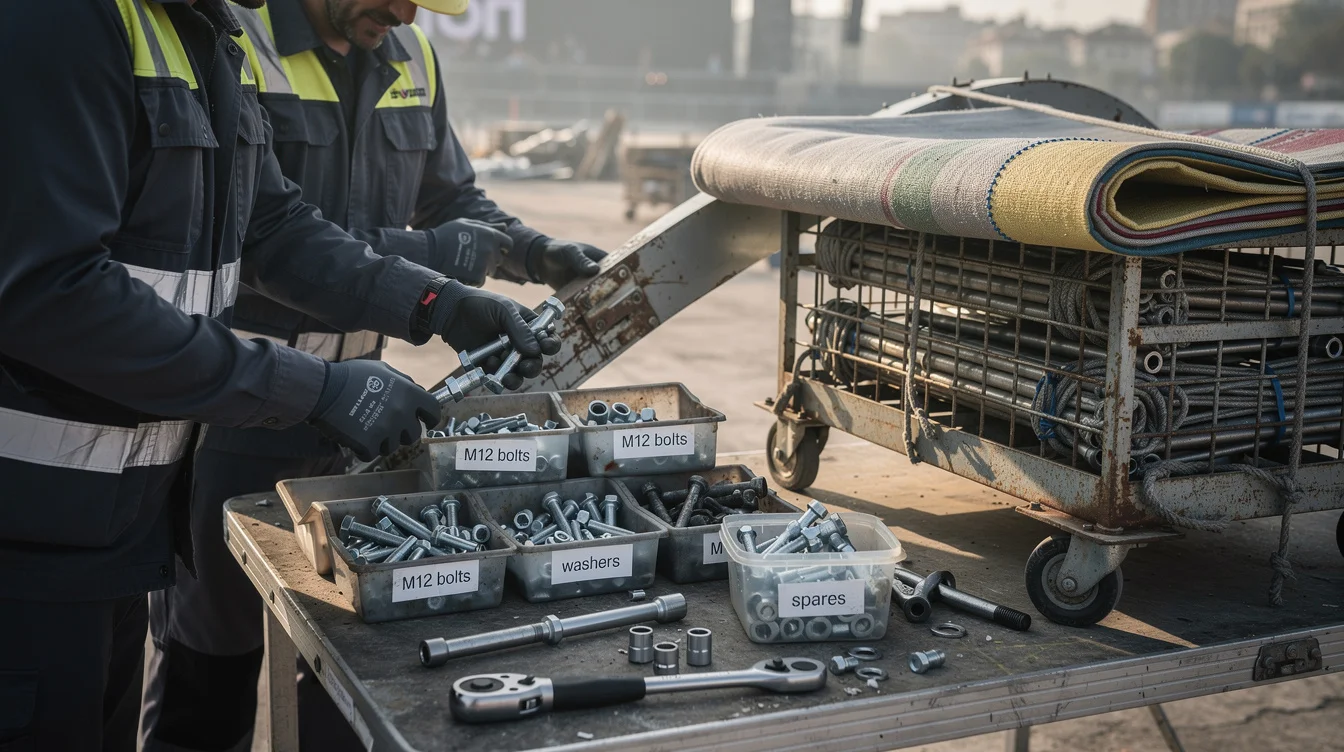
There is nothing inherently fraudulent about designing for disassembly. Bolted connections, replaceable panels and standardised components can keep valuable material out of waste streams. But the ability to reuse an object and the act of reusing it are different achievements. A pavilion that can be assembled ten times but is commissioned only once remains a one-use pavilion.
The source summary identifies recycled fabrics and reusable structures, but does not establish an independently verified whole-life assessment or a documented post-event itinerary. That gap should not be filled with either applause or accusation. It should be filled with evidence.
Consider Stadium 974, designed by Fenwick Iribarren Architects for the 2022 World Cup in Qatar. Its demountable design made it a prominent reference for temporary sports architecture. Yet demountability alone cannot demonstrate that a second deployment has displaced a new build. That requires a destination, a programme and a completed transfer—not just an engineering possibility.
Madrid deserves the same scrutiny. Recycled content describes a material’s previous life. Reusability describes a possible future life. Neither tells us the total emissions of the life being lived now. These are useful design attributes, not interchangeable sustainability certificates. The same distinction applies to building with straw: a material choice is the beginning of an assessment, not its conclusion.
The Missing Architecture Is a Logistics Plan
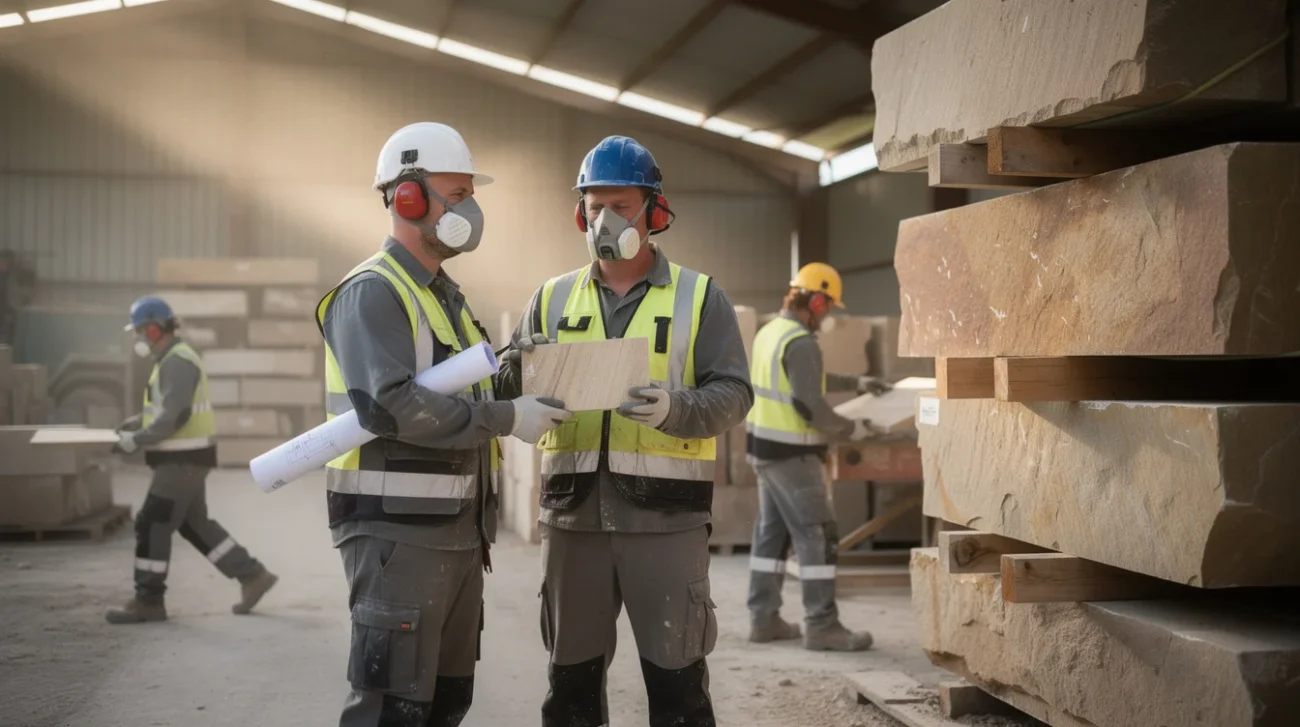
After dismantling comes a less photogenic sequence: inspection, cleaning, sorting, packaging, loading, transport and storage. Each step can preserve the value of a temporary structure—or destroy it. A damaged connector can make an otherwise reusable assembly unusable until a replacement is fabricated. Damp storage can turn a textile asset into a disposal problem.
The environmental calculation is specific, not ideological. Shipping a heavy kit across continents may erode the benefit of avoiding new manufacture. Equally, transporting an existing structure can still outperform building another one. Distance alone does not settle the question: weight, transport mode, vehicle utilisation, repair requirements and the avoided alternative all matter.
The Crystal Palace offers a historical reminder that an architectural second life is a construction project in its own right. Joseph Paxton’s building for London’s Great Exhibition of 1851 was dismantled and substantially reconfigured at Sydenham, reopening in 1854. Its afterlife required a new site, investment and extensive work—not merely a claim that iron and glass were reusable.
For Madrid, credible reporting would identify storage locations, transport routes, expected losses and responsible operators. “Dismantled for reuse” is an interim status. It is not the end of the environmental story.
Recycled Fabric and 500 Trees Need Their Own Accounts
Recycled textiles can reduce demand for virgin feedstock, but the word “recycled” leaves important questions unanswered. What proportion is recycled? What coatings, inks or fire-retardant treatments have been applied? Can the finished fabric be cleaned and used again under the relevant safety requirements? A membrane designed around one performer’s identity may become commercially obsolete long before it becomes physically exhausted.
The more useful design move may be to separate a durable, neutral fabric system from replaceable graphics. That is less visually heroic than inventing an entirely new envelope for every tour, but it gives the underlying material a better chance of surviving the branding cycle.
The 500 trees reported for the Madrid scheme also require a destination rather than a symbolic interpretation. Their presence should not automatically be counted as a carbon offset. Species, size, irrigation demand, transport, temporary rooting conditions and subsequent survival all affect their environmental significance.
Landscape architect Gilles Clément’s idea of the garden as a changing living system offers a useful counterpoint to event landscaping as instant scenery. For a temporary venue, the relevant questions are practical: are trees rented from a nursery, transferred to permanent sites, or retained locally? Who funds their care after the gates close? Living material needs stewardship, not just installation.
From Signature Pavilion to Shared Inventory
The most radical version of this project would not be a travelling replica of Shakira’s Madrid environment. It would be a shared stock of architectural components capable of serving programmes that look nothing alike. A shade structure might support a music festival, then a neighbourhood sports event, then a seasonal market. Repetition would become infrastructure rather than an aesthetic embarrassment.
Touring entertainment already knows how this works. Rental companies circulate trusses, lighting rigs, staging and crowd barriers across productions. Their business depends on inspection, compatibility and booked utilisation. Architecture could learn from that operational discipline instead of treating every temporary pavilion as an isolated authorship opportunity.
One instructive architectural afterlife is the 2015 Serpentine Pavilion by SelgasCano, which was later installed in Los Angeles in 2019 through Second Home. That is evidence of actual redeployment. It is not, without further assessment, proof of net environmental savings. Both statements can be true.
For shared concert infrastructure, the procurement model matters as much as the connection detail. Leasing can reward longevity, but only if the owner has incentives and customers to keep the kit moving. Standard interfaces, transferable technical documentation and replaceable parts make that market more plausible. Bespoke geometry without an aftercare business may simply produce exceptionally sophisticated surplus.
Make the Second Booking Part of the First Brief
A serious green claim should name its comparison. Is this temporary city being assessed against a conventional one-off event build, a rented modular system, or greater use of facilities already on site? The answer can change the result. Reuse should receive credit for production genuinely avoided, not for hypothetical future structures that nobody intended to commission.
A practical assessment would distinguish measured impacts from projected ones. Manufacturing and the first installation could be reported initially; actual transport, storage, repairs and subsequent deployments could be added later. If repeated use is essential to the claimed savings, organisers should disclose how many cycles the calculation assumes and update the claim when reality differs.
Visitor travel, energy, water and waste also belong in an event-wide assessment. A better pavilion cannot absolve the entire concert, just as audience transport does not make architectural material choices irrelevant. The accounting needs clear boundaries rather than one convenient headline. The same boundary problem arises when assessing a sustainably designed cruise terminal.
Mainifesto’s position: no circularity victory lap without an afterlife ledger. BIG’s Madrid scheme makes reuse part of a highly visible architectural conversation. The next ambition should be harder: contracts for subsequent use, funded storage and repair, and public reporting of what actually moves where. Concert architecture earns its green credentials when another client uses it—not when the first rendering promises they could.
FAQ
What would prove that temporary concert architecture saves resources?
A comparative whole-life assessment supported by actual operating data. It should account for manufacture, installation, dismantling, transport, storage, repair and end-of-life treatment, alongside the construction genuinely avoided through subsequent use. Forecast savings should be distinguished from demonstrated savings.
Do recycled fabrics automatically make a pavilion sustainable?
No. Recycled content is one attribute. Durability, material composition, treatments, maintenance and realistic recovery routes also matter. A recycled fabric discarded after one show may perform differently from a longer-lasting alternative used repeatedly; that comparison needs evidence.
What should happen to the 500 trees after the Madrid event?
The available source summary does not establish their destination. A credible plan would identify who receives them, how they are transported and maintained, and who monitors their survival. Their temporary presence should not be treated as proof of permanent greening or carbon compensation.
Can concert structures become shared public infrastructure?
Yes, provided their design and ownership support different users. Standard components, accessible technical records, appropriate safety checks, maintenance funding and an operator with a reliable booking pipeline are essential. Occasional public access alone does not turn a privately controlled event compound into civic infrastructure.
If a pop-up city cannot show who will use it next, should it be allowed to call itself green?
Watch the Mainifesto Short
Get the Mainifesto weekly — curated design debates, speculative ideas and the week's best articles every Saturday.
Editorial Perspectives
Questions and counterpoints developed by the Mainifesto editorial desk to extend the discussion.
Perspective 1
Reusable isn’t the same as reused, especially once you price in dismantling, haulage and a warehouse outside Madrid. Before calling this green, I’d want a funded recovery plan and someone accountable for finding its next job.
Perspective 2
Designing for disassembly is a start, but how many reuses does this system need before it outperforms the alternatives on carbon? If its connections and dimensions only suit this production, the parametric flexibility may be more visual than practical.
Perspective 3
Old buildings rarely knew their next tenant, so I wouldn’t make a named future user the only test. But before celebrating a new temporary city, ask whether Madrid’s existing spaces could have hosted it—and whether the event leaves those places more useful to residents or simply more expensive.
Perspective 4
The next operator needs something that works for their guests, not a costly souvenir of Shakira’s show. Show me conversion costs, setup times and credible demand; until then, sell it as a memorable experience, not a proven green investment.