Does Wildlife Architecture Owe You a Better View?
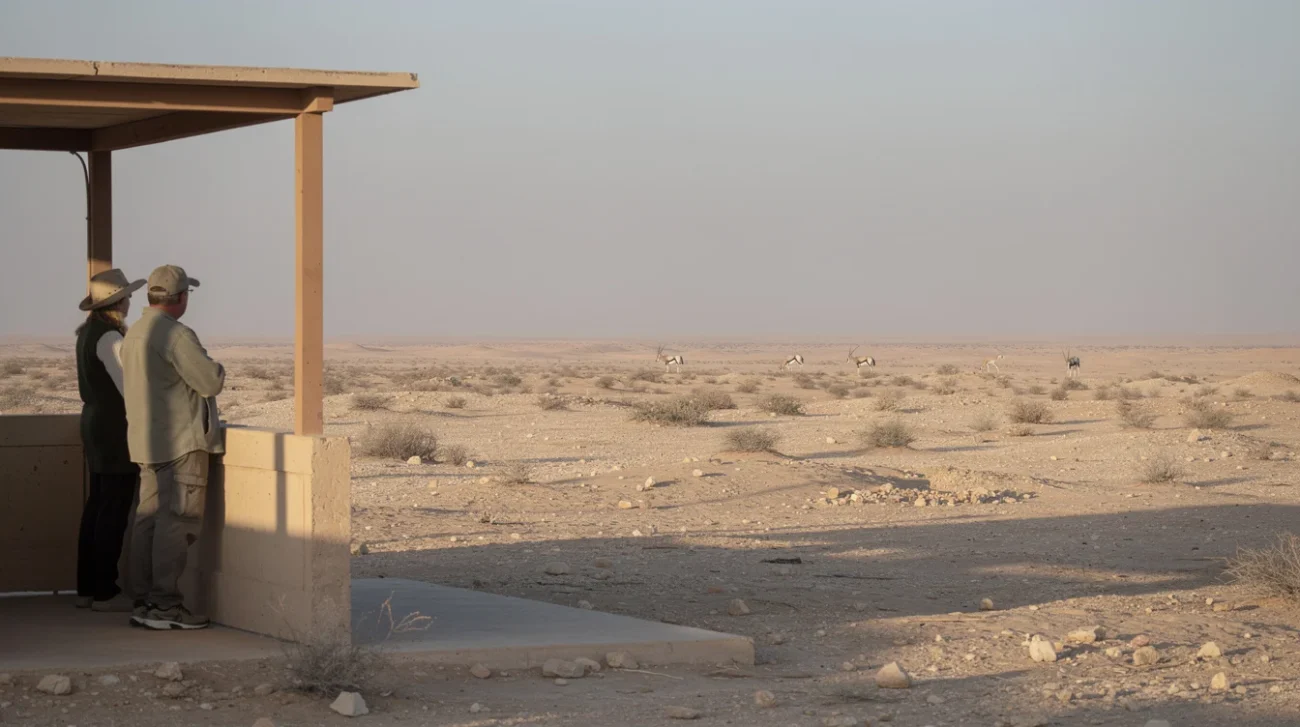
A ticket buys entry. Does it also buy an animal’s appearance? Wildlife tourism often behaves as though it does. Observation decks, panoramic windows and elevated paths turn habitats into compositions, with the animal expected to complete the picture. An empty landscape becomes a disappointing product rather than evidence that another creature has somewhere else to be.
Shomari Wild Reserve, in eastern Jordan near Azraq, makes that expectation worth confronting. Known for its role in Arabian oryx conservation under Jordan’s Royal Society for the Conservation of Nature, it belongs to a landscape where distance is not wasted space. Taking Shomari as its starting point, this debate asks what wildlife viewing architecture should deliver: a rewarding encounter, certainly, but must that encounter always include a visible animal?
PRO: A Better View Can Be a Conservation Tool
The strongest argument for viewing infrastructure is not that visitors deserve entertainment. It is that unmanaged curiosity can be destructive. When people cannot understand where to stand, what to watch or why a boundary exists, they may crowd fences, leave paths or pursue a sighting. A well-positioned viewing point can concentrate human activity instead of allowing it to spread across a habitat. Visibility can protect distance when it makes approaching unnecessary.
At a reserve such as Shomari, that suggests a practical design brief: shaded observation, clear routes, accessible sightlines and optical assistance. A telescope can bring a distant animal into perceptual reach without bringing the visitor physically closer. Comfortable seating can turn a hurried scan into sustained attention. These are design possibilities, not claims about particular installations at Shomari; their value would depend on species-specific assessment and local management.
Snøhetta’s Norwegian Wild Reindeer Centre Pavilion at Hjerkinn offers a useful comparison. Its sheltered viewing space faces an expansive mountain landscape rather than guaranteeing an animal performance. Architecture gives visitors somewhere compelling to remain while the terrain retains its scale. The lesson is not to export its sculptural timber interior to Jordan. It is to make the human position sufficiently rewarding that visitors do not need to occupy the animal’s position too.
PRO: Access Must Mean More Than a Distant Promise
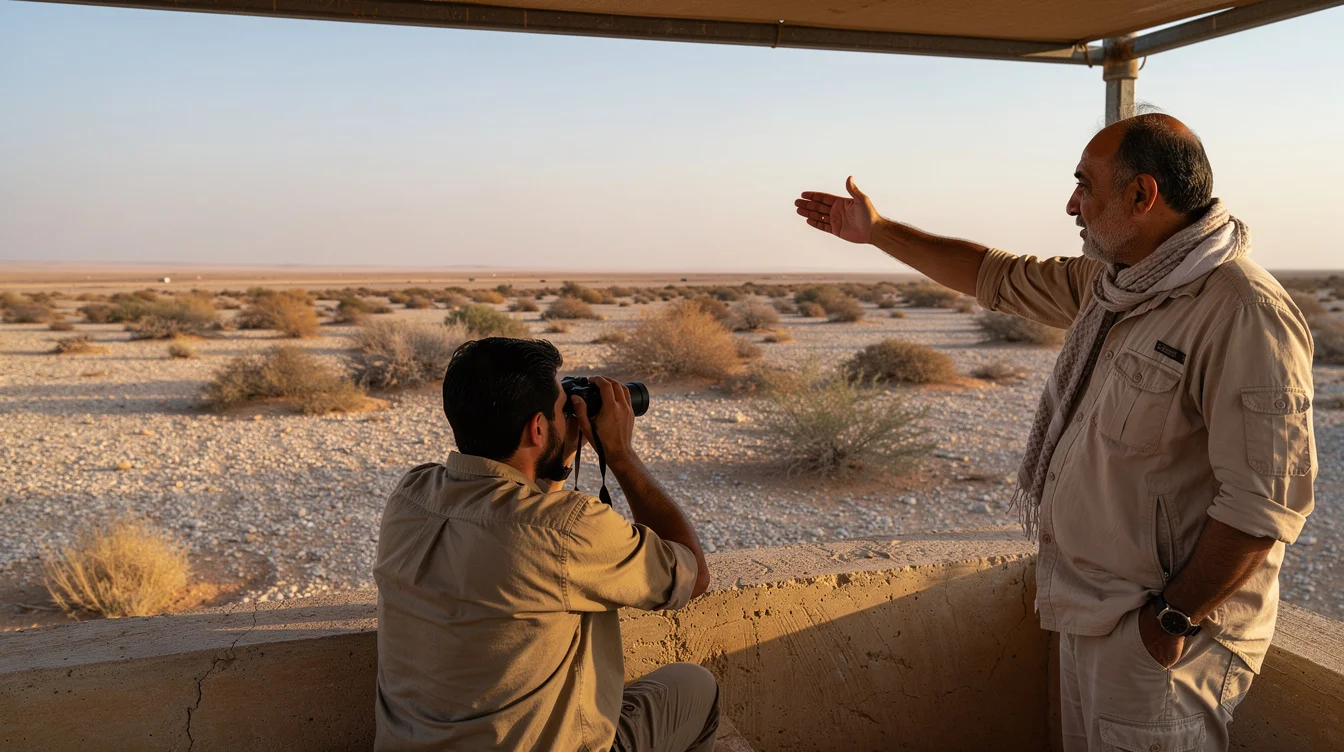
There is also a social problem with romanticising difficult encounters. The patient wildlife enthusiast with expensive binoculars, abundant time and excellent mobility is not the universal visitor. Children, older people, wheelchair users and first-time visitors need infrastructure that makes looking possible. A viewing aperture at only one height is not ethically superior because the building surrounding it is discreet. It is simply exclusionary. As in debates over who has time to participate in democratic housing, access depends on more than a nominal invitation.
The Cornell Lab of Ornithology’s visitor facilities at Sapsucker Woods demonstrate another model: observation connects to interpretation, trails and a wider culture of learning about birds. The encounter is supported rather than merely sold. At Shomari, the equivalent ambition would be to explain Arabian oryx conservation and desert ecology while helping visitors distinguish movement, tracks and habitat features. An animal seen briefly can become meaningful when someone understands what they are seeing.
Nor should architects dismiss the economics. Visitor income and public support can contribute to conservation, although the connection requires transparent accounting rather than promotional assertion. People who leave feeling excluded or misled may be less willing to return or support the institution. A reserve should not promise a sighting, but it should promise a serious experience. Good viewing infrastructure earns its place when it broadens participation, contains disturbance and communicates why conservation matters. Refusing every demand for visibility would surrender those benefits unnecessarily.
CONTRA: The View Can Become an Extraction System
The opposing case begins where that reasonable promise becomes an operational target. Once visitor satisfaction is measured primarily through sightings, every hidden animal starts to look like a design failure. The pressure is predictable: open another sightline, extend another platform, bring the route closer. In more troubling circumstances, feeding or habitat management can become organised around making animals available. A conservation landscape then risks being managed as a stage.
Architecture has a long history of making animal display look progressive. Berthold Lubetkin and Tecton’s Penguin Pool at London Zoo, completed in 1934, turned circulation into a dazzling modernist spectacle. Its architectural fame outlasted its use for penguins. The point is not that formal invention inevitably harms animals, or that a zoo pool is equivalent to Shomari. It is that the prestige of an architectural object cannot establish the adequacy of the habitat it frames. This is also a challenge for preserving buildings designed to change: protecting architectural significance must not make adaptation impossible.
At Shomari, the ethical question is therefore not simply whether visitors can see Arabian oryx. It is whether animals retain meaningful alternatives to being seen. Can they occupy suitable resting and feeding areas beyond visitor attention? Do routes leave sufficiently quiet zones? Those questions require ecological evidence. A panoramic photograph cannot answer them, and a discreet-looking shelter can still sit in precisely the wrong place.
CONTRA: The Right to Disappear Must Be Designed
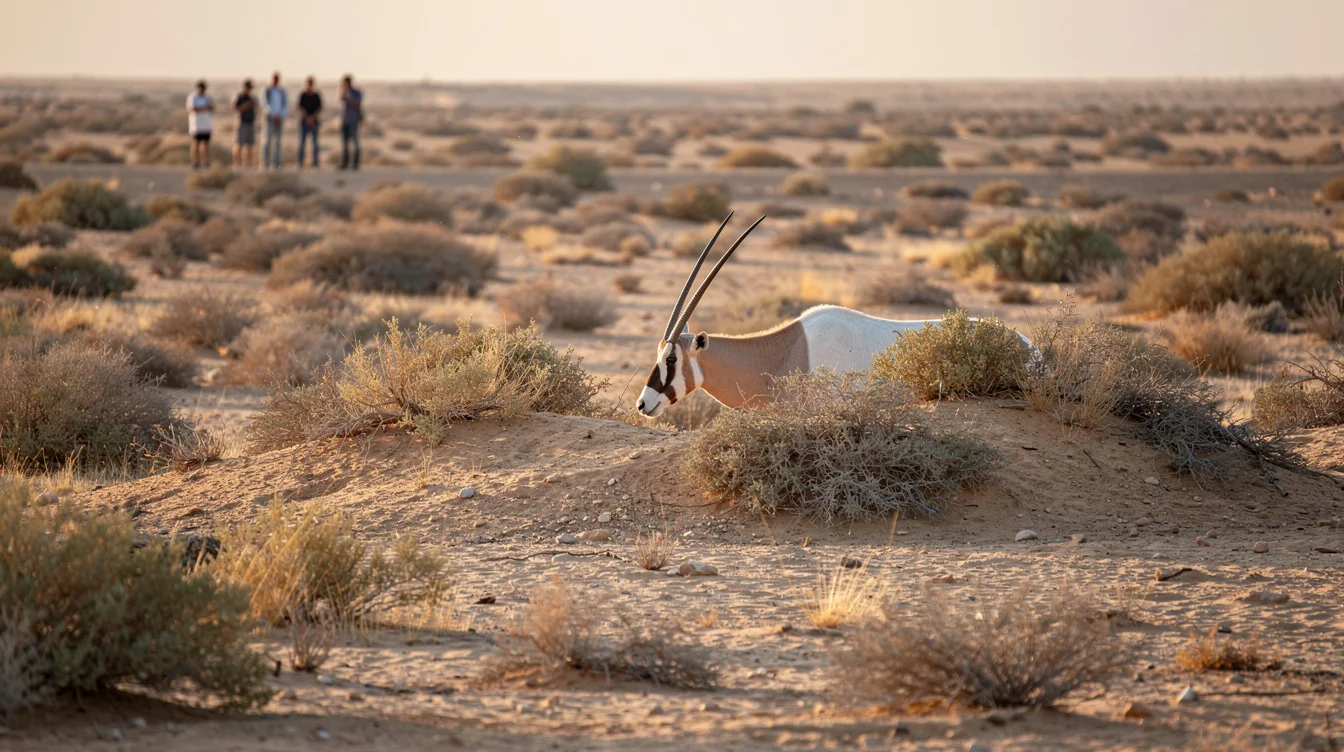
Maximum visibility is a poor measure of success because it treats animal withdrawal as a defect. The better test is whether animals can use appropriate habitat without repeatedly encountering human activity. That does not mean assuming that every unseen animal is comfortable or every visible animal is disturbed. Behaviour, habitat use and responses to visitors must be monitored; invisibility alone is no welfare certificate.
Cedric Price’s work with Frank Newby and Lord Snowdon on the original Snowdon Aviary at London Zoo offers a revealing historical reference. Its walk-through format challenged the conventional separation between spectators and birds. Yet the ambition to create proximity also exposes the central problem: a richer human experience does not automatically establish an animal’s ability to avoid it. Access and retreat must be assessed separately.
For Shomari, a defensible evaluation framework would examine refuge areas, visitor noise, route placement and changes in animal behaviour alongside accessibility and visitor learning. Seasonal closures, screened approaches or limits on group size should remain available where evidence supports them. Guides could interpret tracks and conservation work when animals stay distant, rather than treating those moments as service failures. Designers should also be willing to remove or relocate an unsuccessful viewing point. The provocative conclusion is that a platform may work best when its view remains incomplete: visitors receive access to a landscape, not a claim on every living thing within it.
FAQ: Rethinking the Wildlife Encounter
What makes wildlife viewing architecture responsible?
It supports observation while limiting disturbance and preserving suitable places for animals to retreat. Accessible routes, shade and interpretation matter, but their location must follow ecological assessment rather than the most photogenic angle.
Does keeping animals out of sight improve their welfare?
Not necessarily. Animals need appropriate habitat and opportunities to avoid disturbance, not invisibility for its own sake. Monitoring behaviour and habitat use is more informative than counting either sightings or empty views.
Why is Shomari relevant to this debate?
Its association with Arabian oryx conservation makes the relationship between public access and conservation purpose particularly important. It provides a concrete setting for questioning whether rewarding visits must depend on close or continuous animal visibility.
How can a reserve satisfy visitors without guaranteed sightings?
Set honest expectations before arrival, provide comfortable and accessible observation, and offer skilled interpretation of habitat, tracks and conservation work. Evaluate what visitors learn and how wildlife responds, not simply how many animals appear.
If a wildlife viewing platform gives animals more freedom to remain unseen, should we call the missing view a failure—or the architecture’s greatest achievement?
Get the Mainifesto weekly — curated design debates, speculative ideas and the week's best articles every Saturday.
Editorial Perspectives
Questions and counterpoints developed by the Mainifesto editorial desk to extend the discussion.
Perspective 1
The empty view may be the platform’s finest achievement: it breaks with the menagerie’s old promise that every creature exists for our inspection. After Foucault, we can hardly pretend the viewing apparatus is innocent. Architecture that lets an animal escape our gaze is doing rather more than supplying a picturesque afternoon.
Perspective 2
Calling a missing view architecture’s greatest achievement lets the designer off too easily. At Shomari, animal refuge should be non-negotiable, but the platform still owes visitors a meaningful encounter through careful siting, seasonal access or interpretation. Otherwise, people with money can keep returning until they see something, while everyone else gets a lecture about restraint.
Perspective 3
In restoration, an apparently empty space can hold more history than the bit everyone photographs; I’d be slow to call an unseen animal a failed encounter. But absence isn’t automatically a virtue either. I’d want to know what this platform preserves, what its construction displaced, and whose knowledge shaped where it stands.
Perspective 4
You can’t guarantee wildlife, and trying to do so defeats the point of a reserve. But if you’re paying to build and maintain a platform, it needs to offer something on a quiet day: shade, a decent place to sit, a better understanding of the habitat. The animal doesn’t owe you an appearance; the building still has a job.