A Record Price Cannot Resolve a Painting’s Past

A Record Price Cannot Resolve a Painting’s Past
A spectacular auction result is a remarkably efficient storytelling machine. It supplies a number, a winner and an apparent conclusion. According to Surface, Vincent van Gogh’s Blossoming Chestnut Trees sold for $190.4 million at Sotheby’s in New York amid a restitution claim. The price commands attention. The unresolved ownership question demands something more difficult: sustained scrutiny.
The distinction matters. A successful sale demonstrates that a buyer was willing to transact under particular conditions. It does not, by itself, establish that every historical transfer was legitimate, settle a claimant’s case or erase an earlier injustice. Market confidence is not a verdict on ownership. Yet the visual machinery surrounding an auction can make these different judgments look interchangeable.
Surface’s supplied report does not establish the claim’s evidentiary basis, the parties’ full positions or its legal status. Those omissions are a limit on what can responsibly be concluded here—not permission to declare either side right. The immediate design question is nevertheless concrete: when a painting is presented while its ownership history is contested, where does that contest appear? Beside the work, inside the catalogue’s principal narrative, or somewhere a casual viewer will never reach?
The Auction Room Is Already an Argument
Auction display is not neutral infrastructure. Lighting isolates the painting; generous spacing grants it singularity; a carefully scaled caption supplies institutional assurance. In print and online, the full-page image, scholarly essay and sequence of previous owners manufacture a coherent object of desire. None of these techniques is inherently dishonest. Their hierarchy becomes a problem when uncertainty is technically disclosed but perceptually suppressed.
Brian O’Doherty’s Inside the White Cube exposed how the apparently empty gallery shapes artistic value. An auction preview adds another layer: the room prepares an object for exchange. A restitution claim placed outside that room’s main field of attention is not simply additional information. It is information that the presentation has made easier to disregard.
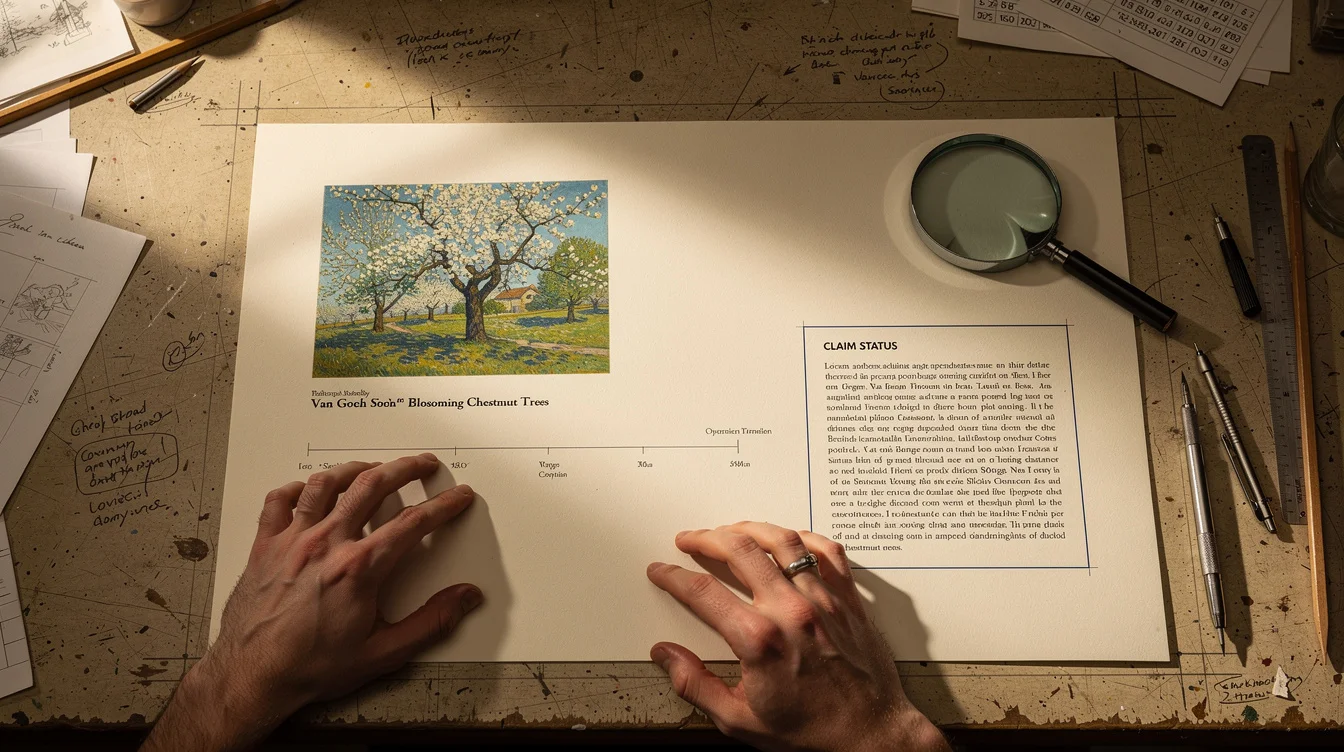
For a painting offered amid an unresolved claim, the principal wall label should therefore carry a concise notice, not merely a reference to sale conditions. It should identify the existence of the claim, distinguish the claimant’s allegation from established facts, summarize the seller’s or auction house’s response where available, and state when the information was last updated.
This is not an argument for a theatrical red warning sign. Alarm can prejudge a dispute as readily as luxury can obscure it. The requirement is proportionate visibility: legible type, ordinary viewing distance and placement that does not require an interested visitor to ask for privileged access.
Design the Catalogue Around Evidence, Not Reassurance
A provenance list can look complete while concealing enormous differences in evidentiary strength. An invoice, a family recollection, a dealer’s stock book and an unexplained gap should not acquire equal authority simply because they share a typeface. Chronology is useful; certainty disguised as chronology is not.
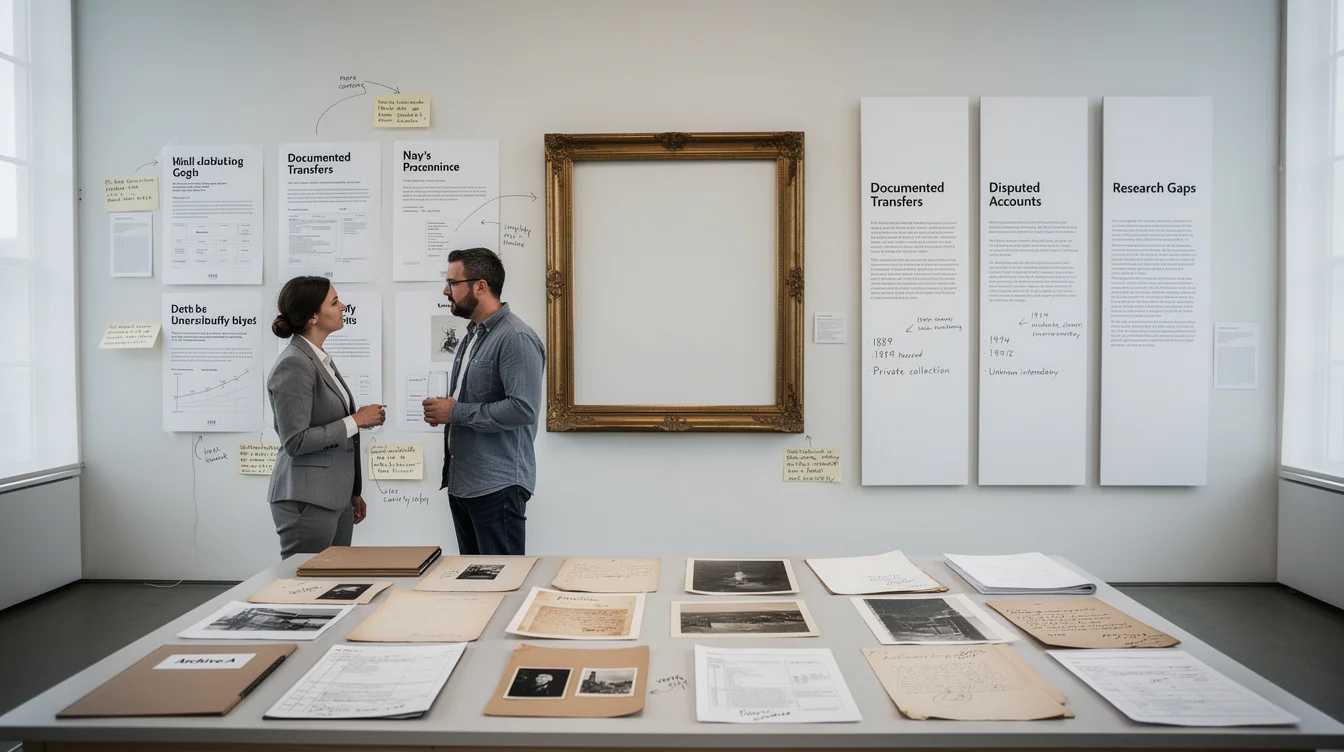
A better catalogue would separate three layers: documented transfers, disputed interpretations and unresolved gaps. Each significant entry could identify its supporting source and any qualification. Where research is incomplete, plain language should say so. Where accounts conflict, the disagreement should be attributed rather than compressed into a reassuringly seamless chain.
Irma Boom’s books demonstrate how sequencing, paper and scale can make reading an active encounter. Sheila Levrant de Bretteville’s socially engaged graphic practice offers a different lesson: a communication system can accommodate multiple voices without pretending they possess identical authority. Neither reference supplies a ready-made restitution template. Both challenge the idea that a catalogue must be a polished monologue.
For this Van Gogh, the design brief should require a prominent claim-status panel beside the principal entry, with a fuller account available in print and online. Digital updates should retain dated versions so that a later settlement or ruling does not silently overwrite what buyers and visitors were originally told. A QR code can extend disclosure; it cannot substitute for disclosure on the page.
Make Uncertainty Precise, Not Spectacular
Transparency has its own potential for abuse. A dramatic ownership timeline can turn dispossession into aesthetic content. Reproduced letters can expose private information. A vague phrase such as “controversial provenance” can stain a work’s history without explaining anything. The answer is editorial discipline, not maximal publication.
Maria Eichhorn’s Rose Valland Institute, presented at documenta 14 in 2017, provides a useful reference for research becoming publicly visible. Its investigation of ownership and property expropriated under National Socialism positioned historical inquiry as substantive work rather than a footnote to cultural prestige. That example does not establish that the Van Gogh claim concerns Nazi-era persecution; the supplied source context does not specify its basis.
The distinction is crucial. The 1998 Washington Principles address Nazi-confiscated art through nonbinding commitments, including provenance research and just and fair solutions. They are not a universal adjudication mechanism for every restitution dispute. Institutions should identify the framework actually relevant to a claim instead of borrowing the moral authority of a familiar category.
Any public dossier should distinguish legal ownership, ethical responsibility and factual uncertainty. It should also protect sensitive personal information and explain why some material cannot be published. Precision gives readers tools to assess competing positions. Spectacle merely gives them another emotionally charged image.
The Next Exhibition Must Not Reset the Story
The auction is only one episode in a painting’s public life. A subsequent museum loan can create a second impression of validation: the object appears beneath an institutional logo, enters an exhibition narrative and receives the reassuring attention of scholarship. None of that necessarily resolves an existing claim.
Fred Wilson’s Mining the Museum, staged at the Maryland Historical Society in 1992–93, demonstrated how selection, adjacency and labels expose histories that conventional displays suppress. Its relevance here is methodological. Exhibition design decides which histories accompany an object and which disappear behind it.
A future exhibition of the Van Gogh should not allow “sold for $190.4 million” to become the only accessible account of its recent history. If the claim remains unresolved, a concise, updated explanation belongs in the gallery. If it has been settled, withdrawn or adjudicated, the label should describe that outcome accurately, subject to legitimate confidentiality limits. A confidential agreement should not be paraphrased as public proof that one side was right.
Loan planning should establish who supplies provenance information, who checks it and who authorizes updates. Exhibition designers need that material before layouts are finalized. Otherwise, disclosure becomes the small paragraph squeezed into the space left after the painting, sponsor credits and interpretive essay have taken their places.
A Price Is a Result, Not an Acquittal
The practical standard should be simple: the unresolved claim must travel with the public presentation of the work. That does not mean every poster needs a legal dossier. It means the main catalogue entry, auction preview label, public collection page and exhibition label should not tell materially incompatible stories.
Hans Haacke’s Manet-PROJEKT ’74, which investigated the ownership history of Manet’s Bunch of Asparagus, remains a pointed precedent. Provenance was not decorative scholarship attached to the painting. It became a way to examine the social and political structures surrounding cultural possession. The uncomfortable implication survives: ownership history is part of what an artwork means in public.
For auction houses and museums, implementing this principle requires resources. Researchers need time; editors need access to evidence; claimants need a clear route to submit corrections; designers need room to make distinctions readable. A claimant should not control the label, and neither should a consignor’s marketing priorities. Institutional responsibility lies in accountable synthesis.
The $190.4 million figure will remain an irresistible headline. But a culture capable of assigning extraordinary financial value to a painting should be capable of presenting a few hundred careful words about its disputed past. Anything less is not elegant restraint. It is a decision about whose history deserves to be seen.
FAQ
Does an auction sale resolve a restitution claim?
No. A sale alone does not adjudicate a claim or establish that every previous transfer was legitimate. Resolution depends on the relevant facts, applicable law and any settlement or authoritative decision.
What should an auction catalogue disclose?
It should clearly identify an unresolved claim, attribute competing positions, distinguish documented ownership from gaps or disputed transfers, and provide a dated route to fuller information. Disclosure should be prominent rather than confined to fine print.
Should museums exhibit works with contested provenance?
Not automatically, and not automatically never. Museums should assess legal and ethical risks, consult relevant parties where appropriate and explain the dispute if they proceed. Exhibition must not imply that institutional display has settled ownership.
How should labels change after a claim is resolved?
Labels should state the outcome accurately and date the update. A settlement, withdrawal and court decision are different events. Institutions should preserve earlier public versions and avoid implying that confidential terms prove more than they disclose.
If a painting’s price earns the largest headline, what obligation do the institutions displaying it have to give its contested past comparable visibility?
Watch the Mainifesto Short
Get the Mainifesto weekly — curated design debates, speculative ideas and the week's best articles every Saturday.
Editorial Perspectives
Questions and counterpoints developed by the Mainifesto editorial desk to extend the discussion.
Perspective 1
We fuss over frame profiles, wall finishes and the exact warmth of a spotlight; the provenance label deserves that same care. Put the disputed history beside the painting, in type people can actually read—not in a footnote that disappears into the room.
Perspective 2
A catalogue has a hierarchy, and making the price prominent while burying provenance is a design decision. Why not give ownership history a visible timeline, with gaps and disputed transfers clearly marked? The harder question is who gets to define what counts as disputed.
Perspective 3
In restoration, a beautiful finish can hide the very history a building should reveal. A museum should resist that same temptation: name the contested transfers and the people making claims, without pretending a short label can settle them. A record price is not a clean title.
Perspective 4
In manufacturing, a polished product doesn't excuse a hole in the traceability record. Auction houses and museums should put documented ownership, missing records and unresolved claims in the main information panel, not behind a QR code. If they can make the sale figure instantly legible, they can make uncertainty legible too.