Why Must Visitors Move When Art Could Come to Them?
Why Must Visitors Move When the Art Could Come to Them?
The gallery has a preferred visitor: someone who can stand, walk, turn, wait and repeat. Seating, when provided, often feels like an apology tucked against a wall. We call this arrangement neutral because its demands are so familiar. It is not neutral. It distributes access according to stamina.
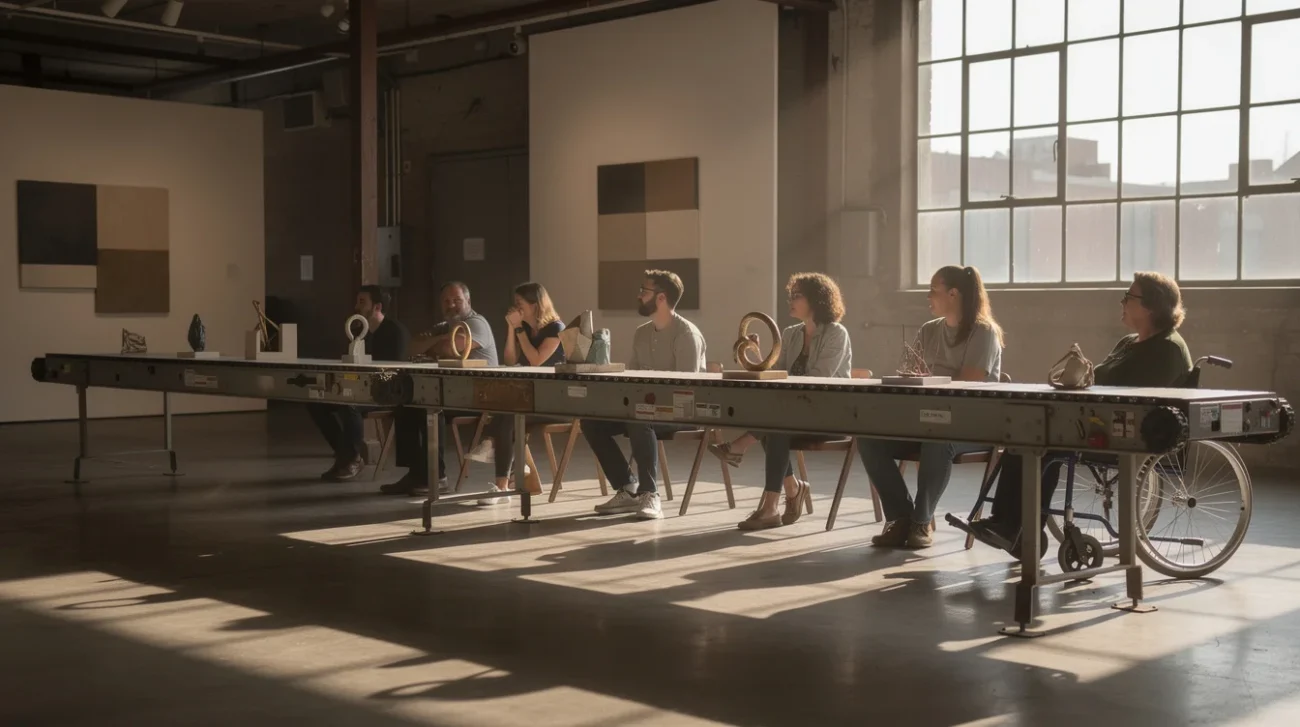
New York City-based artist Finnegan Shannon reverses that relationship in There’s No Me Without You, a conveyor-belt installation at Pioneer Works in Brooklyn. Art moves rather than requiring every visitor to circulate. According to Pioneer Works, quoted in Dezeen’s report, the installation fulfils Shannon’s “longtime fantasy of an exhibition space that would meet their access needs”.
That reversal deserves more than applause for an ingenious mechanism. It poses a difficult design question: does reducing the labour of looking also increase the freedom to look? A moving display can relieve physical demands while introducing another authority—the exhibition’s timetable.
PRO: Stop Making Endurance the Price of Admission
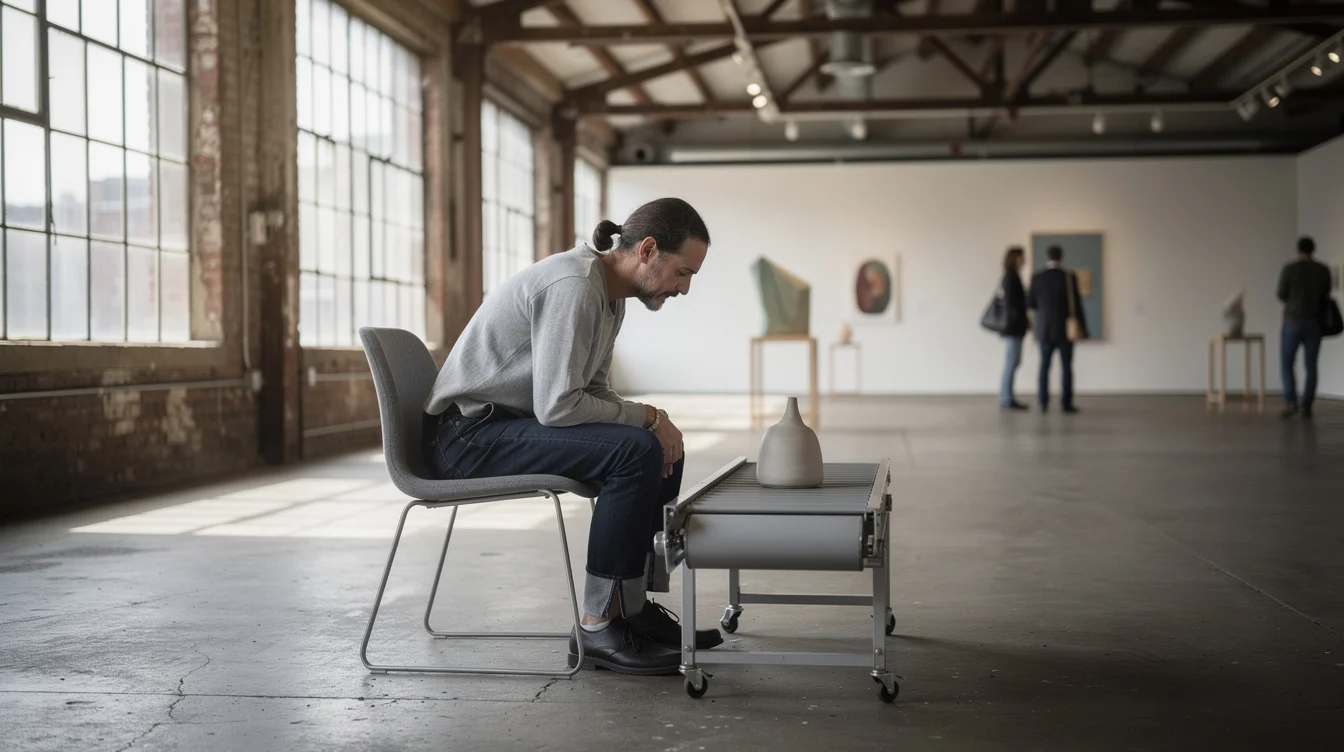
Shannon’s strongest proposition is not that conveyor belts belong in every museum. It is that visitors should not have to perform physical competence before receiving an aesthetic experience. For someone managing chronic pain, fatigue or difficulty standing, the distance between two works can matter as much as the distance between home and the institution. A step-free entrance does not make an exhausting exhibition accessible.
Shannon has already challenged this hierarchy through Do you want us here or not, a project that uses benches and cushions bearing direct messages about sitting and belonging. These objects expose an institutional contradiction: galleries invite contemplation while frequently withholding the bodily support contemplation requires. A seat is not the opposite of engagement. It can be its infrastructure. The broader question—whether inclusion requires changing the institution itself—also runs through debates about Black design’s place within the museum.
The conveyor extends that argument from furniture to choreography. Instead of asking where a tired visitor might recover, it asks why recovery must be separated from viewing. Consider the familiar choice between resting on a distant bench and approaching a small object closely enough to examine it. That is not simply a personal inconvenience; it is a design decision with unequal consequences.
The radical move is to treat conserving energy as a legitimate way of participating, not as evidence that someone has failed to experience the exhibition properly.
PRO: Make the Institution Do Some of the Work
Architecture routinely choreographs bodies and then disappears behind the language of experience. Frank Lloyd Wright’s spiral ramp at the Solomon R. Guggenheim Museum makes circulation inseparable from looking. Its celebrated continuity also demonstrates that an exhibition route is never merely a route: slope, distance and stopping points shape encounters with art.
Shannon makes that choreography conspicuous by assigning movement to a machine. A conveyor is normally associated with manufacturing, logistics and checkout counters. Redirecting it towards access unsettles the assumption that efficiency must mean processing more visitors. Here, the more compelling ambition is to reduce what the institution demands of each body.
That shift could benefit people with very different circumstances: a visitor with limited standing tolerance, someone recovering from surgery, or an older person who wants to spend their available energy discussing a work rather than reaching it. These needs should not be treated as interchangeable. Their overlap nevertheless reveals how narrow the default gallery script has become.
Charles and Ray Eames’s exhibition design, including Mathematica: A World of Numbers… and Beyond, offers a useful precedent for treating display systems as active mediators rather than invisible supports. Shannon brings an explicitly bodily challenge to that tradition. The display is not merely explaining content; it is questioning who must expend effort to encounter it. That is a legitimate artistic subject, not a facilities problem masquerading as art.
CONTRA: A Moving Display Can Become Another Gatekeeper
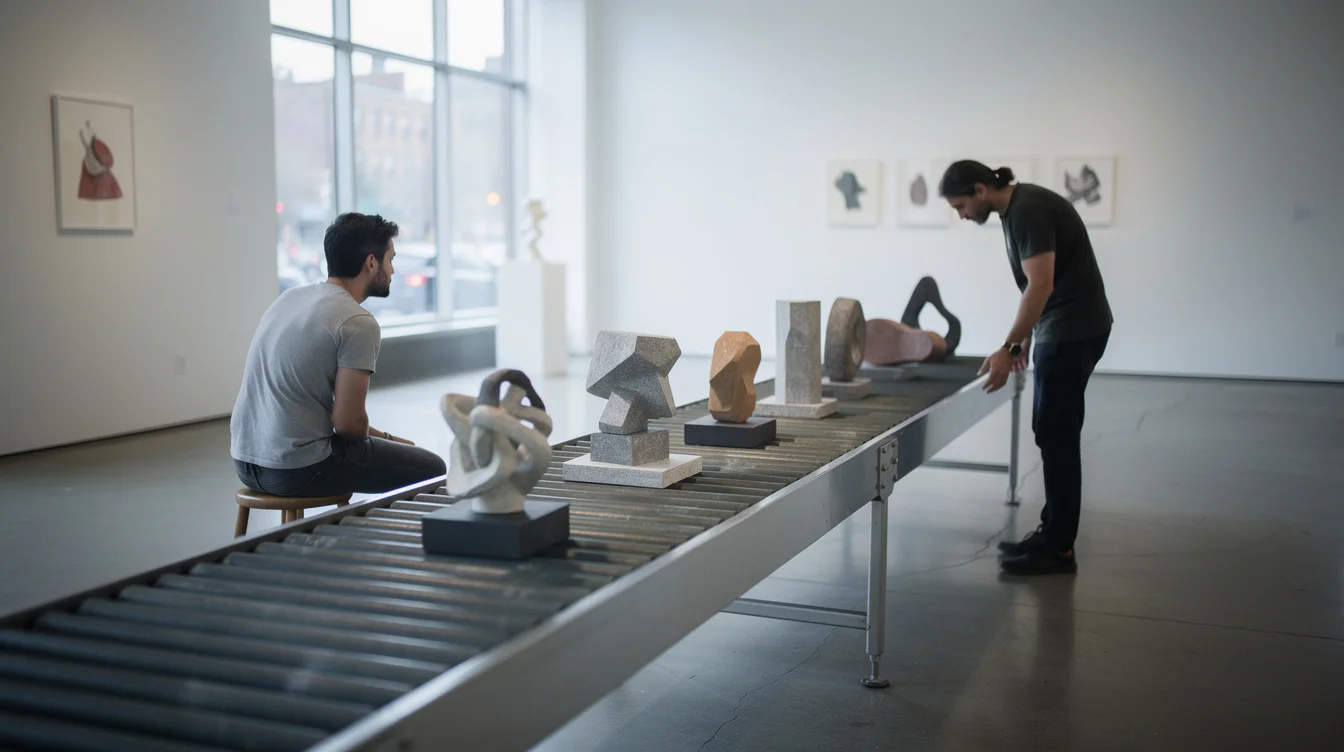
But a conveyor does not abolish choreography. It reallocates control. In a conventional gallery, a visitor who can navigate the space may stop before one painting for twenty minutes and pass another in seconds. When the object moves, the encounter can acquire an externally imposed duration. Relief from walking is not automatically freedom from pressure.
Imagine studying a small ceramic vessel. You notice an irregular rim, then a repaired seam, then a glaze change that only becomes legible from another angle. If the work travels away before those observations connect, the mechanism has interrupted attention. Another circuit might offer a second chance, but waiting for recurrence is not equivalent to choosing uninterrupted time.
This is a design risk, not a claim about the specific speed, controls or viewing options at Pioneer Works. The supplied account establishes the conveyor concept; it does not establish how every visitor can pause, approach or revisit each object.
Lygia Clark’s hinged metal Bichos offer a sharp historical comparison. Conceived for manipulation, they make the participant’s decisions integral to the encounter, even though conservation often constrains handling today. The lesson is not that every artwork should be touchable. It is that agency has material conditions. A display can appear participatory while leaving its most important decisions elsewhere, echoing the distinction between watching architects work and having a voice.
CONTRA: Access Requires Choices, Not a New Universal Route
The strongest criticism of conveyor viewing is therefore not that it disrupts the traditional gallery. Disruption is overdue. It is that one alternative can become another universal prescription. Some visitors need a predictable rhythm; others need extended pauses. Some benefit from remaining seated; others need to change position frequently. A display height that serves one person may obstruct another’s sightline.
Ronald Mace’s universal-design thinking offers a productive test here. The principles developed by Mace and colleagues include flexibility in use and low physical effort. Neither principle cancels the other. A system that reduces exertion but narrows control solves only part of the problem.
Possible responses include stationary viewing opportunities alongside moving displays, clear information about timing, and seating that does not block routes or force a single viewing distance. These are proposals for the exhibition type, not reported features of Shannon’s installation. Visitor-operated pauses might help, but they introduce a collective negotiation: whose request governs a belt shared by several people?
Maintenance matters too. Motor noise, vibration, breakdowns and staff procedures belong in the access brief, not an appendix. An exhibition that depends on machinery needs a dignified alternative when that machinery stops. The critical standard should therefore be neither movement nor stillness. It should be meaningful choice over the conditions of attention. Otherwise, the gallery merely trades the compulsory walking tour for a compulsory timetable.
FAQ: Moving Art, Access and Visitor Agency
What is Finnegan Shannon’s conveyor-belt installation?
There’s No Me Without You is an installation at Pioneer Works in Brooklyn that uses a conveyor belt to display art. It challenges the expectation that visitors must move through an exhibition and connects that reversal to Shannon’s own access needs.
How can moving artworks improve accessibility?
Bringing artworks past a viewing position can reduce the need to walk repeatedly or stand for extended periods. Its usefulness still depends on seating, sightlines, viewing distance, sensory conditions and the opportunity to spend enough time with individual works.
What could visitors lose when the display moves?
Depending on the system, visitors could have less control over how long an artwork remains nearby or which angle they view it from. This is a potential trade-off, not a verified description of every viewing option in Shannon’s installation.
Should conveyor belts replace conventional gallery layouts?
No single layout can meet every access need. The more valuable lesson is to offer different ways of encountering art and to develop those choices with disabled visitors, rather than assuming that either circulation or stillness suits everyone.
If a gallery can move art to spare our bodies, how much control over the encounter should we be willing to hand it?
Watch the Mainifesto Short
Get the Mainifesto weekly — curated design debates, speculative ideas and the week's best articles every Saturday.
Editorial Perspectives
Questions and counterpoints developed by the Mainifesto editorial desk to extend the discussion.
Perspective 1
The supposedly free gallery visitor already follows a choreography of doorways, benches and curatorial importance; let us not romanticise the aching feet. Shannon’s conveyor makes that apparatus visible—a useful institutional critique—and I would gladly surrender some control over pace in exchange for art that comes to a seated body.
Perspective 2
I wouldn’t trade walking fatigue for a conveyor belt that decides when I’m finished looking. Give visitors seats and control over what comes next; otherwise you’ve bought a maintenance bill and called it a better experience.