
A Car That Can Fly—but Where Should It Be Allowed To?
A Car That Can Fly—but Where Should It Be Allowed To?
The most consequential thing about a flying car is not that it leaves the ground. It is that everyone around it has organised their movements around the assumption that it will stay there.
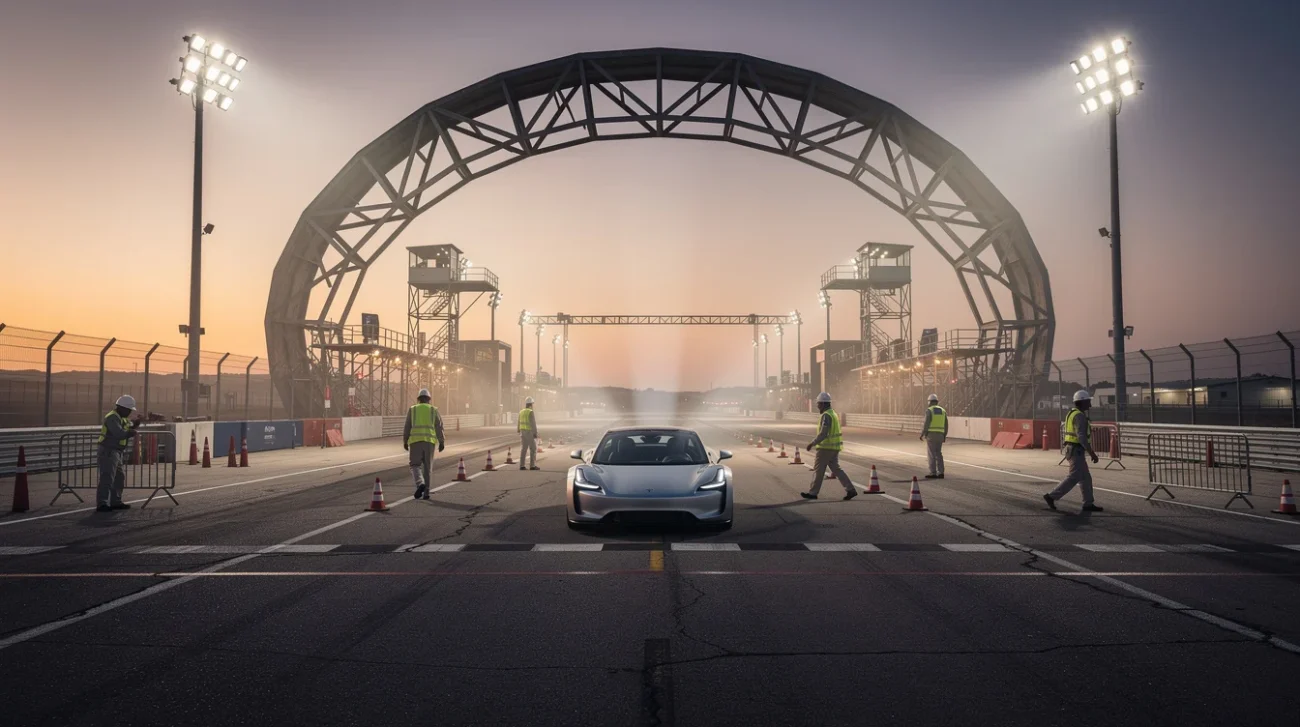
According to Dezeen’s 16 October 2026 report, Tesla unveiled its thruster-equipped Roadster concept at a live demonstration in Texas. The two-seat electric car drove up a half-pipe, travelled upside down, flipped off a ramp and briefly flew. Tesla claims its compressed-air thrusters will help make it the world’s quickest production car. Those are reported demonstration details and a manufacturer’s performance claim—not evidence that the vehicle is ready for unrestricted road use.
The distinction matters. A ramp, a rehearsed sequence and a controlled venue establish conditions that an ordinary street cannot promise. Brief airborne movement also does not establish sustained flight, usable range in the air or an approved operating category.
The design question is therefore not whether Tesla can make a car fly. It is whether a product should retain access to extraordinary capabilities in places where other people cannot reasonably anticipate them. The Roadster makes that question spectacular. Public space makes it unavoidable.
The Street Is a Contract About Behaviour
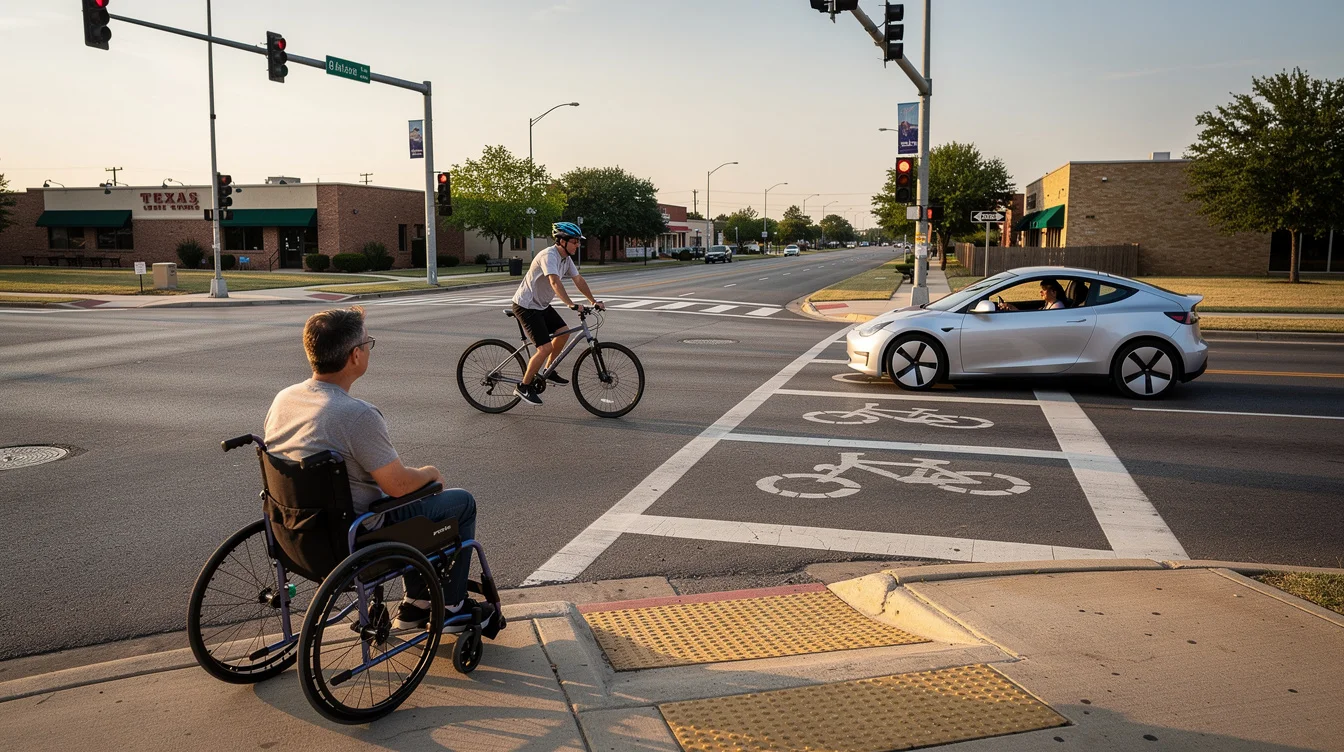
A road is more than a surface engineered to carry weight. It is a system of shared expectations: vehicles generally follow lanes, stop at signals and remain within an envelope that pedestrians can judge. Those expectations are imperfect, but they make crossing a street possible without calculating every approaching machine’s maximum capabilities.
Consider a person waiting beside a raised crossing, a cyclist passing a stationary queue or a maintenance worker beneath a low structure. Each reads a vehicle through familiar cues: wheel direction, speed, distance and available stopping space. An unexpected thrust-assisted manoeuvre could disrupt that reading even without becoming airborne. Vertical movement adds further questions about clearance, landing position and what occupies the space below.
Hans Monderman’s shared-space experiments in the Netherlands attempted to make road users negotiate more attentively by reducing conventional traffic controls. Whatever their limitations, including accessibility concerns, the underlying proposition depended on behaviour remaining legible. A street cannot negotiate with a capability it cannot perceive.
This is the provocation behind the Roadster: spectacular performance is private excitement with potentially public consequences. A purchaser may accept the risk of a stunt. A wheelchair user at the next crossing has neither purchased the experience nor agreed to participate. That tension between technical capability and responsibility also runs through the ethics of dual-use wheel design.
A Demonstration Is a Designed Environment
Stunts are not the opposite of design discipline. Successful ones depend on it. Ramp geometry, surface condition, vehicle preparation, timing and separation from spectators turn an extreme manoeuvre into a bounded event. The source report does not establish the details of Tesla’s safety arrangements, but these are precisely the variables any credible assessment would need to examine.
Land-speed projects such as ThrustSSC illustrate the distinction between a machine’s achievement and its suitability for everyday transport. A purpose-built vehicle operating on a prepared course does not offer a template for negotiating a school junction. Nor does a record attempt demonstrate how a vehicle behaves after years of imperfect servicing.
The relevant evidence would therefore extend far beyond a successful jump. How does a thruster-equipped car respond to crosswinds, uneven loading, wet pavement or a failed sensor? What happens if compressed-air pressure is lower than expected halfway through a manoeuvre? Where is the vehicle allowed to come down if the intended landing area becomes occupied?
These are questions, not established defects in Tesla’s concept. They expose the gap between showing that something can happen and demonstrating that it can happen reliably under specified conditions. A product launch sells the exceptional moment. Safety engineering must account for everything around it.
The Essential Feature Might Be a Refusal
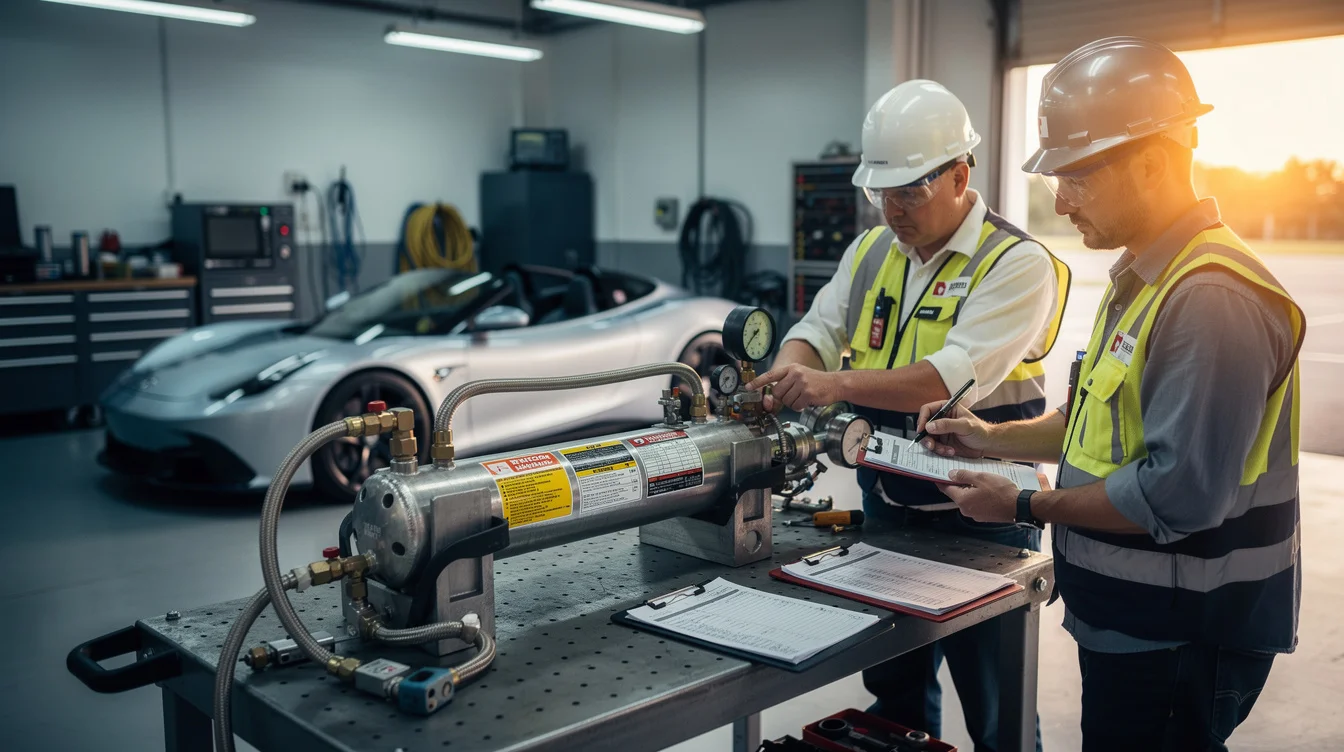
If this capability reaches customers, its most important interface may be the one that says no. A warning screen asking drivers to accept responsibility is not a sufficient boundary between a closed-course stunt and a public junction.
Don Norman’s writing on constraints offers a useful design reference: safer systems do not merely explain undesirable actions; they make certain mistakes difficult or impossible. Here, that could mean a physically and electronically separated road mode that prevents airborne manoeuvres, rather than a dramatic button accompanied by small print.
Exceptional operation would require more than recognising a location on a map. A plausible authorisation system would combine approved-site verification with vehicle diagnostics, sufficient pressure reserves, confirmed course clearance and trained supervision. Geofencing could contribute, but positioning errors, outdated maps and unauthorised software changes make it an inadequate safeguard on its own.
Failure behaviour would also need to depend on the vehicle’s state. Before a manoeuvre begins, uncertainty should normally prevent activation. Once airborne, abruptly disabling a system might create a worse outcome; the design would need a validated strategy for maintaining control and reaching the safest achievable landing.
Predictability must be engineered into the machine, not outsourced to the owner’s judgement. That includes understandable mode indicators, tamper resistance and verification that a software update has not silently weakened the operating boundary.
Permission Should Attach to a Place and a Mode
The choice need not be between banning the vehicle and allowing every advertised capability everywhere. Cars already operate under different conditions on public roads and private circuits. The Roadster suggests that this distinction may need to become part of the product’s architecture rather than remaining a rule printed in its documentation.
Volvo’s decision to cap new cars at 180 kilometres per hour, introduced in 2020, offers a modest but relevant precedent: a manufacturer can define restraint as a product characteristic. A thruster-equipped vehicle demands a more contextual version of that idea. Ordinary road operation and exceptional closed-course operation should be demonstrably different states.
For airborne demonstrations, an approved venue might need clear zones, controlled access, suitable overhead clearance and emergency arrangements. Those provisions would have to follow evidence about actual trajectories and failure conditions, not an assumed radius around a spectacular launch point. Calling a space private does not prevent consequences from reaching beyond its boundary.
The category question also remains open. Depending on the jurisdiction and final design, airborne operation could raise aviation as well as vehicle-regulation issues. A brief flight does not automatically settle that classification. Regulators would need to assess the specific capability and intended use—not simply accept either the familiar label “car” or the promotional label “flying car”.
Do Not Rebuild the City Around a Party Trick
Architecture becomes implicated the moment an exceptional vehicle asks the city to accommodate it. Would streets need additional exclusion zones? Would parking operators need new inspection procedures? Could emergency crews safely approach damaged compressed-air equipment? Each question transfers part of the product’s complexity to people who did not design or buy it. At a different scale, the responsibility of running a smarter home raises a similar question: who takes on the work that added capability creates?
That transfer should face resistance. NACTO’s urban street design guidance treats streets as public spaces serving multiple users, not simply as channels for maximising vehicle performance. The same principle should govern this debate: new mobility must justify its demands on the street, rather than treating the street as unfinished infrastructure for its ambitions.
A credible deployment case would include independent testing, service requirements for pressurised components, incident-data access with privacy protections, emergency-response guidance and clear responsibility for software-controlled operating limits. Approval should address the condition of vehicles in use, not merely their factory configuration. A safeguard that disappears after a modification or deteriorates unnoticed is not a durable safeguard.
None of this requires hostility to experimentation. Keep the ramp. Keep the audacious prototype. But separate experimentation from entitlement. The mature design achievement would not be a car that can fly anywhere. It would be a car that knows—and can reliably enforce—where its extraordinary behaviour does not belong.
FAQ
Has Tesla demonstrated an everyday flying car?
The supplied Dezeen report describes brief flight during a controlled Roadster demonstration. It does not establish sustained aerial travel, everyday operational reliability or approval for airborne use on public roads.
Why are compressed-air thrusters a public-road design issue?
They potentially extend the vehicle’s behaviour beyond what surrounding road users expect. Assessment would need to examine acceleration, controllability, pressure-system integrity and any airborne manoeuvres, including their effects on people nearby.
Would geofencing make extraordinary manoeuvres safe?
Not by itself. Location restrictions would need support from vehicle diagnostics, tamper-resistant controls, verified site conditions and validated failure responses. Being inside an approved area does not mean that area is clear or safe.
Where should airborne Roadster demonstrations be permitted?
A defensible starting point is specially assessed, access-controlled venues with adequate clearance, trained operators and emergency arrangements, subject to applicable approvals. Public-road operation should exclude airborne manoeuvres unless a rigorous, specific safety case establishes otherwise.
If a vehicle’s most exciting capability makes shared space less predictable, should the manufacturer restrict the machine—or should everyone else be expected to adapt?
Watch the Mainifesto Short
Get the Mainifesto weekly — curated design debates, speculative ideas and the week's best articles every Saturday.
Editorial Perspectives
Questions and counterpoints developed by the Mainifesto editorial desk to extend the discussion.
Perspective 1
A street is already a negotiation over scarce space; adding flight does not erase the people underneath. Restrict the machine first, especially where enforcement is uneven—otherwise wealthy drivers get a new freedom and everyone else inherits the risk.
Perspective 2
We can model a takeoff zone, but can a pedestrian understand its boundary without an app? I’d keep flight disabled outside designated sites until that boundary is both technically reliable and obvious at street level.
Perspective 3
A spectacular demonstration tells me almost nothing about how the system behaves after years of vibration, poor maintenance, and replacement parts. Before enabling flight around other people, the manufacturer needs to demonstrate safe failure modes and specify which inspections keep that capability available.
Perspective 4
As spectacle, a Roadster lifting off is irresistible; as a daily encounter outside your apartment, perhaps less so. Let it fly in controlled venues, but don’t mistake an audience’s appetite for a viral stunt for public consent to live beneath it.