
Airless Wheels and the Ethics of Dual-Use Design
The Same Wheel Can Carry a Casualty—or Ammunition
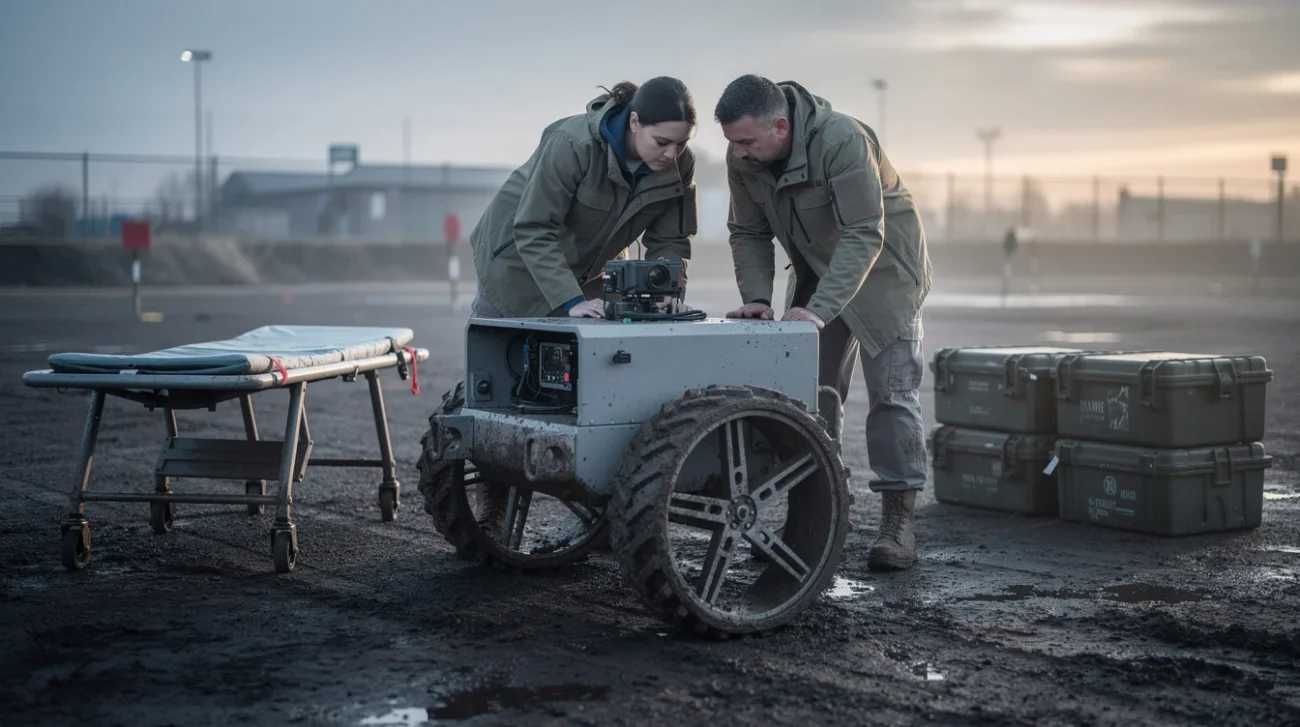
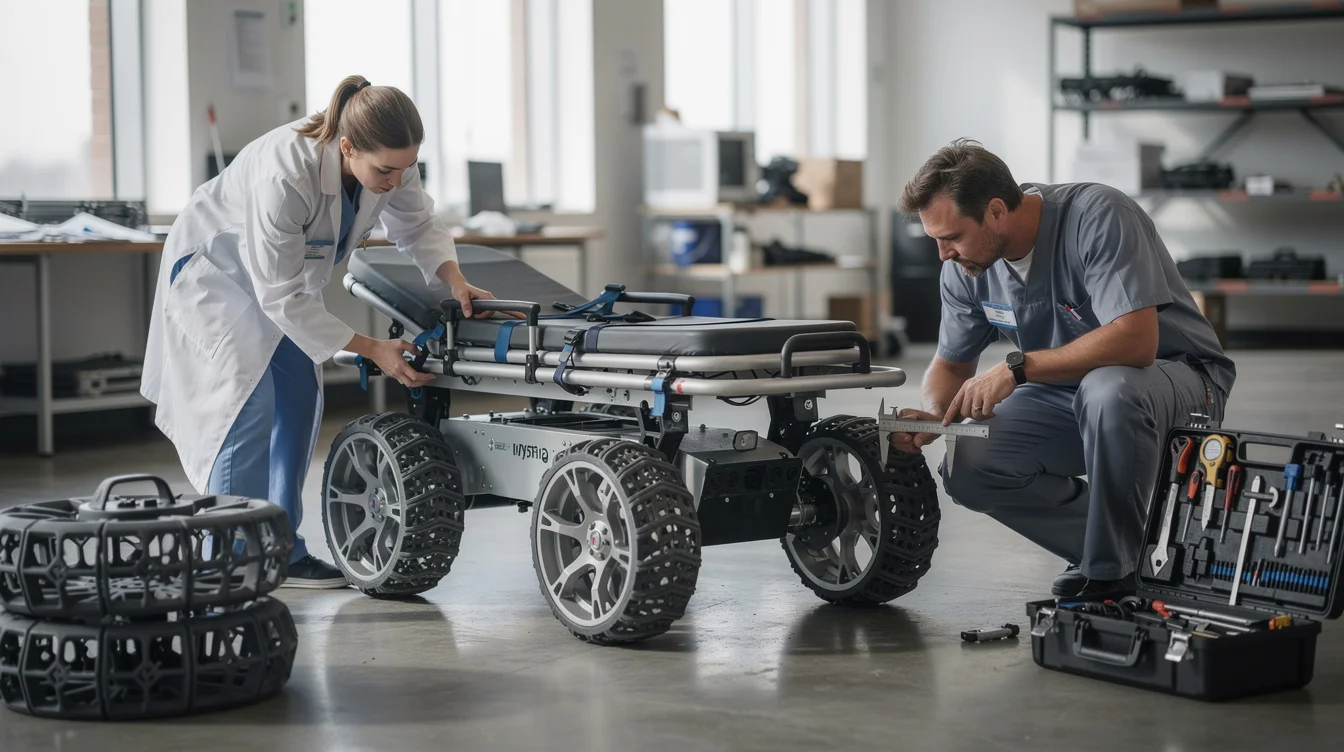
A wheel has no conscience. Its designers, manufacturers and publicists do. Developed by print&live and iSCALE3D, arkan is a set of 3D-printed airless wheels for unmanned ground vehicles used in casualty evacuation, ammunition transport and logistical support. Those applications belong in the same sentence. Separate them, and a component that supports battlefield mobility becomes an uncomplicated rescue story.
Designboom’s coverage foregrounds bringing wounded people to safety. That is a legitimate application, but not a complete ethical description. Arkan poses a harder question than whether military technology can save lives: how should designers take responsibility when saving lives and sustaining combat depend on the same product?
PRO: Reducing Exposure Is a Real Design Achievement
The strongest argument for this work begins with the person who would otherwise have to enter danger. A ground vehicle carrying a casualty can potentially reduce the number of rescuers exposed along an evacuation route. A vehicle carrying supplies can likewise replace a dangerous human journey. Neither benefit becomes imaginary because the surrounding institution is military.
There is an established design lineage here. PackBot, originally developed by iRobot, became associated with bomb disposal and hazardous reconnaissance: tasks in which sending a machine ahead can protect a person. It is not an equivalent to arkan, nor evidence of arkan’s performance. It illustrates a defensible principle: design can move human vulnerability away from the point of maximum danger.
Airless wheels address one part of that problem. Without a pressurized air chamber, they eliminate the conventional failure mode of losing inflation. Michelin’s Tweel provides a familiar commercial reference for the broader category. But “airless” does not mean indestructible, and additive manufacturing does not automatically mean field repairability. Structural damage, traction, load capacity and the availability of replacements still matter.
The supplied source context offers no independent test results for arkan. Its humanitarian promise should therefore be presented as an application, not a verified outcome. That distinction strengthens the argument for responsible engineering: if lives may depend on a wheel, measured performance deserves more attention than an uplifting headline. The gap between persuasive presentation and physical performance also raises questions about how AI design education should account for real-world constraints.
PRO: Responsibility Can Be Built into Development
Rejecting every component that might sustain combat would also reject equipment that protects wounded people. The same battery, stretcher mount or navigation system can serve different missions. A blanket prohibition on such development mistakes ethical clarity for distance from difficult circumstances. Refusal is sometimes justified; it is not automatically the most protective choice.
A better defense of arkan would make responsibility operational. Designers could specify separate evaluation requirements for casualty evacuation and cargo transport. A casualty is not simply a fragile payload: vibration, restraint, posture, loading time and access for medical care all become design questions. These are proposed responsibilities for the vehicle-development team, not documented features of these wheels.
The International Committee of the Red Cross’s Health Care in Danger initiative offers a useful reference point: protecting health care requires attention to practices and systems, not merely equipment. A wheel supplier cannot solve evacuation medicine, but it can refuse to imply that mobility alone delivers medical safety.
Communication should follow the same discipline. Publish intended applications together. Explain what has been tested, under which loads and conditions, and what remains uncertain. Invite independent technical and clinical scrutiny where feasible. The credible pro position is not that humanitarian intent purifies a military product. It is that a product’s protective contribution can justify development when that contribution is evidenced, limitations are explicit and responsibility continues after delivery.
CONTRA: The Rescue Story Can Launder the Supply Chain
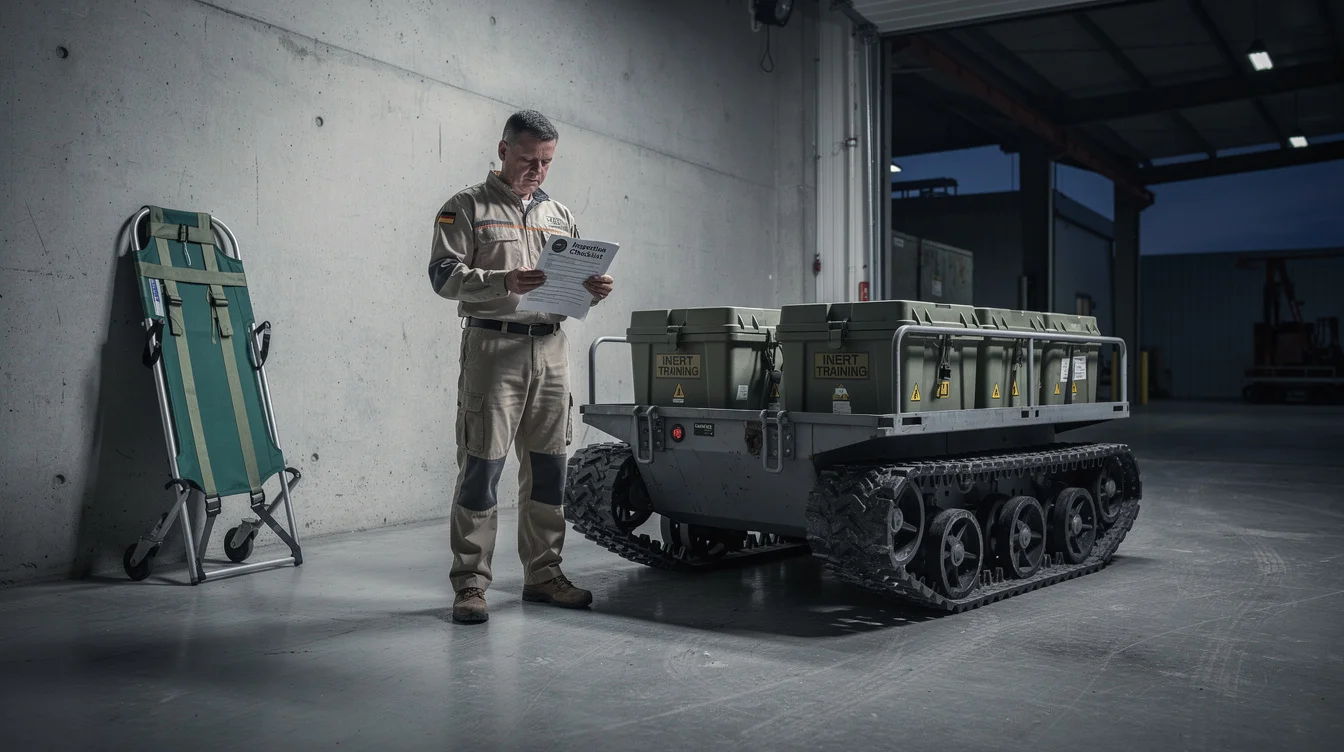
The strongest objection is not that casualty evacuation lacks value. It is that its moral force can become a promotional shield for everything else a product enables. An ammunition carrier does not merely move objects. It supports the ability to continue fighting. When the same wheel serves both roles, describing it principally through rescue risks turning a partial truth into an ethical alibi.
This is where design media must examine its own machinery. A photograph of an empty evacuation stretcher suggests care. A photograph of stacked ammunition containers suggests combat logistics. Neither image is necessarily false, but choosing only the first organizes the reader’s judgment before technical details appear. Editorial framing becomes part of the product’s public legitimacy.
Victor Papanek’s Design for the Real World remains an uncomfortable reference because it challenges designers to consider the consequences of what they help produce, rather than treating a commission as its own justification. Applied here, that means looking beyond the immediate user to the wider system whose capacity the component increases. In a different setting, the bystander problem with smart glasses raises the same foundational question: who bears the consequences of a product they did not choose to use?
There is no evidence in the supplied context that print&live or iSCALE3D deliberately concealed ammunition transport; that application is explicitly identified. The criticism concerns the framing available to manufacturers and publishers alike. A disclosed military use can still be rhetorically subordinated. Transparency is not only whether a fact appears somewhere. It is whether the audience is allowed to understand its significance.
CONTRA: Disclosure Is Not the Same as Accountability
Even an impeccably balanced product description leaves the material consequence unchanged: a better wheel may make both evacuation and resupply more reliable. A manufacturer cannot discharge that responsibility by adding “dual-use” to a press release. Naming a conflict of values is the beginning of accountability, not its completion.
Anthony Dunne and Fiona Raby’s Speculative Everything offers a useful contrast to solution-first design culture. Its value here is not a ready-made military ethics framework, but an insistence that design can question desirable futures rather than simply accelerate available ones. For arkan, the corresponding question is uncomfortable: which forms of battlefield capability should a studio agree to improve, and where would it refuse?
Practical answers could include customer screening, documented end-use commitments, review of credible misuse reports and conditions for suspending further supply or technical support. These measures have limits. A component maker may lack visibility after delivery; contracts cannot guarantee conduct; printable parts may circulate beyond the original relationship. Those constraints should be disclosed rather than converted into an excuse for having no policy.
Nor should a studio invent a reassuring equation in which casualties evacuated cancel ammunition delivered. The effects cannot be reliably reduced to a moral balance sheet. The contra position demands a threshold: if the team cannot articulate unacceptable uses and meaningful responses, humanitarian messaging is premature. Design responsibility must include the possibility of losing a customer, declining a contract or stopping a project.
FAQ: Airless Wheels, Military Use and Designer Responsibility
What are arkan’s airless wheels designed for?
According to the supplied source context, print&live and iSCALE3D developed arkan as 3D-printed airless wheels for unmanned ground vehicles used in casualty evacuation, ammunition transport and logistical support. Independent performance results are not provided in that context.
Does an airless wheel make an evacuation vehicle safer?
It removes the risk of losing tire inflation, but overall safety depends on much more: structural durability, traction, vehicle stability, patient restraint, ride quality and operating conditions. Airless construction alone does not establish clinical safety or battlefield reliability.
Can a military product legitimately have humanitarian value?
Yes. Reducing exposure during casualty evacuation can provide a genuine protective benefit. But that benefit does not make every application humanitarian or erase the product’s contribution to combat logistics. Both consequences belong in its public description.
What should designers disclose about products with these overlapping uses?
They should identify intended applications, distinguish tested performance from anticipated benefits, explain relevant limitations and state their policies for unacceptable uses. Commercial or security constraints may restrict detail, but they do not justify a misleading rescue-only narrative.
If the same design makes rescue and resupply more effective, what would a studio have to refuse before you would trust its claim to humanitarian responsibility?
Get the Mainifesto weekly — curated design debates, speculative ideas and the week's best articles every Saturday.
Editorial Perspectives
Questions and counterpoints developed by the Mainifesto editorial desk to extend the discussion.
Perspective 1
I’m for developing airless wheels that can get wounded people out; dual use doesn’t erase that value. But I’d trust the studio’s humanitarian claim only if it refused ammunition-specific commissions and stopped presenting rescue imagery as the whole story.
Perspective 2
I don’t buy the humanitarian label when casualty evacuation and ammunition delivery are both design objectives. If the same load capacity and puncture resistance serve both, would the studio actually refuse a military resupply brief—or just describe the shared engineering as neutral?
Perspective 3
The exciting design brief isn’t just a wheel that survives punishment—it’s one that rescue crews can afford, repair and keep using. I’d want the studio to refuse contracts that restrict civilian access to parts or repair documentation, even if that means losing its biggest customer.