

Can 3D-Printed Housing Deliver More Than a Faster Build?
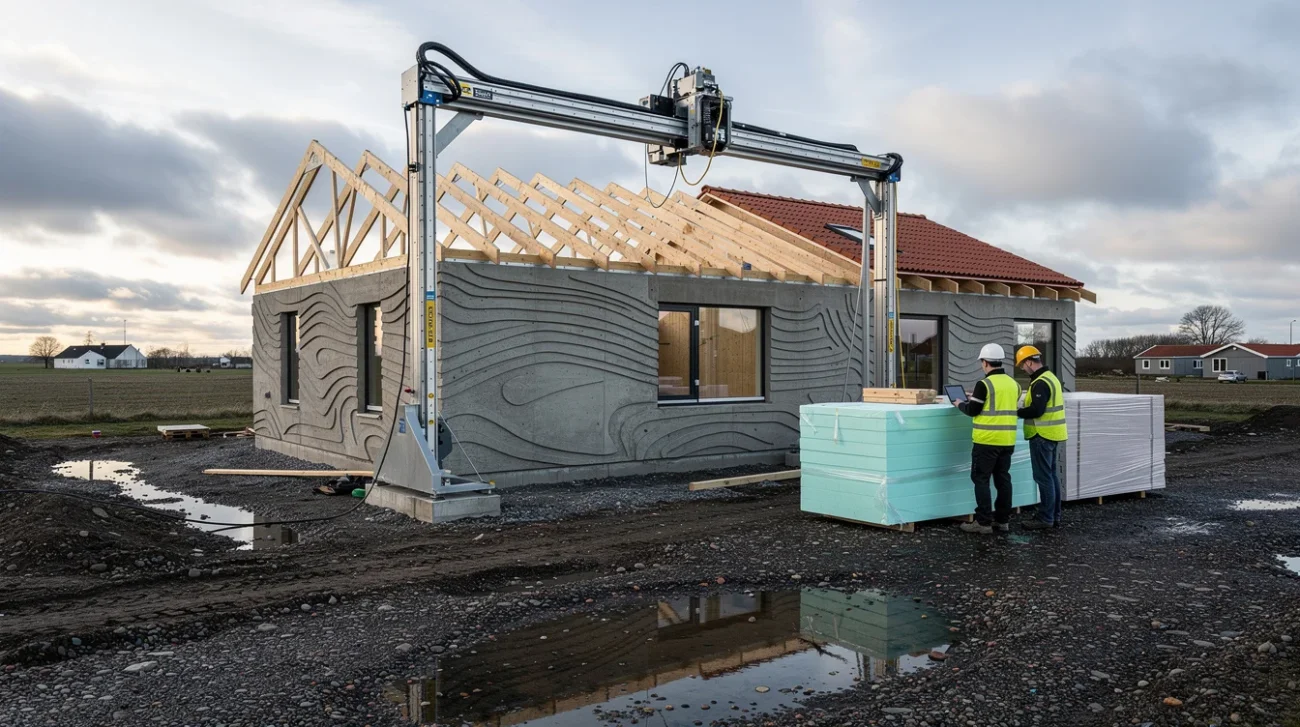
A robotic nozzle laying down concrete is an irresistible image of progress. It makes construction look programmable: fewer delays, less repetitive work, a building rising through controlled movement rather than coordinated chaos. Denmark’s reported experiment with 36 3D-printed homes brings that promise into sharper focus. A development of this scale must answer questions that a demonstration pavilion can dodge: who gets to live there, what residents pay, and what happens when the walls need repairing.
The machine is not the housing policy. Printing might improve how homes are made. Whether it improves who can obtain them depends on ownership, regulation, design, and the distribution of savings. The Danish proposition deserves neither technological worship nor reflexive dismissal. It deserves two equally demanding arguments.
PRO: Repetition Can Become Public Infrastructure
Construction automation is most persuasive where conventional building is weakest: repetitive operations exposed to labor shortages, inconsistent execution, and difficult scheduling. A gantry-mounted printer can deposit cementitious material along a digital path, reducing some manual wall-building and formwork operations. Denmark’s COBOD, which supplies construction-printing equipment internationally, represents this shift from bespoke machinery toward a repeatable industrial platform. The important product is not the spectacular nozzle. It is a process that can be learned, measured, and deployed again. As with AI becoming a craft tool in design, the value lies in what the system enables, not merely in its novelty.
Thirty-six homes offer a meaningful opportunity for that learning. Repeated layouts can reveal whether crews become faster at preparing sites, managing mixes, positioning reinforcement, and coordinating follow-on trades. Setup costs can be distributed across several buildings rather than loaded onto a solitary prototype. For a housing provider planning multiple developments, a predictable sequence could be more valuable than a record-breaking wall-printing time.
ICON’s collaboration with Lennar and BIG at Wolf Ranch in Georgetown, Texas, demonstrates the ambition at neighborhood scale: 100 homes using printed wall systems. It does not establish that printing automatically produces affordable housing. It does show why the debate must move beyond whether a robot can make a habitable enclosure.
The strongest public case is reliable delivery, not technological spectacle. If automation reduces delays and cost volatility, nonprofit or municipal clients could commission housing with greater confidence. That possibility matters even before anyone claims a dramatic reduction in the final price.
PRO: Standardize the Process, Not Every Home
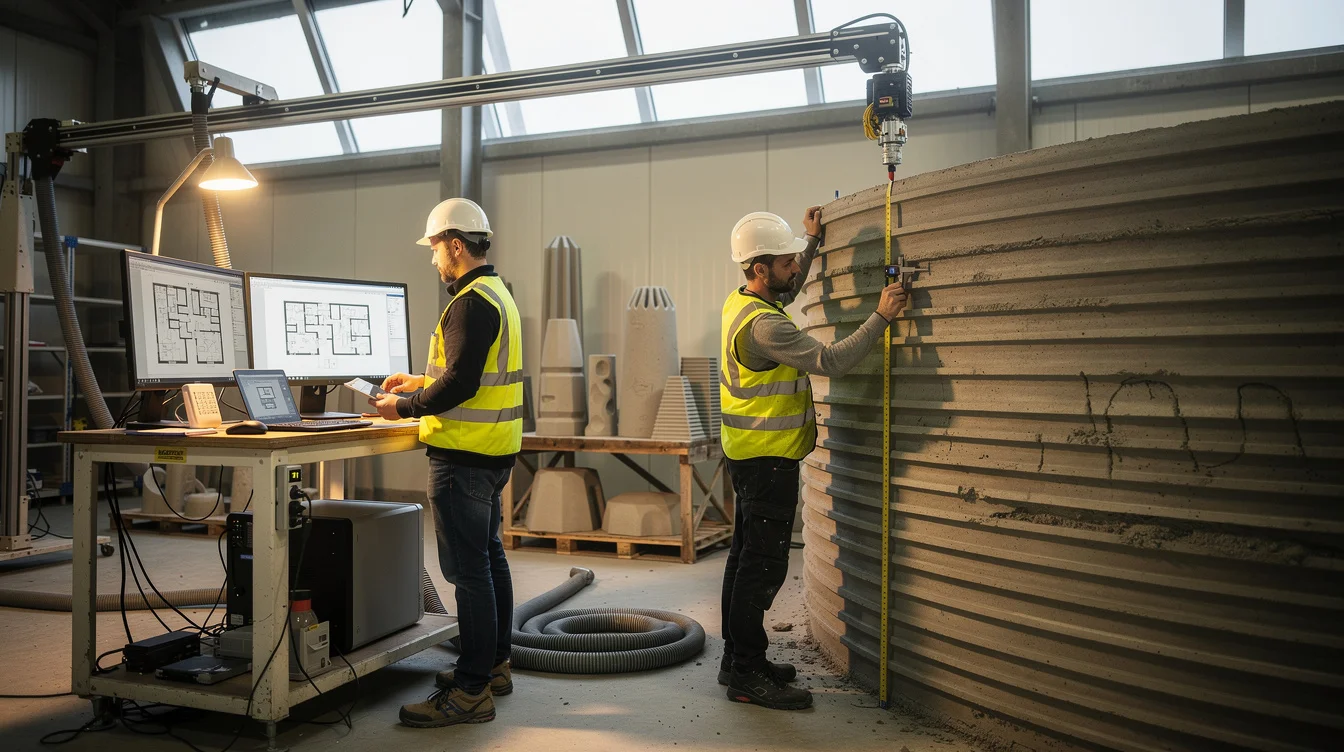
Industrialized housing has often treated variation as an enemy. Panels, molds, and standardized components reward repetition; departures can require additional tooling and coordination. Additive construction changes part of that equation. Within a printer’s operating limits, a curved wall or adjusted plan may require a different toolpath rather than a new mold. Architectural difference becomes potentially less expensive at the wall-making stage, although roofs, windows, finishes, and engineering still impose costs.
Project Milestone in Eindhoven, associated with Houben & Van Mierlo Architects and a wider technical partnership, offers a useful reference. Its boulder-like printed concrete forms challenge the assumption that industrial construction must produce rectilinear boxes. The lesson is not that every neighborhood needs sculptural houses. It is that repetition of a production method need not dictate repetition of an architectural silhouette.
Mario Cucinella Architects and WASP explored another direction with TECLA in Italy, a prototype made using locally sourced raw earth. TECLA is not evidence that an earthen wall system can simply be transplanted into Denmark’s wet, cold climate. It demonstrates that construction printing need not be conceptually confined to conventional concrete.
For Denmark’s 36-home experiment, the valuable design test would be ordinary rather than theatrical: can one production system accommodate different household sizes, accessible layouts, sheltered entrances, and shared spaces? Automation earns architectural credibility when it supports difference without turning difference into a luxury upgrade. The opportunity is mass customization with a social purpose, not a catalog of expensive curves.
CONTRA: A Faster Wall Is Not a Cheaper Home
The industry’s favorite shortcut is rhetorical: describe a rapidly printed wall system as a rapidly delivered house. Foundations, reinforcement, insulation, roofs, glazing, mechanical services, waterproofing, inspections, and connections to utilities do not disappear when a nozzle arrives. Neither do land prices, financing costs, planning delays, or developers’ margins. A fast printing operation may sit inside a slow development process.
Wolf Ranch is instructive here, too. A large neighborhood of commercially marketed printed homes demonstrates production capacity, not universal housing access. Project Milestone’s architectural achievement likewise cannot substitute for evidence about total development cost. Across these examples, the relevant comparison is a completed, compliant, occupied home against a conventional equivalent—not a printed shell against an entire traditional building.
Denmark’s experiment should therefore be judged through disclosed figures: total cost per usable square meter, occupancy-ready delivery time, maintenance allowances, and eventual rents or sale prices. Savings should be separated from subsidies and unusual research expenditure. Without that accounting, claims of affordability remain propositions rather than outcomes.
More fundamentally, cheaper production does not compel cheaper access. On scarce land, a developer can retain a construction saving rather than pass it to residents. Social housing ownership, enforceable affordability conditions, or other mechanisms are needed to make the benefit durable. A printer can reduce an input cost; it cannot decide who captures the surplus. Treating automation as housing reform conveniently leaves the politics of land untouched. A similar question runs through design responses to gentrification: who benefits from urban change, and who can afford to stay?
CONTRA: Durability and Labor Cannot Be Beta Features
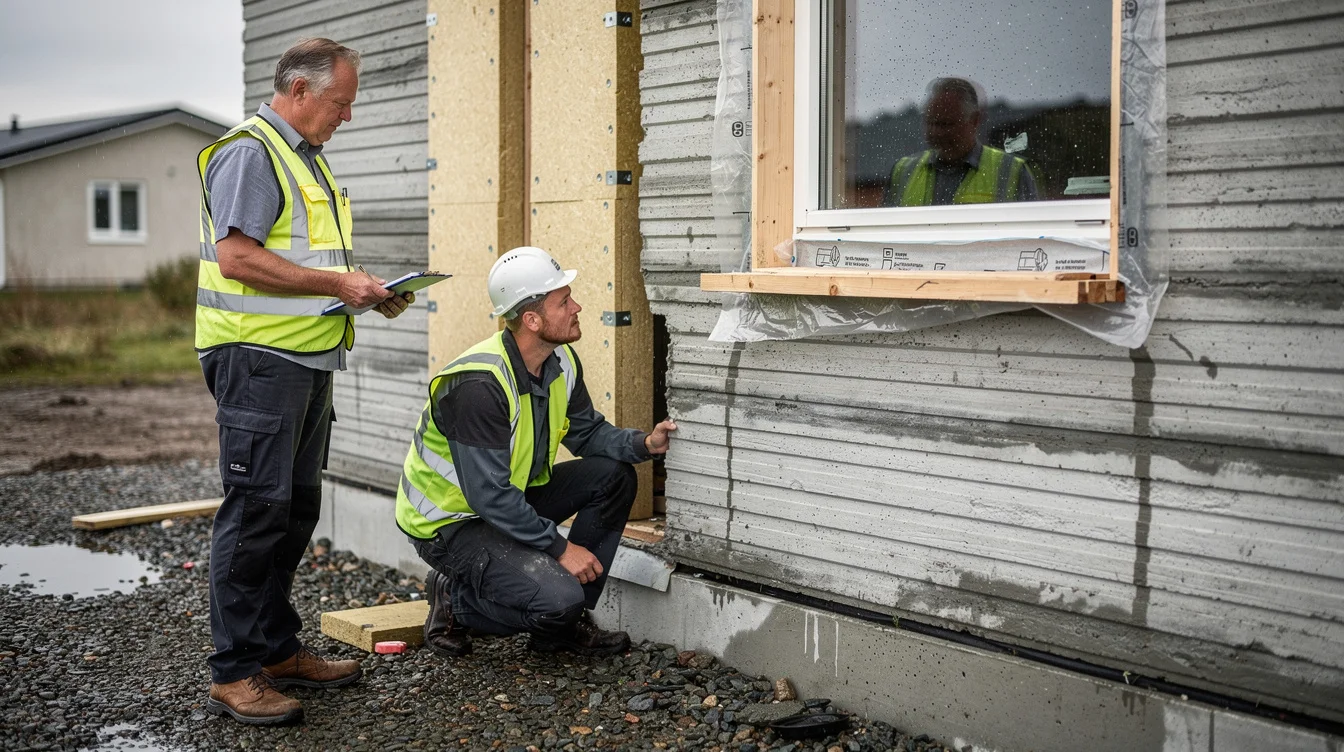
A printed wall must survive far longer than the excitement surrounding its installation. Layer interfaces, curing conditions, material consistency, reinforcement strategies, and junctions with conventional components all deserve scrutiny. In a Danish climate, moisture exposure and freeze-thaw performance are consequential wherever the assembly is exposed. A ribbed surface may be expressive, but expression is not evidence of weather resistance. Thermal performance belongs to the complete wall assembly, not its photogenic outer layer.
Concrete printing also has no automatic environmental exemption. Some printable mixes use substantial binder content to achieve pumpability and early strength. Material savings from precise deposition must be weighed against the actual mix, reinforcement, insulation, transport, and expected service life. TECLA’s earth-based experiment shows why material choice matters; it does not validate the environmental claims of unrelated cementitious systems.
Labor presents an equally uncomfortable balance sheet. Printing can remove some strenuous, repetitive tasks while creating work in machine operation, material testing, maintenance, and digital coordination. But those benefits require paid training and credible routes for existing workers. The International Labour Organization’s just-transition framework offers a better ethical reference than promotional language about replacing crews.
Architectural individuality also needs protection after handover. Residents should know whether they can drill, extend, repair, or reconfigure their homes without depending on a single proprietary supplier. Denmark’s experiment will be more convincing if it produces accessible maintenance guidance alongside buildings. The real test is not whether the machine finishes its path, but whether residents inherit a durable home they can understand and change.
FAQ
Are 3D-printed homes genuinely more affordable?
They can reduce particular construction costs, especially when repeated projects spread equipment and setup expenses. Affordability still depends on land, financing, unprinted building elements, and whether savings reach residents. Completed-home prices and long-term housing costs matter more than wall-printing estimates.
Is an entire house produced by the printer?
Usually not. Many current systems print walls or wall components, while conventional construction supplies foundations, roofs, windows, services, and other elements. The extent of automation varies, so claims about printing time should identify exactly what was produced.
Can printed homes be durable in Denmark’s climate?
Potentially, provided the specific material and complete assembly meet applicable structural, moisture, fire, and thermal requirements. Climate suitability requires project-specific testing, sound detailing, quality control, and maintenance planning—not confidence in printing as a general category.
Does construction printing eliminate skilled labor?
It changes the mix of work rather than removing the need for skilled people. Operators, engineers, electricians, plumbers, and finishing trades remain important. A fair transition requires worker participation, paid retraining, and safety standards suited to the new equipment.
If Denmark can automate the production of walls, what should it change next to ensure the resulting homes belong to a wider public rather than merely a more efficient market?
Watch the Mainifesto Short
Get the Mainifesto weekly — curated design debates, speculative ideas and the week's best articles every Saturday.
Editorial Perspectives
Questions and counterpoints developed by the Mainifesto editorial desk to extend the discussion.
Perspective 1
I’m for printing housing components when it cuts rework and makes production more predictable, not just when the wall texture photographs well. For these 36 homes, show us the finished cost per square metre—including reinforcement, services and finishing—then tie public support to passing those savings on to residents.
Perspective 2
I’m against treating 3D-printed housing as the next big answer to access: a faster concrete wall does nothing by itself to lower land costs or secure a tenancy. Let’s put that ambition into low-carbon materials and resident-owned housing instead, and make the printer compete on those terms.
Perspective 3
Automate the walls, fine, but whoever controls the land still decides who gets to live there. Denmark should attach lasting affordability requirements to publicly supported projects and give nonprofit housing providers access to the technology, rather than assume contractors’ savings will become lower rents.
Perspective 4
I’d like to see the design model optimise for a home’s next thirty years, not just the printer’s next toolpath. Can residents move partitions, repair services or adapt a unit without going back to the original supplier? A cheaper build with expensive alterations could quietly shut out the households it’s meant to help.
Perspective 5
The printer footage is compelling, but it gives the machine a starring role while ownership stays offscreen. I’d rather see residents get a say in the brief and a stake in the homes than another developer sell robotic construction as social progress.