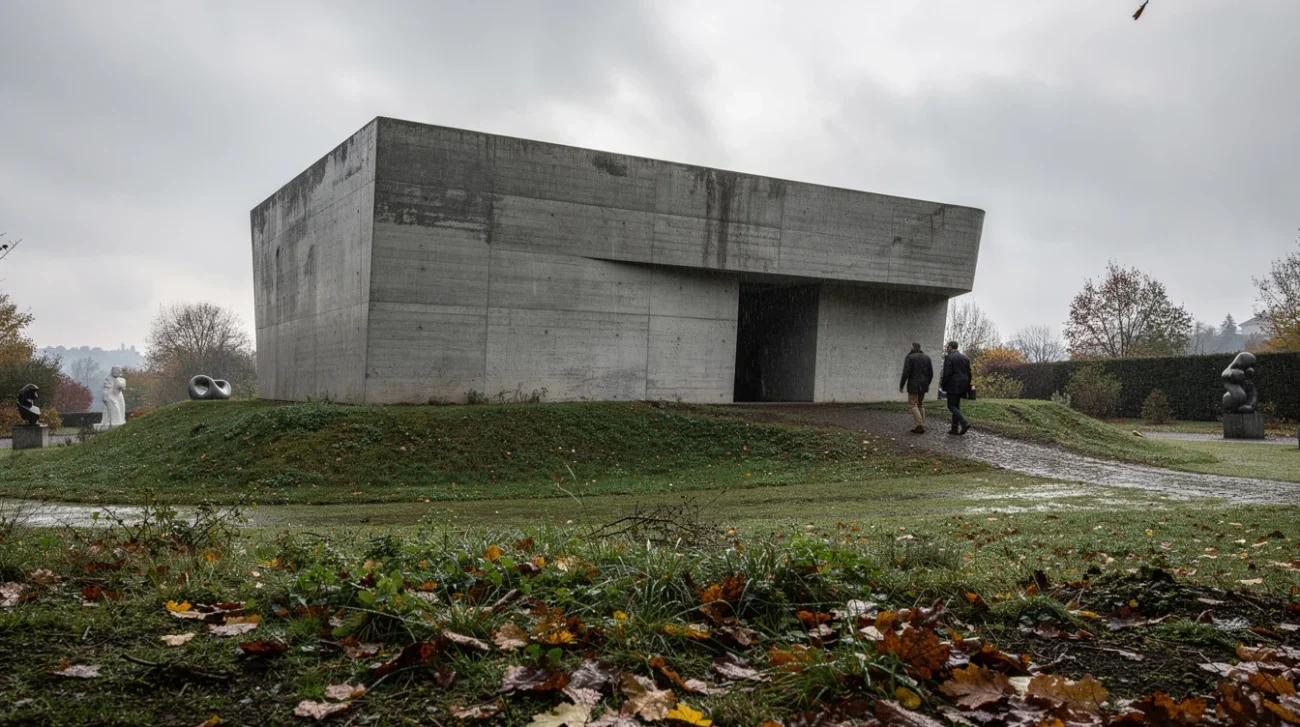
Can Ocean Plastic Safely Become a Building’s Skin?
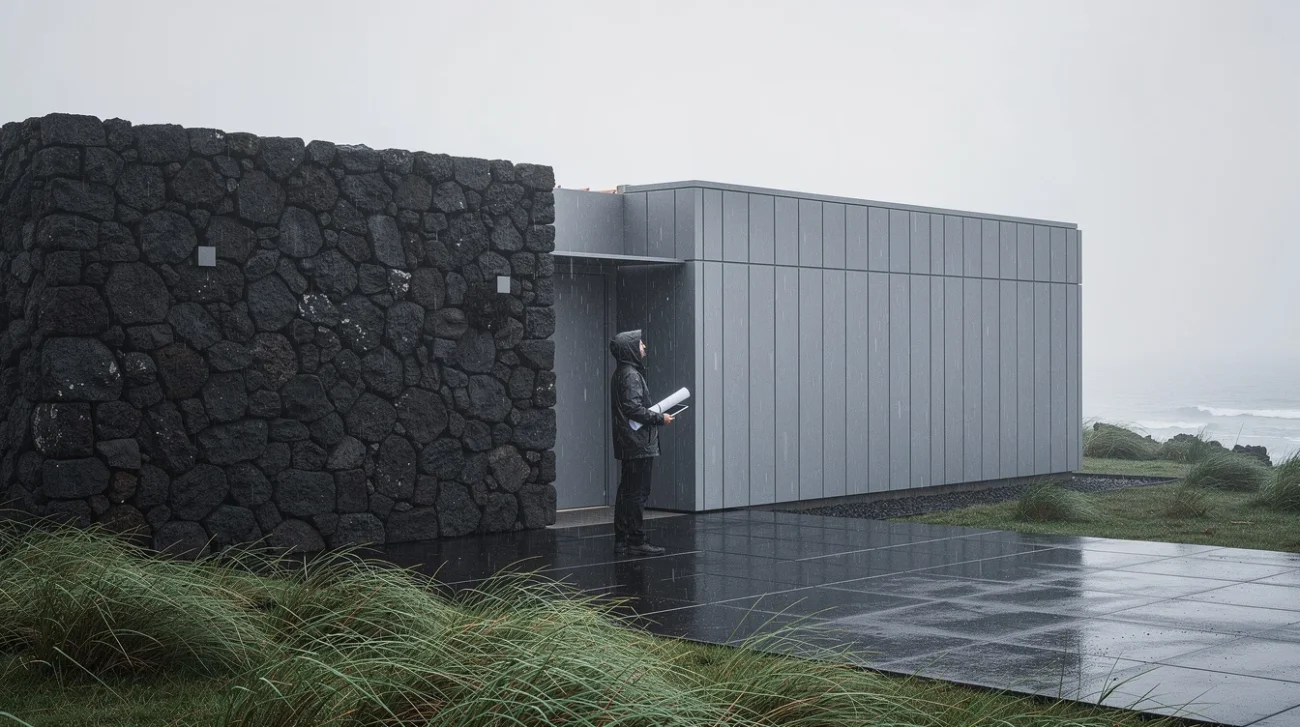
A building can rescue waste and still become a source of pollution. That uncomfortable possibility sits behind the appeal of the Blue House in the Azores, where recovered marine plastic becomes cladding. Dwell presents Atelier Backlar’s project as a meeting of prefabricated construction, stone ruins and environmentally friendly materials. The architectural proposition is compelling: retain the old, assemble the new and give discarded plastic another purpose. But the Atlantic coast is not a showroom. An environmental claim must survive sunlight, wind-driven rain, maintenance and eventual dismantling—not merely the journey out of the factory.
PRO: Turn a Waste Stream Into a Useful Building Component
The strongest argument for ocean plastic cladding is not that it looks virtuous. It is that a durable building component could give difficult waste a useful destination while displacing some virgin material. Marine litter can arrive contaminated, degraded and mixed; collecting it does not automatically create a market for it. A facade product with predictable specifications could help turn recovery from an occasional cleanup into an ongoing supply chain.
The Blue House gives that argument architectural force by pairing a new envelope with existing stone fabric. The supplied project context does not establish a whole-building carbon balance, but it suggests a productive hierarchy: work with what exists, then scrutinize what gets added. Lacaton & Vassal’s transformation of Grand Parc Bordeaux, with Frédéric Druot and Christophe Hutin, offers a related reference—not for recycled plastic, but for treating retained buildings as resources rather than obstacles.
The environmental opportunity is substitution, not spectacle. Recycled cladding earns its place if it performs a necessary job with fewer lifecycle burdens than a credible alternative. Simply making a facade from an unusual waste stream is not enough; making a serviceable component that avoids repeated replacement could be.
PRO: Good Detailing Can Make Reuse More Than a Slogan
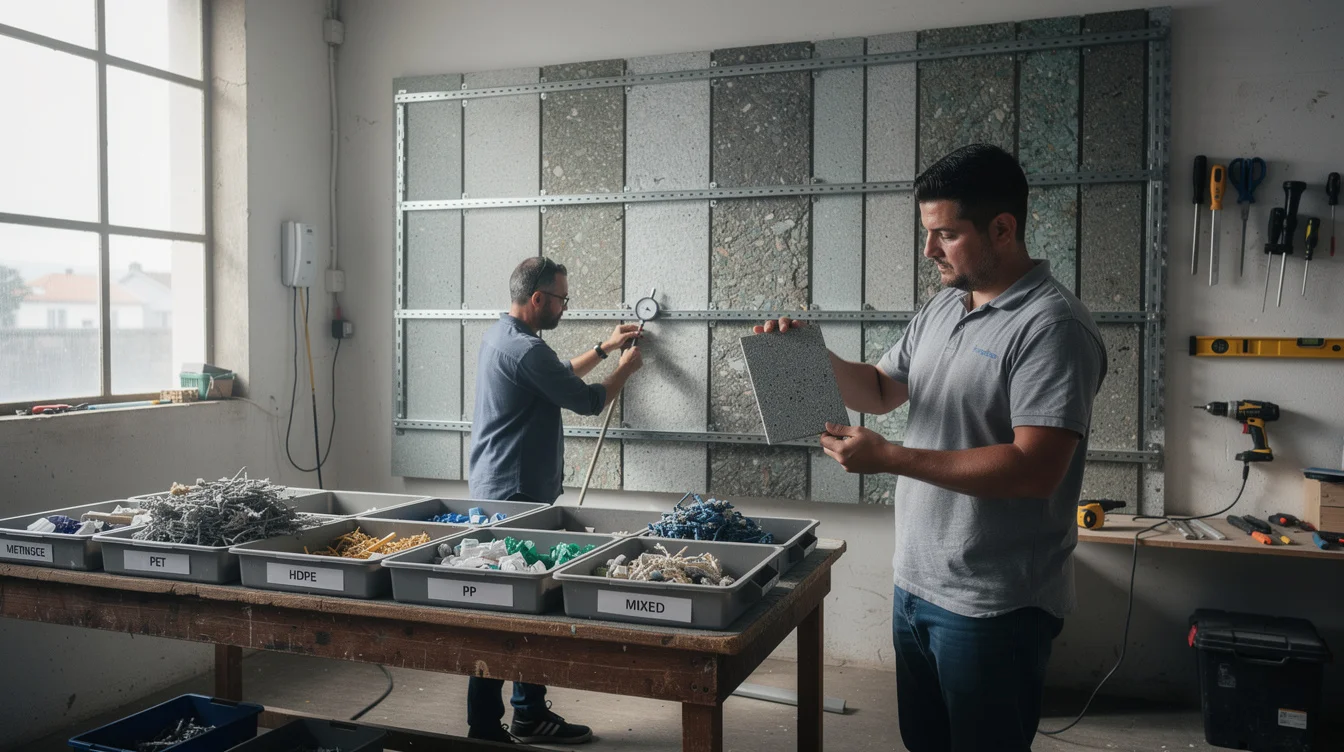
A promising plastic panel is only one part of a credible facade. Ventilated cavities, drainage paths, suitable fixings and allowances for thermal movement can determine whether an otherwise useful material remains serviceable. Many plastics expand considerably with temperature changes. Restraining panels incorrectly can encourage distortion or stress around fasteners; accommodating movement is a design responsibility, not an optional refinement.
Imagine a mechanically fixed rainscreen whose damaged panels can be removed individually. Compared with a bonded composite that must be torn apart, that assembly offers a clearer route to repair and recovery. This is a proposed evaluation model, not a claim about the Blue House’s concealed construction. Rotor DC’s work in architectural salvage demonstrates the broader principle: components become more reusable when designers make their extraction possible.
The Precious Plastic network similarly shows the value of making plastic processing understandable and accessible, although workshop ingenuity is not a substitute for facade certification. The useful connection is traceability: identify the feedstock, document the formulation and explain how the resulting component can be repaired. A panel with accessible fixings, a replacement supply and a genuine return route has a stronger circular claim than one supported only by a recycled-content percentage.
PRO: Exposure Can Become Evidence Rather Than Embarrassment
A coastal project could become a valuable proving ground if its owner and suppliers commit to monitoring. Record panel condition at installation; inspect sun-facing and sheltered elevations; document cracking, chalking, distortion and fixing failures. Measure cleaning frequency, water use and panel replacement. Those records would turn a photogenic prototype into evidence that other architects could actually use.
Laboratory testing belongs alongside that fieldwork. Weathering methods within the ISO 4892 series can expose plastics to controlled light and moisture cycles. Results should examine retained mechanical properties as well as appearance: a stable colour does not prove that a panel remains resistant to impact. Conversely, a colour change does not automatically mean the material has failed.
Environmental accounting can become equally concrete. An independently verified environmental product declaration, prepared under relevant rules such as EN 15804, can disclose impacts and assumptions. It does not certify ecological harmlessness, but it creates something more useful than a green adjective: numbers that can be interrogated.
The affirmative case is serious but conditional: recovered marine plastic could be a defensible building skin when its formulation, assembly, service life and recovery system are demonstrated together. Experimental materials deserve opportunities to prove themselves, not automatic exclusion.
CONTRA: The Ocean Does Not Stop Acting at the Factory Gate
The opposing case starts with a distinction that marketing tends to erase: recycled content describes origin, not outdoor performance. Plastic recovered from marine environments may already have experienced ultraviolet exposure, oxidation or mechanical damage. Sorting, cleaning, blending and stabilization can help produce a consistent material, but the words “ocean plastic” tell an architect almost nothing about those processes.
On an exposed coastal elevation, sunlight can promote polymer degradation while temperature changes repeatedly move the panels. Windblown grit can abrade surfaces; wind-driven rain can transport loosened material. Salt exposure also demands attention to fixings and other components. These mechanisms interact, and their significance depends on the polymer, additives, panel geometry and local conditions.
Accelerated ageing is useful, but translating a laboratory exposure into a precise number of service years requires validation. A specified quantity of chamber hours is not, by itself, a twenty-year coastal guarantee. Nor does a warranty necessarily cover particle release, appearance changes or the labour required for replacement.
The source context supplied for the Blue House does not provide a resin specification, weathering dataset or long-term inspection record. That is an evidence gap in this account—not proof that the project lacks testing or that its cladding is failing.
CONTRA: Cleaning Up Plastic Must Not Redistribute It
The most consequential question is whether a facade releases plastic particles as it ages. Weathered polymers can fragment, and abrasion can detach material. But that general mechanism cannot establish an emission rate for the Blue House. Claiming that this particular facade sheds dangerously would be as unjustified as declaring it particle-free without measurements.
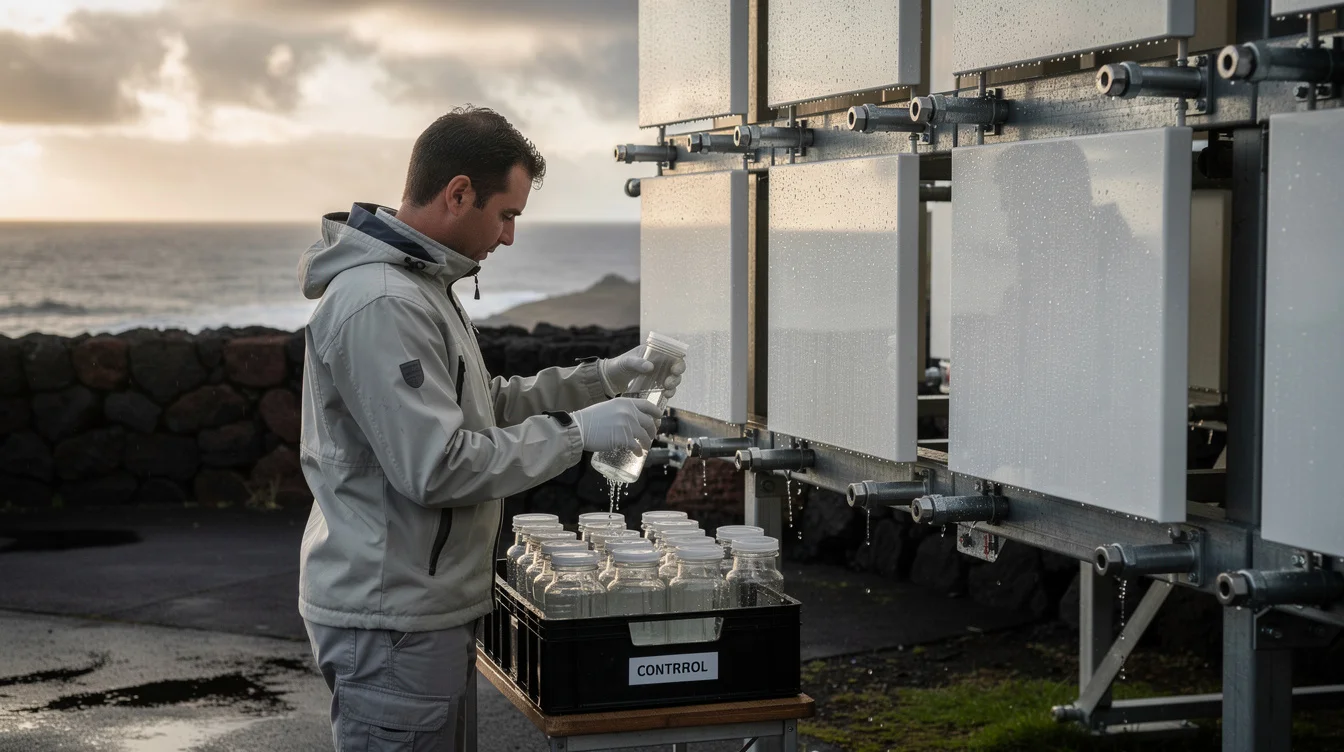
A meaningful investigation would sample runoff and deposited debris, use field blanks and background controls, and identify particles with methods such as micro-FTIR or Raman spectroscopy where appropriate. Researchers would need to distinguish facade-derived material from airborne plastic, nearby coatings and other contamination. Particle counts should include size ranges and sampling conditions; where feasible, mass measurements would provide another useful perspective.
Maintenance belongs inside the same investigation. Test the manufacturer’s recommended cleaning method and foreseeable misuse, including abrasive brushing or excessive pressure washing. If a protective coating is necessary, its renewal interval, composition and potential emissions enter the environmental calculation too.
There is no honest shortcut from “recovered from the sea” to “safe beside the sea.” Particle release and additive leaching are separate questions, requiring different measurements. A responsible claim should disclose what was tested, what was detected and what remains unresolved.
CONTRA: Circularity Fails Without an Exit Plan
A facade can contain recycled plastic and still be effectively disposable. Mixed polymers, fillers, pigments, coatings and contamination may complicate its next recycling cycle. A take-back promise is useful only if somebody is responsible for collection, transport and an identified treatment route when the panels finally come off. “Recyclable” is a technical possibility; a functioning recovery system is infrastructure.
Safety also extends beyond weathering. Reaction-to-fire classification, smoke behaviour, cavity design and any required facade-system assessment must suit the building and jurisdiction. Recycled origin grants no exemption, and testing one component does not automatically establish the performance of the installed assembly. Equally, no material should be dismissed solely because it contains recycled polymer: the actual product and system require assessment.
The fair comparison is one square metre of facade delivering equivalent performance over the same study period. Include cleaning, coatings, repairs, replacements and end-of-life treatment. Test alternatives available to the project rather than assuming timber, metal or mineral cladding is automatically superior.
The Blue House’s provocation is valuable precisely because it exposes the unfinished argument. Architecture should welcome recovered materials while refusing unearned environmental absolution. Until durability and emissions evidence catches up with the imagery, “promising reuse” is a more defensible description than “proven environmental benefit.”
FAQ: What Ocean Plastic Cladding Must Prove
Is recovered marine plastic inherently suitable for exterior cladding? No. Suitability depends on the polymer, contamination controls, additives, manufacturing consistency and facade design. Marine origin describes a waste stream, not a performance grade. Ask for product-specific evidence covering weathering, mechanical performance and relevant fire requirements.
Does recycled plastic cladding necessarily shed microplastics? Weathering and abrasion can release particles from plastics, but the rate and significance depend on the product and exposure. The supplied Blue House context does not quantify shedding. Product-specific testing and field monitoring are needed before making either a safety guarantee or an accusation of harmful release.
What maintenance information should an architect request? Request approved cleaning methods, inspection intervals, limits on pressure washing, coating requirements and procedures for replacing individual panels. Clarify who supplies replacements and whether maintenance runoff needs controls. Include these activities in lifecycle comparisons rather than treating upkeep as environmentally free.
What evidence supports a credible environmental claim? Seek verified feedstock provenance, declared recycled content, relevant safety testing, weathering results, realistic service-life assumptions and an independently verified lifecycle assessment or environmental product declaration. Add particle-release and leaching evidence where relevant, plus a practical end-of-life plan. No single certificate answers every question.
If recovered ocean plastic can replace virgin material but its lifetime particle release remains uncertain, what evidence should architecture demand before calling that facade environmentally responsible?
Get the Mainifesto weekly — curated design debates, speculative ideas and the week's best articles every Saturday.
Editorial Perspectives
Questions and counterpoints developed by the Mainifesto editorial desk to extend the discussion.
Perspective 1
I’m for using recovered ocean plastic as cladding: replacing virgin feedstock is worth pursuing, not postponing until uncertainty disappears. But credibility needs a system—local exposure testing, funded maintenance and producer take-back—not another island showcase whose waste eventually gets shipped somewhere poorer.
Perspective 2
I’m against putting recovered plastic on exposed facades while lifetime particle release is unresolved; diverting waste doesn’t justify creating another dispersal route. Could we couple accelerated UV and salt-weathering tests with field measurements of runoff and airborne particles, then compare the results with non-plastic alternatives before specifying it?
Perspective 3
Architecture has long confused the virtue of a material with the virtue of its image; the Blue House gives that habit an attractive ecological costume. Read through Barthes, ‘ocean plastic’ becomes a reassuring sign of redemption, while the less photogenic questions—abrasion, repair, disposal—remain unanswered.
Perspective 4
I’d want independent testing of the actual cladding assembly under Azorean sun, salt and wind-driven rain, backed by field monitoring rather than accelerated ageing alone. Then show its whole-life performance against a realistic alternative, including cleaning, replacement and end-of-life treatment; recycled content alone isn’t enough to call it environmentally responsible.