
Coastal Defence Needs Land, Not Just Trees
Coastal Defence Needs Land, Not Just Trees
A mangrove plantation can make an infrastructure project look responsible without making its coastline safer. The photograph shows saplings; it rarely shows the development boundary that prevents them becoming a functioning forest. Along India’s coast, the real contest is not between concrete and vegetation. It is between competing claims on space: roads, housing, ports, tidal channels, fishing grounds and sediment. The mangrove landscape described in ArchDaily’s discussion of coastal protection and urban development in India exposes an uncomfortable architectural question: what must development relinquish before a living defence can work?
PRO: Give the Forest a Territory, Not a Planting Strip
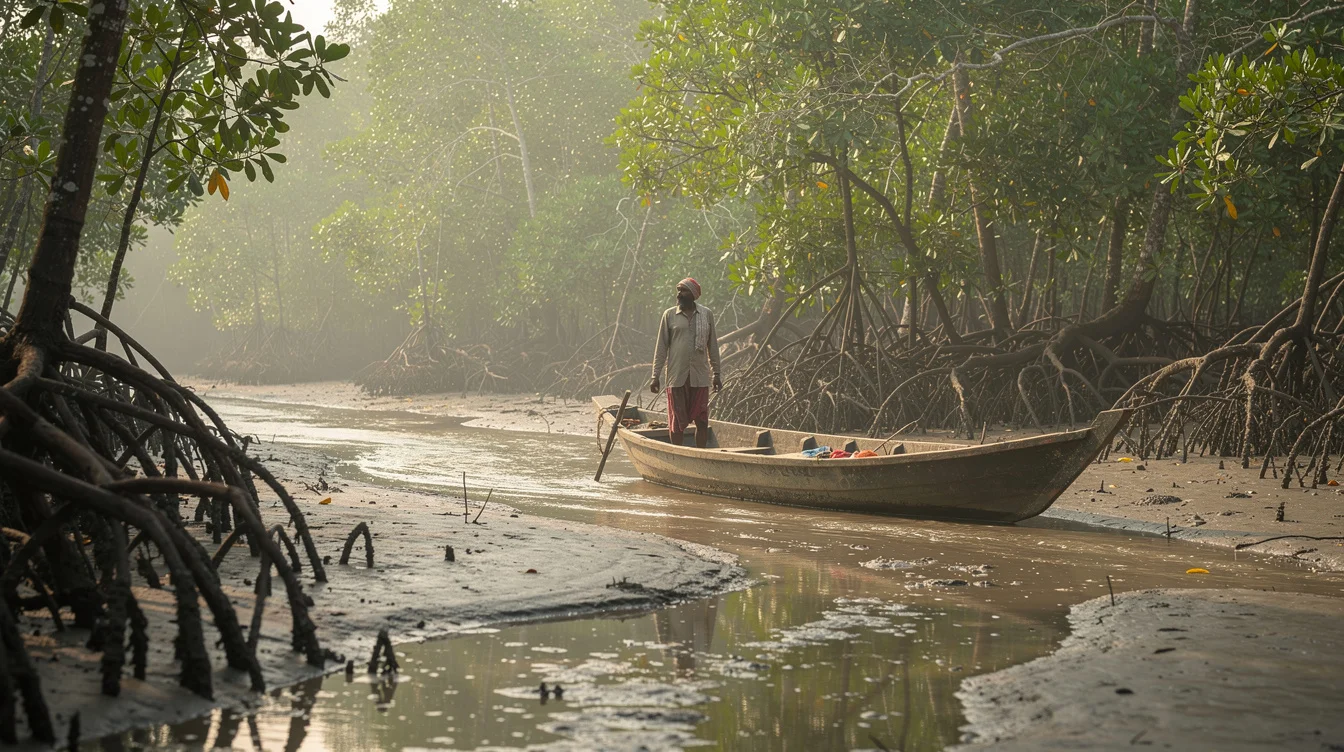
The strongest argument for mangrove coastal protection begins below the canopy. Roots and trunks create resistance to moving water, while tidal channels carry water and sediment through the forest. Under suitable conditions, sediment accumulation helps sustain wetland elevation. None of this behaves like a freestanding wall. Performance depends on forest width, vegetation structure, local water depth, incoming waves and the condition of the wider coastal system. A narrow ribbon of trees cannot be assumed to deliver the protection of an extensive, connected wetland.
Bhitarkanika in Odisha makes the spatial argument tangible. Its mangrove forests sit within an estuarine landscape of creeks, islands and mudflats. The relevant design unit is not an individual tree, or even a planting plot, but the relationship between forest and water. Protecting that relationship means resisting reclamation and obstructions that would interrupt tidal exchange. It also means acknowledging that coastal protection is one benefit of a functioning habitat, not an excuse to redesign every intertidal surface as a plantation.
For architecture, this reverses the conventional sequence, echoing the question of whether a rainforest retreat can put the forest first. Instead of fixing the buildable envelope and asking a landscape consultant to green its leftovers, planners must establish the wetland’s operating space first. The setback becomes infrastructure. It reserves room for water, sediment and, where terrain and conditions permit, the landward movement of mangroves as sea levels rise. That reservation must survive beyond a project’s opening photograph.
PRO: Make the Land Budget Visible
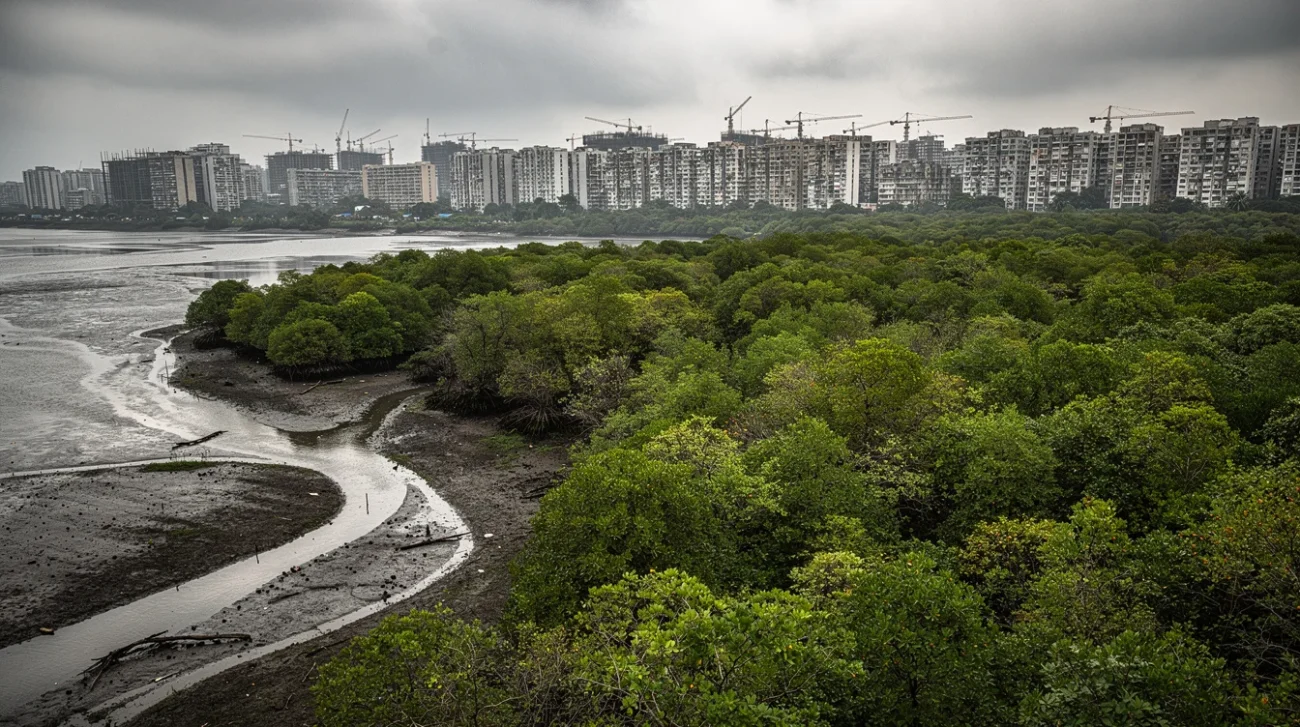
Mumbai’s metropolitan shoreline exposes why this is difficult. Around Thane Creek, mangroves and intertidal mudflats coexist with dense development and major infrastructure. The Thane Creek Flamingo Sanctuary also makes a crucial distinction visible: mudflat is habitat, not vacant ground awaiting trees. A credible coastal strategy must protect a mosaic of environments rather than maximise the number of planted stems. Afforestation on the wrong intertidal habitat can be ecological damage dressed as restoration.
The planning precedent worth borrowing is not necessarily another mangrove project. The Netherlands’ Room for the River programme, including the dyke relocation and secondary channel at Nijmegen, demonstrates a different political proposition: reduce risk by giving water more space. It is a river-management example, not a technical template for India’s tidal forests. Its relevance is institutional. Land allocation becomes part of the defence budget rather than an inconvenience concealed behind engineering drawings.
Indian coastal projects should face an equivalent spatial accounting. Where will tidal water enter and leave? Which land remains available for future habitat migration? Which proposed road, podium or storage yard obstructs that space? Developers should have to disclose these conflicts before presenting planting totals. Acquiring development rights, relocating proposed structures or abandoning reclamation may contribute more to resilience than a ceremonial planting campaign. The provocative position is also the practical one: sometimes the most effective coastal architecture is the building that planning refuses to permit.
CONTRA: Land Is Occupied, and Retreat Is Not Innocent
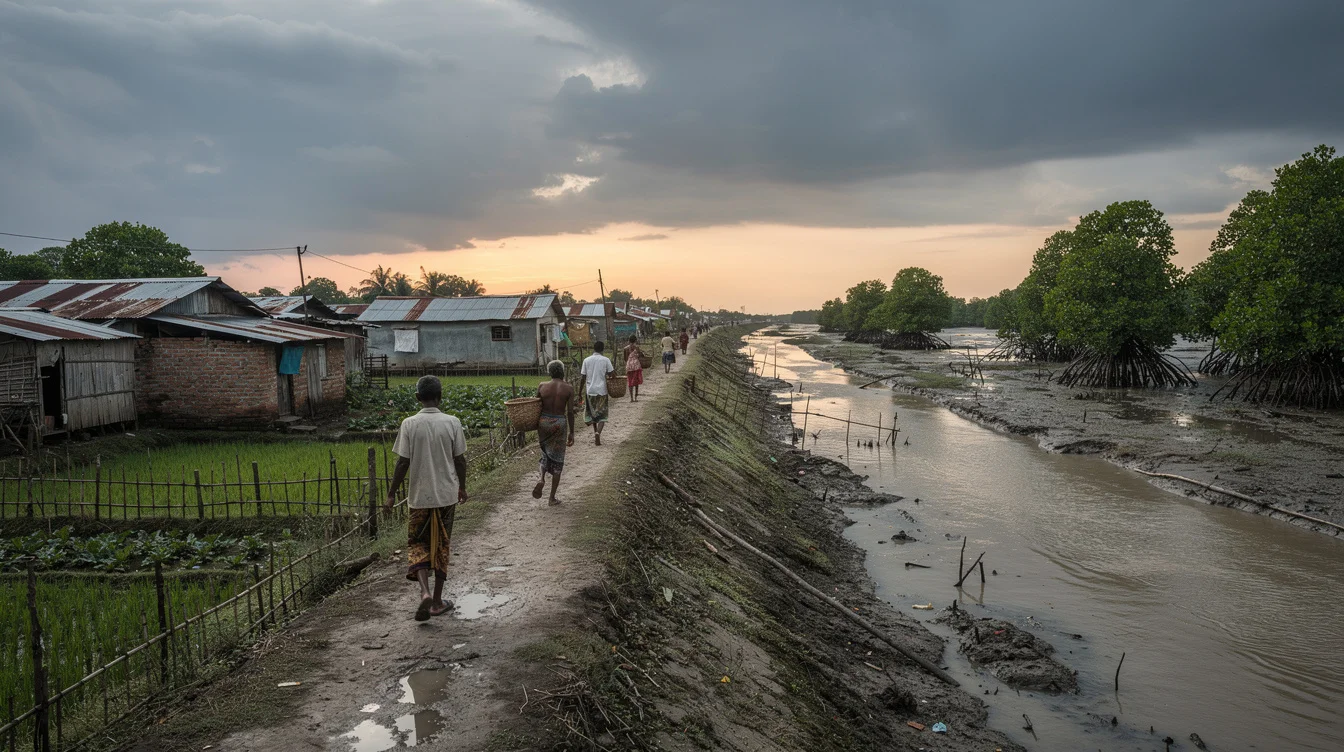
But “give nature space” becomes a dangerous slogan when it avoids naming whose space will be taken. India’s coastal margins contain fishing settlements, landing places, workshops and informal housing, not merely speculative real estate. A green buffer can protect expensive development while removing the people whose livelihoods depend on reaching the water. Ecological restoration does not automatically produce spatial justice; it can become another instrument of exclusion.
The Indian Sundarbans expose the stakes. Inhabited islands depend on embankments that separate homes and farmland from tidal water. Cyclone Aila in 2009 demonstrated the devastating consequences of embankment failure and saline inundation. Proposing realignment in such a landscape is not simply a matter of drawing a wider mangrove belt. It can mean changing access to fields, freshwater, schools and employment. The ecological case for accommodating water does not dissolve these social obligations.
Nor should longstanding residents carry the same burden as a developer seeking permission for new reclamation. Any land-release strategy must distinguish between preventing additional exposure and displacing existing communities. Secure tenure, livelihood continuity, compensation and meaningful participation belong inside the defence proposal, not in a later mitigation document. If a scheme makes a vulnerable household surrender land while allowing a new luxury waterfront to proceed, it is not nature-based resilience. It is selective protection with a green perimeter.
CONTRA: A Forest Is Not a Universal Safety Standard
The second objection is technical. Mangroves can reduce wave energy and contribute to coastal resilience, but they cannot be assigned one universal protective capacity. Wave attenuation is not the same as eliminating storm surge. Extreme water levels, channel geometry and coastal topography can overwhelm simplistic claims about a forest’s defensive role. A newly planted site also lacks the structure of a mature stand. Protection promised today cannot depend entirely on vegetation that may take years to establish—or fail altogether.
Mumbai illustrates another limit: coastal flooding intersects with intense rainfall, constrained drainage and tidal conditions. A mangrove belt cannot repair an undersized drain or guarantee that an outfall functions during high water. Nor are all urban shores suitable mangrove habitat. Planting should follow an assessment of tidal elevation, substrate, sediment supply and ecological history, rather than the visual appeal of a green edge.
This is where hybrid strategies deserve serious consideration. In parts of the Sundarbans, maintaining essential embankments while restoring suitable foreshore habitat may be more defensible than treating vegetation and engineered protection as mutually exclusive. Elsewhere, drainage improvements, raised critical infrastructure and carefully located barriers may remain necessary. These measures need site-specific assessment, monitoring and provision for failure.
The objection therefore narrows, rather than defeats, the land argument. Space is necessary for a functioning mangrove system, but space alone does not guarantee safety. What development must relinquish is both physical territory and the fantasy of a single, marketable solution. The credible project combines ecological room, engineering judgement and an explicit account of who benefits, who pays and who remains exposed.
FAQ: Mangroves, Development and Coastal Risk
How much mangrove width is needed for coastal protection?
There is no universally sufficient width. Performance depends on vegetation structure, water depth, coastal geometry, waves and the hazard being assessed. A meaningful design requires local hydrodynamic and ecological assessment, not a standard buffer dimension copied between sites.
Is planting mangroves enough to restore a coastline?
No. Restoration may first require reopening tidal connections, removing obstructions or addressing altered sediment conditions. Where suitable conditions and seed sources remain, natural regeneration may be appropriate. Planting unsuitable sites can fail or damage existing habitats such as mudflats.
Can mangroves replace seawalls and embankments?
Sometimes they can reduce reliance on hard infrastructure, but replacement is not a universal prescription. Dense settlements and critical facilities may still require engineered protection alongside wetlands, drainage improvements, evacuation planning and reliable maintenance.
What should coastal development relinquish first?
Start with proposed encroachments, reclamation and layouts that obstruct tidal exchange or eliminate future habitat space. Existing communities require a different process, centred on rights and livelihoods. Setback lines must be ecologically meaningful without becoming a shortcut to eviction.
If a living coastal defence needs land that a city intends to sell or build on, which claim should prevail—and who should have the power to decide?
Watch the Mainifesto Short
Get the Mainifesto weekly — curated design debates, speculative ideas and the week's best articles every Saturday.
Editorial Perspectives
Questions and counterpoints developed by the Mainifesto editorial desk to extend the discussion.
Perspective 1
The city’s right to build should yield where mangroves need room; a coastline has a history longer than its property titles. But restoration cannot become another excuse to evict fishing communities while waterfront investors collect the benefits—those residents need binding power over what land is surrendered.
Perspective 2
I wouldn’t give mangroves automatic priority over housing or other urban needs. Show the protection they can deliver at that site, the land required, and the alternatives; elected authorities should make that trade-off through a public planning process, not treat ecological restoration as beyond scrutiny.
Perspective 3
A waterfront hotel loses its appeal pretty quickly when guests can’t reach it after a storm. If keeping land unbuilt measurably reduces that risk, put it in the investment case—and make the properties benefiting from that protection help pay for the land and ongoing care.