
Can a Rainforest Retreat Put the Forest First?
Can a Rainforest Retreat Put the Forest First?
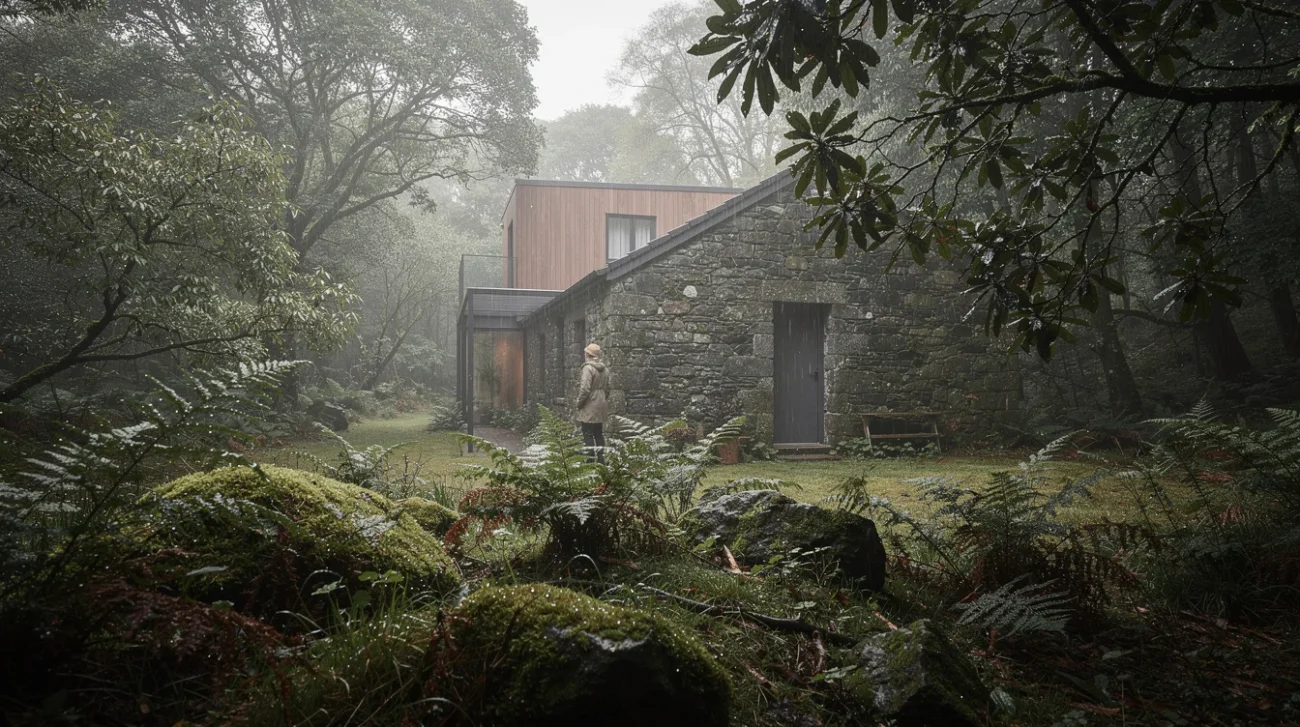
A yoga studio can be a modest architectural intervention and a powerful machine for attracting visitors. That contradiction sits at the centre of Linden House, Schemata Architects’ renovation of a guesthouse in Dromgarriff Rainforest, Glengarriff, Ireland. According to Dezeen’s report of 15 October 2026, the Japanese practice has connected two existing stone buildings with a timber- and steel-framed yoga studio. The house is one of five guesthouses distributed across a 39-hectare woodland, described as one of Ireland’s last temperate rainforests and a protected ecological area.
The architectural proposition is seductive: retain the old buildings, introduce a contemporary connection, and make the forest the setting for restorative hospitality. But restoring people is not the same as restoring habitat. The available source summary establishes the project’s basic configuration, not its ecological performance. Its strongest defence—and its sharpest criticism—must therefore turn on what happens beyond the guestroom.
PRO: Reuse Can Keep the Building Footprint in Check
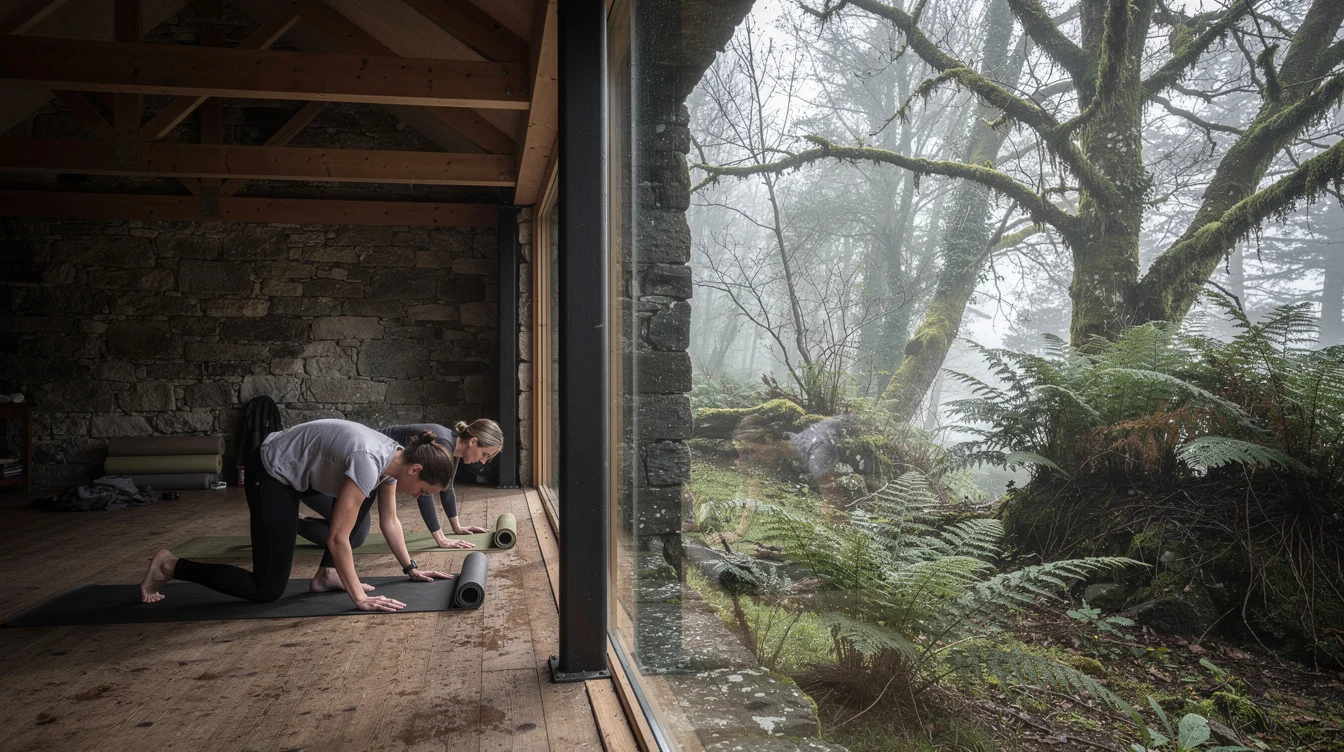
The strongest argument for Linden House begins with what was already there. Renovating two stone buildings offers an opportunity to accommodate hospitality without clearing a separate site for an entirely new retreat. Existing walls represent materials and labour that need not be replaced wholesale. A connecting studio could also consolidate shared activity rather than disperse new pavilions through woodland. These are credible advantages, although neither retained masonry nor a compact plan automatically establishes a low-impact project.
There is a useful architectural precedent in Lacaton & Vassal’s insistence on transformation rather than demolition. At Grand Parc Bordeaux, undertaken with Frédéric Druot and Christophe Hutin, existing housing was expanded and improved instead of erased. The transferable principle is not its aesthetic: it is the refusal to treat replacement as the default. In a sensitive woodland, that refusal can matter even more because building land is also habitat. As debates over conserving the Guggenheim’s white walls suggest, retaining a building also means deciding which values preservation should serve.
However, the relevant comparison must include alternatives beyond a larger new development. What would essential repairs without a yoga studio have required? Could the same activity fit within existing rooms? A persuasive reuse argument would document retained fabric, additional floor area, material quantities and site access. It would also show that foundations, drainage and construction staging remained within carefully assessed disturbance zones. Reuse becomes an ecological argument when it demonstrably avoids harm, not merely when old stone remains photogenic.
PRO: Hospitality Could Finance Long-Term Stewardship
A second defence is economic. Woodland protection requires recurring work: ecological surveys, invasive-species control where necessary, path management, drainage oversight and specialist advice. A small hospitality operation could generate reliable income for those tasks. Five guesthouses do not, by themselves, establish either excessive pressure or exemplary restraint; occupancy, guest behaviour and the wider management regime determine the consequences.
Fogo Island Inn in Newfoundland offers a useful governance reference. Designed by Saunders Architecture and operated within Shorefast’s community-oriented model, it connects hospitality to an explicit local economic mission. That does not make it a template for Irish rainforest ecology. It does demonstrate that the financial purpose of a hotel can be made more legible than a generic promise to “give back”. At Dromgarriff, an equivalent commitment would need to identify what income supports woodland care, who decides priorities and how results are reported.
Visitor management could then become part of the hospitality offer rather than an apologetic restriction. Guests might receive briefings on staying on designated routes, avoiding wildlife disturbance and respecting seasonal closures. Ecologists could define which areas remain inaccessible. Night lighting could be limited to what safety genuinely requires. These are proposals, not documented features of Linden House. Their attraction is that they turn restraint into an operational obligation: a retreat selling immersion in nature should be willing to sell less access, not ever more access, when the habitat requires it. The logic resembles that of a park designed to disappear under water: access must yield when environmental conditions demand it.
CONTRA: A Small Retreat Can Create a Large Pressure Network
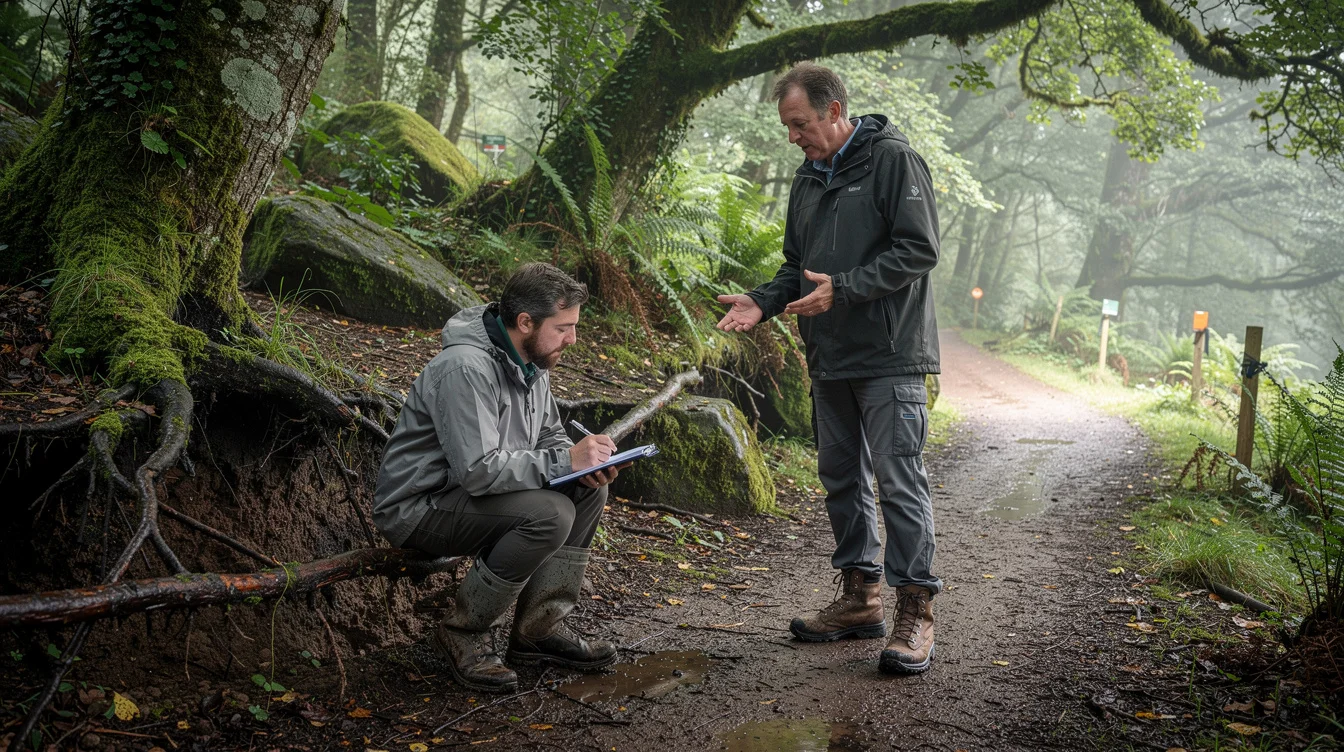
The weakness in the pro case is that architecture measures what it encloses more easily than what it attracts. A yoga studio does not simply occupy ground; it adds a reason to book, a potential programme of classes and a new image for marketing. Without occupancy and operating data, it is impossible to know whether Linden House redistributes existing activity or helps intensify it. Calling the intervention modest cannot settle that question.
The appropriate unit of assessment is therefore the whole 39-hectare estate and its connections, not the renovated building alone. Five guesthouses share an ecological context even if their bedrooms feel secluded. Guest arrivals, deliveries, maintenance vehicles, laundry, water demand and wastewater all belong in the account. So do footsteps: a lightly used path and a frequently used route through persistently wet ground can have very different consequences. Informal shortcuts may widen disturbance beyond a mapped trail.
Peter Zumthor’s Therme Vals illustrates the cultural power of architectural wellbeing: an intensely atmospheric building can itself become a destination. The comparison is about attraction, not equivalent habitats or impacts. In a protected woodland, that destination effect deserves scrutiny before it is celebrated. Managers would need monitoring that can trigger actual limits on bookings, routes or activities. If the business plan requires rising visitor numbers while the ecological plan requires restraint, the contradiction is structural—not something a nature-themed welcome booklet can fix.
CONTRA: Retained Stone Does Not Prove a Protected Forest
Construction disturbance is the other blind spot. A timber- and steel-framed link still needs assembly, deliveries and some form of structural support. Depending on the works, excavation can damage roots, compact soil or alter water movement; sediment and poorly managed site runoff can travel beyond the immediate footprint. None of these impacts is established by the source summary. Equally, the summary provides no basis for assuming that they were avoided.
The necessary evidence would be unglamorous: a pre-construction ecological baseline, root-protection measures, carefully planned access, materials-storage locations and controls on runoff. Timing should respond to surveyed ecological sensitivities rather than a generic seasonal rule. Protection during construction also needs enforcement. An exclusion zone that becomes a convenient place to stack supplies is not a safeguard.
After opening, stewardship must outlast the architectural publicity cycle. Monitoring should track relevant habitat conditions and visitor effects, with responsibilities and funding attached to corrective action. The protected status reported for Dromgarriff makes the applicable permissions and management obligations important; the available summary does not identify their precise legal form or demonstrate compliance. Those details should be established rather than guessed.
The burden of proof belongs to the operator and project team. Linden House may ultimately show that carefully bounded hospitality can support woodland protection. But the decisive design achievement would be a system that lets ecological limits overrule guest expectations. Without that authority, the rainforest risks becoming the retreat’s most valuable amenity while receiving the weakest guarantee.
FAQ: What Would Forest-First Hospitality Require?
What did Schemata Architects change at Linden House?
The reported renovation connects two existing stone buildings with a timber- and steel-framed yoga studio. Linden House is one of five guesthouses within the 39-hectare Dromgarriff woodland in Glengarriff, Ireland.
Does renovating existing buildings make a rainforest retreat sustainable?
It can reduce demolition and demand for new construction, but it does not establish overall sustainability. Added floor area, construction disturbance, visitor activity, energy, water and wastewater must also be assessed.
How should visitor pressure be measured?
Assess guest-nights, peak occupancy, staff and service movements, route use and seasonal sensitivities across the estate. Pair those figures with habitat monitoring; there is no defensible universal guest limit based on woodland area alone.
What evidence would substantiate a forest-first claim?
A credible case needs an ecological baseline, documented construction safeguards, funded habitat management and ongoing monitoring. Crucially, it needs enforceable thresholds that can reduce access or occupancy when ecological conditions deteriorate.
If putting the forest first sometimes means closing rooms, cancelling retreats or keeping guests out of the woodland, should that sacrifice be a condition of operating there?
Get the Mainifesto weekly — curated design debates, speculative ideas and the week's best articles every Saturday.
Editorial Perspectives
Questions and counterpoints developed by the Mainifesto editorial desk to extend the discussion.
Perspective 1
Yes—closing rooms or restricting woodland access should be an enforceable condition, not a voluntary gesture when bookings are slow. Those limits need ecological triggers and local oversight; otherwise investors collect the wellbeing premium while neighbouring communities carry the environmental cost.
Perspective 2
No—I wouldn’t make cancelling retreats or closing rooms a standing condition of operating; unpredictable revenue can undermine the maintenance and conservation budget too. Set firm limits on the footprint and guest numbers before approving the project, then give the operator a workable business rather than an open-ended shutdown risk.
Perspective 3
The picturesque taught landowners to arrange nature for the visitor’s gaze; wellness hospitality merely adds a treatment menu. If the forest must always remain available to guests, it is still an amenity, whatever the architecture claims.