
When the Park Must Disappear Under Water
When the Park Must Disappear Under Water
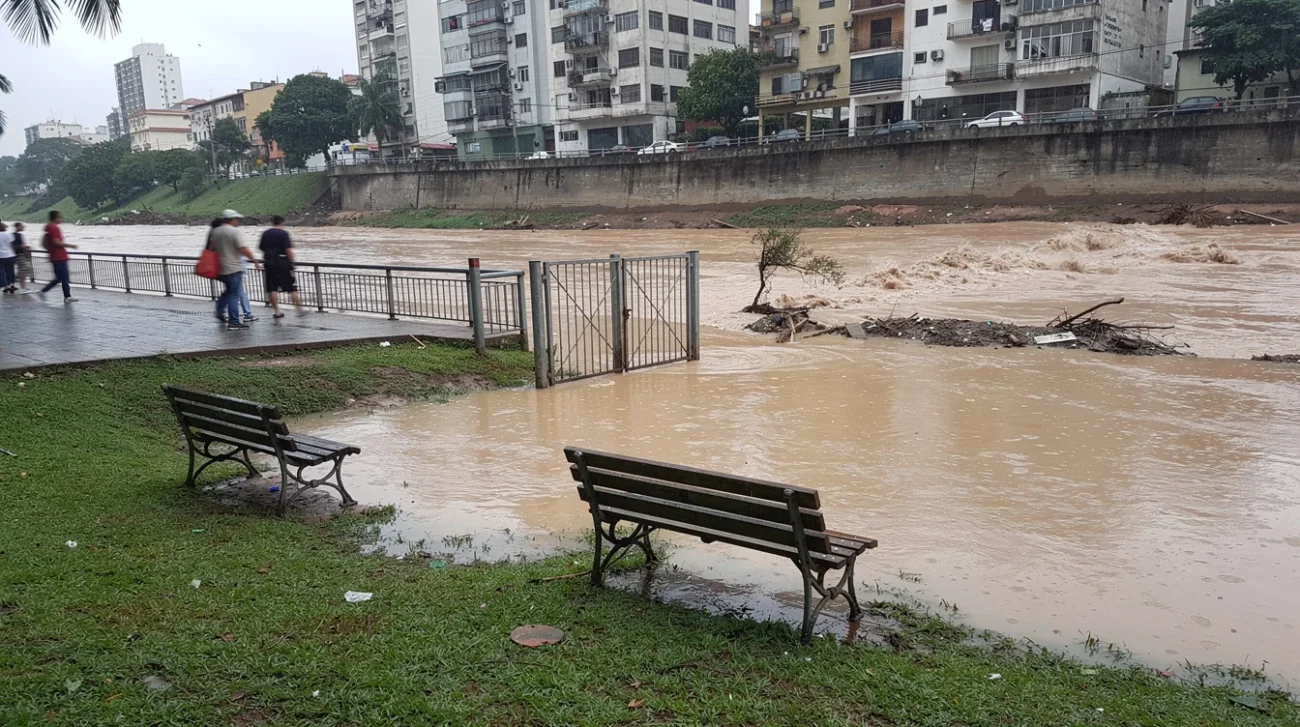
A park disappears beneath brown water. The benches become depth markers; the football pitch becomes a basin. Is this failed architecture, or architecture finally acknowledging where it stands?
Across Latin America, floodable parks challenge an unusually stubborn expectation: that successful public space must always be available for occupation. As ArchDaily’s account of the region’s floodable landscapes explains, twentieth-century urbanisation straightened rivers, confined them in concrete and built over their floodplains. Water kept returning. The Inter-American Development Bank identifies flooding as the most frequent natural disaster in Latin America and the Caribbean.
The corrective is compelling: give water somewhere to go before it enters someone’s home. But the promise contains a political trap, familiar from debates over who should provide urban shade. In neighbourhoods with few green spaces, a park that serves the watershed can stop serving its immediate neighbours precisely when they are already dealing with disrupted streets, schools and transport. The real design problem is not how to flood a park. It is how to make its disappearance safe, temporary and fair.
PRO: A Park Can Be Working While Nobody Uses It
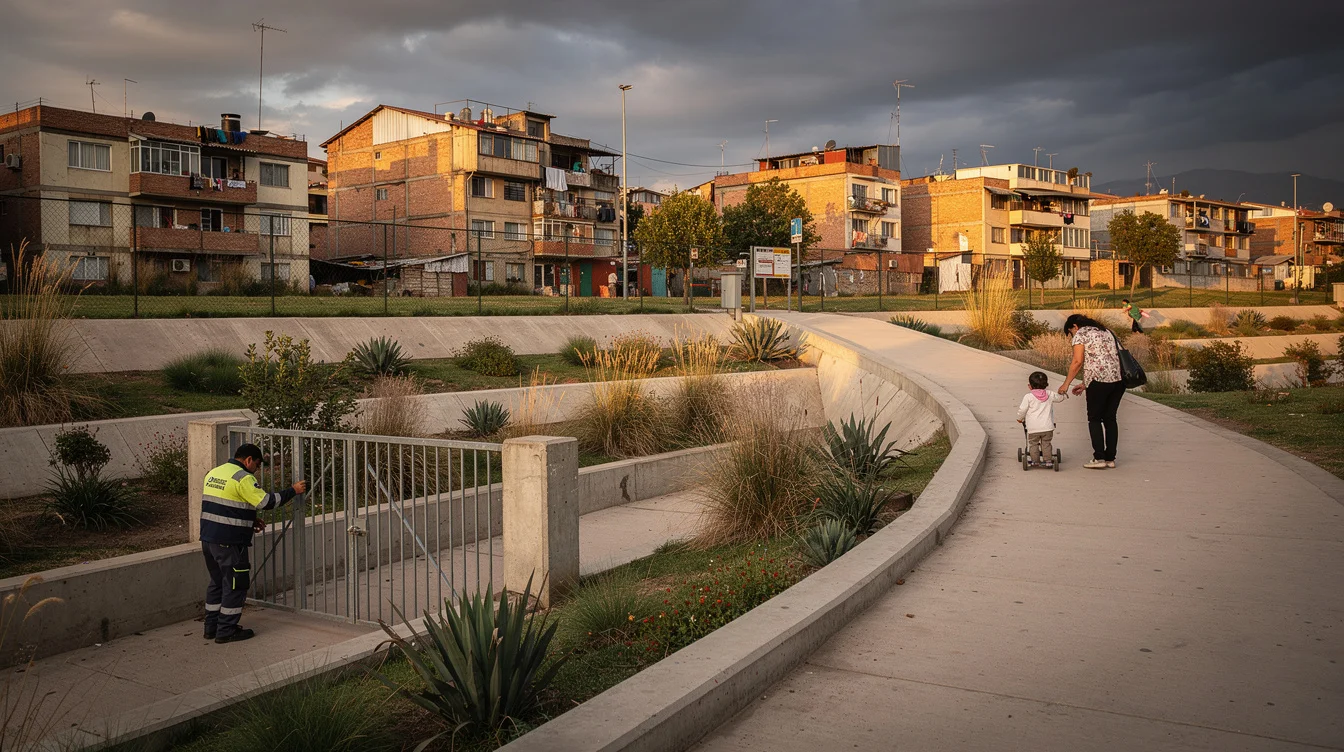
Curitiba offers a long-established rebuttal to the idea that recreation and flood management belong in separate departments. Parks including Barigui and São Lourenço integrate lakes and river landscapes into the city’s green infrastructure. Their significance is not that every path should flood, but that urban land can accommodate water rather than insist on excluding it everywhere.
A conventional drainage project is often judged by how quickly it removes runoff. A floodable landscape asks whether some of that water can be held back, spread out or conveyed through a less damaging route. These are different hydraulic functions, and designers should name which one a project actually performs. A lawn beside a river is not automatically flood-storage infrastructure.
Done properly, the approach makes public spending do more than one job. A basin can offer recreation between storms; a protected river corridor can support shade, habitat and movement alongside flood management. Temporary closure is not necessarily a loss of function. It can be the moment the park performs its most consequential function. The measure of success shifts from uninterrupted access to reduced harm across the catchment.
PRO: Design the Exit as Carefully as the View
Santiago’s Parque Inundable Víctor Jara, associated with the Zanjón de la Aguada drainage corridor, makes this dual identity explicit. Its flood-management role is not an incidental benefit attached to landscaping: it is central to the project. That clarity should extend from engineering drawings to the visitor’s experience.
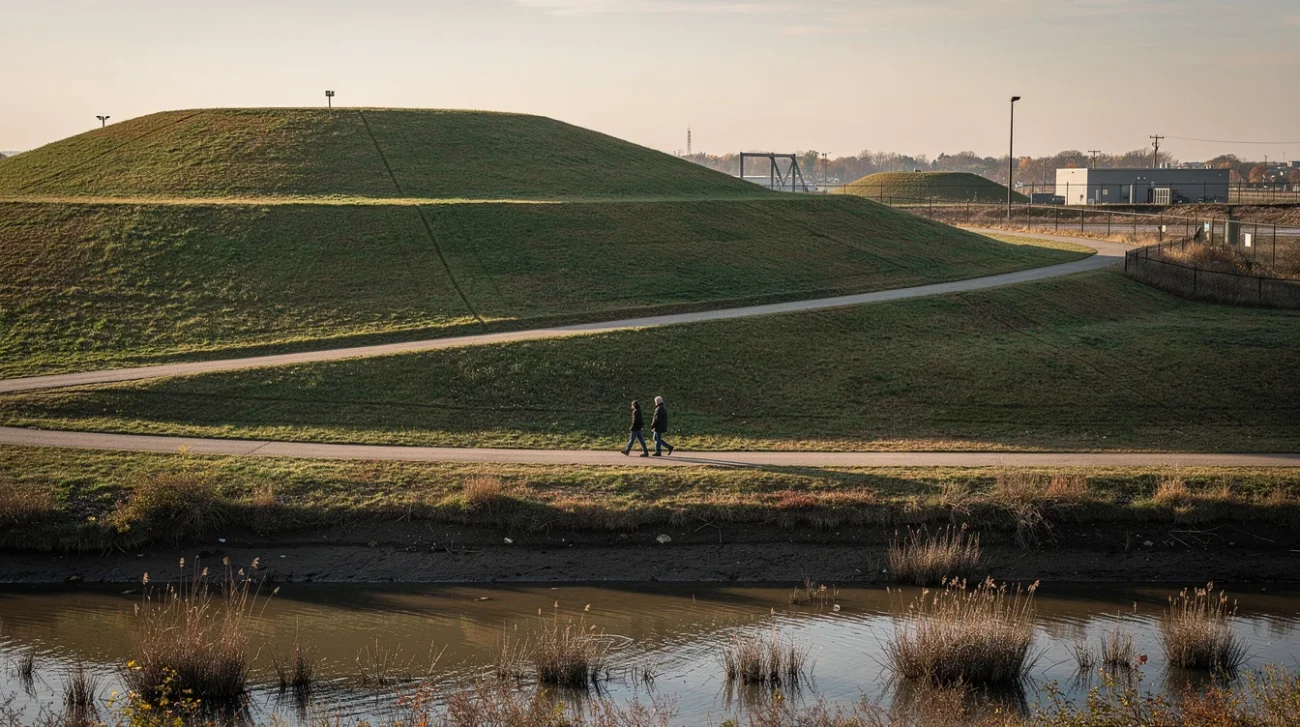
A responsible floodable park needs a legible hierarchy of ground: lower areas intended to receive water, higher circulation where feasible, and exits leading beyond the expected hazard zone. These are design requirements, not claims that every existing project already satisfies them. Routes must work for wheelchair users, children, older residents and anyone unfamiliar with the site. An elegant stairway is not an evacuation strategy.
Closure should begin before dangerous inundation, using locally validated rainfall, upstream water-level and forecast thresholds. Waiting until visitors can see water crossing a path leaves too much to chance, especially in rapidly responding urban catchments.
Physical gates, staff procedures, audible warnings and clear signs need to work together; a smartphone alert cannot carry the whole burden. The landscape should explain its changing status without asking users to interpret hydrological uncertainty. The most important architectural detail may be the route that lets someone leave calmly.
PRO: Floodability Can Rebuild a Larger Public Landscape
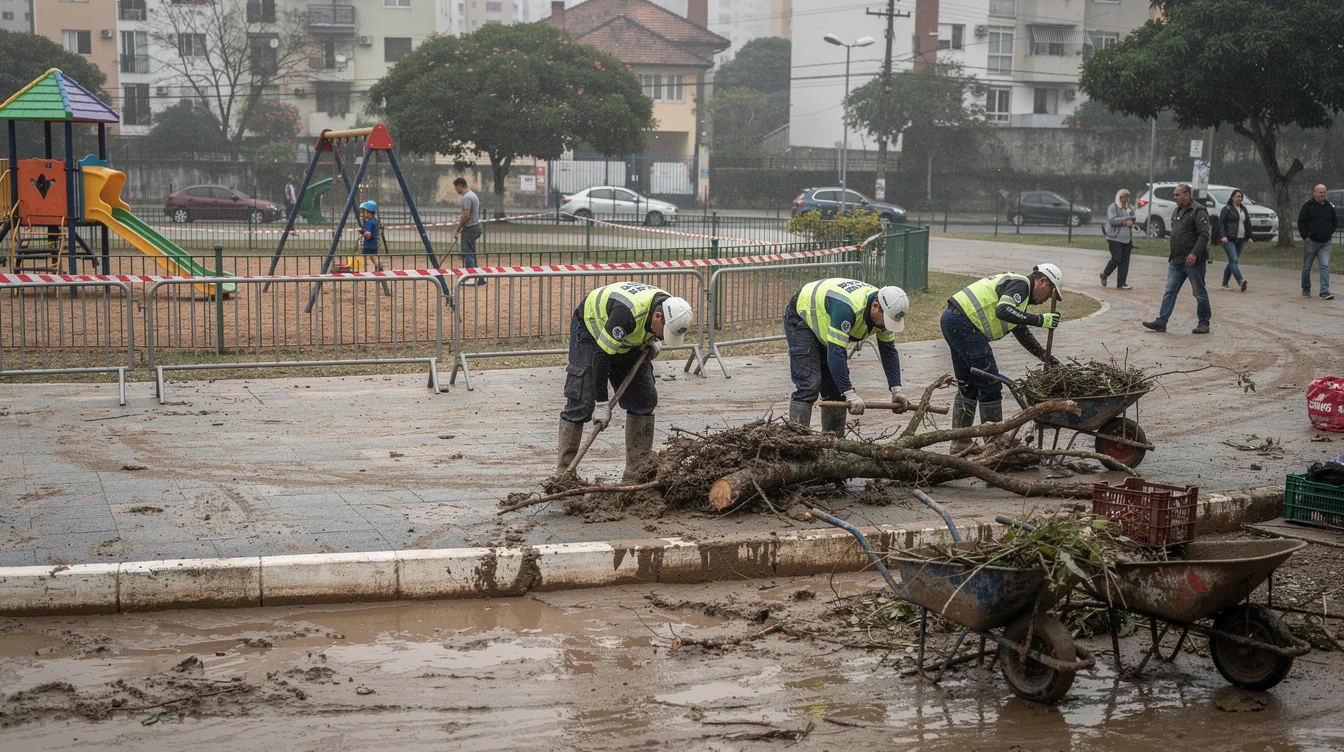
São Paulo’s Parque Várzeas do Tietê programme illustrates the metropolitan ambition behind this approach: treating floodplain land as a connected landscape rather than a collection of leftover parcels. Its scale also exposes why one photogenic basin cannot solve a catchment-wide problem. Upstream development, drainage connections and the continued occupation of flood-prone land all affect what happens downstream.
A stronger model distributes both hydraulic capacity and recreation. Lower terraces might accommodate water more frequently, while selected higher areas retain everyday uses where conditions allow. Courts, playgrounds and community facilities should not automatically occupy the first ground to flood simply because it is cheapest to designate as open space.
Reopening can also be designed in advance. Washable surfaces in appropriate locations, accessible sediment-removal routes, protected electrical equipment and planting suited to expected inundation can reduce recovery work. None eliminates maintenance; each makes that work more achievable.
The proposition is therefore larger than a park that occasionally becomes a lake. It is a public-space network with different elevations, functions and recovery periods. Redundancy, usually celebrated in engineering, belongs in recreational planning too. A neighbourhood should have another usable destination when its river park changes roles.
CONTRA: The Watershed’s Gain Can Be the Neighbourhood’s Loss
The strongest objection is not that parks should never flood. It is that the costs of floodability can be assigned to people with the fewest alternatives. A metropolitan authority may count protected roads, buildings and drainage capacity while overlooking the child whose only nearby football pitch is closed repeatedly through the wet season.
The scale of Parque Várzeas do Tietê makes that distributional question unavoidable. Floodplain restoration programmes must confront existing settlement, land tenure and access to services. Where relocation is proposed, calling the outcome green infrastructure does not settle questions of consent, compensation or proximity to livelihoods. Environmental benefit cannot substitute for housing justice.
Even without displacement, access can become unequal. A household with a car may substitute another park; a caregiver walking with two children may not. A supposedly temporary closure can therefore have radically different consequences within the same city.
Flood storage should not be purchased with an unacknowledged withdrawal of neighbourhood life. Project evaluation should count lost recreation days, the accessibility of alternatives and seasonal patterns of closure alongside hydraulic performance. Otherwise, the language of multifunctionality disguises a landscape that serves everyone except its closest users during the hardest weeks.
CONTRA: Floodwater Does Not Leave a Clean Slate
The seductive rendering shows clear water among reeds. Urban floods may bring sewage, litter, hydrocarbons, sharp debris and contaminated sediment. The precise risks depend on the catchment, but treating every inundation as benign irrigation is irresponsible. A river landscape in Curitiba and a drainage corridor in Santiago cannot simply share the same cleaning specification.
Nor does the disappearance of standing water mean that a park is ready to reopen. Paths may be undermined, slopes unstable, playground surfaces fouled and electrical installations damaged. Vegetation can conceal debris. A dry-looking field may still require inspection or remediation before children should use it.
Reliable reopening therefore means a published process, not a promise to unlock the gates after a fixed number of hours. Depending on the event and site, that process should include structural and electrical checks, debris removal, assessment of sediment and contamination, and verification that accessible routes are usable. Partial reopening is sensible only where the open area can be safely separated.
Someone must also pay for this work repeatedly. A floodable park without a funded recovery operation is not resilient infrastructure; it is deferred maintenance with a landscape concept. Municipal maintenance crews deserve as much attention in the design brief as the aerial perspective.
CONTRA: A Green Label Cannot Replace a Public Contract
Curitiba’s parks demonstrate that water management and everyday urban life can share territory. They do not prove that every city can reproduce the result by excavating a depression and planting its edges. Available land, catchment behaviour, public-sector capacity and maintenance budgets differ. More intense rainfall and continued urbanisation can also undermine assumptions made at the design stage.
The answer is an operational public contract. Before construction, authorities should explain the intended flood function, expected closure patterns under stated assumptions, warning responsibilities and reopening criteria. After completion, they should publish actual closure durations, recovery costs and performance during major events. Uncertainty is not a reason to withhold information; it is a reason to explain its limits.
Neighbourhood participation must reach beyond choosing benches. Residents should help identify indispensable activities, safe routes and realistic alternatives during closure. Additional green space may need to precede the conversion of an existing park into flood storage, rather than arrive as an unfunded future phase.
The verdict is conditional but firm: floodable parks are worth building when they reduce risk without making exclusion routine. Designers should defend the right of a park to disappear under water—and insist that the public’s claim to recreation does not disappear with it.
FAQ: Living With a Park That Floods
What makes a park floodable rather than simply flood-prone?
A floodable park is deliberately planned to accommodate water through storage, conveyance or floodplain space, with defined operating and recovery procedures. A flood-prone park may be inundated without those safeguards. The difference lies in designed performance and management, not just the presence of water.
Can people remain in a park while its lower areas flood?
Only where a site-specific safety plan allows it and genuinely safe areas and exit routes remain outside the hazard. Rising water can isolate apparently dry ground. Many sites will require full closure; staying to watch the flood should never be an assumed part of the programme.
When is it safe to reopen after a flood?
When the relevant inspections and cleanup are complete, not merely when the water recedes. Requirements depend on contamination, erosion, infrastructure damage and the activities being restored. Authorities should communicate reopening criteria and explain delays rather than announce an unsupported universal timetable.
How can neighbourhoods keep access to recreation during closures?
Planning should provide accessible alternatives outside the same flood hazard, potentially including nearby parks, higher-ground play areas or agreed shared-use facilities. Their routes, capacity and opening hours matter. A distant green patch on a map is not a meaningful substitute for daily neighbourhood space.
If a park protects the city by closing to its neighbours, what does the city owe those neighbours in return?
Watch the Mainifesto Short
Get the Mainifesto weekly — curated design debates, speculative ideas and the week's best articles every Saturday.
Editorial Perspectives
Questions and counterpoints developed by the Mainifesto editorial desk to extend the discussion.
Perspective 1
I’m for floodable parks: protecting homes is a real return on public space. But the user experience includes the closure—clear warnings, a safe way out and somewhere nearby to take the kids. Budget for cleanup and tell people when they can expect their park back.
Perspective 2
I’m not convinced a neighbourhood’s everyday park should double as the city’s flood basin. Once you price in repeated cleanup, repairs and replacement play space, the apparent saving needs a harder look. I’d rather fund dedicated flood storage than make local families absorb the disruption.
Perspective 3
I’d want to see how often the park closes and how long it actually takes to reopen, not just how much water it holds. The city owes neighbours published safety criteria, a funded maintenance team and alternative play space within an accessible walk. If those promises keep slipping, the design isn’t working as public space.
Perspective 4
Follow the water, then follow the money: whose homes are protected, and whose only park gets shut? If the benefits reach across the city, the cost of evacuation, cleanup and alternative recreation belongs in the citywide budget. Put a named agency in charge, with funding that survives the next election.