
Shade Should Be Cheap—but Must Citizens Build It?
A cheap pavilion asks an expensive question
Shade should not be a luxury product. You should not have to buy a coffee to escape direct sun, own a garden to sit outdoors comfortably, or wait for a prestige public-realm scheme before your neighbourhood becomes tolerable in hot weather. Pearce+’s Guerrilla Shading Pavilion in Camden makes a useful architectural provocation: protection from heat can begin with something simpler than a major infrastructure commission.
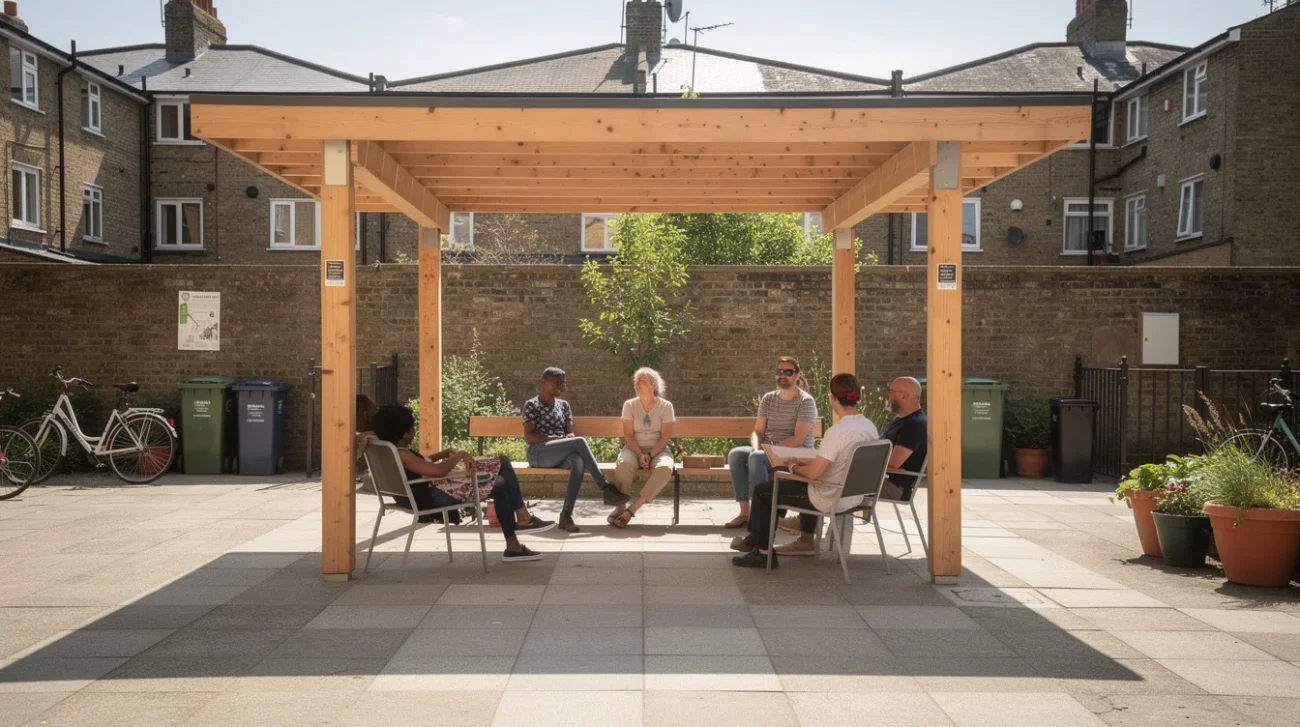
According to Dezeen’s report, the timber pavilion was commissioned by Camden Inspire festival and installed at the Camden Collective charity’s site in north London. Its stated ambition is to draw attention to the UK’s need for shade and encourage people to build their own. The proposition that shade need not be expensive or complicated is persuasive. Architecture frequently makes ordinary needs unnecessarily elaborate.
But the invitation contains a political trap. Demonstrating that citizens can build shade is not the same as establishing that they should have to. A modest structure can challenge inflated construction budgets. It can also become an alibi for institutions that would rather celebrate community resilience than fund public comfort. The question is not whether DIY shade works. It is who gets the materials, permission and spare Saturday to make it happen.
Low-tech is a design achievement, not a lesser ambition
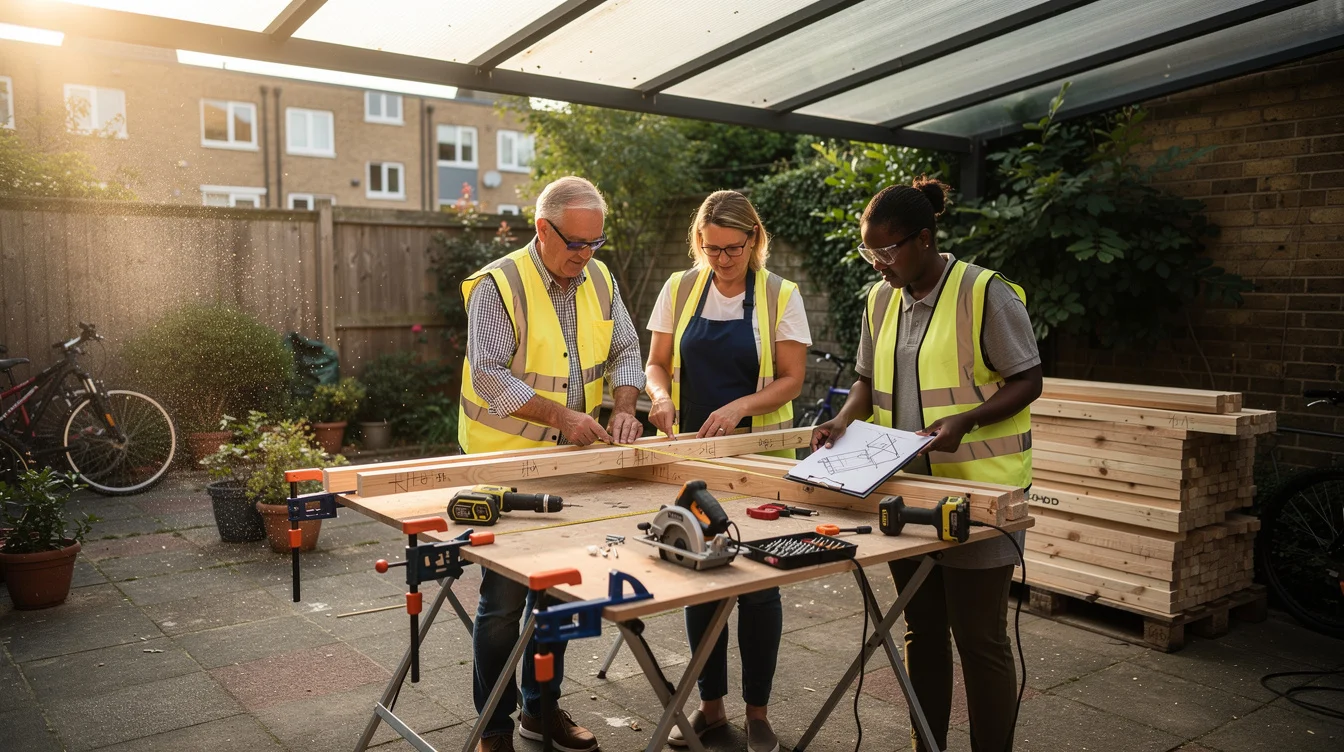
The architectural value of the Camden intervention lies in making shade legible as something achievable. Trees are essential, but a sapling cannot immediately deliver the canopy of a mature street tree. Major street reconstruction can improve planting conditions, but exposed seats and gathering spaces need relief before those programmes are completed. Lightweight shading structures can help bridge that gap.
Shade works by intercepting solar radiation before it reaches people and surfaces. That can substantially improve outdoor comfort without necessarily producing a comparable reduction in measured air temperature. The distinction matters: a shaded bench can be useful even when the weather app shows no change. Equally, shade alone does not make dangerous heat safe; ventilation, drinking water and access to cooler indoor spaces remain important.
There is a productive design lineage here. Enzo Mari’s 1974 Autoprogettazione offered instructions for making furniture from standard timber, challenging the distance between designer and user. Pearce+’s invitation belongs in that wider conversation about making practical knowledge accessible. But Mari’s lesson should not be reduced to cheapness. Simplicity can reveal how an object is assembled, repaired and understood. A shading structure becomes genuinely empowering when people can adapt it—not merely supply unpaid labour for someone else’s design.
The missing material is permission
Timber is only one ingredient in a pavilion. Space is another, and often the more expensive one. A resident with a garden can consider a freestanding canopy. A tenant overlooking a paved courtyard may need a landlord’s agreement before attaching anything. Someone living above a busy shopping street may have no outdoor space to alter at all. These are not differences in enthusiasm or resourcefulness. They are differences in power.
The Camden pavilion was commissioned by a festival and given a host site. Those facts matter because they identify enabling conditions that a casual instruction to “build your own” can conceal. A project with an organiser and a location is not equivalent to a resident improvising on a pavement. Public installations may raise questions about highway access, land ownership, planning, structural stability and liability, depending on their circumstances.
This is where the romance of guerrilla architecture becomes inadequate. Pallet Park, the temporary public-space project by Raumlabor and zukunftsgeraeusche in Berlin, used a modest material palette to create a place for collective activity. Such experiments can expand the imagination of a street. But their transferable lesson is not simply that ordinary materials are available. Temporary urbanism still needs someone to negotiate the ground beneath it. Permission is infrastructure, even when it leaves no visible trace.
Community labour is not a renewable resource
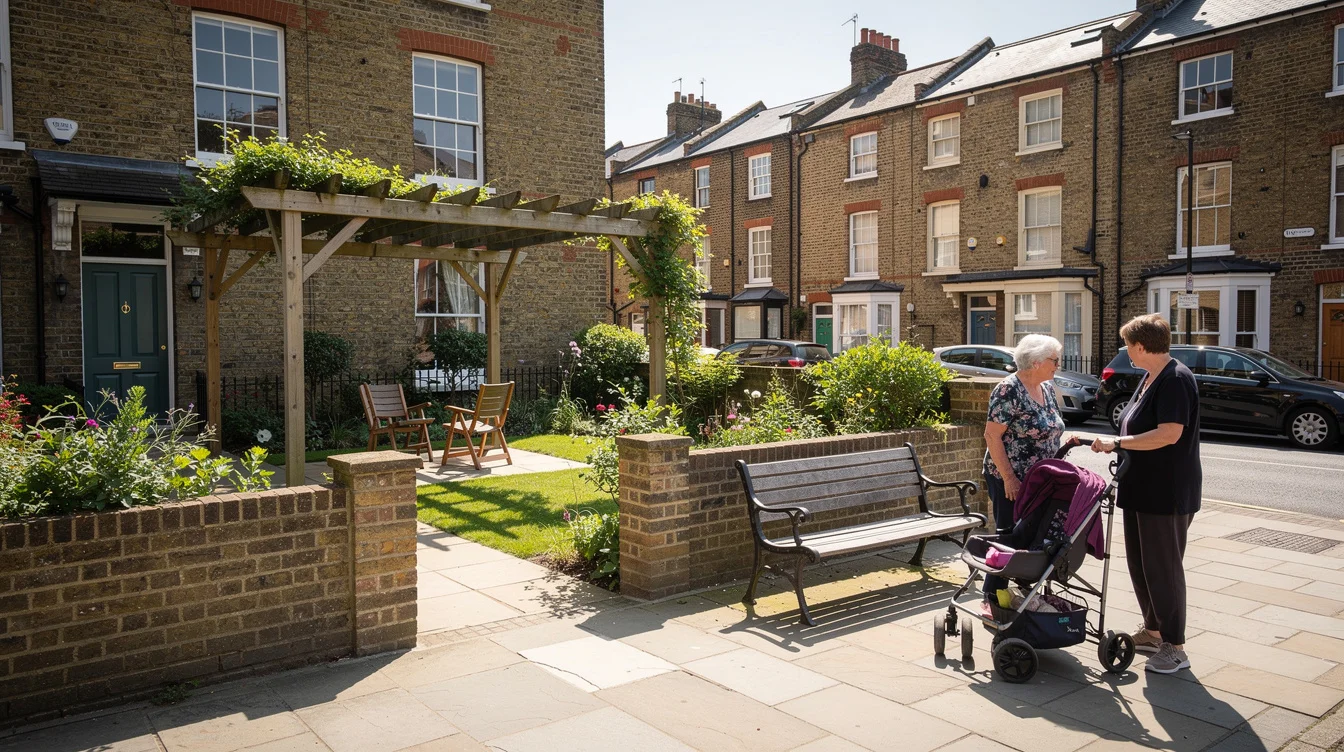
Then comes time. The residents most exposed to heat may include shift workers, carers, older people and people whose health limits physical work. A neighbourhood does not become less deserving of shade because its residents cannot organise a construction weekend. Nor should its public comfort depend on whether someone happens to own a drill, understand fixings or feel confident negotiating with a property manager.
Participation also has a maintenance tail. Who checks connections after strong winds? Who replaces damaged components, removes a structure when necessary, or makes sure seating remains usable? A cheap installation can become an expensive obligation if those tasks are quietly handed to a small group of volunteers. Calling that arrangement community ownership does not make it equitable.
Assemble’s work with Granby Four Streets in Liverpool offers a more demanding reference point than the one-day build. Its relationship with the community land trust and the development of Granby Workshop connect making to organisation, skills and a longer-term local economy. The context differs from a shading pavilion, but the principle travels: participation needs institutional support. The meaningful alternative to top-down design is shared power, not outsourced responsibility. Residents should be able to shape shade provision without having to become its permanent unpaid facilities team.
Make DIY an option, not the delivery model
A fair shade policy would start with public need rather than volunteer availability. Map exposed walking routes, bus stops, play areas and places where people queue. Prioritise locations used by people with limited alternatives. Then select the appropriate combination of trees, fixed canopies and seasonal structures, accounting for accessibility, underground services, sightlines and maintenance. Not every site needs a pavilion; every decision needs a reason.
Barcelona’s climate-shelter network offers a useful counterpoint because it treats access to heat relief as something to organise across a city, using public facilities and outdoor spaces. Paris’s OASIS schoolyard programme similarly places cooling within the transformation of civic assets. Neither model eliminates delivery problems. Both move beyond the idea that a resident’s access to relief should begin with their ability to build something.
DIY can sit inside that public commitment. Councils and partner organisations could offer small grants, shared tool libraries, practical workshops, competent structural advice and a clear permissions route. Residents could be paid for organising and maintenance. Design guidance should address wheelchair access, seating and changing sun angles, not just an attractive assembly diagram. This is not bureaucracy smothering initiative. It is the support that lets initiative extend beyond people who already possess property, equipment and professional connections.
The pavilion should embarrass the budget, not excuse it
The strongest reading of Pearce+’s project is not that the public sector can step back. It is that excuses for doing nothing have become weaker. If a modest timber intervention can demonstrate the value of shade, authorities should explain why so many everyday waiting and resting places remain exposed. Cheapness should increase expectations of provision, not lower expectations of government.
There is still no universal bargain canopy. Wind loads, anchoring, durability and the practicalities of public use can add legitimate costs. Temporary structures also require a plan for storage, reuse or disposal. Comparing projects only by their initial material bill rewards false economy. The relevant calculation includes how long useful shade is available, whom it serves and what keeping it safe demands.
The success test for Camden’s provocation should therefore reach beyond whether more residents pick up tools. Does the demonstration lead to funded shade in places with fewer resources? Do landowners make suitable space available? Does temporary experimentation inform lasting provision? The right to shade must survive the absence of a volunteer. Guerrilla architecture is most valuable when it changes what institutions consider possible—not when it teaches them how much essential work citizens can be persuaded to do for free.
FAQ: DIY shade and public responsibility
What is Pearce+’s Guerrilla Shading Pavilion?
It is a timber pavilion commissioned by Camden Inspire festival and installed at the Camden Collective charity’s site in north London. The project highlights the need for shade in the UK and encourages people to consider DIY shading.
Can inexpensive shade meaningfully improve outdoor comfort?
Yes. Blocking direct sunlight reduces radiant heat exposure and can make outdoor spaces more comfortable. Its effectiveness depends on coverage, orientation, materials and ventilation. Shade complements rather than replaces drinking water, heat-health precautions and access to cooler indoor spaces.
What should residents check before building DIY urban shade?
Start with landowner consent and any relevant local requirements. Consider wind stability, safe anchoring, fire safety, accessibility and maintenance. A structure intended for public use may need competent professional assessment; low-cost materials do not remove safety responsibilities.
How can councils support community shade without exploiting volunteers?
Provide funding, suitable sites, permissions support, technical assistance and paid coordination where needed. Establish who maintains each structure, and continue delivering public shade in neighbourhoods without active volunteer groups. Community participation should improve provision, not determine eligibility for it.
If shade can be inexpensive, should citizens be invited to build it—or entitled to find it already there?
Watch the Mainifesto Short
Get the Mainifesto weekly — curated design debates, speculative ideas and the week's best articles every Saturday.
Editorial Perspectives
Questions and counterpoints developed by the Mainifesto editorial desk to extend the discussion.
Perspective 1
Mexico City’s courtyards and portales remind us that shade is hardly a new design problem, though access to it has always been unequal. Let residents adapt their streets, but pay for their work—and don’t turn their improvements into the next selling point for landlords.
Perspective 2
Lefebvre’s right to the city was not an invitation to assemble your own public services. The Camden pavilion may be a useful experiment, but celebrating its cheapness tells us very little until we know who owes whom shade.
Perspective 3
I’d want to test the pavilion’s mean radiant temperature reduction, not just its material cost: cheap cover isn’t necessarily effective shade. Could residents help design and prototype it while the city guarantees installation, maintenance and access, especially for people who can’t join a build day?
Perspective 4
A fabrication file is not a shade service: someone still needs permission to build, safe fixings and a maintenance budget. In Beirut, DIY can be a necessary response to institutional failure; that doesn’t make it a model governments should aspire to. Invite citizens to build, but guarantee shade whether they volunteer or not.