
Who Gets to Improvise on the Public Street?
Who Gets to Improvise on the Public Street?
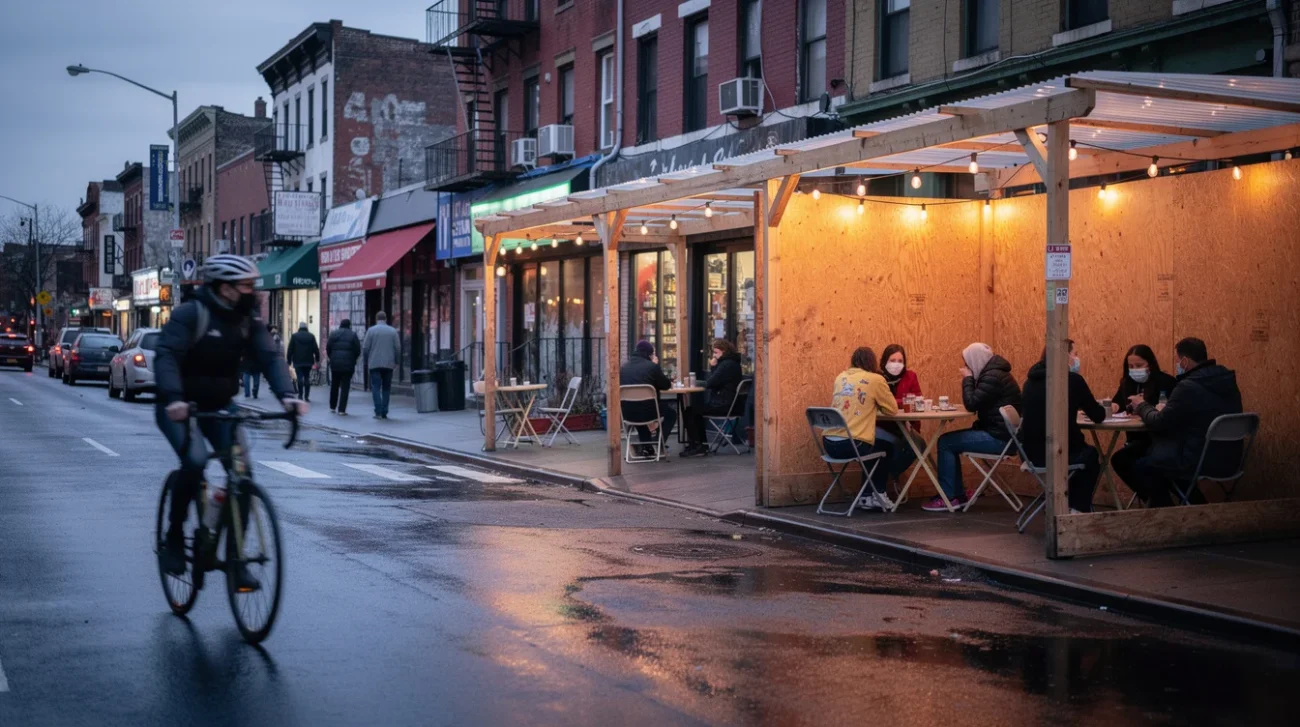
New York’s pandemic dining sheds turned the curb into an architectural argument. Plywood, tents, planters and increasingly elaborate enclosures appeared where parked vehicles had seemed immovable. Restaurants suddenly possessed something usually rationed through permits, capital and professional expertise: permission to alter the city’s visible form.
Penny Hardy’s recently announced book, Pandemic Architecture: NYC Dining Sheds 2020–2024, records the absurdity, delight and ingenuity of that transformation. Dezeen’s selection from the archive highlights structures ranging from hurried shelters to considered compositions with distinctive signage. But the important question is not whether these objects were charming. It is whether emergency architectural freedom can become a durable public right without becoming a private entitlement.
PRO: The Street Became a Design Laboratory
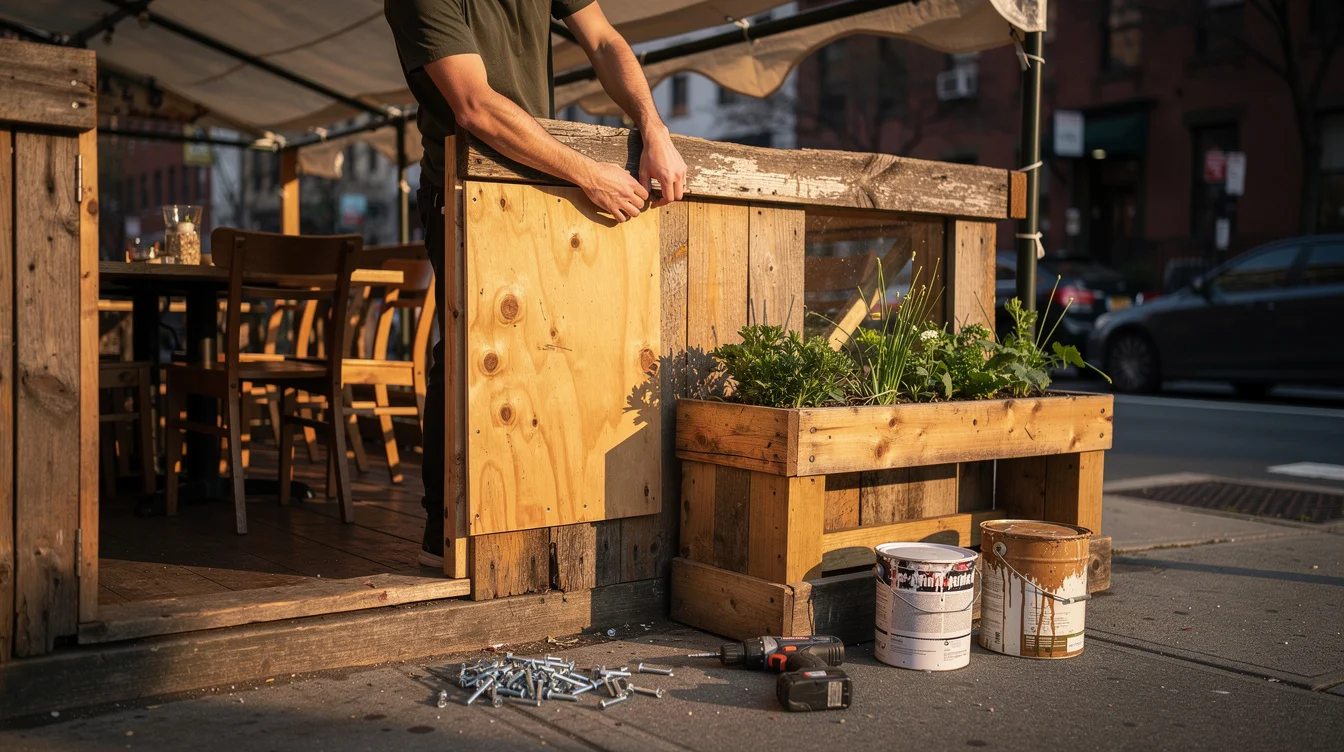
The strongest argument for NYC dining sheds is that they exposed how much architectural possibility ordinary street management suppresses. A restaurant did not need to commission a landmark to change the experience of a block. A canopy could establish a threshold; a painted partition could give a dining area an identity; a few carefully positioned tables could turn storage space for cars into somewhere people lingered. These were small interventions with metropolitan consequences.
Hardy’s archive matters because it preserves difference rather than a single approved aesthetic. The spectrum described in the source—from improvised tents to more intricate, sign-bearing structures—suggests a city being authored by many hands. Not every result deserved admiration. That is precisely the point: a public realm that permits experimentation must accommodate some awkwardness, visual disagreement and failure.
There are precedents. In 2005, San Francisco collective Rebar transformed a metered parking space into a temporary miniature park, helping launch PARK(ing) Day. New York’s Street Seats program subsequently offered another route for converting road space into places to sit. Pandemic dining multiplied the visibility of curbside occupation, although its commercial purpose distinguished it from freely accessible seating. The lesson was nevertheless forceful: the curb’s existing use was a policy choice, not a law of nature. Design became a way to contest it.
PRO: Improvisation Is Architectural Knowledge
Architecture’s professional culture often treats improvisation as the messy stage before a proper design arrives. The sheds challenge that hierarchy. Making a shelter quickly, with limited money and uncertain conditions, requires spatial judgment: where rain lands, how a server turns, what separates a table from passing traffic, and how an enclosure announces that a business remains alive. A modest structure can contain serious intelligence without looking like an architecture award submission.
This does not mean every shed performed well. It means performance should be investigated rather than inferred from polish. A rough canopy may provide useful shade; an immaculate enclosure may trap heat or obstruct movement. The archive invites a distinction between design quality and design pedigree. Neither expensive detailing nor professional authorship automatically guarantees the former.
Designer Enzo Mari’s 1974 Autoprogettazione project offered instructions for making furniture from standard timber, challenging the distance between designer and maker. Berlin collective raumlabor has likewise made temporary structures and collective construction central to its practice. Neither is a direct explanation of New York’s sheds, but both provide a useful lens: building can produce knowledge through participation and adjustment. That also raises a question familiar from unfinished housing and resident-led construction: when does participation become an obligation to do unpaid work?
The defensible legacy is therefore not permanent permission for every emergency enclosure. It is a route through which small operators can test reversible ideas without first purchasing an expensive design process. A city that only permits experimentation during catastrophe has misunderstood experimentation.
CONTRA: A Dining Room Is Not a Public Commons
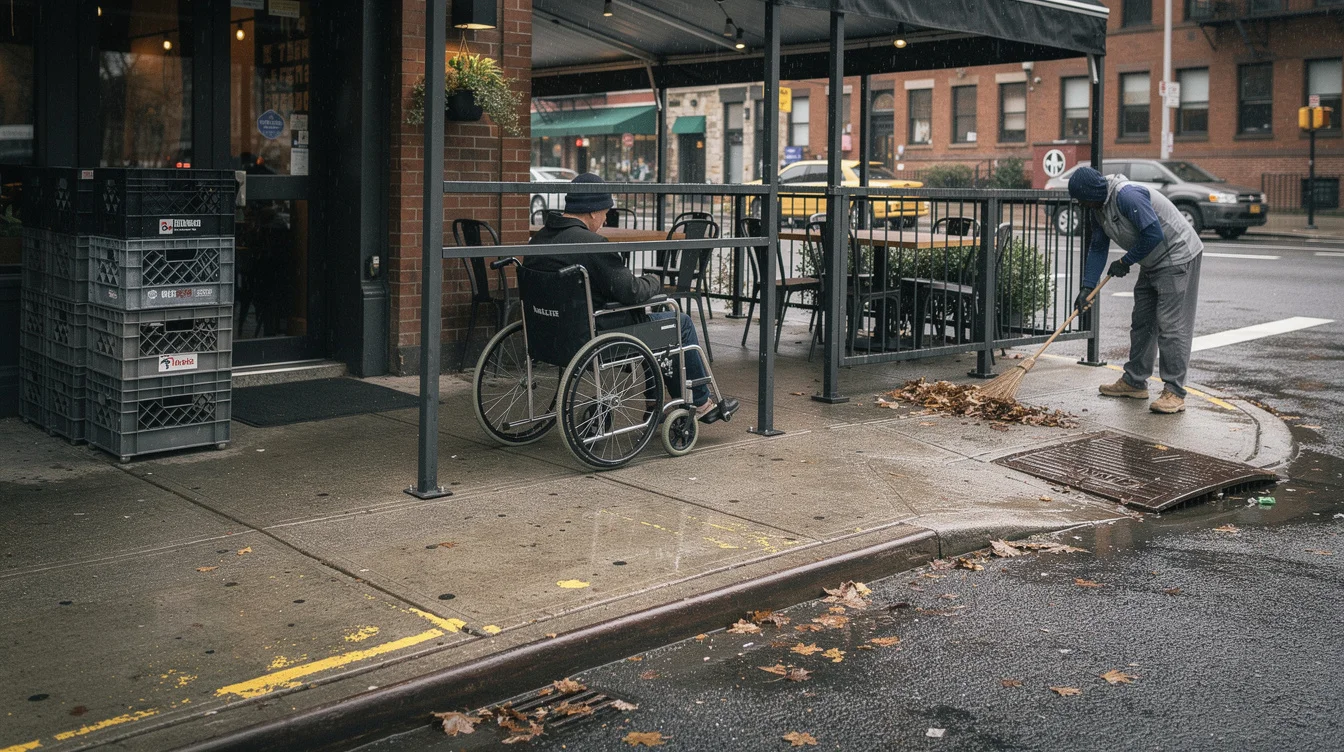
The strongest objection begins with ownership, not appearance. A restaurant’s initiative does not give it an automatic claim to the space outside its door. A dining shed may replace a parked car, but it can also replace opportunities for public seating, loading, planting or other shared uses. The comparison cannot stop at “better than parking.” It must ask which alternative serves the street, and whom that alternative excludes.
Commercial occupation carries an admission price even when it has no gate. Someone buying dinner can remain; someone seeking a place to rest may not be welcome. This distinction matters especially for older people, delivery workers and anyone whose use of the city cannot be organized around repeated purchases. More people visible outdoors does not necessarily mean more public access.
William H. Whyte’s observations in The Social Life of Small Urban Spaces emphasized the importance of usable places to sit. His work offers a corrective to evaluating street life through photogenic crowds alone. Jan Gehl’s attention to everyday pedestrian experience points in the same direction: assess what bodies can actually do, not simply how animated a scene appears.
A commercially lively street can still distribute freedom unfairly. Businesses with greater resources can produce more persuasive enclosures, while quieter needs remain unbuilt and therefore less visible. Bottom-up design is not automatically democratic when the participating “bottom” consists primarily of adjoining businesses.
CONTRA: The Unphotogenic Details Are the Public Contract
Accessibility is where the romance of improvisation meets its hardest test. Can a wheelchair user follow a continuous clear route? Can a blind pedestrian detect a boundary without encountering projecting elements? Can a diner enter and use the outdoor space, rather than merely pass it? These are different questions. Solving one does not solve the others, and a decorative planter is not evidence that any has been considered.
Maintenance presents an equally collective problem. Rainwater, accumulated debris, damaged components, snow clearance and access to underground infrastructure do not respect a restaurant’s preferred image. Nor does a delivery driver’s need to stop safely. One successful enclosure can impose costs beyond its footprint; several on the same block can compound conflicts that none of their owners can resolve alone.
The Americans with Disabilities Act supplies a civil-rights framework, not an optional design preference. The National Association of City Transportation Officials’ Urban Street Design Guide offers a complementary way of thinking about streets as coordinated systems rather than leftover parcels. Neither substitutes for site-specific review, but both challenge the idea that ingenuity excuses external consequences.
The answer should be conditional freedom, not aesthetic prohibition: clear accessibility requirements, assigned maintenance responsibilities, reviewable permissions and genuine opportunities for noncommercial uses. Public authorities should establish the shared obligations; individual builders should retain room to invent within them. Keep the unusual forms. Refuse the assumption that a good-looking experiment has already earned its place.
FAQ
What does Penny Hardy’s dining shed archive document?
Her book, Pandemic Architecture: NYC Dining Sheds 2020–2024, collects New York’s pandemic-era outdoor dining structures. The source coverage emphasizes their variety, from hastily installed sheds and tents to more elaborate designs with distinctive signage.
Why should dining sheds be considered architecture?
They organize shelter, movement, boundaries and social interaction through built form. Their temporary status and sometimes improvised construction do not disqualify them. They still deserve scrutiny for safety, accessibility, environmental performance and their relationship to the street.
Are restaurant dining sheds genuinely public space?
They occupy street space but generally serve a commercial use. That can contribute to urban life without providing the same access as a public bench or plaza. Evaluation should distinguish visible activity from the right to stay without buying anything.
How could cities preserve experimentation while protecting access?
Offer affordable, understandable routes for temporary proposals while requiring accessible layouts, maintenance plans and coordination with other curb uses. Review permissions over time and reserve opportunities for noncommercial occupation. Standards should protect shared functions without dictating a single visual style.
If the curb belongs to everyone, who should receive permission to improvise there—and what should they owe everyone else?
Watch the Mainifesto Short
Get the Mainifesto weekly — curated design debates, speculative ideas and the week's best articles every Saturday.
Editorial Perspectives
Questions and counterpoints developed by the Mainifesto editorial desk to extend the discussion.
Perspective 1
Streets have always been remade by the people working along them; I’d let restaurants keep improvising rather than freeze the curb into one approved design. But permission should favor neighborhood businesses, not whoever can buy the prettiest enclosure, and require clear passage and seating that doesn’t depend on ordering lunch. Otherwise, we’re just giving gentrification a charming little roof.
Perspective 2
I wouldn’t give restaurants free rein over the curb: a shed that adds twelve covers but blocks a wheelchair or traps the neighboring shop’s deliveries is bad hospitality. Set a tight footprint, require maintenance, and revoke permits when operators don’t deliver. If the business case only works by making everyone else absorb the inconvenience, it doesn’t work.