
Who Keeps the Forest Alive After the Building Opens?
Who Keeps the Forest Alive After the Building Opens?
A tree on the twenty-third floor is not just a tree. It is a long-term claim on water, skilled labour, structural capacity and somebody’s bank account. Architectural photography usually crops out those obligations. The leaves get the publicity; the maintenance contract stays in a drawer.
Dezeen’s November 2026 examination of whether trees on buildings amount to greenwashing, by Nat Barker, frames a debate that deserves to move beyond appearances. The decisive question is not whether a planted tower looks ecological. It is whether its ecological promises survive changes of ownership, drought restrictions and the first expensive replacement cycle. There are two serious positions here: living facades can be valuable urban infrastructure; they can also turn environmental aspiration into an unfunded liability.
PRO: A Living Facade Can Be Real Infrastructure
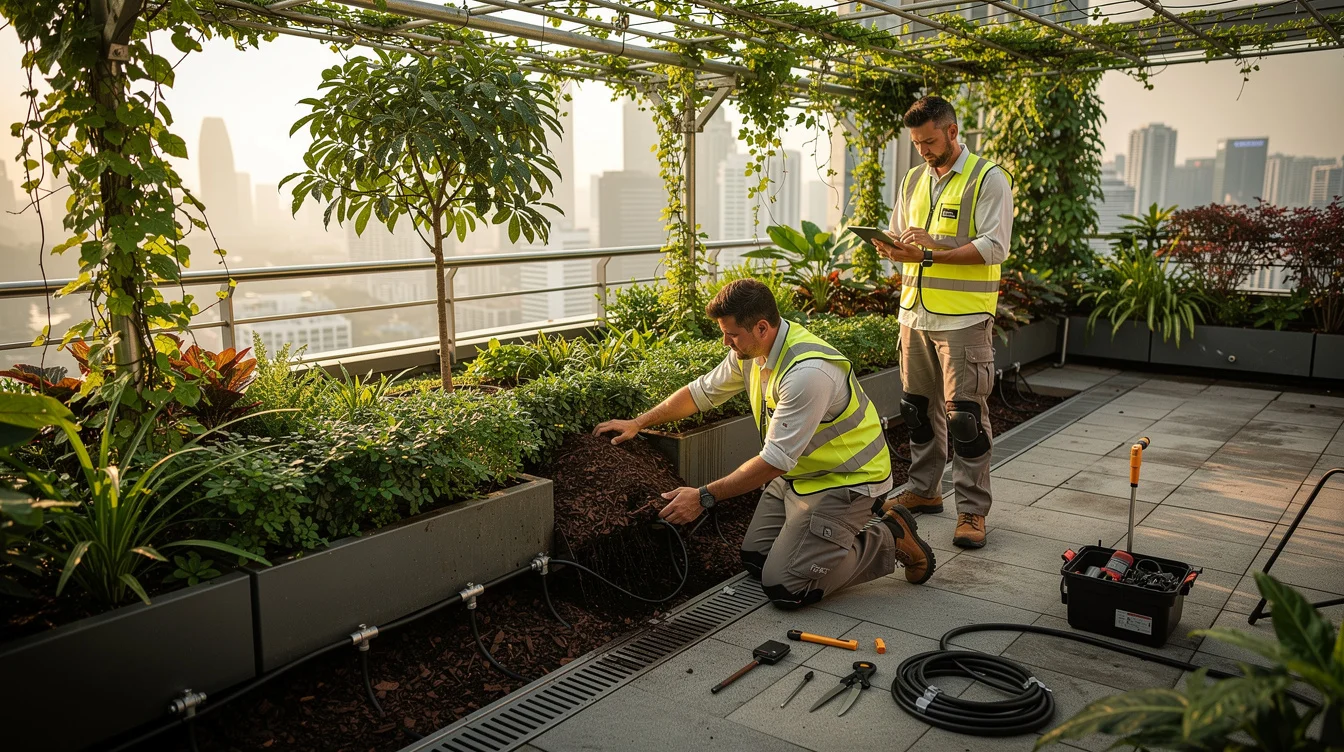
Dismissing every planted building as greenwashing is intellectually lazy. In dense neighbourhoods, the choice is not always between a tower with trees and a generous new park. It may be between an exposed facade and one that provides shade, vegetation and opportunities for habitat. Those are legitimate differences, even when they cannot repair the wider environmental damage of construction.
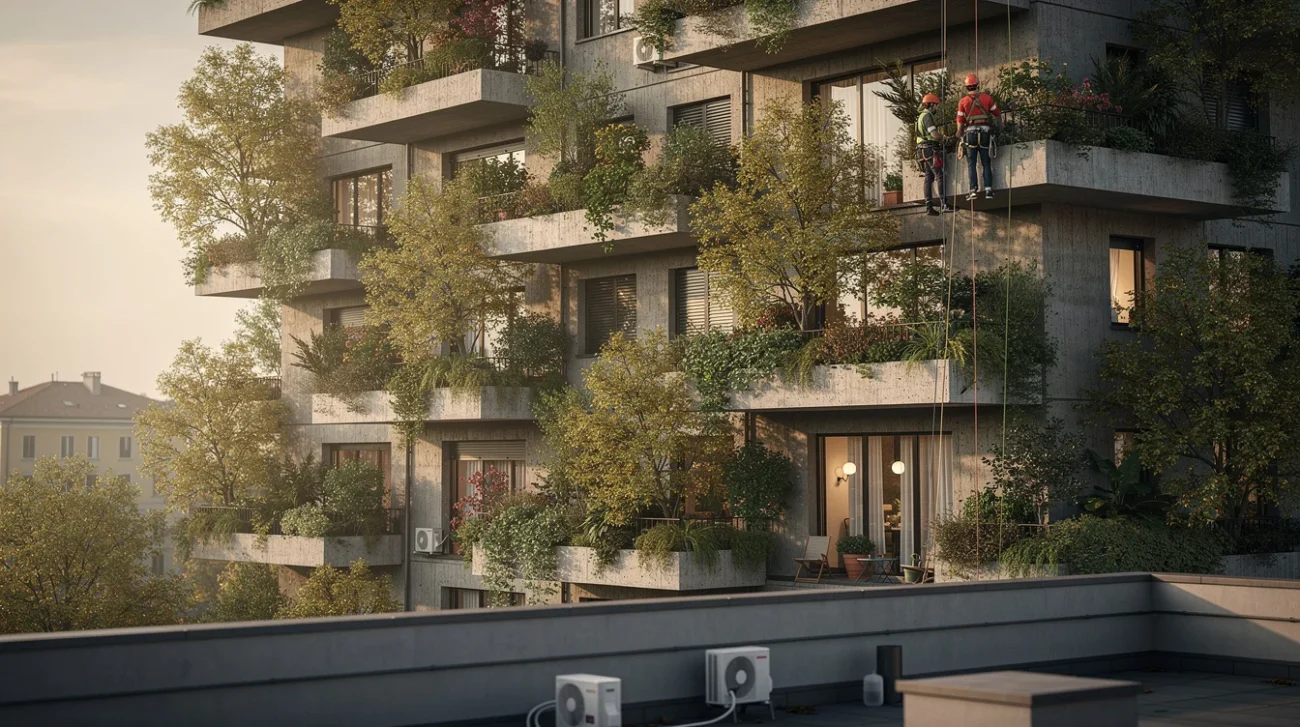
Stefano Boeri’s Bosco Verticale in Milan, completed in 2014, makes the argument unusually visible. Trees and shrubs occupy projecting balconies on two residential towers, placing vegetation across a vertical surface rather than concentrating it at ground level. Its most useful lesson is not that every city should reproduce the silhouette. It is that planting at height must be designed as a system: species selection, root space, irrigation, wind exposure and maintenance access belong in the architectural brief.
Sydney’s One Central Park, designed by Ateliers Jean Nouvel with vertical gardens by Patrick Blanc, offers a related but different model. Its planted facades sit within a development incorporating water-recycling infrastructure. That connection matters more than the promotional adjective “lush”: it makes the source and circulation of irrigation water part of the environmental argument.
The strongest defence of tree-covered buildings is therefore conditional: greenery can perform useful work when its biological needs shape the building, rather than decorate a completed commercial proposition.
PRO: Maintenance Can Make the Promise Credible
The fact that vegetation needs care is not, by itself, an indictment. Solar panels need servicing; drainage systems need clearing; public parks need gardeners. Declaring planted buildings fraudulent because they require maintenance applies a standard that almost no urban infrastructure could meet. The pertinent distinction is between a funded service and an architectural wish.
Bosco Verticale’s specialist gardening arrangements, including work by rope-access arborists, demonstrate why ordinary balcony care is an inadequate model. A resident cannot safely improvise pruning on an exposed canopy several storeys above the pavement. Centralised expertise is part of the architecture’s operating system, not an optional luxury.
WOHA’s Oasia Hotel Downtown in Singapore offers another useful reference. Its climbing vegetation and planted sky terraces are not equivalent to a forest of mature balcony trees. They show that designers can pursue substantial greenery through different combinations of plants, support structures and accessible growing areas. The appropriate system depends on climate, building use and the resources available to maintain it.
A credible project should translate those choices into an explicit operating plan: who inspects the planting, how workers reach it, where water comes from and what happens when plants fail. Ring-fenced reserves and enforceable responsibilities can give the ecological claim substance. The pro position is not “more trees everywhere”. It is that buildings can host living infrastructure when ownership accepts the continuing duties that infrastructure creates.
CONTRA: The Green Image Can Outlive the Green System
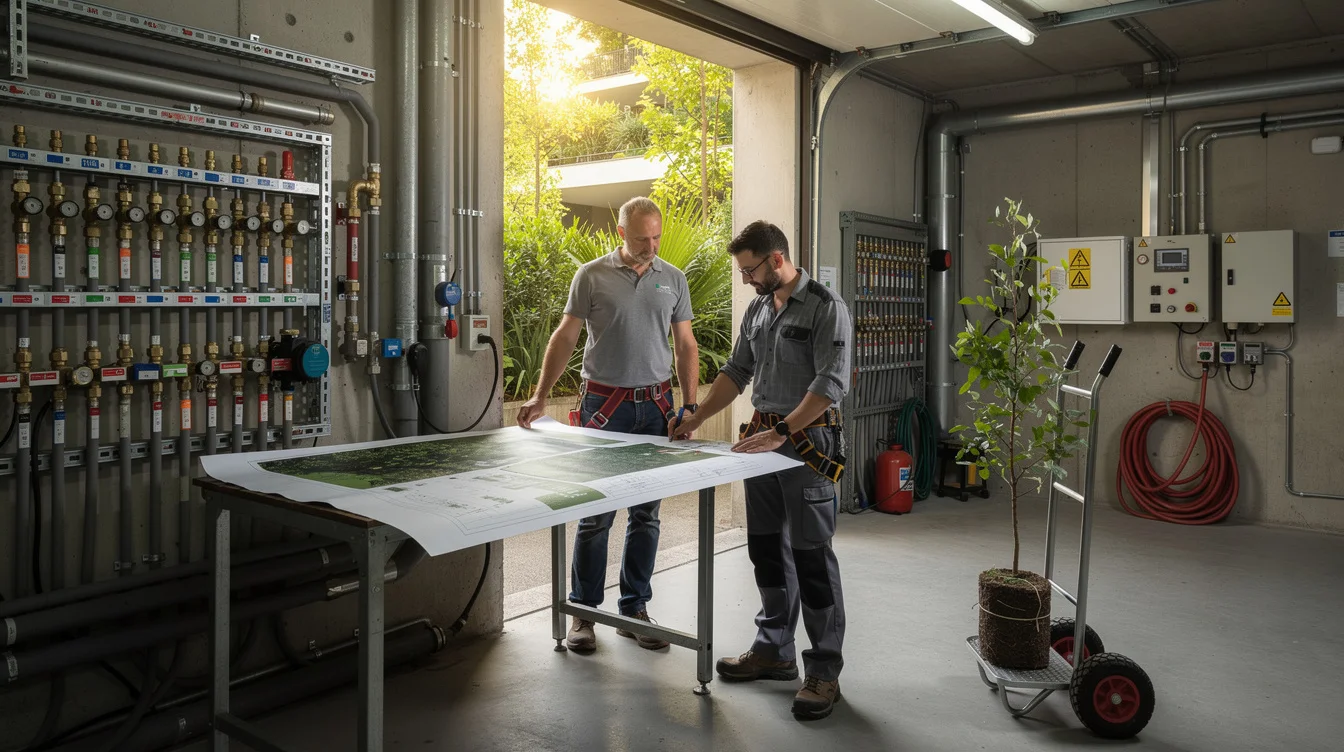
The opposing case begins with a blunt asymmetry: developers can monetise greenery immediately, while owners and occupants inherit its costs for decades. Sales imagery captures the anticipated canopy at its most flattering. The service charge arrives later. Without binding arrangements, the party selling the environmental promise may never have to deliver its mature form.
Tree-covered buildings also require more than plants. Saturated growing media, containers, drainage, anchorage and access provisions all have physical consequences. Where planting demands additional structure, that material burden belongs in the environmental assessment. Vegetation does not automatically cancel the emissions associated with concrete, steel or construction. A claim about shade is not proof of a low-carbon building.
Bosco Verticale is useful here precisely because its recognisable image invites imitation. Copying generous balcony trees without copying the horticultural expertise, structural coordination and operating arrangements would reproduce the branding while discarding the mechanism. This is not an allegation about the Milan project; it is a warning about treating a complex system as an exportable style.
Nor is irrigation a neutral input. Species, orientation, local rainfall and water supply determine whether a facade’s needs are defensible. One Central Park’s connection to recycled-water infrastructure illustrates why context matters. The same visual abundance supplied with scarce drinking water elsewhere could carry a very different environmental balance. A green photograph cannot communicate that difference, but a serious claim must.
CONTRA: A Private Garden Is Not a Public Forest
The second objection concerns what the city receives in exchange for the praise. Balcony planting may benefit residents while offering little public access or pedestrian shade. A tower’s visible greenery should not be treated as interchangeable with street trees, connected habitat or a park where people can sit without buying anything.
WOHA’s PARKROYAL COLLECTION Pickering in Singapore, with its extensive elevated gardens, demonstrates how strongly planting can define hospitality architecture. Yet the relevant public question remains distinct from the architectural achievement: which benefits extend beyond the property, and how are they measured? Visibility is not access. Leaf area is not, by itself, evidence of biodiversity.
Responsibility also becomes harder when ownership fragments. If apartment owners face a major replacement bill, can they vote to simplify the planting? If a hotel changes hands, does its landscape budget survive? These are governance scenarios, not claims that either named project has failed. They expose the weakness of attaching permanent ecological language to arrangements that may be financially temporary.
The appropriate response is an enforceable landscape obligation tied to the property, supported by a costed maintenance plan, a replenished replacement reserve and transparent reporting. It should cover safe access, plant mortality, irrigation use and a workable replacement route. Where those commitments cannot be secured, the green claim should shrink to match the guarantee. Architecture should not receive lifetime environmental credit for vegetation funded only through the launch.
FAQ: What Should Architectural Greenness Guarantee?
Are tree-covered buildings automatically greenwashing?
No. Planting can provide shade, amenity and habitat opportunities. Greenwashing arises when marketing exaggerates those benefits, overlooks relevant environmental costs or implies lasting performance without credible provision for care. The test is evidence and responsibility, not the presence of leaves.
Who should pay for maintaining a living facade?
The operating owner or owners’ association should have clearly allocated duties and a disclosed budget. Developers should establish realistic cost forecasts and an initial reserve before sale, with enforceable arrangements for replenishment. Prospective buyers should understand the obligation before inheriting it.
What should an environmental assessment include?
It should examine additional structural and landscape materials, water sources, irrigation energy, maintenance access, plant replacement and measurable benefits. Comparisons should include plausible alternatives, such as external shading or ground-level planting, rather than assuming a planted facade is inherently the best option.
Must every original tree remain for the building’s lifetime?
No. Living systems change, and responsible management includes replacement and adaptation. Commitments should define achievable landscape performance, safe management and replacement funding, rather than promise that every opening-day specimen will survive indefinitely. Adaptation should not become an excuse for quietly abandoning the planting.
If a building cannot guarantee the care of its greenery beyond the first owner, should it be allowed to sell that greenery as a lasting environmental benefit?
Watch the Mainifesto Short
Get the Mainifesto weekly — curated design debates, speculative ideas and the week's best articles every Saturday.
Editorial Perspectives
Questions and counterpoints developed by the Mainifesto editorial desk to extend the discussion.
Perspective 1
Yes, owners should be allowed to sell the long-term environmental value of greenery without guaranteeing what every future owner will do. But buyers need the maintenance budget, replacement costs and management obligations upfront—not a rendering that quietly assumes trees look after themselves.
Perspective 2
No—if the care doesn't survive a change of ownership, don't sell the greenery as a lasting benefit. Guests experience the dead planters, leaking irrigation and closed terraces, not the launch campaign; ring-fence the upkeep money before charging a green premium.
Perspective 3
I'd separate keeping the planting alive from proving its environmental benefit: a healthy tree on a tower doesn't automatically justify the resources needed to maintain it. Require a funded care plan that transfers with ownership, then check survival rates, water use and actual shading rather than counting trees on opening day.