When Your Body Becomes the Factory Floor
When Your Body Becomes the Factory Floor
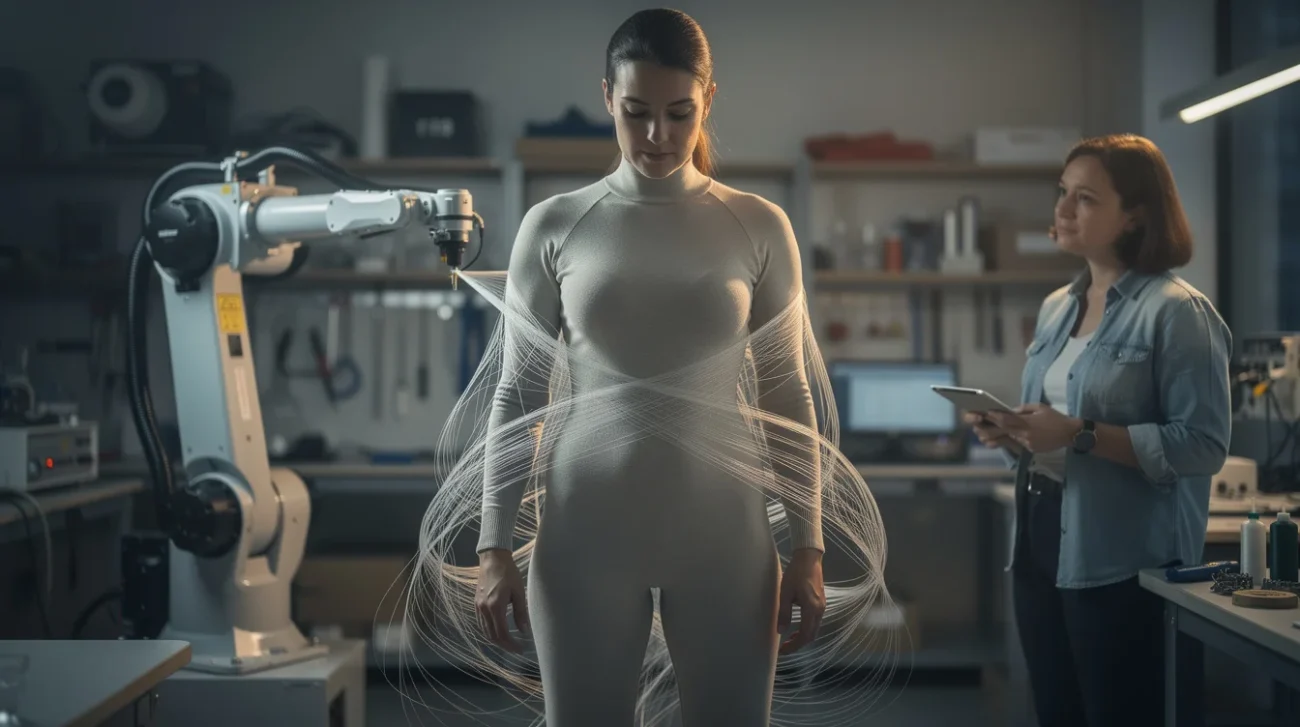
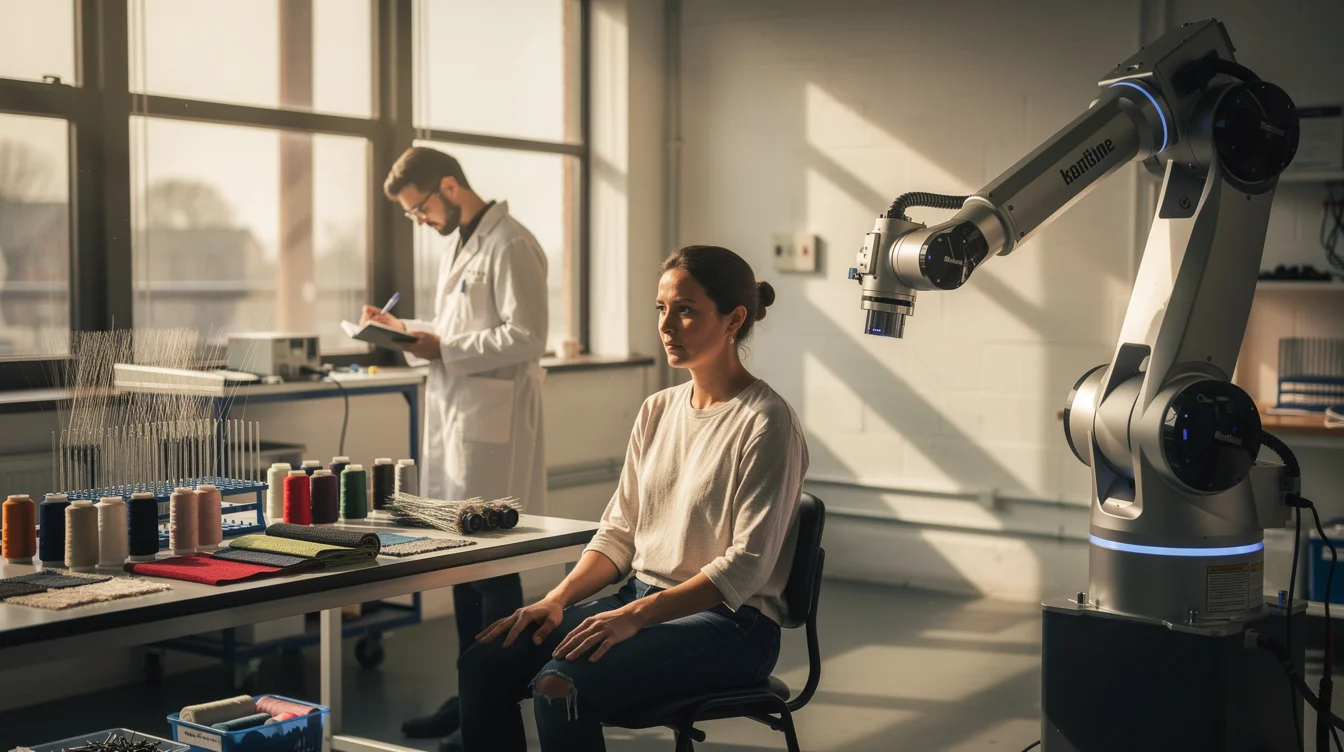
Fashion has spent decades asking bodies to accommodate clothes. MIT’s InSituWear proposes reversing that relationship: robotic motion forms clothing directly around the wearer, with bodily contours and the tension of ultrafine fibers helping determine the result. As described in designboom’s report, the body becomes more than a source of measurements. It participates in fabrication. That is a powerful challenge to standardized sizing—and a potentially uncomfortable redistribution of work. The decisive question is not simply whether the garment fits. It is what the wearer must do while that fit is being produced.
PRO: A Body Is More Informative Than a Size Label
Standard sizes compress anatomical variation into a manageable retail system. Two people with the same chest circumference can have different shoulder slopes, spinal curves and distributions of muscle. A label cannot describe those differences. As with health-monitoring systems that define what counts as normal, the categories matter as much as the measurements. Traditional tailoring addresses them through observation, fittings and alteration; much ready-to-wear asks the customer to absorb the mismatch. InSituWear’s proposition is radical because it brings the actual body into the material-forming process rather than treating it as an imperfect version of a template.
This belongs to a longer argument about who gets to determine a garment’s geometry. Issey Miyake and Dai Fujiwara’s A-POC project explored clothing emerging from continuous textile production, challenging the conventional separation between fabric and finished garment. Shima Seiki’s WHOLEGARMENT knitting technology makes complete knitted pieces without the usual assembly of separate panels. Neither is equivalent to weaving around a person, but both expose cutting and sewing as choices rather than laws.
InSituWear pushes that reconsideration toward the individual. Its reported interaction between body contours and fiber tension suggests a form shaped through physical encounter, not merely selected from a grading chart. The benefit is not “perfect fit,” which remains something to demonstrate. It is a richer starting point for fit. An asymmetric shoulder or a torso that sits between commercial sizes need not automatically become an alteration problem. It can become part of the initial geometry.
PRO: Participation Could Replace Repeated Correction
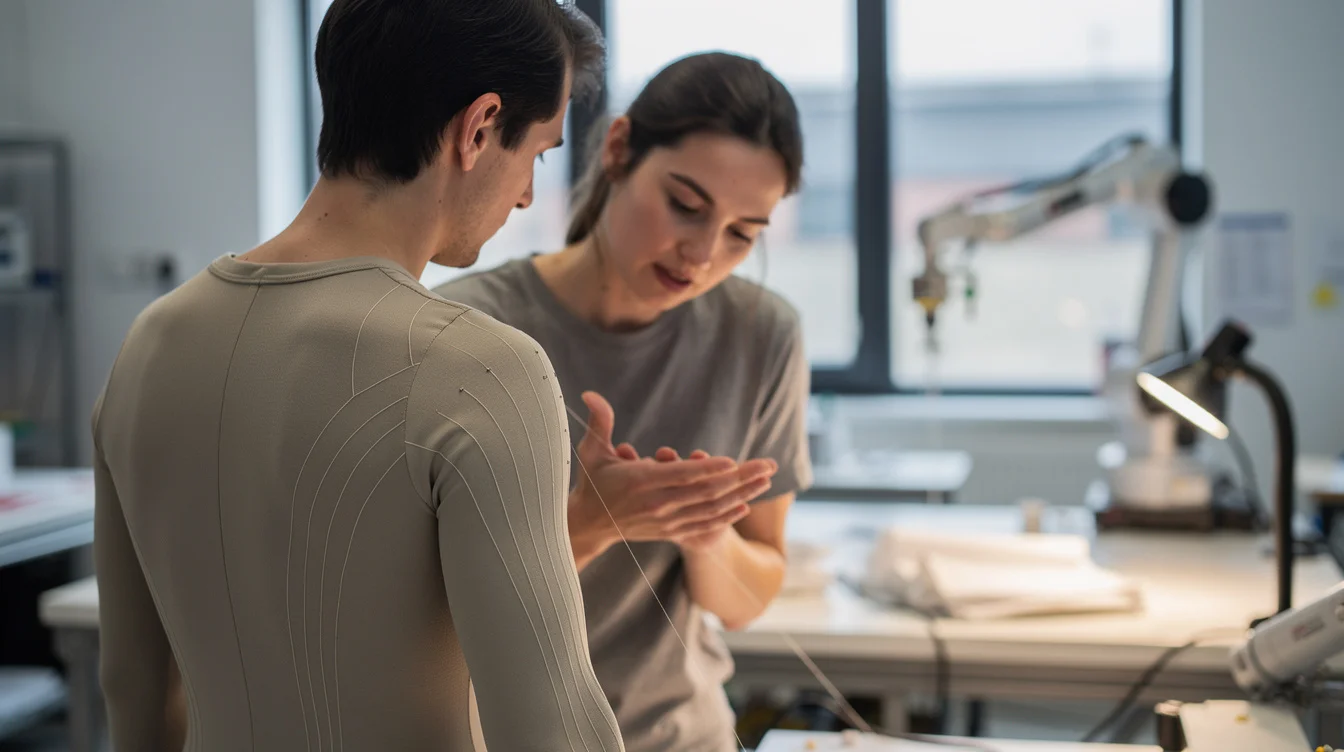
Being present during production is not automatically a burden. Bespoke clothing already demands appointments, standing for measurements and returning for adjustments. The relevant comparison is therefore not always an effortless purchase. For someone who repeatedly orders, returns and alters unsuitable clothes, a concentrated fabrication session could conceivably replace a scattered sequence of disappointments. That is a hypothesis worth testing, not a time saving established by the available source summary.
The distinction matters because convenience should be measured across the whole transaction. Travel, fitting, waiting, alteration and recovery all belong in the calculation. A longer encounter in a studio might be worthwhile if it reliably reduces later work. Equally, a visually rapid demonstration could conceal substantial preparation. The honest metric is total effort for the wearer, not the robot’s most photogenic interval.
Direct participation could also make material behavior easier to discuss. A wearer might identify an unwanted pressure point or explain that shoulder mobility matters more than a sculptural silhouette. This would require a process designed to accept feedback and, where technically possible, accommodate different fitting postures; it should not be assumed to describe InSituWear’s demonstrated capabilities.
Hussein Chalayan’s mechanically transforming garments offer a useful reference: technology becomes compelling when it changes the relationship between clothing and the person inside it, rather than merely decorating the surface. On-body fabrication could make that relationship more collaborative. Its strongest promise is not to remove the wearer from design decisions, but to bring their knowledge into them.
CONTRA: The Customer Can Become Production Infrastructure
The same physical participation can turn coercive when it stops being a choice. Conventional fabrication usually allows the wearer to leave while someone—or something—makes the garment. On-body fabrication ties at least part of production to the person’s presence. The customer may no longer be waiting for the factory. The factory may be waiting for the customer to hold a usable position.
The supplied source context does not establish session duration, required poses, permitted movement or break procedures. It would therefore be irresponsible to portray InSituWear as either an endurance test or an effortless fitting. But these unknowns are central design questions, not peripheral operational details. Ten minutes with relaxed arms and ten minutes with elevated arms are different demands. Standing, sitting and maintaining balance are not interchangeable capabilities.
Coperni’s Spring/Summer 2023 presentation, in which a Fabrican spray-on dress was formed on Bella Hadid, provides a revealing comparison—not a technical equivalent. Spray-on fabric is not robotic weaving. Yet the runway image made a production dependency unmistakable: a person’s physical presence and positioning were part of the event. Spectacle can make that participation look frictionless while telling viewers little about how the process would accommodate other bodies.
Eliminating size categories does not automatically eliminate exclusion. A system might welcome unusual proportions while disadvantaging people with chronic pain, tremor, fatigue or limited standing tolerance. If anatomical difference is accommodated but variable endurance is not, standardization has merely moved from garment dimensions to bodily behavior.
CONTRA: A Garment Can Fit a Pose and Fail a Life
A body is not a mannequin with better measurements. It expands with breathing, changes shape when seated and redistributes volume when an arm reaches forward. Fabric that closely follows a standing torso may behave very differently when its wearer cycles, bends or pushes a wheelchair. The reported role of fiber tension makes this distinction especially important: matching a contour is not the same as delivering comfortable pressure, useful stretch or sufficient ease.
Madeleine Vionnet’s bias-cut work is an instructive counterpoint. Its significance lies partly in how fabric drapes and responds to movement, rather than simply reproducing a static outline. Likewise, Miyake’s Pleats Please demonstrates that dimensional adaptability can be designed into the textile itself. Neither example invalidates body-specific fabrication. Both challenge the assumption that closer geometric correspondence necessarily produces better clothing.
Evaluation should therefore extend beyond the reveal. The same gap between persuasive images and usable design appears in AI-generated interiors: a convincing visual is not proof of practical performance. Can the wearer sit comfortably, reach a shelf and put the garment on again without assistance? Does its behavior remain acceptable after wear and care? During fabrication, can the person request a pause, change position or leave safely? These are proposed tests, not documented shortcomings of InSituWear.
The burden of proof belongs with the production system. It should disclose the participation it requires and demonstrate what happens when a wearer cannot sustain it. A convincing successor to standard sizing must accommodate bodies in time, not merely bodies in space. Otherwise, the industry trades one rigid template for another: no longer a size chart, but a choreography the customer must perform.
FAQ
What is MIT’s InSituWear?
InSituWear is a research approach to making clothing directly around the human body through robotic motion. According to the supplied designboom context, the wearer’s contours and the tension of ultrafine fibers help determine the garment’s final form.
How is on-body fabrication different from conventional custom fitting?
Conventional custom fitting generally uses measurements and fitting sessions to inform construction performed away from the wearer. On-body fabrication makes the person’s physical presence part of the forming process itself, potentially reducing the distance between anatomy and material production.
How long must a wearer stay still?
The supplied source summary does not specify fabrication time, required stillness or available breaks. Those details would be necessary to assess comfort and accessibility; they should not be inferred from the concept or a striking demonstration image.
Does body-specific fabrication guarantee freedom of movement?
No. A garment can follow the body’s contours without accommodating its full range of movement. Mobility depends on factors including material behavior, tension, ease and construction, and needs to be tested through everyday actions rather than judged from appearance alone.
If escaping standard sizes means becoming part of the production machinery, how much of your time and freedom of movement would you be willing to give—and who should set that limit?
Get the Mainifesto weekly — curated design debates, speculative ideas and the week's best articles every Saturday.
Editorial Perspectives
Questions and counterpoints developed by the Mainifesto editorial desk to extend the discussion.
Perspective 1
I’m for clothing that takes its shape from a person rather than asking that person to fit an industrial template. I’d give it some fitting time, but the wearer needs to control the pauses and the exit—otherwise, the promise of personalisation is just a very photogenic restraint.
Perspective 2
I’m against making the wearer part of the production rig: better fit shouldn’t mean holding a pose while the machine finishes its job. Put that ingenuity into adjustable, repairable garments that accommodate changing bodies, and show me the material and energy savings before calling this progress.
Perspective 3
Whose time does the system assume is free, and whose body can comfortably stay still? The wearer should set the limit within independently tested safety rules, and the service should offer another route to a good fit—not reserve it for people who can tolerate the process.