
A Shoe That Grows Still Has to Fit Today
A Shoe That Grows Still Has to Fit Today
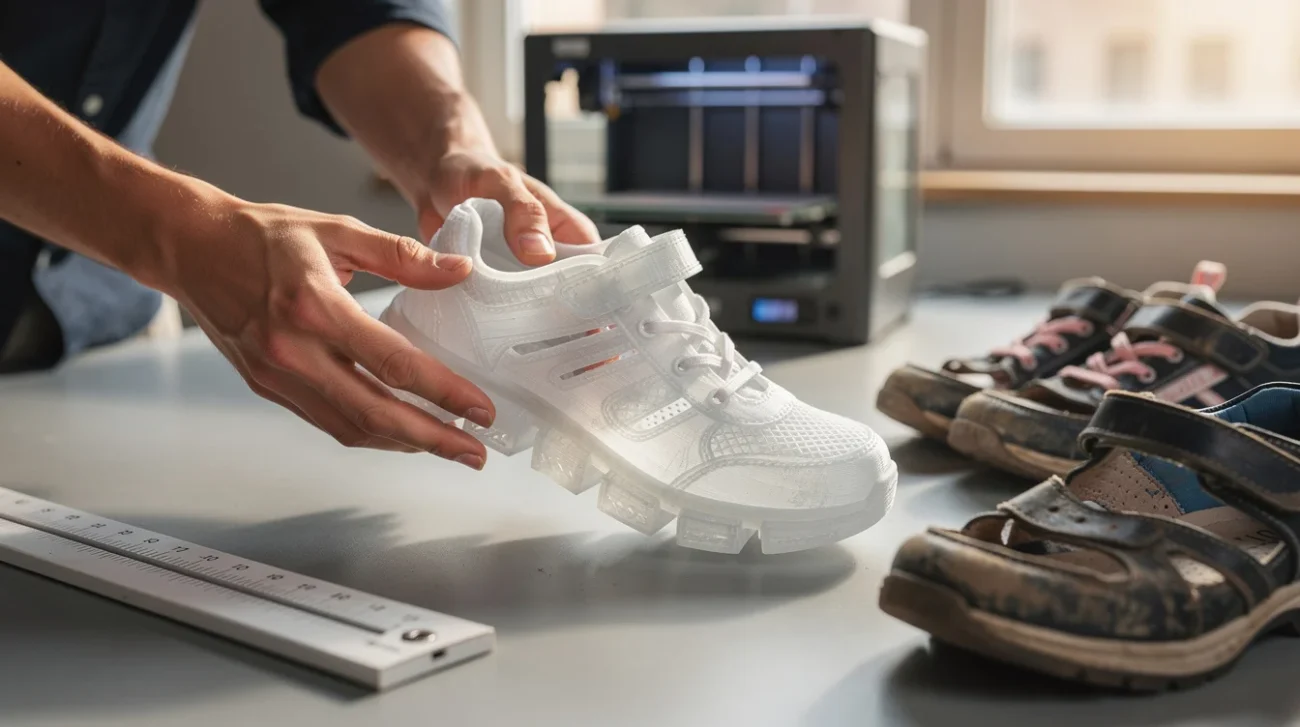
Children outgrow shoes with a speed that makes conventional product longevity look absurd. A perfectly serviceable sole can become useless because the foot above it has changed. Daniel Winter’s Fits attacks that mismatch: according to designboom, the mono-material, 3D-printed shoe uses 75A flexible filament and articulating perimeter segments to accommodate five children’s sizes. The design also adapts to adult foot shapes across a three-size range.
That is a compelling proposition, not yet a verdict. An expandable children’s shoe must do more than become longer. It must remain appropriate for the foot wearing it, through movement, changing proportions and accumulated wear. The design deserves a serious hearing precisely because its promise demands more than applause for the mechanism.
PRO: Growth Is a Design Problem, Not a Shopping Schedule
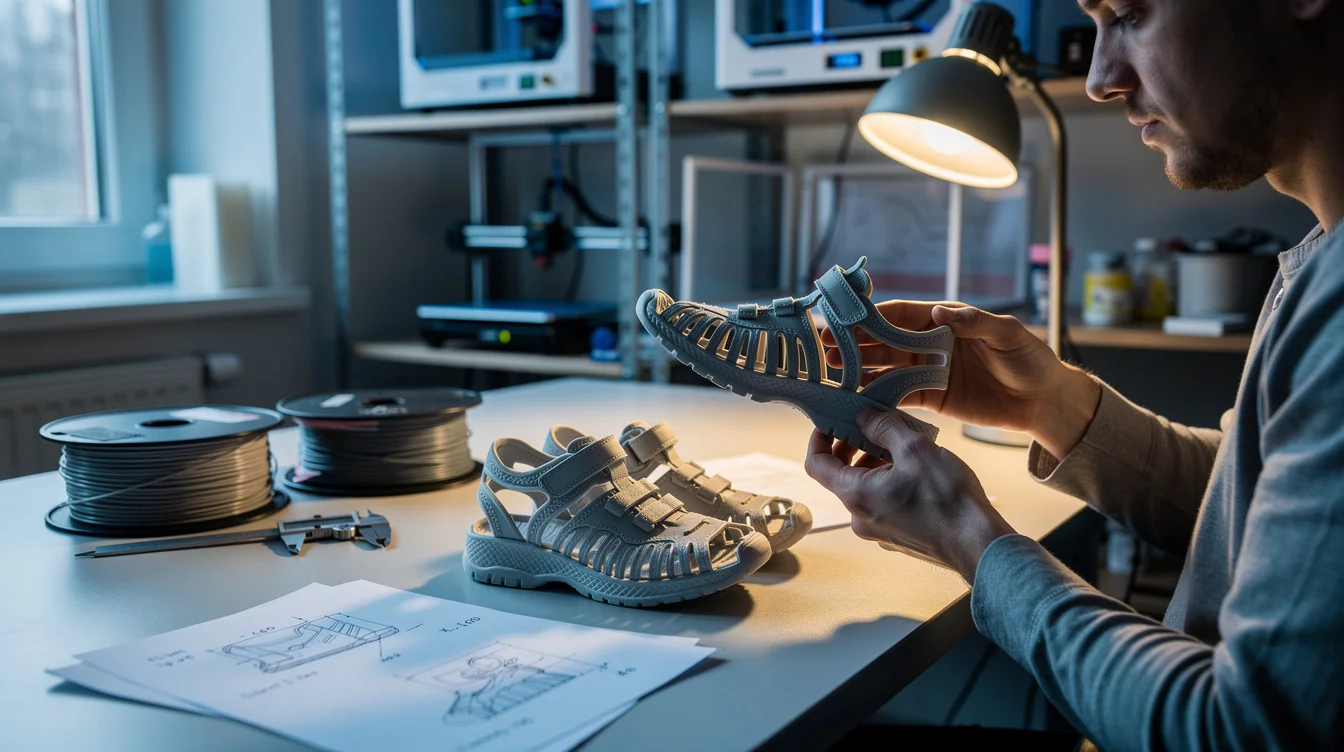
Fits challenges an assumption embedded in the footwear business: when the body changes, the product must be replaced. Winter instead makes dimensional change part of the object’s architecture. The articulating perimeter is not merely a visual signature; it locates adaptability within the shoe itself. That shifts the design brief from making another attractive fixed-size product to managing a relationship between body and object over time.
There is useful precedent in The Shoe That Grows, developed by Kenton Lee and the organisation Because International. Its adjustable sandal treats growth accommodation as a practical response to limited access to replacement footwear. Winter’s proposition differs in fabrication and form, but the comparison matters: expansion is valuable when it extends useful service, not simply when it produces an impressive transformation.
The strongest environmental argument is therefore conditional but substantial. If one pair genuinely replaces several successive pairs, remains comfortable and survives the resulting use, it could reduce manufacturing and purchasing associated with growth. It might also spare families the familiar gamble of buying oversized shoes to postpone another expense. A shoe that adjusts appropriately today would be a better proposition than asking a child to grow into yesterday’s purchase. That is an everyday benefit, not a speculative luxury.
PRO: Material Simplicity Makes the Question More Interesting
Conventional footwear often combines foams, rubber, textiles, adhesives and reinforcements. Those combinations can deliver excellent performance while making separation at end of life difficult. Fits proposes a different starting point: one material, shaped through additive manufacturing. Material simplicity does not guarantee sustainability, but it removes some of the complexity that designers otherwise attempt to solve after manufacture.
Adidas’s Futurecraft.Loop programme offers a relevant comparison because it explored single-material footwear alongside a return-and-remake system. Its lesson is not that a mono-material shoe automatically closes a loop. It is that material selection and recovery infrastructure must be designed together. For Fits, the filament’s identity, collection route and suitability for reprocessing would matter as much as the claim of material unity. The reported 75A designation describes hardness; it does not, by itself, establish polymer chemistry or recyclability.
Additive manufacturing also gives Winter a promising design vocabulary. A single material can behave differently through changes in wall thickness, geometry and internal structure. In principle, a designer could tune flexibility without adding a second substance. That possibility deserves investigation, rather than dismissal because traditional shoes use multiple components. The pro case is strong: Fits puts adaptation, material economy and manufacturing logic into the same design problem. Even an unsuccessful prototype could expose how unimaginatively much children’s footwear currently handles growth.
CONTRA: Five Sizes Are Not Five Verified Fits
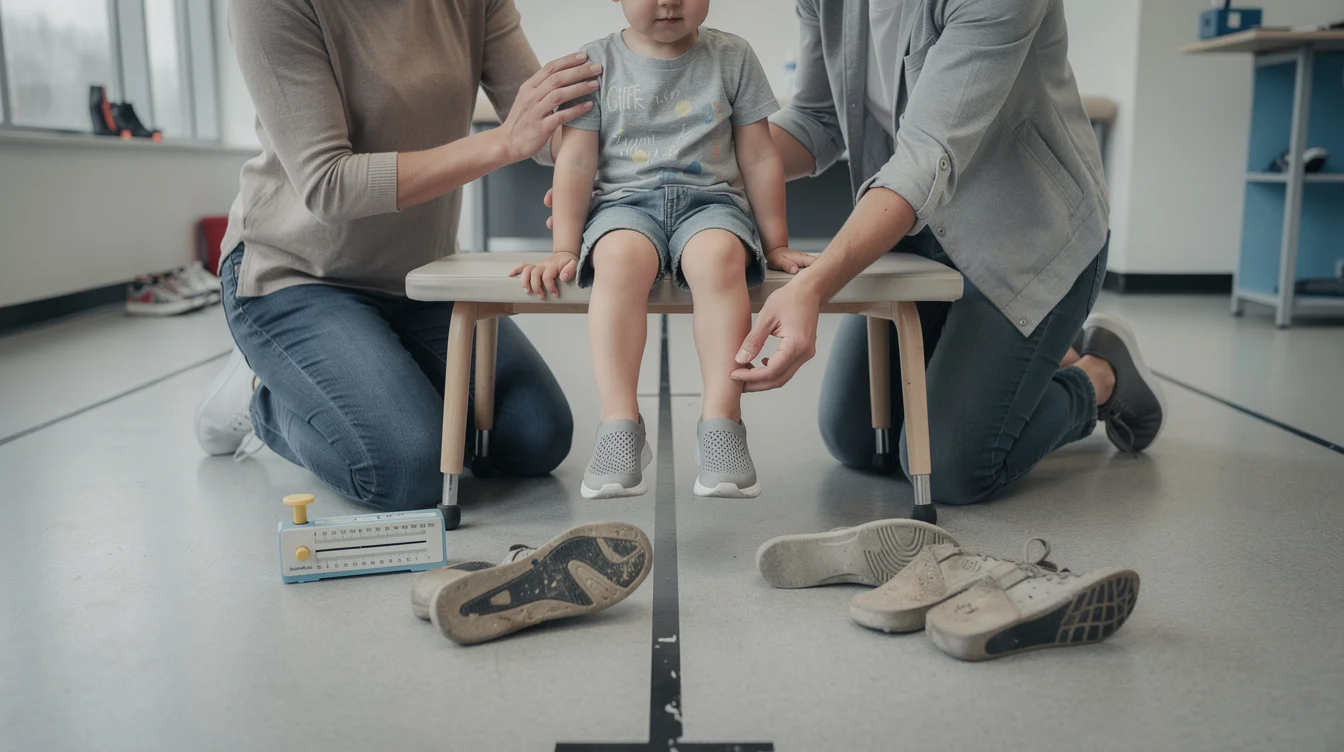
The opposing case begins where the demonstration ends. A shoe can expand through a stated size range while providing an appropriate fit at only some points within it. Children’s feet do not change as uniform scaled copies: length, width, instep volume and heel proportions can differ between wearers and change over time. Adult shape accommodation is an interesting parallel capability, but it cannot establish suitability for growing children. As with 3D-printed personalised medicine, manufacturing adaptability is not a substitute for validation.
Imagine two children with similar foot lengths: one has a narrow heel and fuller forefoot; the other has a broader heel and lower-volume midfoot. An expanding perimeter might accommodate both outlines while retaining their feet very differently. During running or a sudden turn, excessive movement inside the shoe could become apparent even if a standing photograph looks convincing. Conversely, a configuration that holds the heel securely might create unwanted pressure elsewhere.
Support here should not become a vague demand for maximum stiffness or an unproven claim about arch correction. It means evaluating retention, freedom of movement, pressure and stability for the intended activity. Does the shoe bend comfortably as the foot rolls forward? Does expansion alter the relationship between its flexing regions and the wearer’s joints? Is there adequate toe space without uncontrolled sliding? A size range describes adjustment capacity. It does not certify the quality of the fit between its endpoints.
CONTRA: The Mechanism Must Outlast Its Demonstration
Growth accommodation only avoids replacement if wear does not force replacement first. A pair spanning several sizes may face much more cumulative use than a conventional pair worn for one growth interval. The outsole must retain useful traction; repeated flexing must not undermine the perimeter; and the material must resist permanent deformation that changes retention. Articulating regions deserve particular scrutiny because their intended movement makes cyclic loading an obvious test priority, not because failure has already been demonstrated.
The evidence package should combine laboratory testing with supervised, longitudinal wear trials. SATRA’s footwear-testing work provides a useful reference for the kinds of questions involved: flex endurance, abrasion and slip resistance belong alongside fit assessment, not beneath it. Testing should examine fresh and worn specimens at multiple expansion states, including intermediate settings. Wet playground surfaces, grit, repeated cleaning and ordinary scuffing are more revealing than another immaculate studio image.
Real-world trials should include varied foot shapes and follow children through actual growth, with consent and appropriate oversight. Compare Fits against correctly fitted conventional shoes, record adjustment frequency, discomfort, pressure concerns, gait observations and reasons for stopping use. Report failures and individual variation, not just an average satisfaction score. Only then should an environmental comparison count verified replacement avoidance, production impacts and end-of-life outcomes. The source summary establishes an ingenious proposal; it does not supply this validation. The burden of proof is proportionate to the ambition: replace successive pairs without making the wearer absorb the compromise.
FAQ: What Would Make an Expandable Shoe Credible?
How does Daniel Winter’s Fits shoe expand? The designboom source describes a mono-material, 3D-printed shoe made from 75A flexible filament. Articulating perimeter segments allow expansion across five children’s sizes, with adult foot-shape accommodation across a three-size range. Those reported ranges describe the design’s capacity, not independently demonstrated comfort throughout it.
Does accommodating five sizes guarantee an appropriate fit? No. Length is only one fit variable. Heel retention, forefoot width, instep volume, toe clearance and behaviour during movement also matter. Each expansion state needs assessment across different feet, rather than assuming that satisfactory fit at the smallest and largest settings validates everything between them.
Is a mono-material shoe necessarily recyclable? No. A single material can simplify recovery, but practical recyclability depends on the specific polymer, contamination, processing options and an accessible collection system. The 75A hardness designation alone does not answer those questions. Recyclability should be demonstrated through a real route, not inferred from material simplicity.
What evidence would justify choosing it over successive pairs? Independent durability testing and longitudinal wear trials should show appropriate fit, acceptable comfort, retention and traction throughout the claimed range. A comparative environmental assessment should then establish whether longer service actually avoids purchases and reduces impacts. Neither an expansion video nor a single successful fitting would be enough.
If one shoe could follow a child through five sizes, what evidence would you demand before trusting it with the first?
Watch the Mainifesto Short
Get the Mainifesto weekly — curated design debates, speculative ideas and the week's best articles every Saturday.
Editorial Perspectives
Questions and counterpoints developed by the Mainifesto editorial desk to extend the discussion.
Perspective 1
I’m for it: fewer replacements could mean less expense and one less recurring headache for parents. Before buying, I’d want wear trials across all five sizes showing kids can run comfortably, parents can adjust it without a tutorial, and the savings survive actual playground use.
Perspective 2
I wouldn’t back a five-size shoe on material savings alone—growing feet need more than extra length, and an expansion mechanism adds another potential failure point. Show me independent fit testing and lifecycle results against conventional shoes; until then, I’d rather back repairable footwear than ask one structure to do five jobs.
Perspective 3
There is something familiar here: the modernist promise that a clever system can accommodate the unruly body. Five sizes is an elegant specification, but I’d want independent evidence of secure fit and support at each setting; the child inhabits the shoe, not the diagram.