
Five Staircase Facades That Test Who Gets to Make an Entrance
A monumental staircase makes a promise before anyone reaches the door: this building matters, and entering it should feel consequential. But who gets to inhabit that promise? For someone using a wheelchair, walking with pain or pushing a buggy, the same architectural flourish can announce a division between the celebrated visitor and the visitor who must find another way. Accessibility is not simply a question of whether an alternative entrance exists; it is a question of what that alternative makes people surrender.
Dezeen’s roundup of staircase facades, framed around a Japanese wedding chapel, an Indian university and a transformed Albanian monument, provides the starting point for this wider comparison. The five projects below are followed by a sixth item: a civic test. These are readings of architectural arrangements, not on-site accessibility audits; where a continuous accessible route is unverified, that uncertainty matters rather than proving exclusion.
When the ascent becomes the event
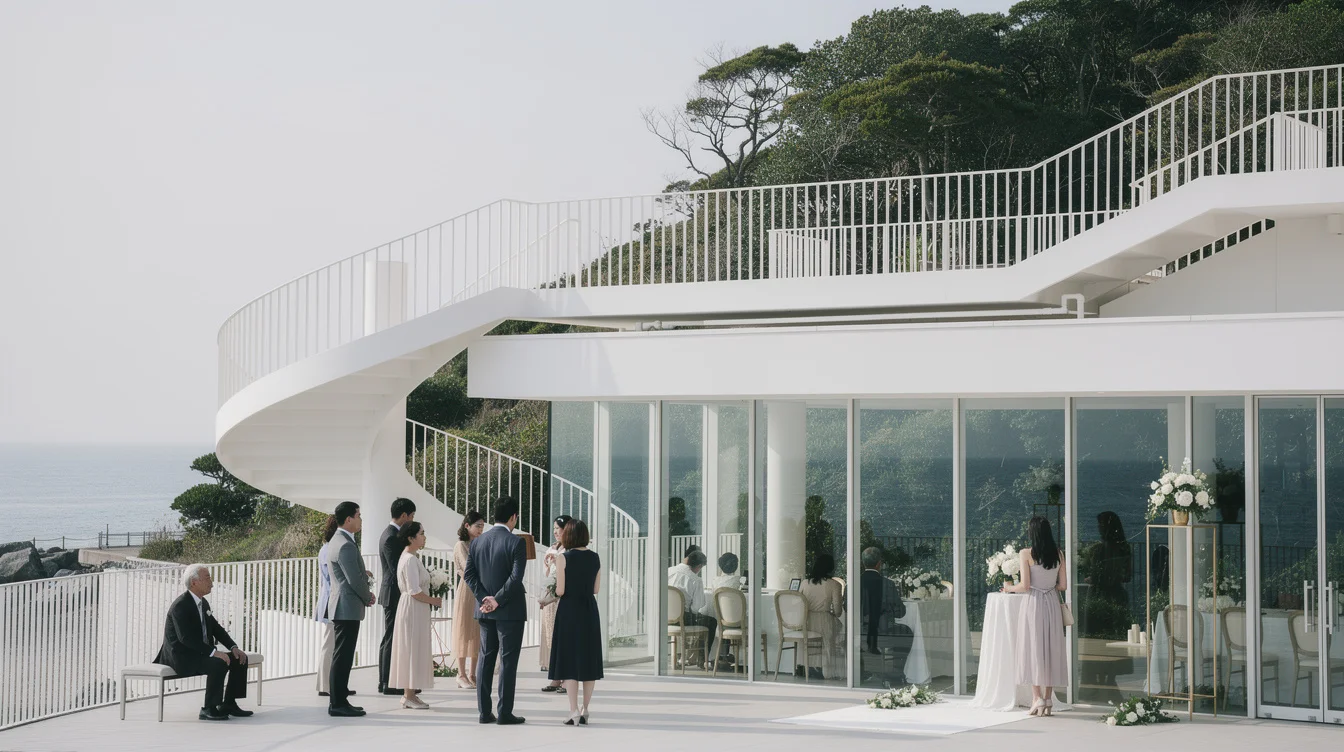
1. Ribbon Chapel, Onomichi: whose ceremony reaches the summit?Hiroshi Nakamura & NAP’s Ribbon Chapel in Japan turns two intertwined exterior staircases into both structure and wedding narrative, with separate paths meeting above the glazed chapel to make ascent an unusually literal image of partnership. Its ground-level ceremonial space offers a fundamentally different arrival from the elevated ribbon walk, and although this is a wedding venue rather than a freely accessible civic institution, that distinction sharpens the question: reaching the service is not necessarily equivalent to participating in the building’s defining ritual. The fair criticism is not an unsupported claim that the chapel excludes wheelchair users altogether, but that its most expressive architectural experience is organised around climbing, making any assessment of inclusion depend on whether a non-stair route offers comparable participation, views and ceremonial prominence—not merely admission below. As with the question of whether wildlife architecture owes visitors a better view, the broader issue is whose experience a building should prioritise.
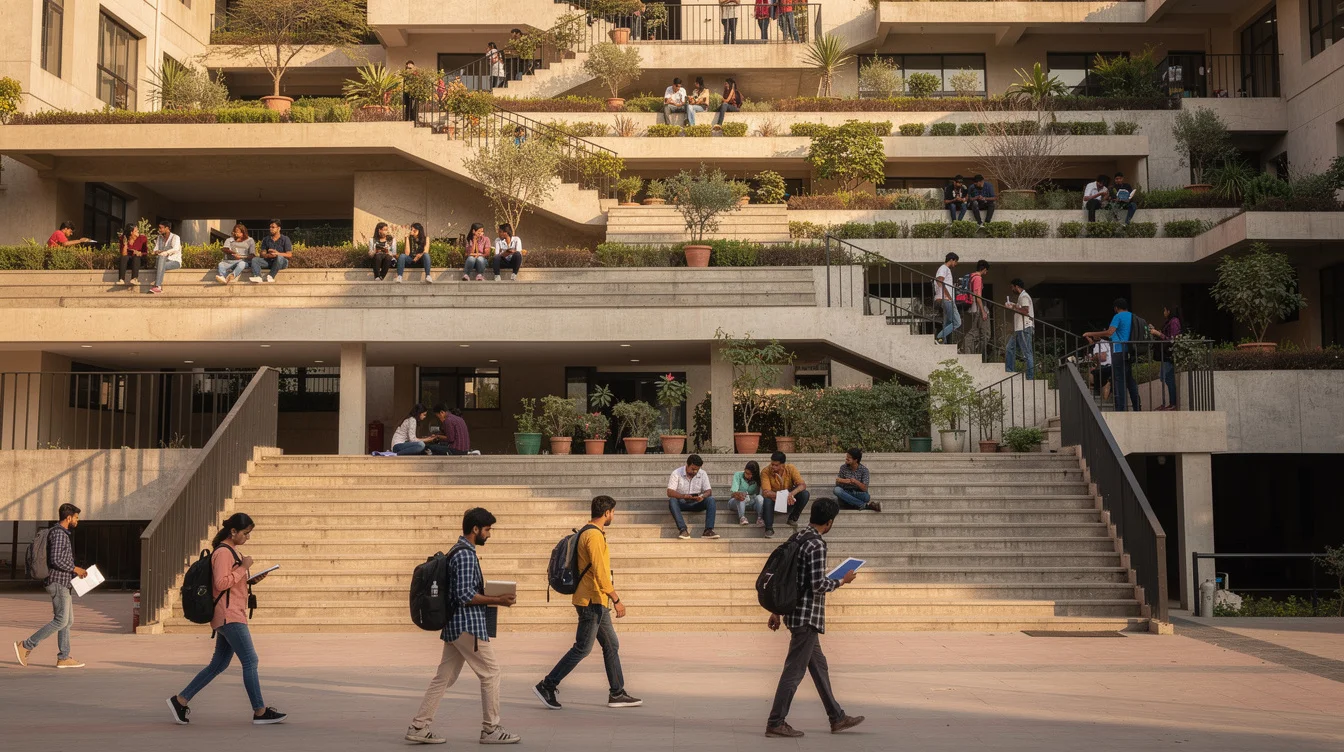
2. Prestige University, Indore: a campus landscape needs more than an internal lift.At Prestige University in India, Sanjay Puri Architects turn a large academic building into a stepped landscape of planted terraces, distributing potential places to meet and pause across a facade that also reads as an inhabited roof. This is a persuasive alternative to the sealed institutional block, but a lift serving classrooms would answer only part of the accessibility question: the social destinations on those terraces also need a continuous, usable step-free network, with connections that remain available during the same hours as the stairs. Without verified route information, the responsible verdict is conditional rather than accusatory: the terraces become genuinely shared campus infrastructure only when students who cannot climb can reach comparable gathering places with their friends, rather than watching university life accumulate on another level.
Public symbolism meets the alternative route
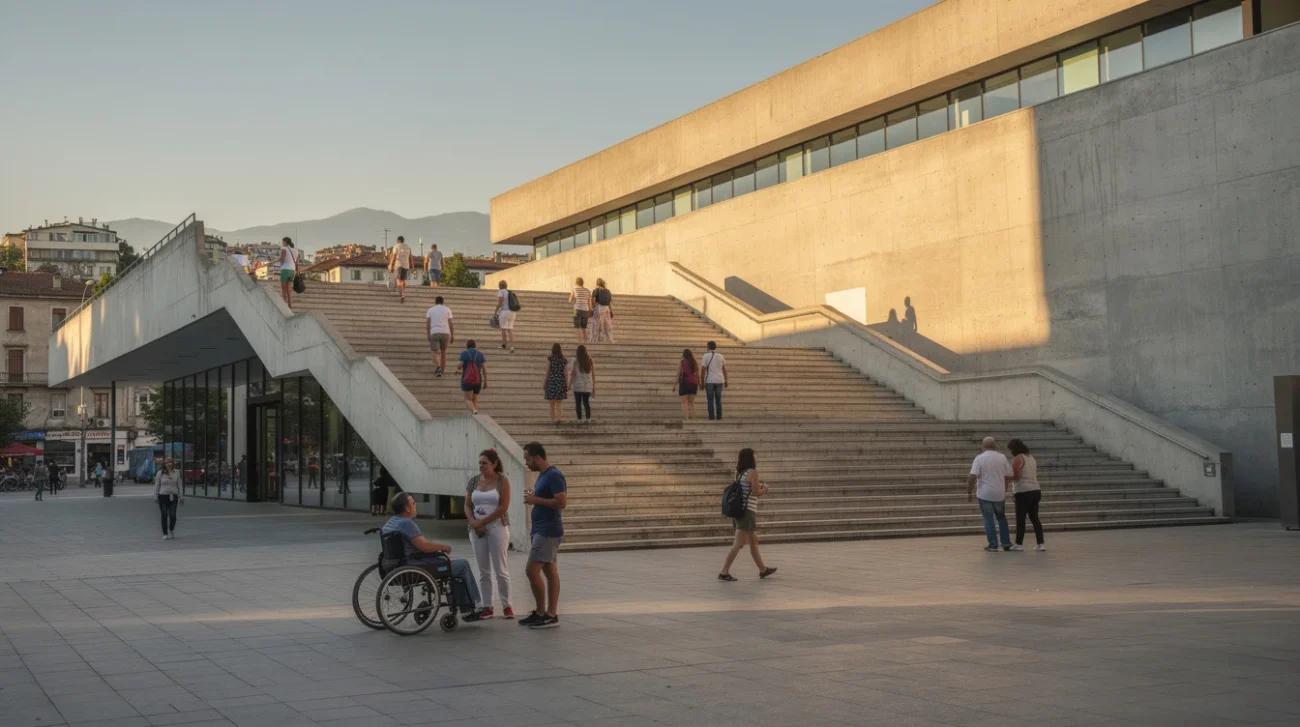
3. Pyramid of Tirana: democratisation must include the journey upward.MVRDV’s transformation of Albania’s Pyramid of Tirana, originally built as a museum honouring dictator Enver Hoxha, recasts a politically burdened monument as a cultural and educational destination, with exterior stairs inviting people onto surfaces once associated with informal climbing and sliding. Crucially, the project also includes lift access to the top, making this a stronger proposition than a spectacular public staircase accompanied by a vague assurance that accessible facilities exist somewhere inside. Yet the inclusion of a lift begins rather than settles the argument: its visibility, independent operation, opening hours and relationship to companions’ routes determine whether the summit is genuinely shared, because an architectural invitation becomes unequal when one visitor can wander upward spontaneously while another must locate assistance or negotiate an operational exception.
4. James-Simon-Galerie, Berlin: the grand entrance and the ground-level alternative.David Chipperfield Architects’ James-Simon-Galerie gives Berlin’s Museum Island an entrance building whose broad exterior staircase and slender colonnade turn museum-going into a composed public procession, linking contemporary visitor infrastructure to the monumental language of the surrounding institutions. A ground-level accessible entrance and lift provide an alternative to the grand stair, but their existence does not erase the representational difference between ascending in full view of the city and entering at a different level before reconnecting with the principal visitor spaces. The critical test is therefore specific rather than theatrical: can a first-time visitor identify the step-free route immediately, use it without special permission and arrive with their group at an equally legible welcome, or does the architecture reserve its most confident gesture of belonging for people taking the steps?
From a usable building to an equal welcome
5. Dokk1, Aarhus: several routes can challenge a single ceremonial front.Schmidt Hammer Lassen’s Dokk1 in Denmark places a library and citizen-service functions within a substantial waterfront public building, where broad external stairs participate in the transition between the harbour landscape and the elevated spaces of civic life. Its lifts and alternative circulation make the relevant comparison less about a single grand front door than about how a network of arrivals works together: a visitor approaching from the city, waterfront or transport connections should encounter an intelligible route, not have to reverse-engineer the building from accessibility signage. Dokk1 is useful here because its civic programme raises the stakes beyond architectural tourism; someone borrowing a book or accessing a public service deserves the same independence and ordinary welcome as everyone else, whether their route involves a staircase, a lift or a level threshold. The related debate over whether a welcoming police station can change institutional power likewise asks us to distinguish an inviting appearance from the conditions people actually encounter.
6. The civic benchmark: equivalent dignity does not require identical movement.These five projects should not be reduced to a simplistic contest between beautiful stairs and virtuous ramps, because stairs can offer direct circulation, places to sit and collective experiences that a generous public building ought to retain. The more demanding benchmark is route parity: step-free access should be readily visible from the principal approach, independently usable during equivalent opening hours, reasonably direct, socially connected to other arrivals and capable of reaching the experiences the architecture presents as important. Architects should consequently draw and publish the accessible arrival with the same care as the ceremonial section, while clients should test it through lived-experience consultation and operational planning, because a discreet lift that requires staff intervention is not the civic equivalent of a staircase whose invitation is permanent, obvious and unconditional.
FAQ: what makes an entrance genuinely inclusive?
Does an inclusive facade have to eliminate stairs?
No. Stairs can be useful circulation and valuable public space. The problem arises when the stair route monopolises the obvious entrance, the shared social journey or a defining destination, while step-free access is harder to find or less reliably available.
What is the difference between accessible entry and equivalent dignity?
Accessible entry concerns whether someone can get into a building; equivalent dignity also concerns how they arrive. Visibility, independence, reasonable travel distance and the ability to remain with companions all matter, even where two routes meet the applicable technical requirements.
Can a lift provide an equivalent alternative to a monumental staircase?
Yes, provided its placement and operation support ordinary, independent use. A clearly identifiable lift connecting the same meaningful destinations can work well; a concealed, unreliable or staff-controlled lift creates a materially different experience, especially when the staircase remains freely available.
How should architects assess a staircase-led facade before construction?
Map complete journeys from pavement and transport stops to entrances, terraces and public rooms, then review them with people with varied access needs. Compare wayfinding, gradients, rest opportunities, opening hours and contingency arrangements rather than treating a compliant doorway as the end of the exercise.
If a building gives everyone access but reserves its most memorable arrival for those who can climb, has it genuinely welcomed the public?
Get the Mainifesto weekly — curated design debates, speculative ideas and the week's best articles every Saturday.
Editorial Perspectives
Questions and counterpoints developed by the Mainifesto editorial desk to extend the discussion.
Perspective 1
A side entrance may satisfy access requirements, but it’s a poor result if some visitors arrive through the building’s best space and others beside the bins. On a new build, make a shared arrival part of the brief before the staircase eats the budget; retrofitting that welcome is usually harder and dearer.
Perspective 2
If a guest has to hunt for a lift while their friends take the grand stairs, we’ve failed before check-in. I’d ask the design team to walk both routes with us: if one gets the view and the other gets a service corridor, we’re paying to deliver two different standards of hospitality.