
When a Monument Becomes a Military Base
A triumphal arch already speaks the language of power. Give it drones and snipers, and that language becomes an operational brief. The question is no longer simply whose victory the structure celebrates, but what its occupants are authorized to do—and what everyone outside must surrender for them to do it.
According to Dezeen’s report of 21 September 2026, US president Donald Trump announced that Washington DC’s proposed 250-foot-high triumphal arch, designed by Atlanta-based Harrison Design, would become a military base equipped with drones and snipers. The report attributes the announcement to a Truth Social post. That is evidence of a declared intention, not proof of an approved military program, a resolved design or a functioning installation. The distinction matters: architecture should interrogate this proposal without pretending its technical details are settled.
Yet the announcement alone changes the debate. A monument ostensibly representing a nation is being recast as an instrument capable of exercising force. This is not an additional amenity. It is a different building type attempting to retain the legitimacy of the first.
The architectural brief cannot remain ceremonial
A ceremonial arch can organize a vista, frame a procession and offer a setting for collective memory. An operational military facility must accommodate authorized personnel, controlled circulation, communications, servicing and restricted activities. Combining them would require more than finding spare rooms inside a monumental silhouette. It would force the architect to decide which program governs when public use and military requirements conflict.
If drones are genuinely part of the program, the brief would need to establish their intended role and the associated requirements for handling, storage, power, maintenance and safe operation. Those requirements cannot be inferred from a presidential post. Nor should an architectural rendering conceal their absence. Sniper positions would raise a separate set of questions about restricted occupation, oversight and the relationship between elevated space and the public below.
Compare this with Johan Otto von Spreckelsen’s Grande Arche at La Défense, completed in 1989 with Paul Andreu’s involvement. It demonstrates that an arch can contain substantial occupied space rather than function as pure sculpture. But inhabitable volume does not make every program interchangeable. An office inside a national symbol and a weapons-related function inside one establish fundamentally different relationships with the city.
The real redesign would happen at ground level
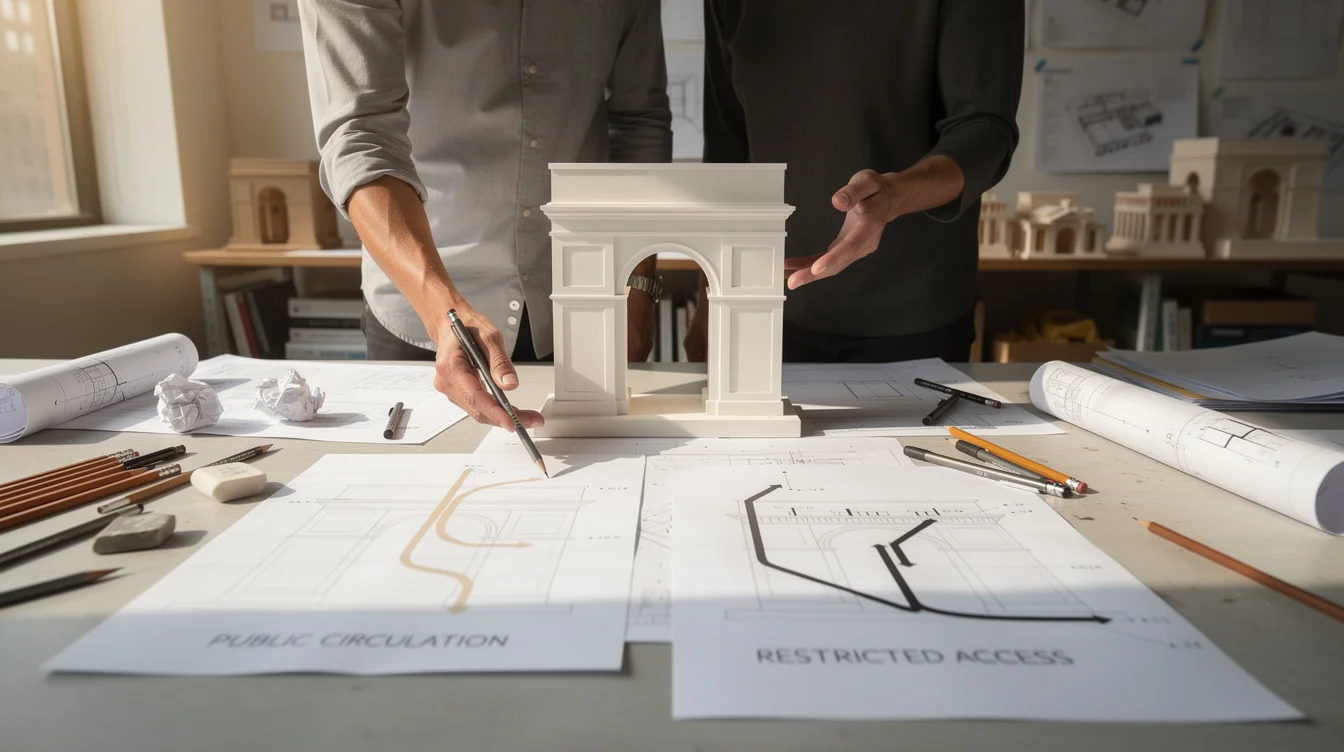
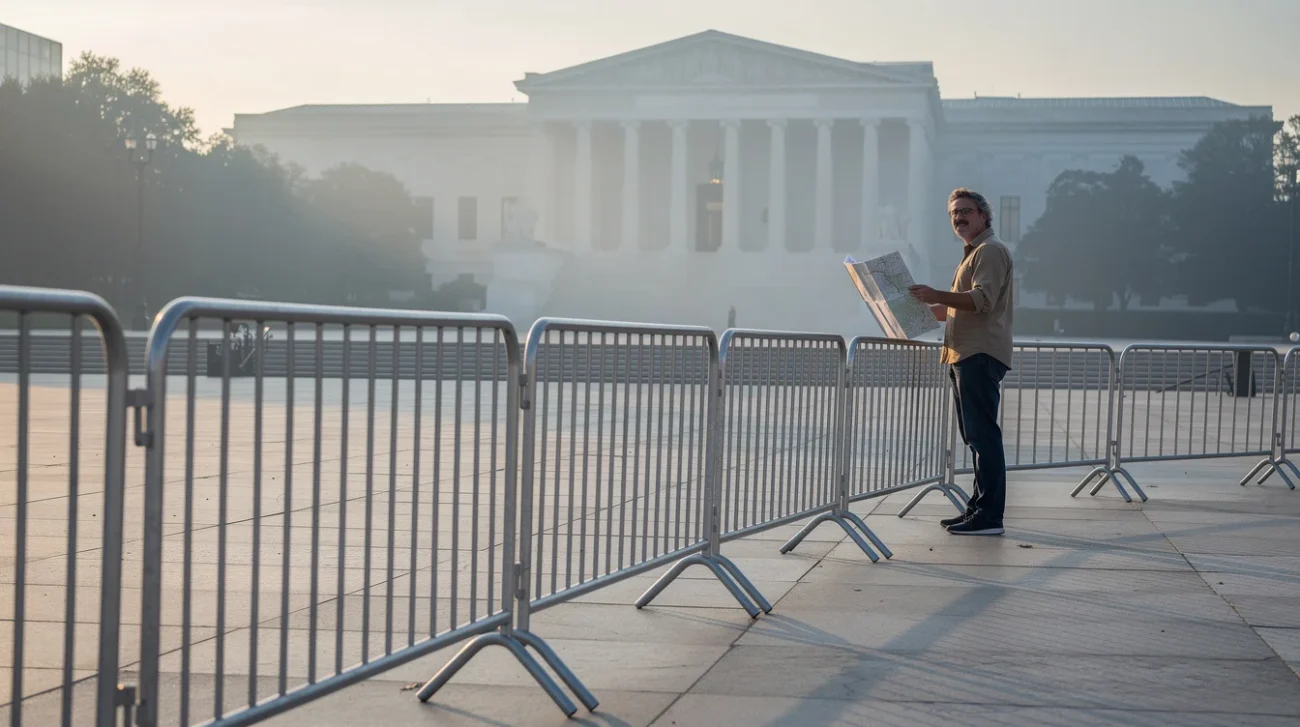
The most consequential architectural changes might be the least photogenic: barriers, checkpoints, diverted paths and areas where lingering becomes suspect. A proposal of this kind should therefore be judged not only by its elevation but by its access plan. Who can approach? Who can pass through? Can people assemble without advance permission? What happens when an operational requirement interrupts an ordinary visit?
Washington already offers a cautionary example in Pennsylvania Avenue’s closure to vehicle traffic in front of the White House in 1995. Security decisions can remake civic circulation without substantially altering a building’s famous image. Subsequent landscape and public-realm design may improve the experience, but it cannot erase the underlying transfer of authority over movement. This is also a question of who gets to change a city’s shared heritage, and whose everyday use counts in that decision.
A military designation would not automatically mean every surrounding space must close. Its exact consequences would depend on the eventual mission, rules and boundaries. That uncertainty is precisely why access cannot be deferred until after the monument’s form has been celebrated. Designers should demand published distinctions between unrestricted public space, screened visitor space and operational territory. A plaza is not meaningfully public just because civilians appear in its rendering. Access needs durable rules, not the aesthetic suggestion of welcome.
A national symbol becomes a command relationship
Triumphal arches have never been politically innocent. The Arch of Titus in Rome represents imperial conquest; the Arc de Triomphe in Paris binds military commemoration to national identity. Their symbolism already asks difficult questions about whose suffering becomes another society’s glory. But representing military victory is not the same thing as providing a contemporary platform for military activity.
That distinction separates remembrance from readiness. A visitor can criticize an imperial monument, reinterpret it or gather near it in protest. When the monument also houses an active security function, the encounter is shaped by operational authority as well as historical meaning. The building no longer only tells a story about power. It participates in power’s present exercise.
Maya Lin’s Vietnam Veterans Memorial offers a radically different architectural proposition. Its descending walls and inscribed names turn attention toward individual loss rather than monumental domination. It is not politically neutral, but its central encounter is between the visitor and the record of the dead. The proposed Washington arch would point elsewhere if its announced military role were realized: toward institutional capability. A nation represented through permanent readiness to deploy force is being offered a narrow portrait of itself.
Do not confuse protection with a military mission
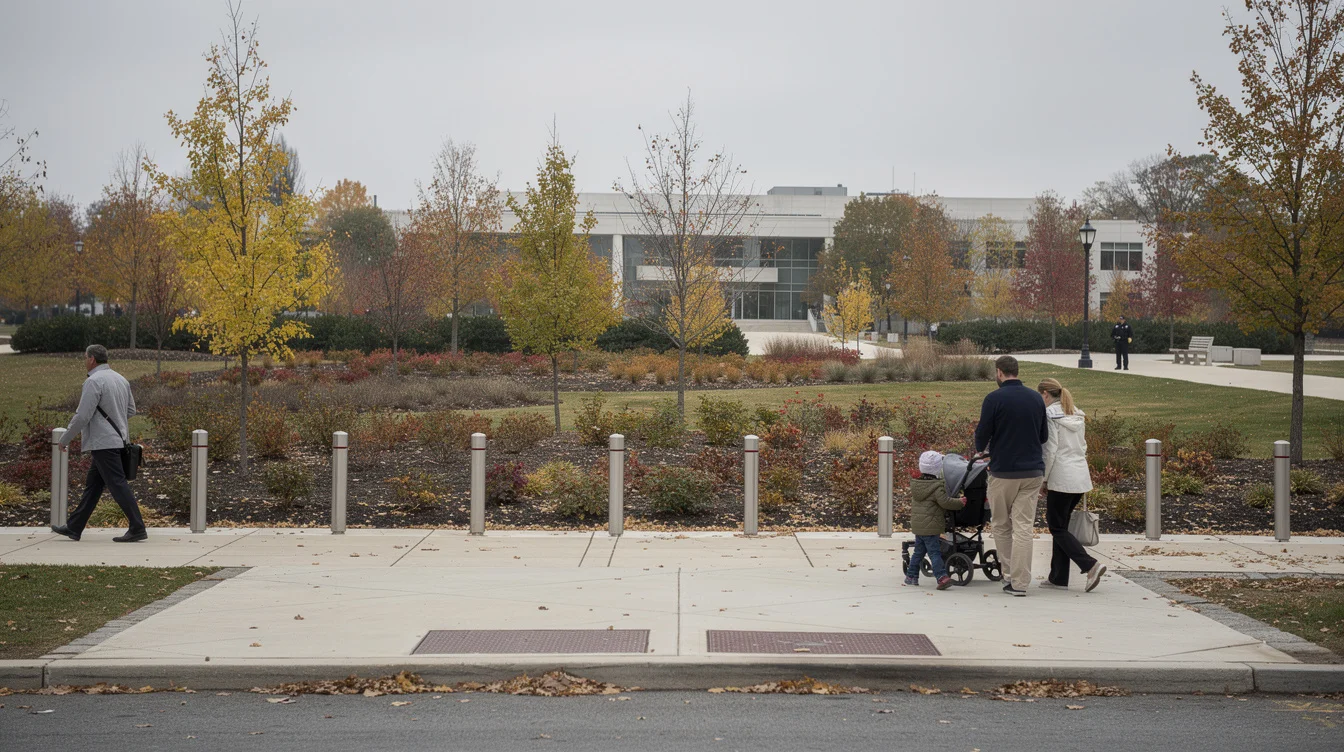
Important public buildings need protection. The existence of guards, screening or protective infrastructure does not, by itself, make a museum or memorial a military base. Treating every security measure as equivalent would weaken the argument. The decisive issue is whether force protects the civic program or becomes a principal program in its own right.
Foster + Partners’ reconstruction of the Reichstag in Berlin illustrates the architectural ambition of bringing public visitation into proximity with state power. The dome’s visitor route gives civic access a conspicuous spatial presence above the parliamentary chamber. That arrangement does not abolish screening, institutional hierarchy or restrictions. It does, however, make a proposition about the public’s place within the image of government.
Washington’s proposed arch demands an equally explicit proposition. Would visitors be guests in a civic monument with protective measures, or permitted entrants into a military installation? Would commemorations take priority, or remain conditional on operational needs? The difference must be expressed in governance as well as drawings. A transparent facade cannot make an undisclosed mission transparent, and an open archway cannot compensate for rules that make the surrounding ground inaccessible.
The missing drawing is a map of authority
Before another heroic perspective image circulates, the project needs a public account of who would own, operate and control it. Which authority would set access rules? Who would approve the military use? What would the drones do? How would changes in mission be reviewed? The supplied report does not resolve these questions, and pretending otherwise would turn architectural criticism into speculative threat illustration.
Bernard Tschumi’s Parc de la Villette in Paris provides a useful counter-reference: architecture conceived through overlapping activities and routes rather than a single frozen ceremonial image. Its lesson here is not a stylistic prescription. It is that the program—the relationships between events, occupants and movement—is architecture, not administrative paperwork appended to it. The question of who gets to program a city’s future is therefore inseparable from who can occupy and use its spaces.
Harrison Design’s proposed arch should therefore be assessed through competing occupation scenarios: a routine visit, a national ceremony, a demonstration and an operational closure. Each would reveal whose claims prevail. The issue is not whether classical architecture can accommodate contemporary technology; that is the easy question. The difficult question is whether a monument can credibly represent a public whose presence is subordinate to its military function. No quantity of national symbolism can settle that conflict on the public’s behalf.
FAQ
Has Washington’s proposed arch already become a military base?
No completed conversion is established by the supplied source. Dezeen reports Trump’s announcement of an intended military role. That should not be confused with evidence of an approved operational design, construction or deployment.
How would a military role change the architectural brief?
It would introduce requirements for restricted occupation, operational support and controlled circulation. The precise requirements would depend on the mission, equipment and responsible authorities, none of which should be guessed from a monumental exterior.
Would the public necessarily lose access?
Not necessarily, but public access could become conditional on screening, operational schedules and exclusion areas. A credible proposal would define enforceable access arrangements before presenting openness as an architectural achievement.
How is this different from a conventional war memorial?
A war memorial represents or commemorates military history. An operational installation supports present activity. Combining them changes the visitor’s relationship to the institution, even if the structure retains a familiar commemorative form.
If a national monument can serve the public only when its military operators permit it, whose nation does it actually represent?
Watch the Mainifesto Short
Get the Mainifesto weekly — curated design debates, speculative ideas and the week's best articles every Saturday.
Editorial Perspectives
Questions and counterpoints developed by the Mainifesto editorial desk to extend the discussion.
Perspective 1
Forget the arch’s silhouette for a moment: who controls the gates, the timetable and the security perimeter? If military operations can override public access, this is military infrastructure with a civic façade, whatever national story gets carved into it.
Perspective 2
I’d want to see the access agreement before calling this a public monument: opening hours, grounds for closure and who can challenge a decision. Security restrictions aren’t automatically unreasonable, but public access needs to be an enforceable commitment, not an operator’s courtesy.
Perspective 3
The triumphal arch has never been an innocent civic ornament; Rome used it to turn military conquest into public spectacle. Washington’s proposal risks reviving the imperial hierarchy rather more faithfully than its advocates might admit: the public may admire power, but only on power’s terms.
Perspective 4
Who pays to build and maintain it, and how often can people actually use the space? If the public carries the bill while military requirements dictate access, I’d call that a poor civic investment, however impressive the renderings.