
Who Gets to Program Benghazi’s Future?
Who Gets to Program Benghazi’s Future?
A city can be mapped in extraordinary detail and still be misunderstood. Its streets become lines, its households become demand, its waterfront becomes an opportunity zone. The dashboard looks increasingly complete while the question that matters remains unanswered: who gets to decide what improvement means?
The ZHA-led concept proposal for Benghazi’s Next Generation City Plan brings that question into focus. According to the ArchDaily source report, the team comprises ZHA, A&O TEC, Prior + Partners, Homa, Buro Happold, Systematica, and Fichtner. Developed for A&O TEC, the proposal combines a Vision and Spatial Strategy with a Digital Planning Hub intended to help guide the Libyan port city’s development toward 2050.
The ambition is to connect Benghazi’s identity and collective memory with an adaptable, evidence-based framework for growth. That is a serious planning task. But evidence does not select its own priorities. Someone decides which conditions become measurable problems, which futures deserve simulation, and which trade-offs the public is expected to accept.
The available source summary describes a concept, not a demonstrated system of democratic oversight. It does not establish how residents would participate or who would control the hub. That gap is not proof of exclusion. It is the issue that must be settled before digital coordination acquires institutional authority.
The Model Is Already Making an Argument
Consider a hypothetical transport decision. A model prioritizing vehicle throughput could recommend widening a road. A model prioritizing safe walking routes, affordable access, and continuity for street-level businesses might favor crossings, public transport, and smaller interventions. Both can be evidence-based. They are answering different political questions.
For Benghazi, the proposed translation of collective memory into a spatial strategy makes this especially important. Whose memory becomes a protected landmark, and whose becomes an inconvenient land use? A historic streetscape may be documented precisely while the social importance of an ordinary market remains barely legible.
Jane Jacobs challenged planning that treated the city as an arrangement of objects rather than a web of relationships. Her critique applies to the dashboard as much as the clearance plan. Digital sophistication does not eliminate the danger of mistaking what is easy to represent for what is worth preserving.
The hub should therefore disclose its objectives before presenting its preferred scenarios. If a redevelopment option scores well, residents should be able to see whether that reflects housing capacity, infrastructure cost, commercial returns, access to services, or some weighted combination. A composite score without visible value judgments is not neutrality. It is an argument with its premises concealed.
Participation Must Happen Before the Options Harden
The weakest version of participation is familiar: experts build the model, select the options, and invite residents to respond to polished images. The public can comment on the answer but cannot change the question. For Benghazi, that would turn consultation into a finishing material.
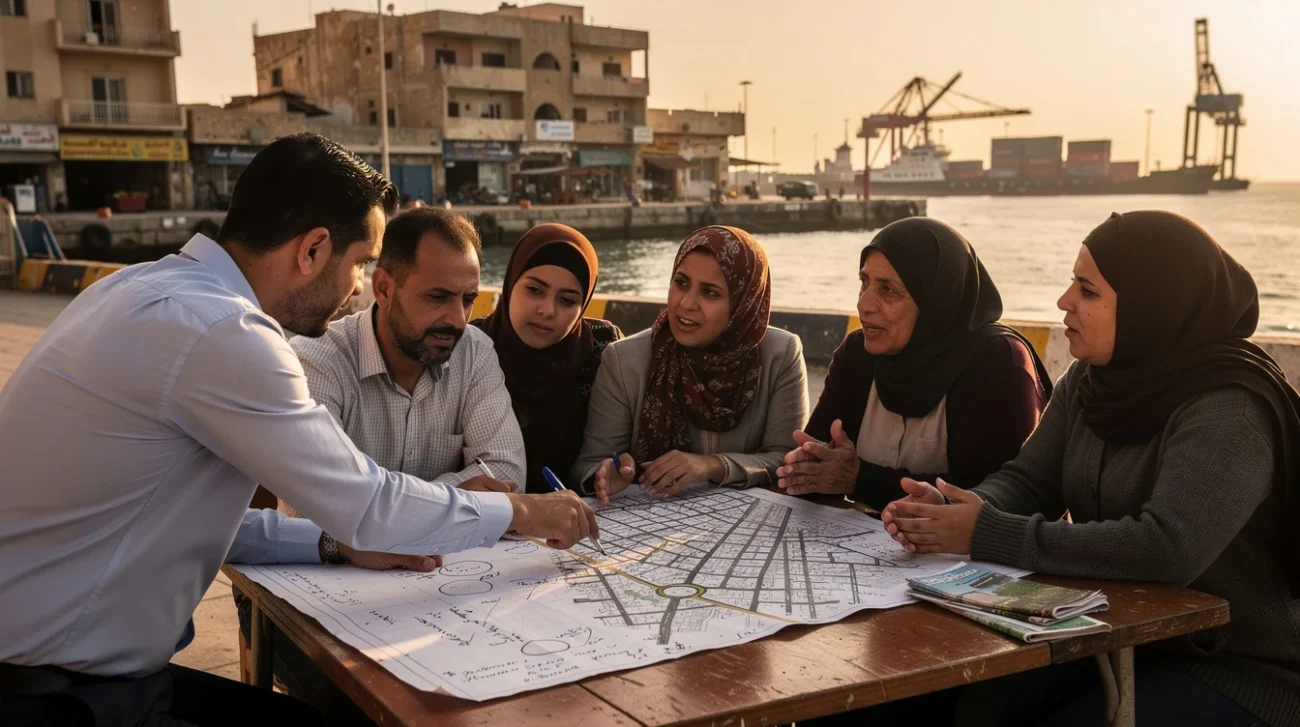
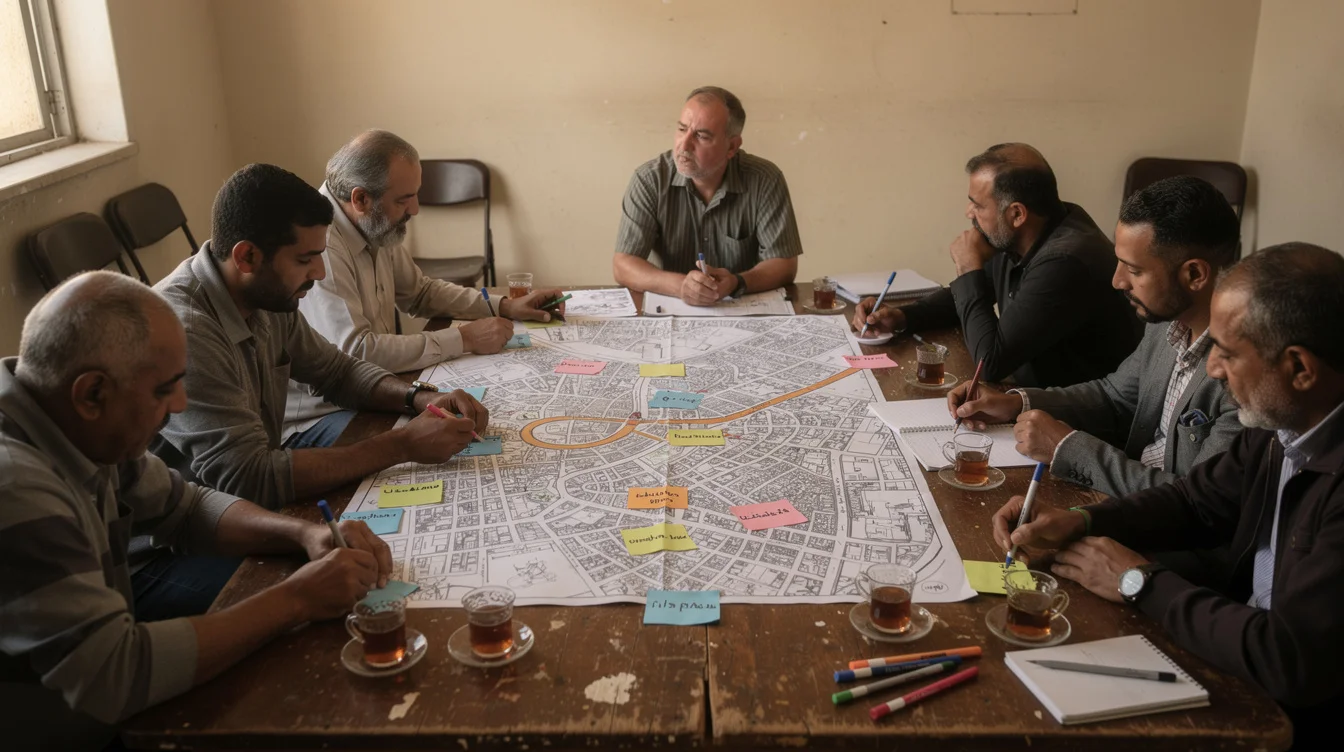
A stronger process would begin with paid neighborhood workshops to define problems and priorities before scenarios are ranked. Residents could map difficult journeys, unreliable services, valued meeting places, and spaces whose importance is not recorded in official datasets. Kevin Lynch’s work on how people perceive cities offers a useful precedent: urban knowledge includes remembered routes and everyday landmarks, not only surveyed geometry.
Barcelona’s Decidim platform provides another reference for organizing public proposals and deliberation. Yet a participation portal is not participation by itself. Benghazi would also need accessible physical venues, Arabic-language materials, paper submissions, and outreach beyond property owners and professional organizations. Renters, disabled residents, young people, and people unable to attend daytime meetings need routes into the process.
The decisive instrument would be a public response register: what residents proposed, what changed, what was rejected, and why. Where representation is contested, the process must record that disagreement rather than manufacture a single neighborhood voice. Consultation deserves credibility only when it can visibly alter a decision.
Open the Evidence, Not People’s Private Lives
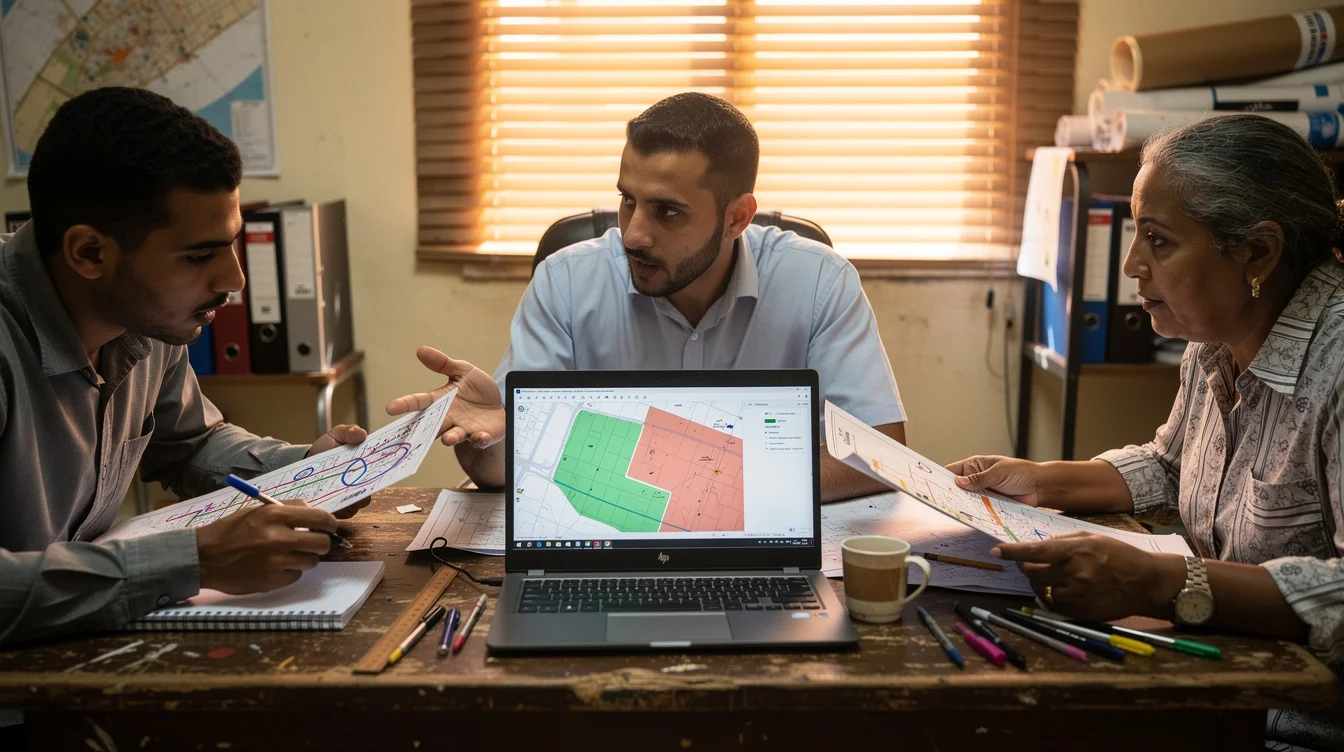
Public access should mean more than watching a model rotate on a screen. Residents and independent researchers need usable information: dataset descriptions, collection dates, geographic coverage, known gaps, licensing conditions, and records of revisions. Where legally and technically possible, non-sensitive planning layers should be downloadable in common formats.
Helsinki’s public 3D city models demonstrate that urban modeling can have a life beyond a consultant’s workstation. Benghazi need not copy Helsinki’s infrastructure to adopt the underlying principle: public planning evidence should be available for uses the original team did not anticipate, including criticism.
But openness has limits. Publishing identifiable household information, sensitive infrastructure details, or disputed occupancy records could expose people to harm. A responsible hub would separate public, aggregated information from restricted records, collect only what is necessary, and establish clear rules for access and deletion. Transparency about government decisions must not become transparency into residents’ private lives.
Uncertainty also belongs in public view. If population estimates are incomplete or service data are outdated, the interface should say so. Scenarios should show ranges and assumptions, not just crisp outputs. The authority of a digital map comes partly from its visual confidence; responsible design must make room for what the system does not know.
Accountability Needs a Name and an Appeal Route
A multidisciplinary team can coordinate transport, utilities, urban design, and development. It can also make responsibility difficult to locate. When a recommendation disadvantages a neighborhood, residents should not have to untangle a chain of consultants, software suppliers, and commissioning bodies to discover who can reverse it.
Before the hub informs consequential decisions, its governance should identify who commissions analysis, approves datasets, changes evaluation criteria, authorizes spending, and signs off on implementation. The source summary does not establish these arrangements. They should be public requirements, not assumptions attached to the reputations of the participating firms.
Amsterdam’s algorithm register offers a useful reference for explaining public-sector algorithmic systems. Benghazi’s hub would need comparable documentation for any consequential automated components it actually uses; a digital planning model should not automatically be assumed to contain AI. Documentation, however, is only the beginning. Residents also need an independent route to challenge errors and the decisions based on them.
Procurement matters too. Contracts should address data ownership, interoperability, audit access, maintenance, and the ability to move to another provider. Local planners must be able to operate and question the system after the unveiling. Otherwise, a tool advertised as city-building capacity risks becoming a permanent dependency on outside expertise.
Make the Hub a Place Where Power Can Be Challenged
The provocative possibility is not that Benghazi could acquire a more comprehensive urban model. It is that the model could become infrastructure for disagreement. Residents, universities, local professionals, and civic groups could use a common evidence base to test competing futures instead of receiving a single expertly packaged destination.
Imagine a hypothetical waterfront proposal tested against three alternatives: intensive commercial development, public-space-led renewal, and incremental improvements focused on existing users. Each could disclose expected costs, access changes, maintenance obligations, and displacement risks. Residents could ask for a fourth scenario. The point would not be to let software choose the winner, but to make the consequences harder to conceal.
Porto Alegre’s participatory budgeting provides a relevant political precedent: participation becomes more consequential when it reaches resource allocation. For Benghazi, a defined portion of neighborhood improvement spending could be subject to resident deliberation, with technical staff checking feasibility rather than quietly resetting priorities.
ZHA and its collaborators should be judged not only on the coherence of their spatial vision, but on the power arrangements their tools enable. The test is whether Benghazi can disagree with its own planning system—and make that disagreement count. A plan for 2050 should enlarge the city’s capacity to govern itself, not merely its capacity to be modeled.
FAQ
What is proposed for Benghazi’s 2050 city plan?
The concept combines a Vision and Spatial Strategy with a Digital Planning Hub. The ZHA-led team proposes connecting Benghazi’s identity and collective memory with evidence-based analysis to guide development toward 2050.
Does the Digital Planning Hub necessarily use AI?
No. The supplied source context describes an evidence-based city model, not a confirmed AI decision-making system. Questions about data quality, priorities, and accountability apply whether its tools use AI or conventional analysis.
What would meaningful resident participation require?
Residents would help define priorities before options are finalized, participate through online and offline channels, and receive documented responses. They would also need ways to challenge evidence and influence actual decisions or spending.
Should all planning data be publicly accessible?
No. Non-sensitive evidence, assumptions, and decision records should be accessible, while personal information and other sensitive records require safeguards. Public scrutiny should expose institutional reasoning without exposing residents to avoidable risks.
If Benghazi’s residents cannot change the priorities programmed into their city’s future, whose future is the plan actually building?
Watch the Mainifesto Short
Get the Mainifesto weekly — curated design debates, speculative ideas and the week's best articles every Saturday.
Editorial Perspectives
Questions and counterpoints developed by the Mainifesto editorial desk to extend the discussion.
Perspective 1
An existing neighborhood is not a data problem waiting to be cleaned up; it holds livelihoods, memories, and arrangements no master plan fully captures. If residents cannot refuse demolition or change investment priorities, Benghazi risks calling displacement modernization.
Perspective 2
Digital coordination earns its budget if it makes water reliable, permits quicker, and streets easier to navigate. Show me how a resident’s complaint changes a spending decision—not just how neatly it appears on a dashboard.
Perspective 3
I’d want to see which decisions residents can actually overturn, and what happens when their preferences conflict with the plan’s targets. Start with a limited pilot, publish the trade-offs, and test whether participation changes allocations before locking in a citywide system.
Perspective 4
In Benghazi, control of the platform cannot be separated from control of budgets, contracts, and territory. Ask who owns the data, who can alter the model, and whether the city can replace its vendors without losing essential services. If residents have no leverage over those arrangements, the system serves whoever does.
Perspective 5
The dashboard gives an old technocratic ambition a fresh interface: the city made legible from above. Lefebvre’s right to the city meant more than being consulted about someone else’s scheme. If Benghazi’s residents cannot rewrite its priorities, 2050 is merely the date attached to somebody else’s vision.