
Nick Cave’s Soundsuits: Hidden Bodies, Public Power
Hidden Bodies, Public Power: The Paradox of Nick Cave’s Soundsuits
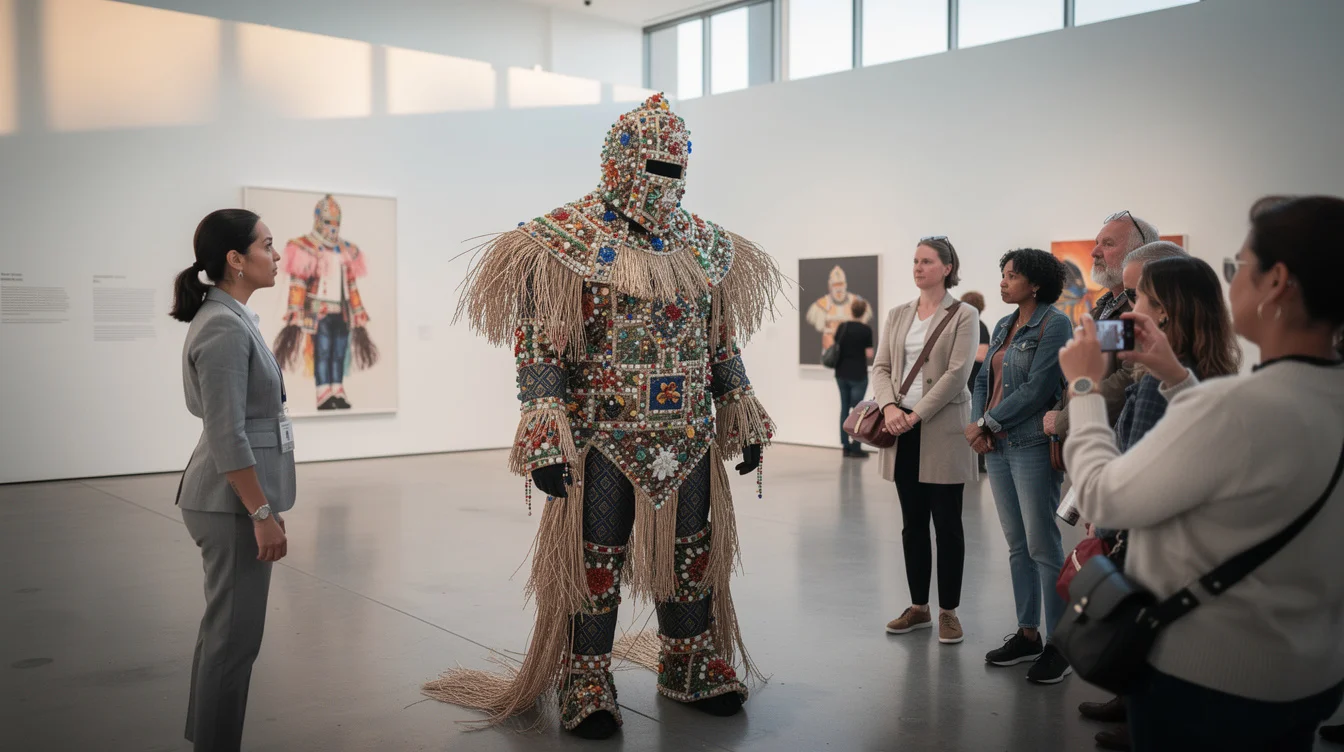
A body can be impossible to overlook and impossible to identify. Nick Cave’s Soundsuits occupy that contradiction: towering, rustling constructions that conceal their wearers beneath synthetic hair, buttons, beads, twigs and found objects. They interrupt the visual shortcuts through which observers assign race, gender, class and threat. Yet concealment arrives through extravagance, not disappearance. These bodies demand the room.
The chronology matters. Cave’s first Soundsuit dates to 1992, following the 1991 police beating of Rodney King. What began as a response to racial violence became a language of sculpture, craft and collective performance. Its political proposition remains urgent: can design make people publicly powerful without making their identities publicly available? The answer splits in two. Soundsuits offer a persuasive model of chosen visibility. They also expose how readily institutions can celebrate protected-looking bodies without protecting actual people.
PRO — Concealment Can Be a Form of Agency

The first Soundsuit was assembled from twigs, an accumulation of discarded material that became audible when worn. That origin is more consequential than its later glamour suggests. The work did not begin by making an already privileged object more precious. It made overlooked matter command attention, while placing another surface between a vulnerable body and the viewer’s judgment.
Cave has described the suits in relation to concealing race, gender and class. This is not the same as claiming that those categories cease to matter. Rather, the costume frustrates their immediate visual assignment. The spectator must encounter motion, scale, sound and material before claiming to know who stands underneath. Recognition is delayed; interpretation loses its usual shortcuts.
That delay is a design achievement. Most public environments demand legibility: a face for a camera, a name for a pass, a body that behaves predictably. The Soundsuit reverses the contract. Its wearer can appear without offering every familiar identifying cue. Visibility becomes something composed rather than simply extracted.
Performance artist and designer Leigh Bowery also used extreme silhouettes and facial concealment to disrupt bodily classification. Cave’s particular force lies in linking that disruption to racial vulnerability and collective movement. The suit is not merely an exceptional look. It proposes a boundary: you may witness this presence without possessing an immediate account of this person.
PRO — Collective Performance Makes Space Public Again
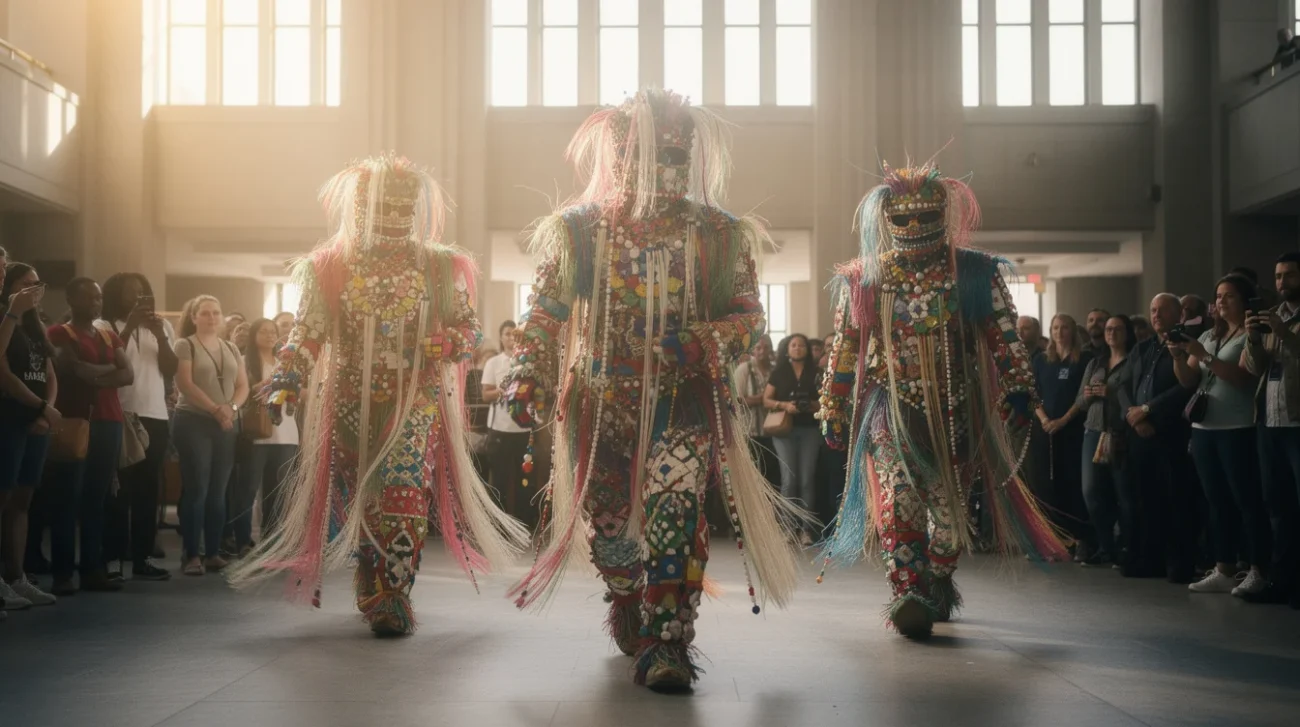
The strongest argument for Soundsuits emerges when they move beyond the isolated museum figure. In HEARD•NY, presented with Creative Time in 2013, thirty dancers animated horse-like Soundsuits in Grand Central Terminal’s Vanderbilt Hall. Raffia-covered bodies brought an unfamiliar rhythm into a space associated with timetables, commuting and regulated circulation. The architecture remained fixed; the terms of attention changed.
Here, anonymity did not produce social emptiness. It supported a temporary collective whose power came from coordinated presence rather than individual celebrity. The performers could be recognized as participants in an event without each face becoming its organizing image. Spectators encountered a group before they encountered a roster of personalities.
Sound is crucial to this redistribution. A photograph can flatten a Soundsuit into fashion or decorative sculpture. Movement reveals an instrument: materials respond to the body, and the body changes the acoustic character of a room. Political presence becomes something heard as well as seen. It need not depend entirely on the frontal, identifiable face.
For architecture and event design, this offers a demanding lesson. Publicness is not guaranteed by an open door or a generously sized plaza. It depends on who can occupy space, interrupt its routines and establish a different tempo. Cave’s performances suggest that design can provide a shared interface between people and institutions without requiring everyone to become individually exposed. That is more ambitious than making a crowd look diverse.
CONTRA — Concealed Identity Is Not Material Protection
The counterargument begins where the metaphor of armor breaks down. A Soundsuit may obstruct a viewer’s assumptions, but it does not suspend policing, institutional racism or the vulnerability of the person who eventually takes it off. Spectacular concealment is not physical security. A similar tension between shelter and political symbolism frames the debate over the Police Shield Pavilion as protection or spectacle. Indeed, an unusual silhouette can attract scrutiny rather than deflect it. In public space, being unreadable can itself be treated as suspicious.
Nor is identity fully sealed inside the costume. Movement, context, accompanying information and the conditions of presentation all influence interpretation. Contemporary identification systems also extend beyond faces, drawing on movement and other data. None of this makes Cave’s artistic strategy ineffective; it makes literal claims of anonymity untenable. A symbolic interruption of classification is not an escape from the infrastructure of classification.
There is a deeper political discomfort. Why should a racialized body need an extraordinary covering to receive an encounter ungoverned by prejudice? If the Soundsuit were treated as a practical solution rather than a critical proposition, responsibility would migrate from the discriminatory observer to the person being observed. The vulnerable would be asked to redesign themselves.
Cave’s work is strongest when it keeps that injustice visible. Its beauty cannot be allowed to imply that the problem has been resolved. The protective-looking shell should accuse the surrounding world: what kind of public realm makes such a shell imaginable as a necessity?
CONTRA — Institutions Can Applaud the Image and Evade the Claim
There is also a recognition problem at the scale of the exhibition. An anonymous performer can help generate an instantly recognizable artistic brand. The face disappears, but the signature remains: Nick Cave. This is not an accusation of bad faith. It is a structural tension within collective performance, where museums, press coverage and markets often direct attention toward the named artist more reliably than toward the people activating the work.
The 2022 survey Forothermore at the Museum of Contemporary Art Chicago demonstrated the breadth of Cave’s practice beyond a single iconic silhouette. Yet the survey format also clarifies the paradox: a practice concerned with otherness and collective possibility enters institutional history through individual authorship. Recognition is not abolished. It is redistributed, and not necessarily evenly.
Cave’s Until, which opened at MASS MoCA in 2016, offers a useful warning against easy consumption. Its dazzling environment of wind spinners, beads and crystalline accumulation incorporated racist lawn-jockey imagery. Seduction did not erase violence; it drew visitors toward a confrontation with it. The lesson should follow the Soundsuits into every exhibition.
If audiences leave remembering only exuberant surfaces, an institution has gained an attractive image while the political claim has weakened. The relevant measures are therefore not attendance and photogenic impact alone. They include performer credit, compensation, accessibility and how explicitly interpretation addresses racial violence. Debates over who can afford visibility in design exhibitions make the material stakes of participation explicit. Collective presence becomes political power only when collective participants retain agency—not merely when they supply the spectacle.
FAQ — What the Soundsuits Reveal About Design
What are Nick Cave’s Soundsuits?
Soundsuits are sculptural forms, many designed to be worn and activated through performance. Cave builds them from materials including twigs, beads, buttons, synthetic hair and found objects. They conceal the wearer’s familiar outline while creating new visual and, in movement, acoustic identities.
Why did Cave create the first Soundsuit?
The first Soundsuit dates to 1992 and followed Cave’s response to the 1991 police beating of Rodney King. Its twig construction developed into a wearable, sounding form. That origin anchors the wider practice in questions of racial vulnerability, judgment and protection.
Do Soundsuits actually make performers anonymous?
They conceal faces and many bodily cues, disrupting immediate judgments about identity. They do not guarantee anonymity or safety: context, movement and documentation can still identify participants. Their political force lies in challenging compulsory legibility, not providing a technically secure disguise.
What can architects and designers learn from them?
Design can support participation without demanding maximum personal exposure. That principle can inform event photography policies, opportunities to participate without being recorded, and spaces offering different degrees of visibility. But visual concealment must accompany consent, accessibility and material safeguards rather than substitute for them.
If a body must become spectacular to escape familiar prejudice, has design expanded freedom—or merely negotiated more beautiful terms for being watched?
Get the Mainifesto weekly — curated design debates, speculative ideas and the week's best articles every Saturday.
Editorial Perspectives
Questions and counterpoints developed by the Mainifesto editorial desk to extend the discussion.
Perspective 1
Visibility is not the same as legibility; a body can command attention without offering its identity for inspection. Cave expands freedom by separating the two, making concealment an assertive choice rather than a retreat.
Perspective 2
Having to become extraordinary to escape ordinary prejudice is a rotten bargain, however beautiful the costume. Debord would recognize the trap: the spectacle absorbs dissent, and the audience gets to applaud without surrendering its power to judge.
Perspective 3
The Soundsuit offers something digital avatars keep promising: presence without compulsory disclosure. But concealment alone isn't collective power; that comes from who gets to perform, gather, and control the images afterward.
Perspective 4
Architecture has long used screens and thresholds to separate exposure from access; Cave makes that boundary wearable. The Foucauldian question is not simply whether we are watched, but who arranges the encounter—and a museum does not stop arranging it because the costume is unruly.
Perspective 5
I'd start with weight, heat, movement, and how much help a wearer needs to get inside. Concealing identity can offer real protection, but if we're calling that freedom, the body's working conditions matter as much as the audience's reaction.