
Would You Trust a Cookie Made from Plastic Waste?
Would You Trust a Cookie Made from Plastic Waste?
A cookie is one of design’s most efficient reassurance devices. It promises familiarity, a manageable portion and a small reward. Put an unfamiliar ingredient inside that familiar format, however, and reassurance can become camouflage. The question is no longer simply whether the object looks edible. It is whether its appearance helps us understand what we are eating—or persuades us to stop asking.
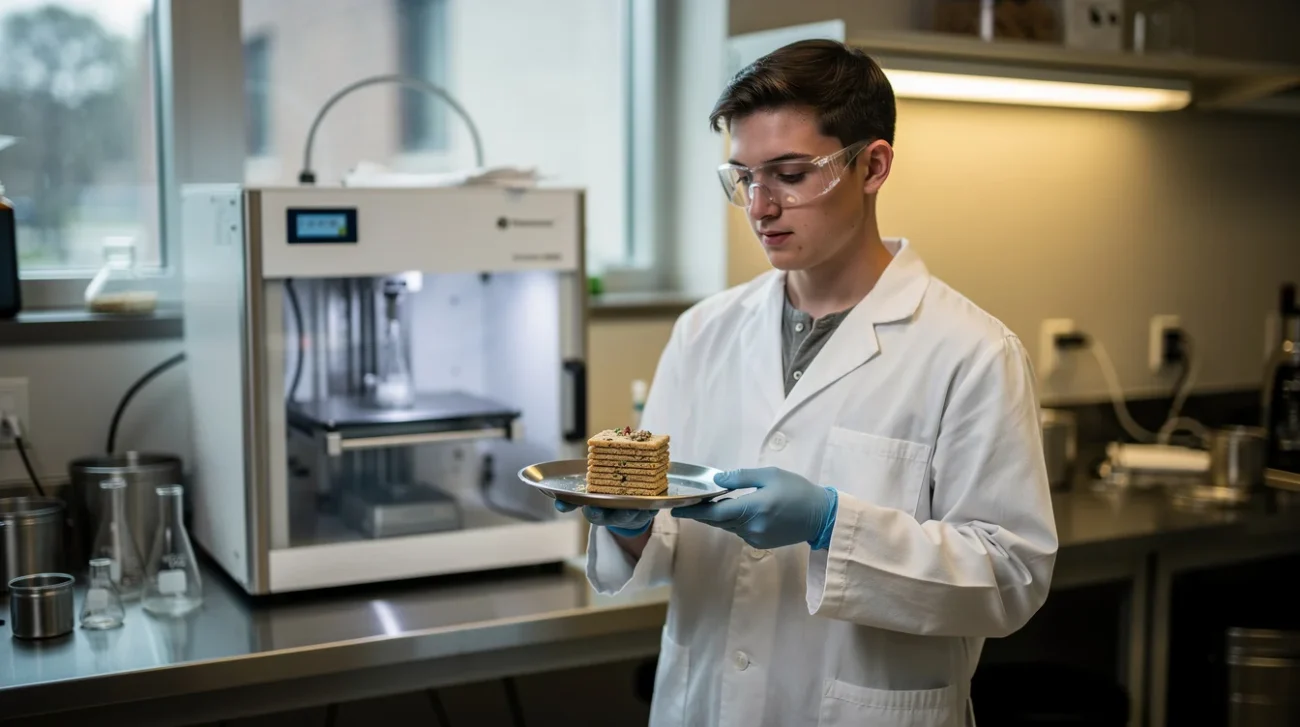
Researchers at Southern Illinois University Carbondale have developed µBites, pronounced “microbites”: a 3D-printed cookie for space travel, using yeast to transform plastic and agricultural waste into edible, protein-rich food. According to Dezeen’s reporting on 14 October 2026, the project was created for and funded by NASA’s Deep Space Food Challenge, which seeks food solutions for resource-limited missions.
That is a formidable circular-design proposition. It is not, by itself, a reason to take a bite. Resource efficiency cannot substitute for evidence when the destination is the human body. The real design challenge is not making waste look appetising. It is making the transformation intelligible, the safeguards inspectable and the invitation to eat genuinely voluntary.
The cookie is an interface, not an alibi
Choosing a cookie rather than an anonymous spoonful of biomass matters. A discrete object can be handled, portioned and recognised. Additive manufacturing could also offer control over geometry and serving size. Those are plausible advantages of the format, not proof of any particular texture, taste or nutritional performance in µBites; the supplied reporting does not establish those details.
Foodini, Natural Machines’ food-printing system, offers a useful comparison. It demonstrates how depositing edible mixtures in controlled shapes can become a kitchen operation rather than an industrial abstraction. But a printer only shapes what it receives. A convincing print is not a convincing safety case. Precise geometry cannot tell a diner whether a feedstock was appropriately selected or whether unwanted compounds were removed. This echoes the test of physical credibility in AI design education: a persuasive form still has to withstand real-world scrutiny.
Designer Chloé Rutzerveld’s Edible Growth project provides another reference: it explored printed edible structures in which organisms continued to develop. Its relevance is conceptual, not evidence for µBites. It treats food as a biological process with a designed presentation, rather than a static object whose origins disappear behind a finished surface.
µBites should be judged through that distinction. The cookie can provide a welcoming entry point, but it should not impersonate an ordinary biscuit so successfully that the extraordinary production pathway becomes invisible. Familiarity should invite questions, not anaesthetise them.
Show the transformation, not just the recycling arrow
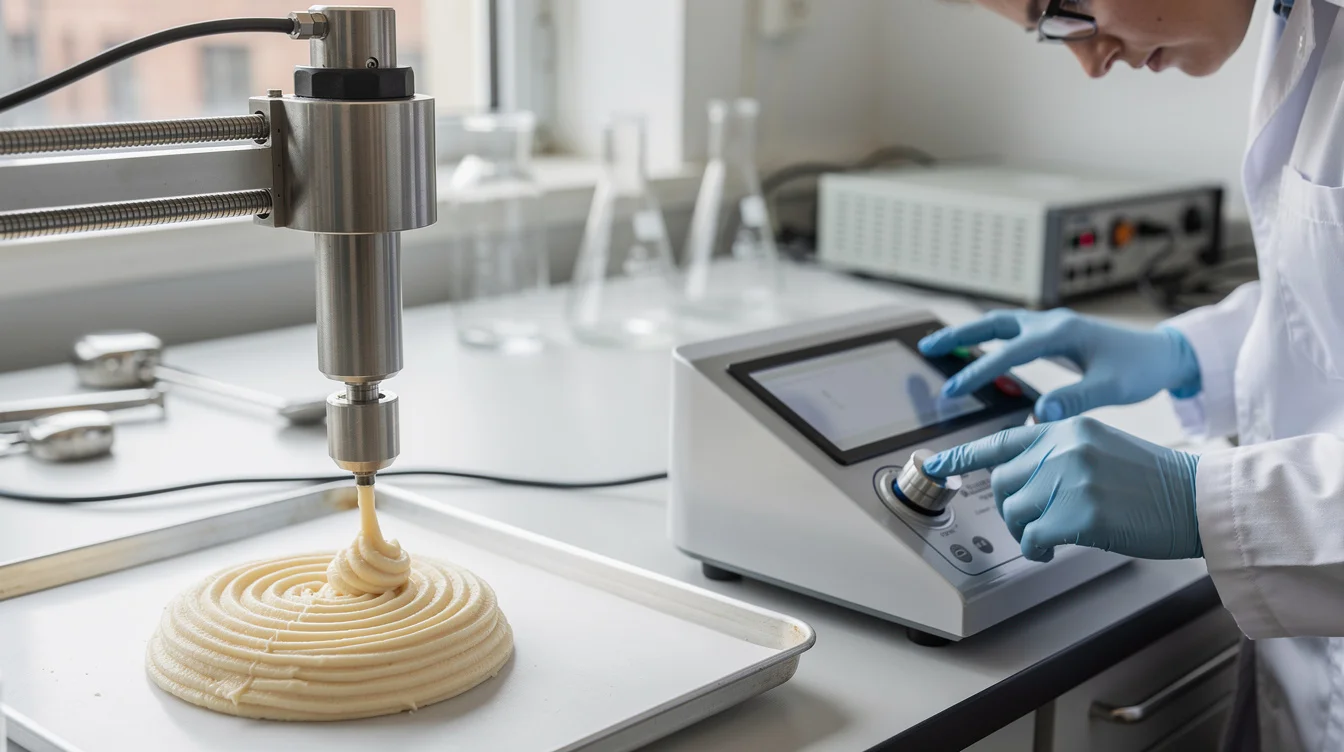
“Made from plastic” is a headline, not an adequate ingredient explanation. The reported proposition involves yeast transforming waste into food; it should not be confused with simply grinding discarded packaging into biscuit dough. Yet that distinction still leaves crucial questions unanswered. Which plastics? Which agricultural residues? What preparation occurs before biological conversion? What is recovered afterwards, and what is excluded?
The supplied source summary does not specify the complete process, accepted polymer types or purification steps. Filling those gaps with an elegant diagram would be design malpractice. Instead, the public-facing account should distinguish what has been demonstrated from what remains under investigation. A useful process graphic would identify incoming materials, conversion stages, the edible output and any residual streams, with uncertainties clearly marked.
Mycoprotein products such as Quorn offer a partial cultural precedent: microbial cultivation already supplies food at commercial scale. Solar Foods’ Solein offers another comparison, using a different microbial production pathway built around inputs including carbon dioxide and hydrogen. Neither validates plastic-derived food. Both show why the organism, its inputs and the finished ingredient must be explained separately.
A recycling symbol collapses all of that into a moral shortcut: waste enters, virtue emerges. µBites needs the opposite. Transparency means revealing the boundaries and losses of the system, not merely celebrating its loop.
NASA’s name cannot do the work of safety evidence
The NASA connection gives µBites an unusually powerful frame. A spacecraft makes scarcity tangible: supplies are constrained, storage matters and waste is a logistical burden. NASA’s Deep Space Food Challenge makes experimentation in that setting understandable. But support through a research challenge is not the same thing as regulatory authorisation for a food product, nor does it establish suitability for unrestricted daily consumption.
A credible safety account would begin upstream. “Plastic waste” is not one consistent ingredient. Polymer identity, additives, contamination and collection conditions can vary. Agricultural residues also require specifications and controls. Biological conversion should never be presented as a magical eraser that automatically eliminates every hazard associated with an incoming material.
The questions then become operational. How are acceptable inputs defined? Which potential contaminants are tested for, using what methods and detection limits? How consistent are successive production batches? What evidence supports digestibility, nutritional claims and appropriate serving levels? What storage conditions preserve the finished food? These are requirements for evaluating the proposition, not allegations that µBites has failed particular tests.
For an eventual commercial product, the applicable regulatory pathway would depend on its composition, production process and market. Public communication should name the actual status rather than shelter beneath “NASA-backed.” Institutional prestige can earn attention. Only relevant evidence can justify ingestion.
Design a label that survives an awkward question
The strongest packaging proposal would not put a giant sustainability claim on the front and bury the conversion process behind a QR code. It would use layered disclosure: a plain-language description on the pack, a readable process explanation nearby, and deeper documentation accessible to anyone who wants it. Digital detail should extend the label, not rescue an evasive one.
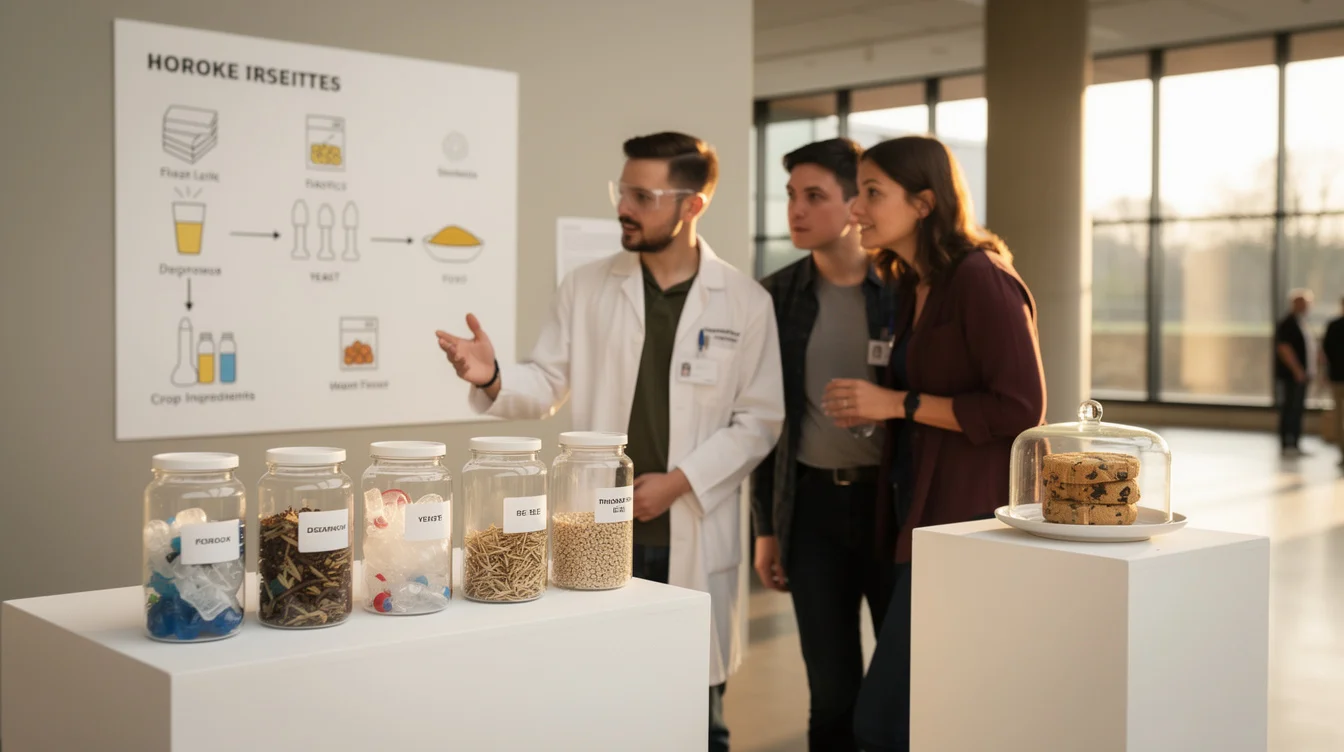
Consider a hypothetical research presentation. Beside the cookie, visitors could see the defined starting materials in sealed containers, a diagram of the documented conversion pathway and a clear statement of the prototype’s evaluation status. Any unverified step would be labelled as such. Raw waste would remain physically separated from food-handling surfaces. The exhibition itself would model the boundaries the process claims to control.
Dunne & Raby’s speculative-design practice offers a useful lesson here: a provocative object can make a technological future debatable without pretending that future has already arrived. A µBites display should similarly resist the polished launch aesthetic when the appropriate story is still research.
This approach also makes room for refusal. In a future consumer study, assuming the necessary safety and ethical clearances, participants should receive the material-origin explanation before deciding whether to taste. Discovering the origin afterwards might generate a dramatic reaction, but it would test the effectiveness of concealment rather than informed trust. The stakes differ from those of privacy and consent in camera-free AI glasses, but the design obligation is similar: explain what people are being asked to accept before treating their participation as agreement.
A circular system still has to prove its arithmetic
Even if a waste-derived food proves safe and acceptable, its environmental case remains a separate question. Preparation, conversion, purification, printing and storage all have material and energy demands. A convincing comparison must consider those demands alongside competing uses for the same waste and alternative ways of producing equivalent nutrition.
The relevant baseline also changes with location. On a deep-space mission, reducing dependence on transported supplies could justify processes that make little sense beside an established terrestrial food network. A solution for a spacecraft is not automatically a solution for a supermarket. Nor should the novelty of eating plastic-derived material distract from reducing unnecessary plastic production in the first place.
The Ellen MacArthur Foundation’s distinction between biological and technical material cycles clarifies why this project is so provocative. Moving material associated with the technical cycle towards nourishment challenges a familiar conceptual boundary. Crossing it responsibly demands more than an attractive closed-loop illustration: the actual chemistry, biological processing and environmental trade-offs must carry the argument.
That is the productive trigger in µBites. The cookie asks designers to work across object, information and evidence rather than polishing only the object. Its most important output may be a new standard for explaining unfamiliar food—not a new silhouette for a snack. If circular design wants a place at the table, it must accept harder questions than whether waste has found another use.
FAQ
What is µBites?
µBites, pronounced “microbites,” is a Southern Illinois University Carbondale research project developing 3D-printed, protein-rich cookies for space travel. The reported process uses yeast to transform plastic and agricultural waste into food, with support through NASA’s Deep Space Food Challenge.
Does “made from plastic” mean eating pieces of plastic?
No: the reported concept is biological transformation, not adding shredded plastic to dough. However, the source summary does not provide enough process or analytical detail to independently establish the finished food’s composition or the absence of unwanted residues.
Does NASA backing mean the cookies are approved to eat?
No. Research funding and participation in a challenge are distinct from regulatory authorisation. Assessing suitability for consumption requires relevant safety evidence, production controls and compliance with the rules applicable to the intended use and market.
Why use a 3D-printed cookie format?
A cookie offers a familiar, portionable object, while printing can provide control over shape. Those design qualities may help people approach unfamiliar food, but they cannot establish safety, nutritional adequacy or environmental superiority.
If the safety and environmental evidence were convincing, would you accept a cookie made through the transformation of plastic waste—or should some material histories remain off the menu?
Get the Mainifesto weekly — curated design debates, speculative ideas and the week's best articles every Saturday.
Editorial Perspectives
Questions and counterpoints developed by the Mainifesto editorial desk to extend the discussion.
Perspective 1
I'd consider it, but a well-designed cookie tells me nothing about how reliably the process removes contaminants across different waste batches. Show me independent testing, batch traceability and the energy bill before asking the 3D printer to make it appetising.
Perspective 2
If the safety and environmental evidence holds up, I'd take a bite—material history alone isn't a reason to reject a useful transformation. But I'd want to know whether this can become affordable food, not just an expensive cookie that makes plastic waste look less urgent.
Perspective 3
I'd try it under those conditions, but I'd want the design to explain the transformation rather than disguise it. Could the printed form help people understand what they're eating, with a clear route to the evidence, or is the geometry just making an unfamiliar process feel futuristic?