
Who Decides When the Kennedy Center Has Failed?
PRO: A monument cannot be exempt from reality
The proposed demolition of Washington, DC’s Kennedy Center is being presented as a building dispute, but it is really a referendum on architectural loyalty. The administration of US president Donald Trump has indicated that the Edward Durell Stone-designed complex may be demolished and replaced with an amphitheatre. In a civil action filed this week, a Justice Department attorney described a possible future in which the building is removed after years of renovation conflict and what the administration calls a structural “death spiral.” The language is deliberately terminal. It asks the public to stop thinking of the Kennedy Center as a beloved institution and start thinking of it as an expensive liability.
The pro-demolition argument is not inherently philistine. Buildings fail. Systems corrode, envelopes leak, theatres become inaccessible, mechanical infrastructure consumes unreasonable amounts of energy, and code upgrades can turn a finite renovation budget into an open-ended ransom. A cultural building that cannot reliably host performances, audiences, workers and artists is not fulfilling its civic contract simply because its silhouette is familiar. The question of whether a cultural institution can remain genuinely public under changing pressures also animates debates about whether a branded museum can still feel public.
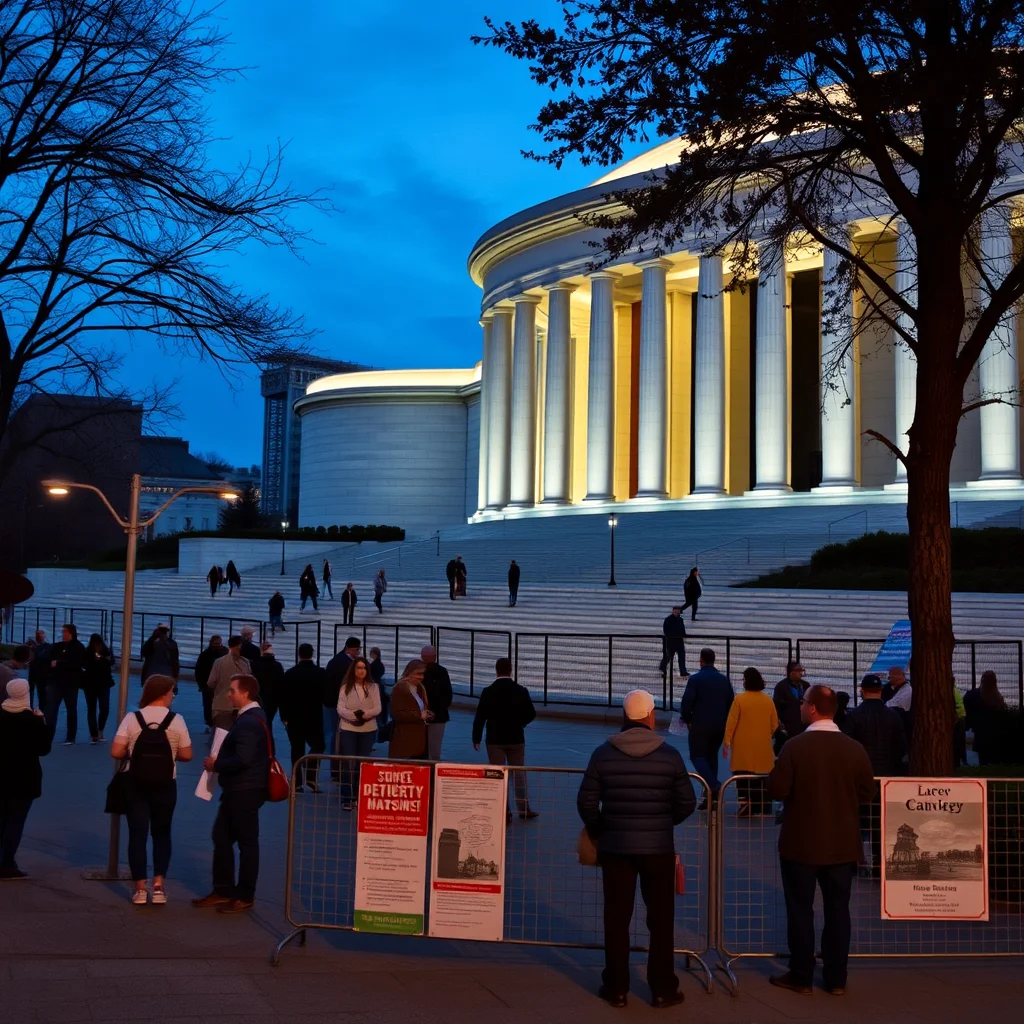
Stone’s 1971 building was conceived as a monumental white-marble statement, a grand object raised above the Potomac. Its architecture depends on scale, repetition and ceremonial distance: a vast terrace, a forest of columns, and interiors designed to make arrival feel like a state occasion. That ambition now carries operational consequences. Monumentality is rarely cheap to maintain. The larger the public image, the greater the hidden burden of plant, structure, accessibility, fire safety, acoustics and climate control behind it.
There are precedents for replacing major cultural buildings when adaptation becomes a form of denial. Berlin’s Palast der Republik was demolished after a ferocious debate over history, contamination and political symbolism, even though its fate was never merely technical. London’s old Wembley Stadium gave way to a new arena because nostalgia could not justify every compromise in capacity, circulation and commercial use. In Paris, the Centre Pompidou’s current closure for extensive renovation demonstrates the opposite strategy: preserve the icon, but accept years of disruption and a major bill.
From this perspective, demolition is not necessarily erasure. It can be a decision to redirect public money toward a venue that works harder. An amphitheatre could offer more flexible programming, outdoor performance, contemporary acoustics and a less ceremonious relationship to its audience. It could reduce the institutional distance that makes the Kennedy Center feel like a national temple rather than a living arts campus. If a new building can host more artists, welcome more citizens and cost less to operate, insisting on preservation may become a form of architectural vanity.
PRO: Cultural purpose is larger than architectural authorship

The Kennedy Center is often defended through its authorship: Edward Durell Stone, a major American modernist; the building’s national role; its association with presidential patronage and the performing arts. But authorship should not become a veto. Cities are not museums of designer intention. They are machines for public use, and cultural architecture must be judged by what it enables rather than by the prestige of the name engraved on its history.
Frank Lloyd Wright’s Guggenheim Museum required adaptation to protect its collections and visitors. Louis Kahn’s Kimbell Art Museum has been extended rather than frozen, proving that a masterpiece can be treated as a framework rather than a sealed relic. The Sydney Opera House has undergone continual technical renewal because its cultural life depends on more than preserving the original image. These cases support a hard truth: preservation is not the same as keeping every material untouched. It is a management choice, and sometimes the most honest management choice is replacement.
The danger in the Kennedy Center debate is that defenders may confuse emotional importance with structural viability. A national arts institution deserves public investment, but public investment deserves evidence. If the renovation plan has become financially unstable, if its sequencing would cripple programming for years, or if the building’s deficiencies cannot be solved without reconstructing nearly everything behind the marble, then the question is not whether the building is beautiful. The question is whether its beauty is being subsidised at the expense of the culture it claims to serve.
CONTRA: Demolition would destroy more than a building
The argument against demolition begins with a simple refusal: a cultural landmark is not a failed office block. The Kennedy Center is an archive in three dimensions. Its terraces have hosted arrivals, protests, ceremonies and everyday acts of spectatorship. Its monumental interior has given generations of Americans a physical setting in which theatre, music, dance and national identity overlap. To demolish it would eliminate not only stone and concrete, but accumulated public memory that cannot be reconstructed by a new amphitheatre.
That distinction matters because cultural architecture is valuable partly through duration. The Kennedy Center’s meaning has been produced by use, not by design alone. Audiences who saw a first opera there, families who travelled to Washington for a concert, workers who spent decades backstage and artists who made their reputations in its rooms have all added layers to the building. A replacement could reproduce seating counts and technical specifications, but it could not reproduce those encounters. A replica of civic memory is an architectural impossibility.
Nor should “structural death spiral” be allowed to function as a verdict before the public has seen a transparent technical record. Buildings are frequently declared obsolete when the real problem is political impatience, fragmented procurement or a renovation strategy that has been allowed to grow incoherent. The phrase sounds scientific while doing rhetorical work: it converts a contestable set of costs and defects into a biological inevitability. Before demolition, the administration should publish independent condition assessments, lifecycle comparisons, carbon calculations, accessibility audits and credible alternatives from preservation architects and engineers.
There is also a profound environmental objection. Demolition wastes the embodied carbon already locked into the Kennedy Center’s concrete, steel and stone, while generating a new wave of extraction, transport and construction emissions. Adaptive reuse is not automatically virtuous; a badly conceived retrofit can be wasteful and technically compromised. The broader question of whether heritage architecture can survive radical conversion likewise turns on the balance between preserving material, meaning and future use. But replacing a huge cultural complex should face a burden of proof far higher than the promise of a cleaner image or a more politically convenient programme.
CONTRA: The amphitheatre is not a neutral replacement
The proposed amphitheatre deserves scrutiny not because open-air performance is inferior, but because programme can become a weapon against complexity. A new venue may be easier to brand, fund and control. It may produce a simpler story: tear down the monumental past, build a populist stage, declare renewal. Yet a national performing-arts centre is not only a stage. It is rehearsal space, education infrastructure, multiple acoustic environments, offices, archives, public circulation and a daily ecosystem of technicians, ushers, administrators and artists.
Replacing that ecosystem with a single flexible format could narrow the cultural institution precisely when it should broaden access. An amphitheatre is exposed to weather, noise, seasonal limits and the economics of spectacular events. It may favour large-scale concerts over chamber music, experimental theatre, dance, opera and subsidised programming. The building’s failure, in this scenario, would be redefined to mean that it does not fit a new political appetite, rather than that it cannot serve the public.
History offers warnings. The destruction of heritage is often sold as liberation from elitism, inefficiency or old symbolism. What follows can be more exclusive, not less, because new construction arrives with higher ticket prices, corporate naming rights and a demand for immediate returns. The Kennedy Center’s marble may be politically loaded, but that is exactly why it should be argued with, altered and inhabited—not deleted by executive preference.
Architects such as Denise Scott Brown and Robert Venturi taught the profession to read buildings as complicated signs rather than pure objects. The Kennedy Center is an especially complicated sign: a modernist monument dressed in classical language, a federal institution with a public audience, a place of performance that also performs national power. Its contradictions are not defects to be scrubbed away. They are the material of democratic culture. A new amphitheatre might be more efficient, but efficiency is a thin substitute for a building capable of holding disagreement.
The real test is who gets the irreversible decision
Both sides are right about one uncomfortable fact: the Kennedy Center cannot be protected by sentiment alone. A landmark that consumes resources without delivering safe, accessible and artistically credible public use has failed in one important sense. But the pro-demolition camp is wrong if it treats replacement as an ordinary capital project. The irreversible act requires a higher civic threshold than a renovation overrunning its budget.
The decisive question should therefore not be whether the building is loved or whether its renovation is difficult. It should be whether a genuinely independent process has tested every serious option: phased renewal, partial deconstruction, selective replacement, new backstage infrastructure, energy retrofits, landscape changes and a separate amphitheatre added without destroying Stone’s complex. The public should see the costs, risks, carbon impacts and cultural consequences side by side. If demolition still wins after that process, it will at least be a decision rather than a slogan.
Cultural landmarks do not have an automatic right to survive. They do, however, have a right to due process. The Kennedy Center is a test of whether political reprioritisation can operate within architectural time, which is slower, more layered and less obedient than an administration’s news cycle. Destroying the building may be defensible. Destroying the argument around it is not.
Get the Mainifesto weekly — curated design debates, speculative ideas and the week's best articles every Saturday.
Editorial Perspectives
Questions and counterpoints developed by the Mainifesto editorial desk to extend the discussion.
Perspective 1
If the Kennedy Center’s structure blocks meaningful improvements in accessibility, performance technology, and environmental performance, demolition should remain a legitimate option—not a cultural taboo. The deeper question is whether we can use parametric analysis and lifecycle modeling to prove that adaptation is actually more sustainable than starting over.
Perspective 2
Demolition would mistake obsolescence for failure, a very contemporary impatience. The Kennedy Center is not merely a container for culture but a layer of civic memory; as Lefebvre might remind us, its meaning is produced through use, not optimized like a balance sheet.
Perspective 3
I care less about whether the building survives in theory than whether people can find their seats, enjoy the program, and return without feeling punished by the experience. Before anyone reaches for a wrecking ball, show me the renovation budget, the attendance upside, and a credible plan for keeping the place alive during construction.