
The Shirt That Refuses to Be Seen
The Shirt That Refuses to Be Seen
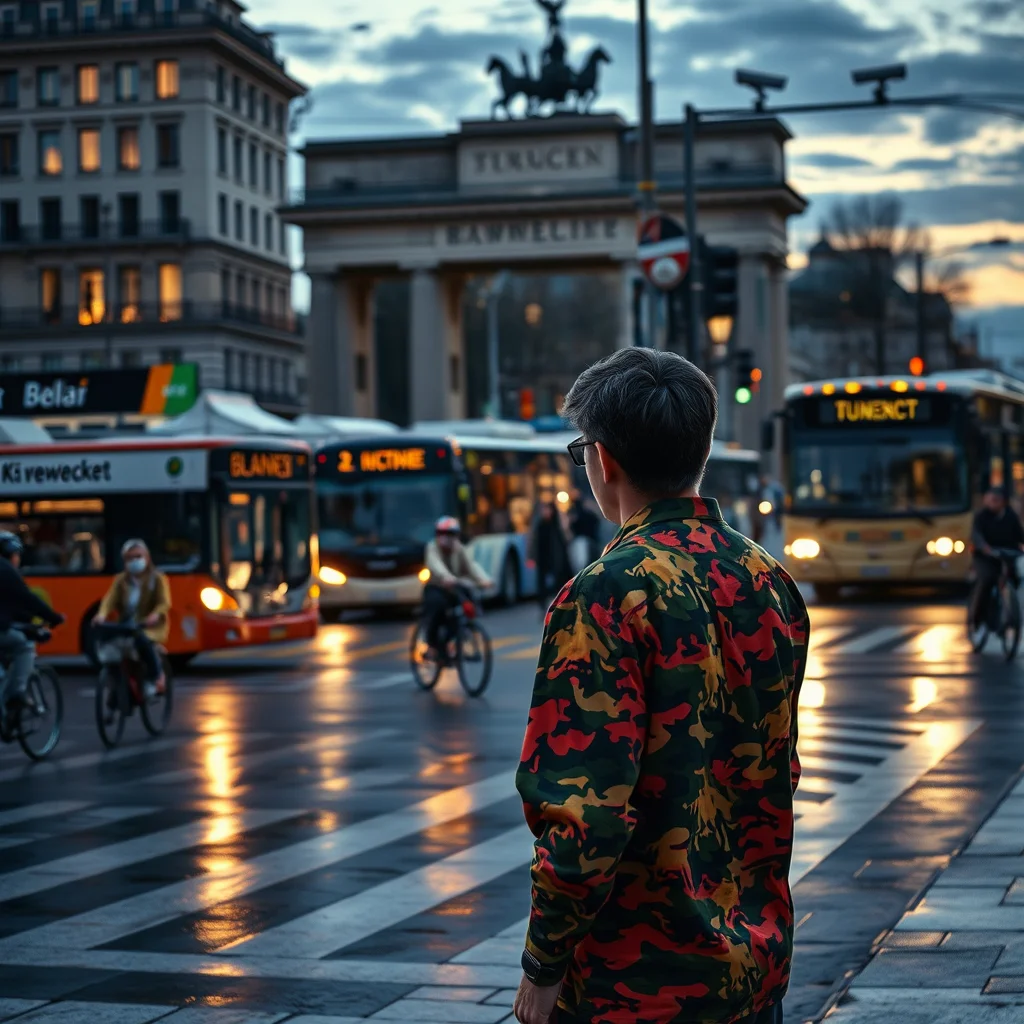
Visibility is usually sold as a virtue. Be visible, be legible, be counted: the contemporary city rewards the body that can be recognised by its cameras, databases and predictive systems. Simon Weckert’s Digital Camouflage reverses that promise. The colourful shirt, unveiled this week, is designed to interfere with AI video surveillance systems and stop the wearer from being detected as an ordinary, machine-readable subject.
That is a startling proposition for an item of clothing. The shirt does not merely conceal the body; it disputes the terms under which the body is allowed to appear. It asks whether public space should be organised around frictionless recognition, or whether remaining unclassified is a civic right.
Weckert developed the garment in response to a pilot project for AI video surveillance at Berlin’s Kottbusser Tor, due to begin this month. The location is not an abstract laboratory. Kottbusser Tor is a dense, heavily used urban crossroads, shaped by transit, commerce, protest, migration and everyday improvisation. Installing machine vision there means converting ordinary movement into data and asking residents to accept that conversion as the price of urban safety.
Digital Camouflage answers with a refusal that can be worn. Its bright, patterned surface is not trying to disappear in the conventional military sense. It is trying to become difficult for an algorithm to interpret. In that distinction lies its political force: the shirt exposes the gap between being seen by another person and being correctly classified by a machine.
When the Body Becomes a Dataset
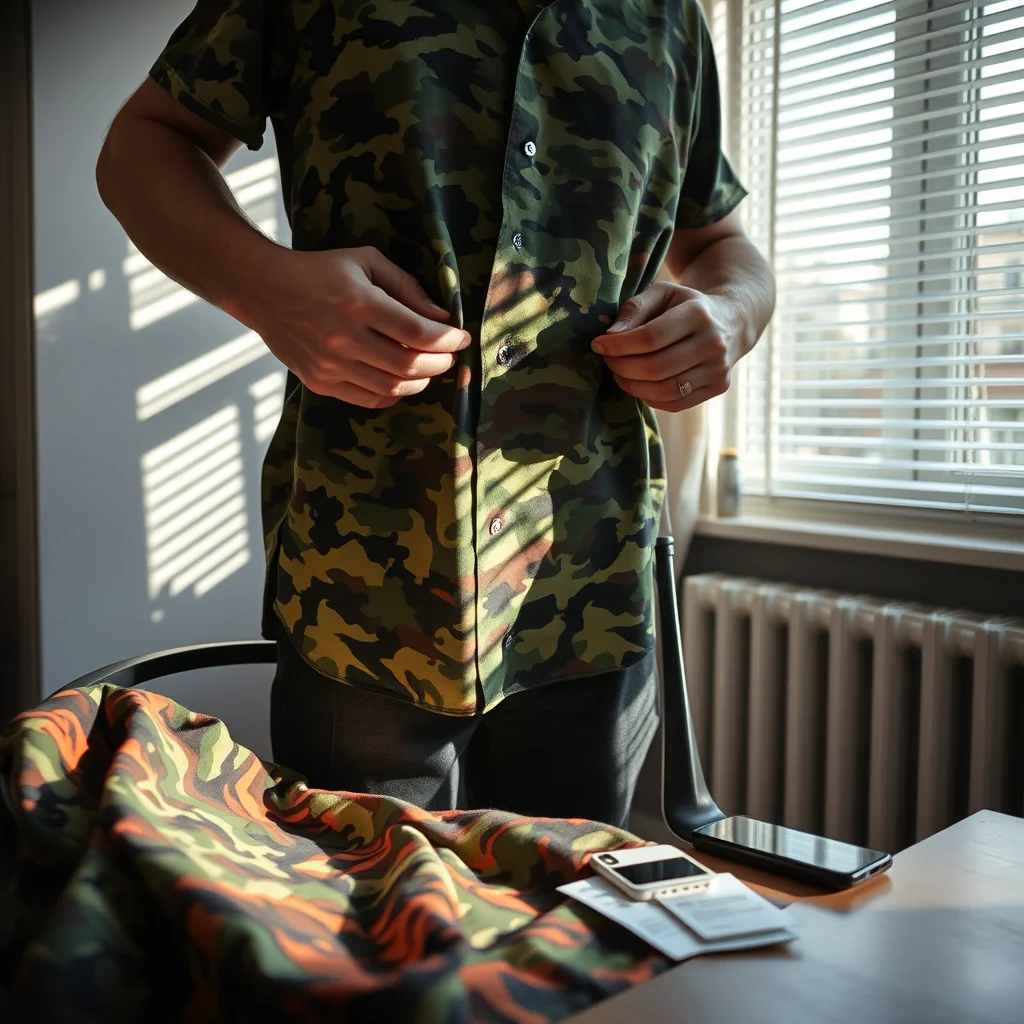
Computer vision does not encounter a person as a person. It encounters pixels, outlines, poses, facial landmarks, clothing, gait and movement patterns. These fragments can be sorted into categories such as pedestrian, loiterer, crowd, anomaly or threat. The system’s authority depends on making those categories appear objective, even though they are designed by institutions, trained on uneven datasets and deployed for particular political purposes.
The danger is not only that an AI system might make a mistake. The deeper problem is that public life becomes structured around the possibility of interpretation. A person who knows they may be tracked behaves differently from a person who understands the street as common ground. The camera does not need to arrest anyone to alter conduct. Its power begins with anticipation.
This is why the shirt matters as design rather than novelty. Architecture and fashion increasingly operate inside computational environments, a shift that raises questions about AI as a design craft rather than merely a spectacle. Buildings are managed by sensors; transport systems identify passengers; retail spaces measure attention; workplaces monitor movement. The surface of the body has become an interface for administrative systems. Clothing, once understood as a social and tactile medium, is now also a potential counter-interface.
Weckert’s intervention follows a lineage of artists and designers who have made surveillance visible by sabotaging its visual assumptions. Adam Harvey’s CV Dazzle proposed makeup and hairstyling strategies that disrupted facial-recognition algorithms through asymmetry, contrast and obstruction. Earlier camouflage experiments, from military dazzle painting to contemporary activist wearables, understood that visibility is never simply optical. It is a contest over what can be recognised, by whom and for what purpose.
Camouflage for the Algorithmic City
Traditional camouflage seeks visual continuity with an environment. Digital Camouflage operates differently. It introduces visual noise into a system that expects stable, human-shaped patterns. The colourful garment reportedly confuses AI video systems by presenting a surface that does not behave like the clothing, skin or silhouette data on which detection models rely.
That strategy is both elegant and unsettling. A shirt has become a low-tech intervention into a high-tech infrastructure. No password is required. No proprietary device must be purchased. The wearer simply enters the street carrying a pattern that says: your database does not have automatic access to me.
Yet the garment should not be mistaken for a universal shield. AI systems change, retrain and combine multiple forms of sensing. A shirt that disrupts one detection model may be ineffective against another. Cameras can still record a wearer even when a software system fails to identify them. There is also a difference between evading detection, avoiding identification and preventing data collection altogether. Digital Camouflage exposes that difference rather than resolving it.
Its weakness is part of its argument. The shirt cannot make surveillance disappear; it makes surveillance perceptible. It asks the public to imagine the invisible processes operating above the pavement. What does a camera think a person is? What does it need to see in order to classify them? Which bodies are treated as suspicious before they have done anything?
In this sense, the shirt belongs to the same speculative design tradition as Dunne & Raby’s critical objects: objects that do not offer seamless solutions but make a political system harder to ignore. It is not a consumer gadget promising total privacy. It is an embodied thought experiment, worn in public.
The Right Not to Be Legible
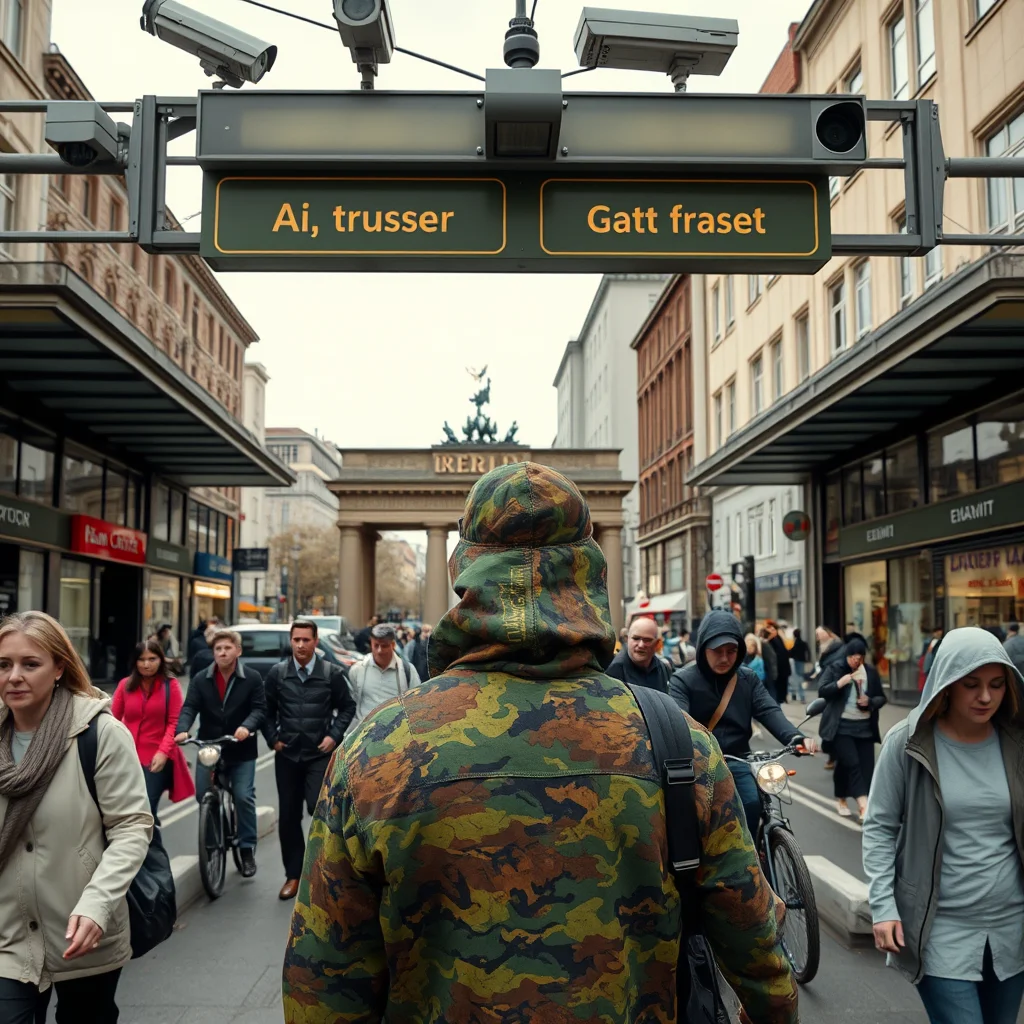
Design culture has spent decades celebrating legibility. Signage should be legible. Interfaces should be intuitive. Cities should be navigable. But legibility becomes coercive when it means that every person must be intelligible to an institution at all times. A city that demands constant recognisability is not necessarily safer; it may simply be more governable.
The right to remain unclassified is not the same as a right to anonymity in every circumstance. Public space has always involved observation, accountability and shared rules. A witness can see a face. A shopkeeper can notice behaviour. A police officer can investigate a specific incident under legal constraints. AI surveillance changes the scale and duration of that observation. It turns fleeting perception into searchable, repeatable and potentially permanent records.
That transformation deserves more than a technical debate about accuracy. Even a highly accurate system can be politically unacceptable if people have not consented to its use, cannot challenge its decisions or do not know how its categories are defined. Accuracy answers the question “does the system recognise?” It does not answer “should the system be recognising?”
Kottbusser Tor therefore becomes a test of urban values, not merely a test of software. If the pilot treats every passer-by as raw material for experimentation, then the burden of adaptation falls on the public. People are expected to modify their routes, faces, clothes and behaviour while the surveillance system remains fixed and unquestioned. Weckert’s shirt changes that geometry. It places the burden back on the machine and the institution operating it.
Fashion as a Public Refusal
Fashion has always negotiated visibility. The uniform makes a person legible as a worker, student, soldier or devotee. The veil can withdraw the face from public interpretation. Punk, drag and subcultural dress turn recognisability into performance, exaggeration or deliberate misdirection. Digital Camouflage extends these tactics into a city where algorithms are among the most powerful spectators.
Its colour is crucial. A dull disguise might be absorbed into the background, but a vivid pattern announces dissent. The garment is not a stealth technology hidden beneath ordinary clothing. It is a wearable sign that says the wearer knows they are being processed. This creates a productive contradiction: to refuse machine vision, the shirt may need to become highly visible to humans.
That contradiction also reveals the limits of individual resistance. Not everyone can afford specialist garments. Not everyone wants to attract attention by wearing one. A public space that requires anti-surveillance fashion for basic privacy has already failed. The responsibility for protecting civil liberties cannot be transferred from governments and technology companies to the wardrobe.
Still, design often begins by making a condition felt. A speculative object can turn an invisible abstraction into a social encounter. The shirt gives form to a question that policy documents tend to bury: who gets to decide when a body becomes data? It makes privacy tactile, colourful and awkwardly public.
Beyond the Shirt
The most important consequence of Digital Camouflage may not be whether it defeats a particular AI model. Its value lies in changing the vocabulary of urban technology. Instead of asking how surveillance can become smoother, more accurate and less noticeable, it asks whether noticeability itself is a democratic requirement.
Architects, planners and technologists should take that challenge seriously. Privacy should be designed into streets, stations and housing estates through restricted data retention, visible signage, independent oversight and meaningful opt-out mechanisms. The same concern appears when considering how data turns a home into a risk object: public space should include zones where people are not continuously assessed. The default should not be that an individual must perform technical resistance to recover an ordinary level of autonomy.
Weckert’s shirt is provocative because it refuses the polite fiction that visibility is harmless. Being seen is not one thing. Being seen by a neighbour, a friend, a journalist or an opaque classification system produces different forms of power. The city must learn to distinguish them.
Digital Camouflage does not promise escape. It offers something more valuable: a visual interruption, a wearable objection and a reminder that machine-readable is not the same as humanly visible. If the future of public space is designed for the camera first, then a shirt may be among the few remaining places where dissent can still move through the street on its own terms.
Get the Mainifesto weekly — curated design debates, speculative ideas and the week's best articles every Saturday.
Editorial Perspectives
Questions and counterpoints developed by the Mainifesto editorial desk to extend the discussion.
Perspective 1
Weckert turns a familiar garment into a glitch in the civic operating system, which is exactly where digital art can be most useful. But the shirt is a provocation, not a solution: if privacy depends on buying and wearing the right object, surveillance has already won.
Perspective 2
The cleverness of the shirt is also its limitation—it treats a structural problem as a surface intervention. From a manufacturing perspective, I’d ask who can afford, maintain, and safely wear this kind of countermeasure, because the burden will not land evenly.
Perspective 3
Public space should guarantee the right to remain unclassified; outsourcing that right to clothing is a policy failure dressed up as innovation. A garment can expose the absurdity of machine vision, but only regulation, procurement rules, and infrastructure standards can change the system.
Perspective 4
The project makes visibility feel like an architectural material, not just a data issue. I’m left wondering whether the real design challenge is to create spaces where opting out is legible and protected, rather than forcing individuals to engineer their own invisibility.