Who Gets to Look at Home in Trafalgar Square?
Who Gets to Look at Home in Trafalgar Square?
A historic square never simply provides a backdrop. It tells us which bodies deserve elevation, which achievements merit permanence and which versions of national identity should appear inevitable. That is why the debate around Tschabalala Self’s Lady in Blue matters beyond the merits of a single sculpture. Defending the work in Dezeen on 30 October 2026, Priya Khanchandani calls it “as fitting a monument to our era as any I can imagine”. Her defence exposes a question that architectural criticism too often disguises as a matter of taste: who gets to look at home here?
There are two serious positions. One holds that new sculpture owes something to the spatial intelligence of its setting. The other insists that the setting’s authority must itself be challenged. Neither deserves a caricature. But “context” cannot be allowed to win an argument merely by sounding professional.
PRO: A Public Square Is More Than an Exhibition Space
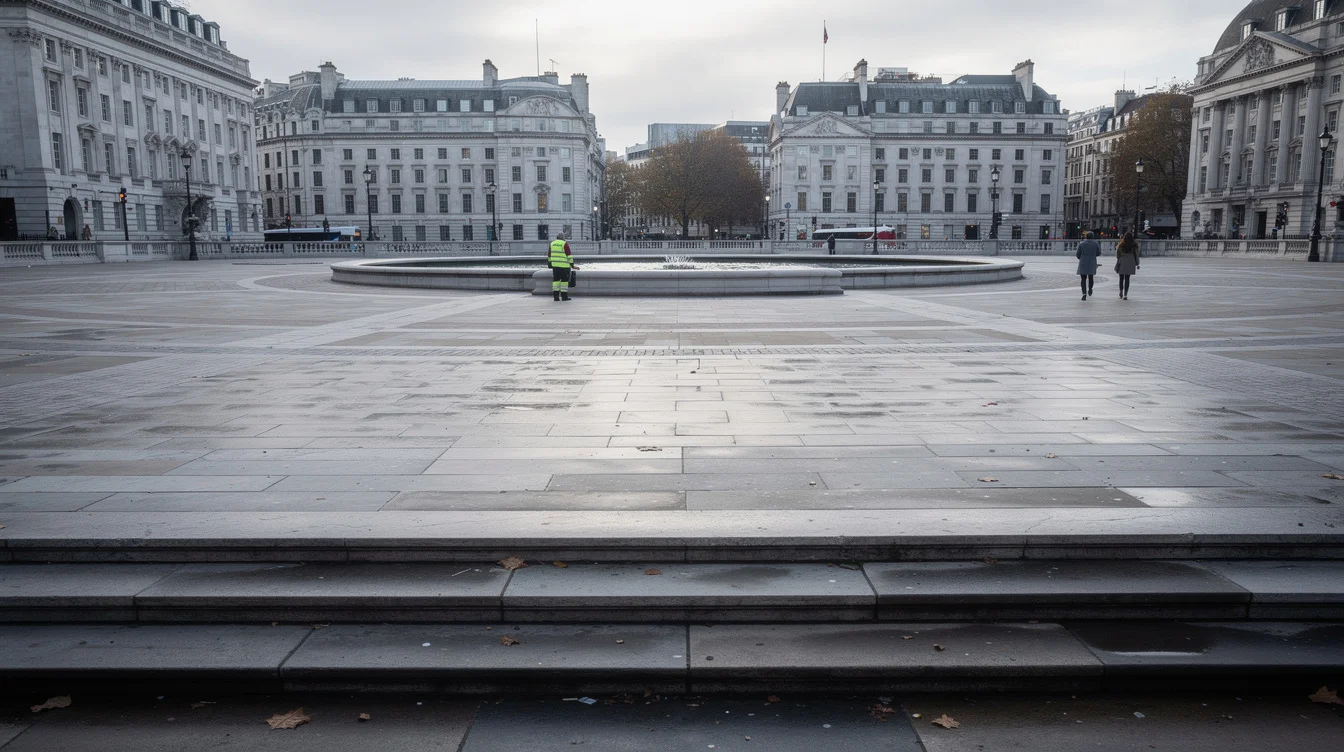
The strongest argument for contextual restraint begins with a public good, not nostalgia. Trafalgar Square is a composed civic environment: stone terraces, fountains, axial views, monumental sculpture and the contrasting architectural presences of a gallery and a church. Its elements establish relationships of scale and distance that visitors experience even without knowing who designed them. A new artwork enters those relationships; it does not arrive on an empty page.
John Nash’s metropolitan planning and Charles Barry’s later work on the square belong to that history of spatial organisation. More recently, the pedestrianisation of the north terrace, delivered in 2003 through a project involving Foster + Partners, changed how people could occupy the space. This was contemporary intervention without treating the inherited setting as disposable. It demonstrates that respecting context need not mean freezing it.
From this perspective, asking whether Lady in Blue works at different distances, holds its own against neighbouring monuments or creates a convincing relationship with its pedestal is entirely legitimate. These are questions of sculptural and urban competence. They should not become unsayable because the work carries representational significance.
Visibility is not automatically public value. A commission that commands attention in a press image may offer less to someone crossing the square daily. Public art must survive weather, repetition, distraction and competing sightlines. Its ambition should include those ordinary encounters, not only its debut as a cultural argument.
PRO: Context Can Be a Design Discipline, Not a Style Police
Contextual thinking becomes useful when it describes relationships rather than demands imitation. Rachel Whiteread’s Monument, installed on the Fourth Plinth in 2001, cast the plinth’s form in transparent resin and inverted it. The work was emphatically contemporary, yet its subject was the support beneath it. Rather than adding another triumphant figure, Whiteread made the apparatus of commemoration visible.
Yinka Shonibare’s Nelson’s Ship in a Bottle, installed in 2010, likewise entered a precise conversation with its surroundings. Its model of HMS Victory connected to Nelson’s Column, while the patterned fabric sails complicated any straightforward account of British identity and imperial circulation. Context here generated critical friction; it did not suppress it.
These projects support a demanding position: artists should be free to contradict a site, but contradiction becomes stronger when it knows what it is contradicting. An unfamiliar figure on a pedestal is not necessarily a searching critique of monumentality. Selection panels should explain why a particular work belongs in this particular location, rather than relying on the prestige of the artist or the urgency of a general theme.
Applied to Self’s work, that standard asks for close attention to form, figure and the meaning of elevation. It also asks commissioning institutions to make their reasoning public. Architectural coherence can protect a shared setting from becoming a sequence of disconnected publicity opportunities. That is a defensible ambition, provided coherence means an intelligible conversation—not compulsory agreement with the square’s existing heroes.
CONTRA: The Existing Monuments Are Not Neutral Context
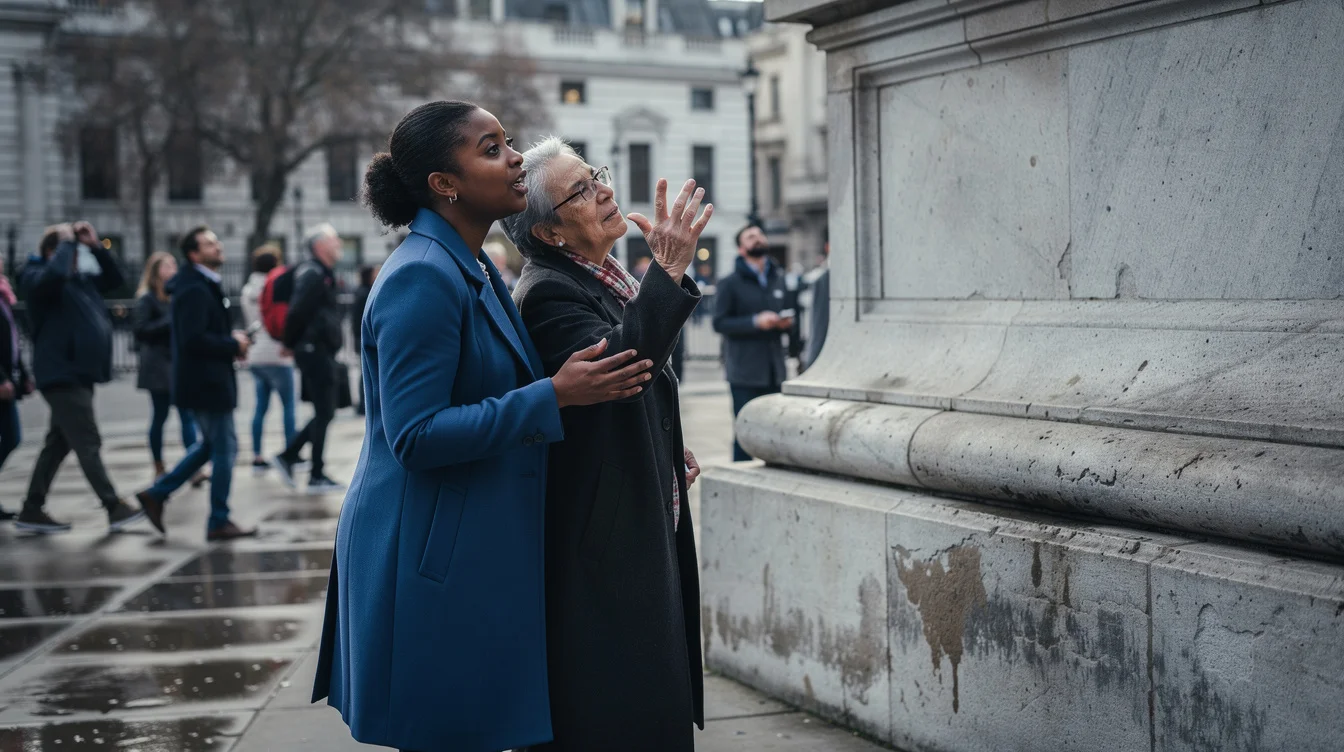
The weakness in the contextual argument appears when inherited choices are treated as natural conditions. Trafalgar Square’s monuments were commissioned to make particular kinds of power visible. Nelson’s Column and the statues of military figures such as Henry Havelock and Charles James Napier do not merely furnish an attractive outdoor room. They organise public memory around martial achievement and imperial authority.
To demand that contemporary sculpture harmonise with that ensemble is therefore never only an aesthetic request. It can also require new subjects to speak in the visual language of the institutions that previously excluded them. A Black female figure such as Lady in Blue unsettles this arrangement without needing to represent a military victory or an office of state. That displacement is not incidental to its public significance.
The burden of explanation is uneven. Existing monuments benefit from familiarity: their politics recede into the category of scenery. A new work must justify its identity, symbolism and appearance all at once. Critics may sincerely discuss proportion or material while overlooking how much accommodation they already extend to inherited objects simply because those objects have been there longer.
Age can make ideology look like architecture. This does not invalidate formal criticism of Self’s sculpture. It does mean that such criticism should apply its standards consistently. If an elevated body must earn its place through civic relevance, the old occupants should face that question too.
CONTRA: A Living Square Needs the Right to Disobey
The Fourth Plinth makes the demand for seamless belonging particularly questionable. Originally intended for an equestrian statue of William IV that was never realised, it became a platform for changing contemporary commissions. Its productive condition is incompletion. To insist that each temporary work settle comfortably into the ensemble risks cancelling the very opportunity the programme creates.
Marc Quinn’s Alison Lapper Pregnant, unveiled in 2005, placed a pregnant disabled artist in monumental marble. Its force came partly from deploying a familiar language of sculptural dignity for a body seldom granted such prominence. Katharina Fritsch’s Hahn/Cock, installed in 2013, used a giant blue cockerel to puncture the square’s prevailing solemnity. Neither needed to disappear politely into the background to make a serious contribution.
Michael Rakowitz’s The Invisible Enemy Should Not Exist, installed in 2018, brought a reconstruction of a destroyed Assyrian lamassu, made using date-syrup cans, into the square’s field of monuments. Its references reached beyond the site’s architectural vocabulary towards destruction, displacement and cultural survival. The square became more intellectually capacious because the work introduced a different frame of reference.
Lady in Blue should be allowed that same possibility: not merely to join an established composition, but to alter the terms by which the composition is understood. A public square is not successful because every element confirms every other. It is successful when competing claims can remain visible without one being dismissed as an intrusion before the encounter begins.
The Brief Should Demand an Argument, Not Obedience
The way forward is not to abandon context, but to stop treating it as a veto. Commissioning briefs should distinguish practical obligations—safe installation, accessible circulation, durable materials and considered sightlines—from judgments about which subjects look appropriate on a pedestal. The first require evidence. The second require scrutiny.
Self’s work need not be declared formally unassailable to defend its presence. Nor should representation serve as a substitute for criticism. The more radical position is to demand both: rigorous attention to sculpture and a willingness to question the inherited distribution of dignity. Trafalgar Square can remain a coherent place without remaining a coherent story about power.
FAQ
What is the central debate around Lady in Blue?
The debate concerns how Tschabalala Self’s sculpture relates to Trafalgar Square’s historic setting. At stake is whether visual contrast weakens a civic ensemble or exposes the narrow range of people and achievements traditionally honoured within it. Architectural fit and political belonging overlap, but they are not the same question.
What is the Fourth Plinth programme?
The Fourth Plinth programme commissions changing contemporary artworks for a previously unoccupied pedestal in Trafalgar Square. Its contemporary commissioning history began in 1999. Because works are temporary, the platform allows different approaches to public sculpture without requiring one permanent answer to what the square should commemorate.
Does respecting architectural context require traditional sculpture?
No. Rachel Whiteread’s Monument and Yinka Shonibare’s Nelson’s Ship in a Bottle demonstrate different ways of responding closely to a site without copying its dominant style. Context can involve scale, historical reference, material contrast or a deliberate challenge to an existing monument.
Can public art be inclusive and still face aesthetic criticism?
It must. Representation does not remove questions about form, execution or the relationship between sculpture and site. But criticism should identify concrete strengths and weaknesses rather than treating unfamiliar subjects as inherently unsuitable. Existing monuments should face equivalent scrutiny instead of receiving automatic approval through age.
If Trafalgar Square belongs to the contemporary public, how much of its inherited visual authority should that public be entitled to overturn?
Get the Mainifesto weekly — curated design debates, speculative ideas and the week's best articles every Saturday.
Editorial Perspectives
Questions and counterpoints developed by the Mainifesto editorial desk to extend the discussion.
Perspective 1
I’m for letting the contemporary public unsettle the square’s inherited authority; keeping the stone needn’t mean keeping its hierarchy. Lady in Blue offers a useful principle for low-impact design: change what a place communicates without assuming you must demolish it first.
Perspective 2
I’m against giving the present a blank cheque to overturn the square’s visual authority: contemporary commissions have gatekeepers too. Curating digital art makes me wary of equating a new image with redistributed power; let Lady in Blue challenge the inherited setting, not make that setting disposable.
Perspective 3
Coherence is not the same as sameness. Lady in Blue can interrupt the square’s visual language without making it illegible; the more revealing question is why some figures read as belonging there before we even consider their form.
Perspective 4
Before calling architectural coherence a public benefit, I’d want to know what it delivers and for whom. Assess the commission’s maintenance, accessibility and how people actually use the space alongside its silhouette; neither visual harmony nor symbolic disruption is enough on its own.
Perspective 5
A public square isn’t a hotel lobby, and protecting a consistent look isn’t its main job. Watch whether people stop, gather and feel comfortable staying around Lady in Blue—not just whether it makes a tidy photograph; that’s a better test of what the commission gives back.