Can a Fake Brand Teach Us to Distrust Fake News?
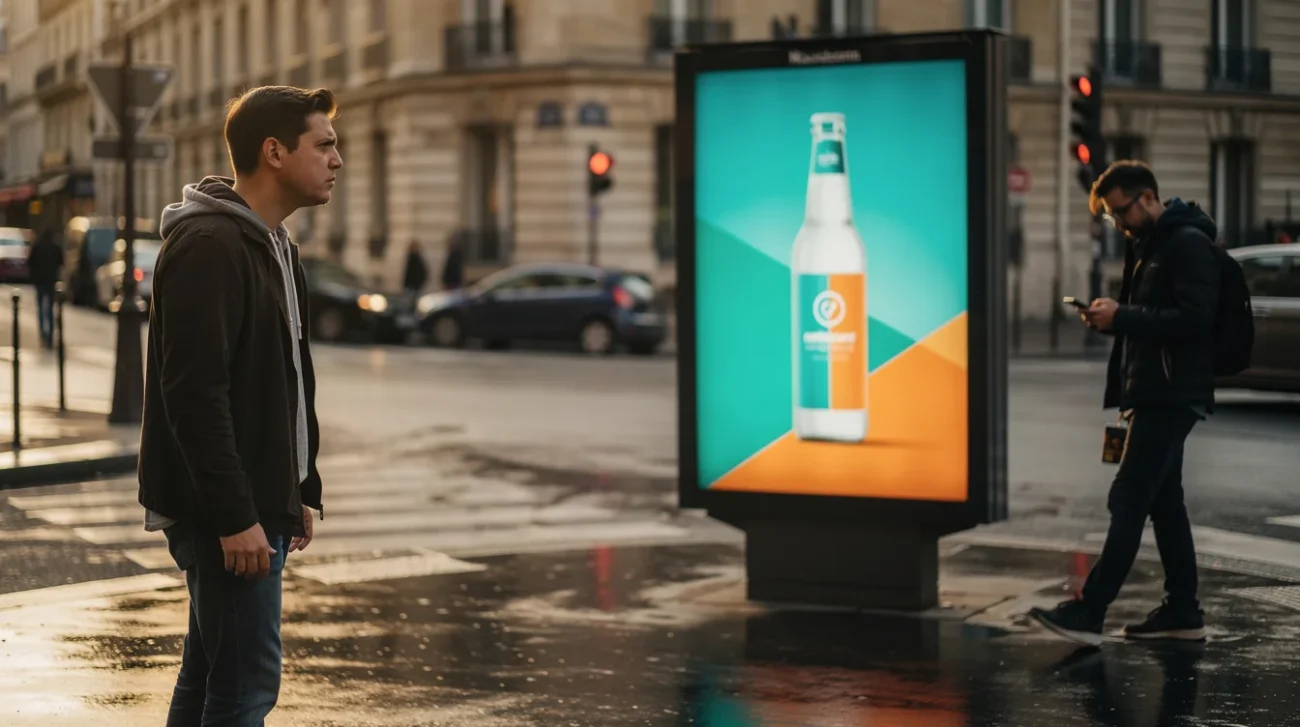
A beverage brand makes a proposition before anyone takes a sip: trust the surface. Typography suggests expertise. Packaging manufactures desirability. Repetition makes an unfamiliar name feel established. Dysturb’s fictional beverage campaign, brought to Paris and New York to encourage media literacy and critical thinking, turns that machinery against itself. The product is invented; the problem it addresses is not.
The provocation is sharp because consumer branding and misinformation share an infrastructure of persuasion. Both can make a claim feel credible before its evidence has been examined. But exposing that resemblance is not automatically educational. The decisive question is whether an encounter with a fabricated drink changes what someone does when the next dubious claim arrives. A successful warning must leave behind a method, not merely a punchline.
PRO: Branding Makes Invisible Persuasion Tangible
Most misinformation education begins with instructions: check the author, inspect the date, question the source. Sensible advice, but easy to forget when a message confirms a fear or arrives from a friend. A fictional consumer product offers a different starting point. It lets audiences encounter the attraction of a credible-looking proposition before asking them to examine it.
For product design, this is fertile territory. A beverage is an unusually legible carrier of manufactured authority. Think of the visual languages surrounding mineral water, energy drinks and functional tonics: clinical restraint, athletic urgency, botanical reassurance. These are real design conventions, not evidence of what Dysturb’s particular campaign looks like. Their relevance is that audiences already understand them, often without noticing that understanding. Debates about design brand dupes and the value of originals raise a related question: how much of a product’s perceived worth resides in recognizable visual signals?
Anthony Dunne and Fiona Raby’s speculative design offers a useful comparison. Their 2013 exhibition United Micro Kingdoms at London’s Design Museum used imagined societies and transport systems to make political choices tangible. Fiction became a device for scrutinizing the present rather than predicting the future.
Dysturb’s premise can work similarly. The invented beverage gives an abstract epistemic problem a recognizable commercial form. Instead of declaring that people are gullible, it can demonstrate that credibility is assembled through familiar design decisions. That distinction matters: people are more likely to examine a mechanism than accept a lecture about their own inadequacy.
PRO: A Controlled Fiction Can Rehearse Resistance

There is also a plausible educational argument for encountering manipulation in a bounded setting. The online game Bad News, developed by DROG with University of Cambridge researchers including Jon Roozenbeek and Sander van der Linden, asks players to adopt the role of misinformation producers. Its premise is that recognizing manipulation techniques can help people resist them later. Research on such interventions supports the promise of this approach, although lasting, real-world transfer remains a harder test than immediate improvement.
A fictional beverage is not the same intervention, and those findings cannot simply be assigned to Dysturb. Nevertheless, the comparison identifies a productive ambition: teach the construction of persuasion, not just the falsity of one claim.
The strongest extension would connect the reveal to a small, repeatable action. Imagine a participant encountering an apparently authoritative product claim, then being invited to identify its source, leave the branded environment and seek independent corroboration. This is a proposed learning sequence, not a description of documented campaign features.
Such an encounter could introduce lateral reading, a practice studied by Sam Wineburg and colleagues at Stanford: checking what other sources say about a website or organization rather than remaining inside its self-presentation. The fake drink would then serve as a rehearsal space. Its educational value would lie in making verification feel achievable, immediate and relevant to an ordinary encounter with design.
CONTRA: The Fiction May Travel Further Than the Correction
The same properties that make the campaign attractive also make it unstable. Advertising is designed to survive distracted attention. A striking product image can circulate without its explanation, be photographed at a distance or appear as a cropped social post. A fictional brand can therefore become memorable while the reason for inventing it disappears. This is a distribution risk, not a documented outcome of Dysturb’s campaign.
Culture jamming has long inhabited this contradiction. In 2004, a member of The Yes Men appeared on BBC World as a purported Dow Chemical representative and announced a false commitment to compensate victims of the Bhopal disaster. The intervention exposed corporate responsibility by temporarily borrowing corporate authority. But its ethical force cannot erase the fact that an invented announcement offered real people a reason to hope.
A fictional beverage is a different, generally lower-stakes proposition. Still, the underlying design dilemma persists: the correction does not necessarily reach everyone who encounters the original fiction. An image travels according to attention; an explanation travels according to patience.
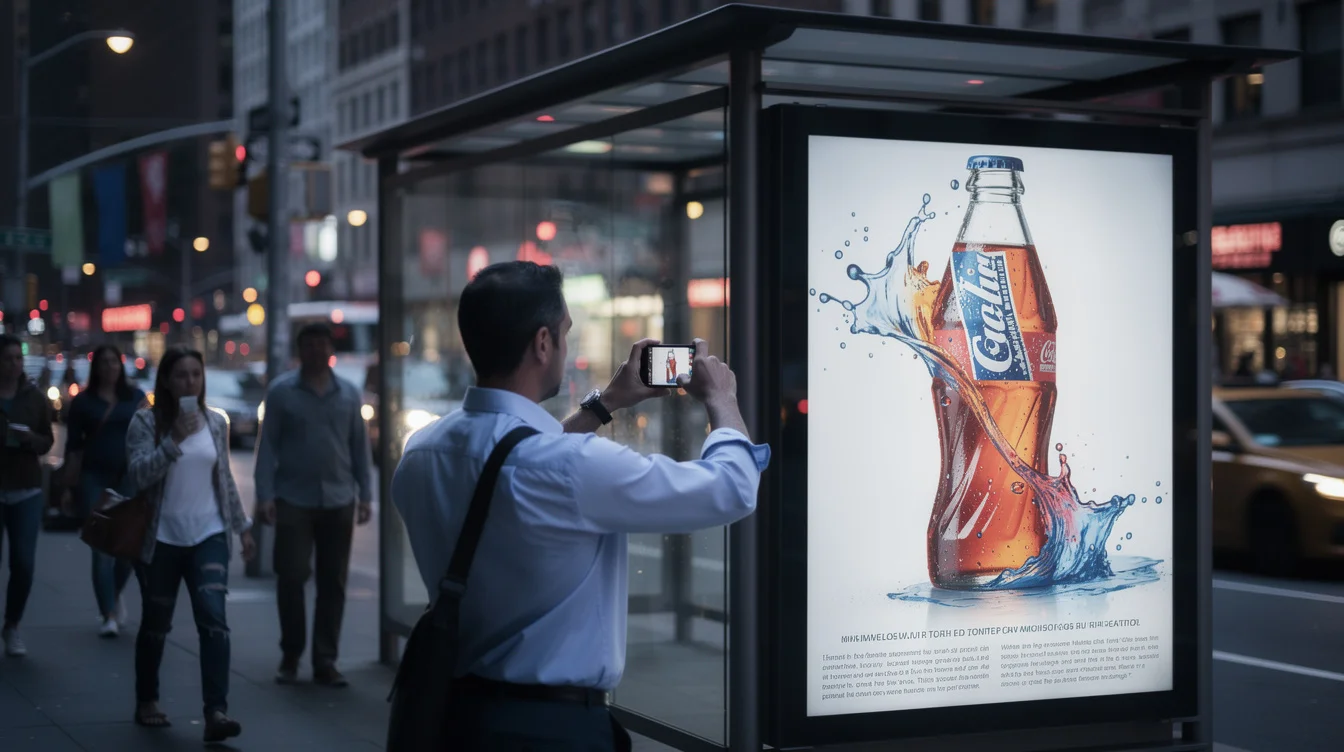
The challenge is especially acute when an intervention occupies the visual territory of advertising. A passerby may correctly classify it as another commercial interruption and move on. Another may remember only the product. Neither response demonstrates a failure of intelligence. Both are predictable encounters with a crowded information environment. A campaign cannot assume that its intended sequence will be everyone’s actual experience.
CONTRA: Suspicion Is Not the Same as Verification
The deeper danger is teaching the wrong lesson. “Professional-looking things can be false” is useful. “Nothing deserves belief” is corrosive. Misinformation thrives not only on misplaced trust but also on indiscriminate distrust, which allows documented reporting and unsupported assertions to appear equally compromised. A fake brand that merely punctures confidence could accidentally strengthen that flattening.
Ken Garland’s 1964 First Things First manifesto challenged designers to redirect their skills beyond the promotion of consumer goods. Dysturb’s premise creates a contemporary twist: use consumer promotion’s tools to question persuasion itself. But an ethical intention does not settle the effectiveness of the interface. Socially ambitious design still has to account for what people actually learn.
A serious evaluation would therefore go beyond recall, impressions or enthusiasm. Could participants distinguish a well-supported report from a polished fabrication several weeks later? Would they investigate an unfamiliar source without prompting? Could they explain what evidence would change their minds? Those outcomes would show more than remembering that one beverage was imaginary. The related question of whether evidence disappears when data becomes a pattern underscores the distinction between making information visually compelling and keeping it open to scrutiny.
The available source context establishes the campaign’s media-literacy ambition and its arrival in Paris and New York, not demonstrated learning outcomes. Dysturb’s wager deserves attention, but manufactured credibility is not its own antidote. The design becomes educational only when its reveal opens onto independent checking. Otherwise, it risks producing an elegant souvenir of skepticism: memorable, shareable and insufficient when the next persuasive falsehood arrives.
FAQ
What is Dysturb’s fictional beverage campaign?
It is a campaign using an invented drink to encourage media literacy and critical thinking about misinformation. The source coverage places it in Paris and New York. Its central design move is to recruit the persuasive language of consumer branding for a warning about credibility.
Can a fake brand improve media literacy?
Potentially, if the fiction leads to explicit, repeatable verification practices. Recognizing one fabricated product does not establish that someone will question an unrelated false claim. That transfer needs evaluation rather than assumption.
What should audiences do beyond questioning appearances?
Identify who is making the claim, investigate that source elsewhere and seek independent corroboration. Where possible, follow the claim back to its original evidence. Several outlets repeating the same unsupported statement do not constitute several independent confirmations.
How should designers assess a campaign like this?
Measure whether audiences understand the reveal and subsequently verify unfamiliar claims, not just whether they remember the brand. Test delayed learning, cropped images and encounters without explanatory context. The intervention should reward inquiry rather than embarrass people for believing it.
When design borrows deception to teach distrust, what must it give audiences beyond the pleasure of discovering the trick?
Get the Mainifesto weekly — curated design debates, speculative ideas and the week's best articles every Saturday.
Editorial Perspectives
Questions and counterpoints developed by the Mainifesto editorial desk to extend the discussion.
Perspective 1
I’m for the fake drink: packaging can make you feel how quickly a polished surface becomes a claim you trust. But I’d treat it like a prototype, not a finished product—give people a source-checking routine, then test whether they use it weeks later.
Perspective 2
I’m not convinced another seductive brand is the right way to teach skepticism; it rehearses the same attention-hungry logic it wants us to resist. I’d rather see that effort go into a modest, reusable verification tool, with evidence that it helps people judge claims more accurately.
Perspective 3
The reveal should explain which details made the drink feel credible: the typography, the label language, the familiar category cues. Those signals don’t carry the same authority everywhere, and understanding them is more useful than simply learning that designers can fool you.
Perspective 4
In restoration, a convincing façade tells you very little about what’s holding a building up. The campaign needs to show how to trace a claim back to its supports—and distinguish a repaired mistake from a deliberate fraud—or it leaves everyone admiring the demolition of trust.