
Design Brand Dupes: What Is the Original Worth?

When Design Brands Undercut Themselves, What Is the Original Worth?
A recognisable lamp appears in a beautifully staged living room. Within seconds, the comments supply its cheaper double. The design brand offers authorship, provenance and an account of painstaking development; the algorithm offers the same outline for less. As Dwell reports, home goods retailers are finding new ways to compete with low-price, low-quality knockoffs circulating on social media. But when the original brand enters that price war with a cheaper alternative, the argument becomes uncomfortable: what, exactly, was the customer paying for before?
There are two serious answers. An accessible version can strip away unnecessary expense while preserving useful design intelligence. Or it can strip away the intelligence and preserve only the photograph. The difference is not whether the cheaper product looks right. It is whether it still works right—and whether the brand tells us what changed.
PRO: A Lower Price Can Fulfil the Original Promise
Design culture has a selective memory about affordability. It celebrates industrial production as a democratic breakthrough, then treats the resulting objects as evidence of superior taste. Charles and Ray Eames developed moulded plywood and fibreglass seating through sustained experiments with materials and manufacturing. Their importance was not simply that they created memorable shapes. They explored how industrial processes could deliver useful, repeatable objects. That history does not dictate today’s retail prices, but it makes the claim that accessibility inherently devalues design look absurd.
A brand-led, lower-priced range can recover that ambition. Standardising dimensions, reducing colour options, simplifying packaging or selling fewer configurations can cut expense without weakening the object. A dining table offered in three sizes instead of fifteen may lose customisation while retaining stable joints, a durable surface and sensible proportions. The customer receives less choice, not necessarily less quality.
IKEA’s Democratic Design framework explicitly brings price into the same conversation as form, function, quality and sustainability. Whatever the uneven results across its enormous catalogue, the principle matters: cost is a design constraint, not something the marketing department addresses after the desirable object has been perfected. Its move into a second-hand marketplace raises a related question: whether affordability extends product use or merely encourages more buying.
These are precedents for accessible design, not evidence that particular historical products were launched against viral dupes. They establish a more useful standard for today’s response: make the economics smarter before making the object worse.
PRO: Redesign the System, Not Just the Price Tag
Jasper Morrison’s Air-Chair for Magis provides a concrete reminder that manufacturing ingenuity can be the design. Its gas-assisted injection-moulding process produces a lightweight plastic chair with hollow structural sections. The material is not an apology for an absent luxury version. Process, geometry and performance belong to the same proposition. A brand responding to cheaper competitors should aspire to this kind of integration rather than imitate its own premium collection badly.
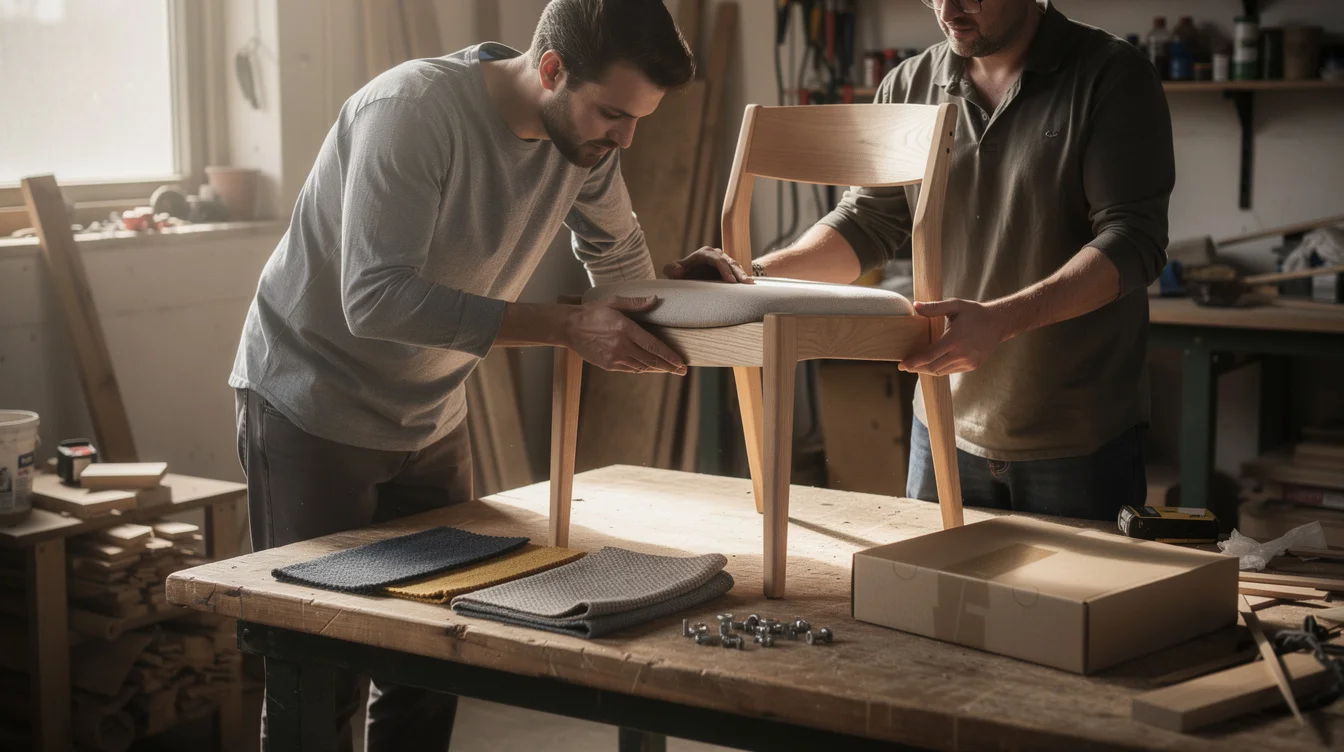
Consider a hypothetical upholstered dining chair. An accessible edition might use a standardised frame, one hard-wearing upholstery fabric and a removable seat pad. Eliminating bespoke upholstery and complicated assembly could reduce cost while making maintenance easier. That is a genuine gain if the chair remains comfortable and structurally sound. Replacing its joints with unreliable fixings while retaining the fashionable backrest curve is not.
There is also a credible authorship argument. An authorised affordable edition can keep the designer involved in decisions that an unauthorised copyist makes without consultation. Where licensing arrangements provide for it, sales can support the designer or rights holder rather than merely extract value from recognition.
The strongest version of this strategy broadens participation without demanding that every household buy an heirloom. A first apartment needs usable furniture now. Insisting that its occupants save indefinitely for the definitive edition confuses design appreciation with purchasing power. An original deserves protection from copying, but it does not deserve immunity from the question of whether its price could be lower.
CONTRA: The Silhouette Can Become an Alibi
The opposing case starts where the product image stops. Social media is unusually effective at comparing outlines and unusually poor at comparing construction. Foam resilience, frame rigidity, finish adhesion and spare-part availability rarely survive the transition into a thumbnail. If a brand launches its own cheaper lookalike without explaining these differences, it validates the knockoff economy’s central proposition: the visible resemblance is the value.
Marcel Breuer’s Cesca chair makes the problem legible. Designed in 1928, its cantilevered tubular-steel structure is not merely a graphic line beneath a cane seat. Tube specification, bends, connections and seat construction affect how the chair flexes and survives use. Two chairs can read almost identically across a room while behaving differently beneath a moving body. The photograph cannot settle the comparison.
Michel Ducaroy’s Togo seating for Ligne Roset, introduced in 1973, offers another example. Its low, crumpled profile is highly recognisable, but the all-foam construction makes the internal material specification fundamental to the sitting experience. Matching the folds does not establish equivalent support or resistance to permanent deformation. Nor does a high price, by itself, prove superior performance; both versions require evidence.
When a brand retains the signature shape but quietly reduces the substance, it is not democratising the original. It is selling recognition in a thinner package. The damage extends beyond one product: customers learn to distrust every future explanation of why design costs more.
CONTRA: An Entry Price Can Conceal an Exit Cost
The premium-versus-budget distinction is also too crude about materials. Solid timber is not automatically virtuous, and veneer is not automatically a swindle. Well-made veneer over a suitable substrate can use valuable timber efficiently and provide dimensional stability. Cheap solid wood can split or warp. The useful questions concern thickness, substrate, edges, joinery, finish and repair—not whether a product description contains a prestige noun.
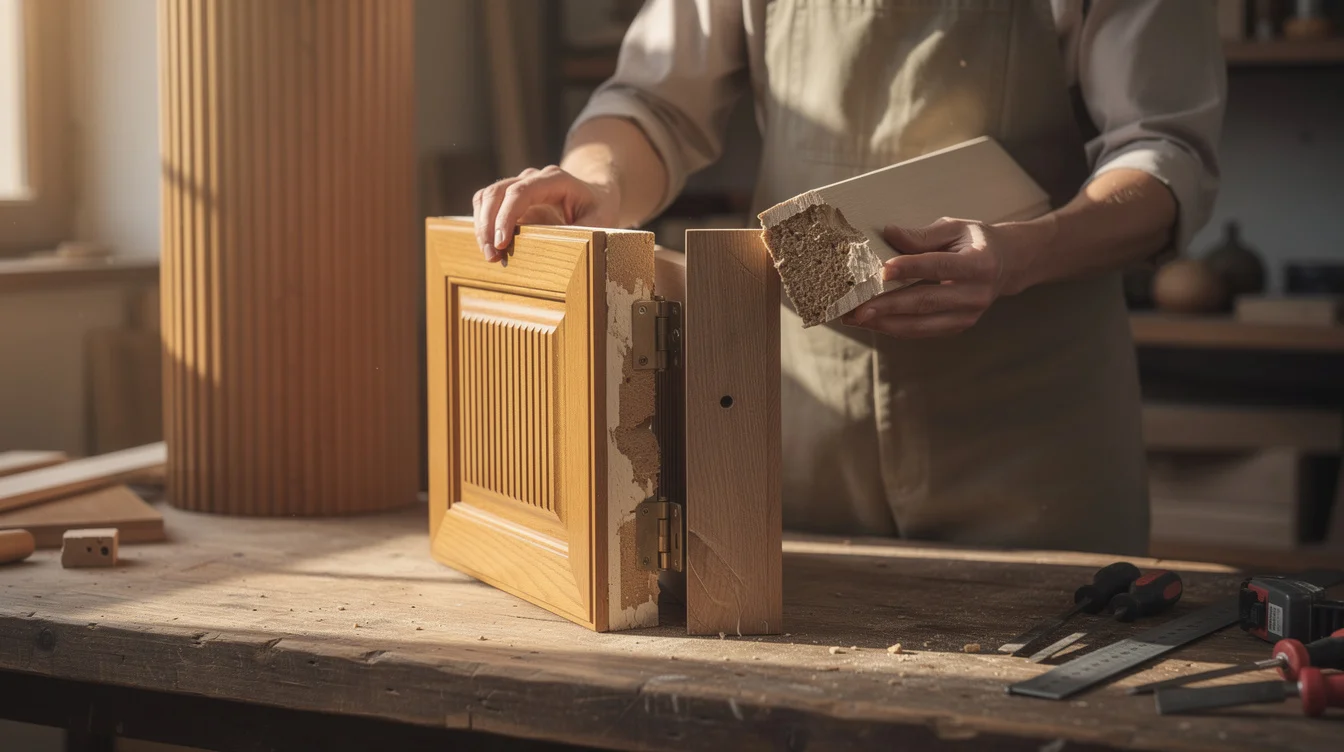
This is precisely why undisclosed substitution is so corrosive. A lower-priced cabinet may preserve its fluted frontage while adopting vulnerable edges, weaker hardware and a back that contributes less rigidity. It can photograph like its expensive sibling and fail differently after moving house. The apparent saving then transfers expense into replacement, repair or disposal.
Dieter Rams’s 606 Universal Shelving System for Vitsœ offers a counterpoint: an object understood through adaptation and continued use, not just its first installation. That approach is no guarantee that every expensive system represents good value. It does expose what a silhouette-only comparison leaves out: whether components remain available and whether the purchase can accommodate a changing life.
A cheaper sibling can also function as a marketing ladder, making the premium version appear more desirable while drawing budget-conscious shoppers into the brand. Access should therefore be judged by outcomes, not intentions. Publish the differences in construction, warranty, repair provision and relevant testing. If the accessible edition is genuinely better value, transparency strengthens its case. If transparency threatens the sale, the strategy deserves suspicion.
FAQ: Judging the Cheaper Original
Is an affordable edition from the original brand the same as a dupe?
No. An authorised edition can retain designer involvement, legitimate licensing and brand accountability. But authorisation does not establish equivalent quality. Buyers still need to know what has changed in the materials, construction and aftercare.
How can shoppers distinguish real affordability from cost-cutting?
Ask where the saving comes from. Fewer finishes, standardised parts and simpler distribution differ from weaker joints or non-replaceable components. Compare specifications, inspect a sample where possible and request relevant test information. A familiar outline is not a performance certificate.
Are cheaper materials always less durable?
No. Suitability and execution matter more than material prestige. Engineered wood, plastics and synthetic fabrics can perform well in appropriate applications. Assess the complete construction and likely conditions of use rather than treating natural materials as automatic proof of quality.
What would a responsible lower-priced collection disclose?
It would explain major material and construction differences, identify what can be repaired, and state warranty terms and spare-part availability. Where longevity claims are made, it should provide supporting evidence. The buyer should understand the compromise before paying, not discover it after failure.
If a brand can deliver its signature silhouette for less, what must survive beyond the outline for the original to remain worth paying for?
Watch the Mainifesto Short
Get the Mainifesto weekly — curated design debates, speculative ideas and the week's best articles every Saturday.
Editorial Perspectives
Questions and counterpoints developed by the Mainifesto editorial desk to extend the discussion.
Perspective 1
I’m for brands making their own more affordable versions: a silhouette circulating everywhere shouldn’t mean only a few people get to live with it. But the original needs to offer something a screen can’t communicate—better materials, thoughtful construction, real aftercare—not just the prestige of having posted it first.
Perspective 2
I’m against treating cheaper spin-offs as democratisation when they just feed the same replacement cycle at a lower price. Make the original repairable, publish its expected lifespan and build a resale route; otherwise, the budget version makes that premium look suspiciously like markup.
Perspective 3
A photograph can make two cups look identical; your lip, your hand and a year of washing will tell you otherwise. If the original deserves its price, the difference should live in those encounters—not in whether someone across the room recognises it.