
Drone Reforestation: Seeds Are Not a Forest
Planting Millions of Seeds Is Not the Same as Restoring a Forest
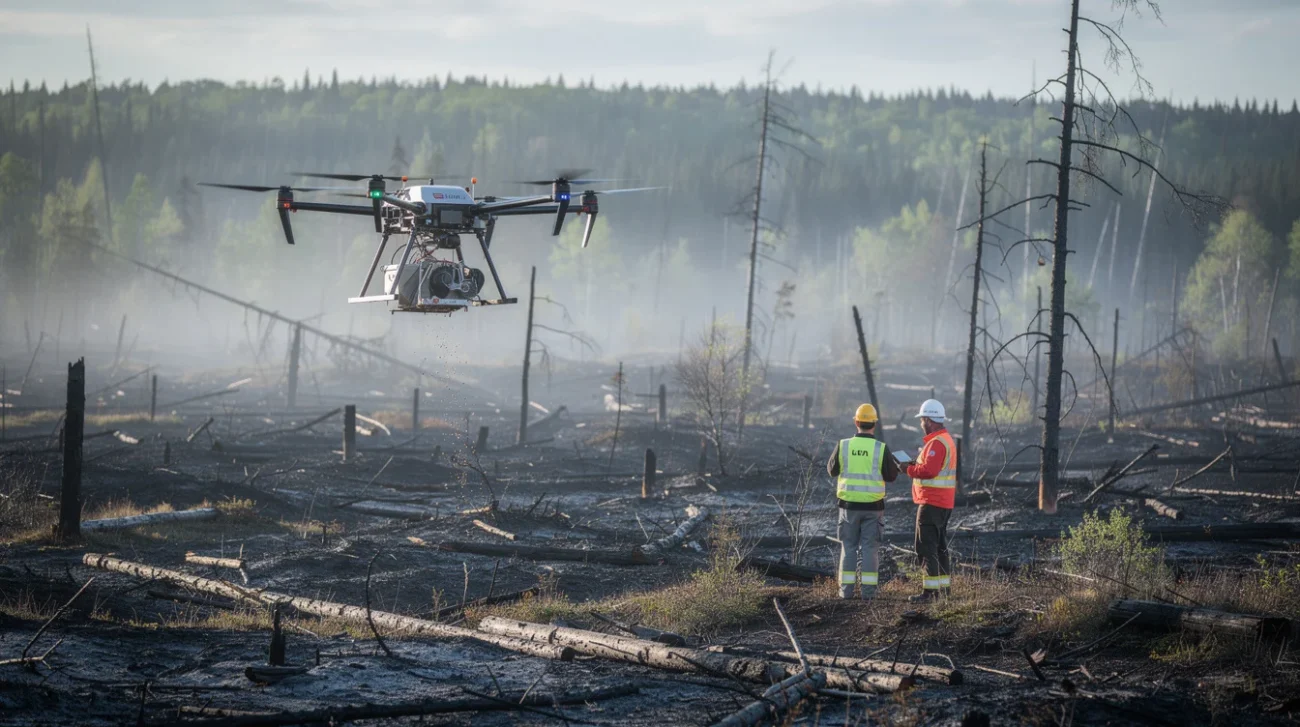
A drone crossing a burned landscape delivers an irresistible image of technological repair: the machine that arrives after catastrophe, carrying life instead of destruction. Flash Forest’s work in northern Quebec, described by designboom, gives that image a tangible mechanism. Drones disperse biodegradable capsules containing native seeds and beneficial fungi across wildfire-damaged terrain. The promise is speed, reach and intervention at a scale that exhausted planting crews cannot easily match.
But the headline unit—millions of seeds—is also the problem. It measures deployment, not recovery. A seed is an input; a forest is a relationship that survives. The strongest case for drone reforestation deserves serious attention. So does the possibility that its most marketable achievement is the least meaningful ecological metric.
PRO: Speed Can Serve Ecology, Not Just Publicity
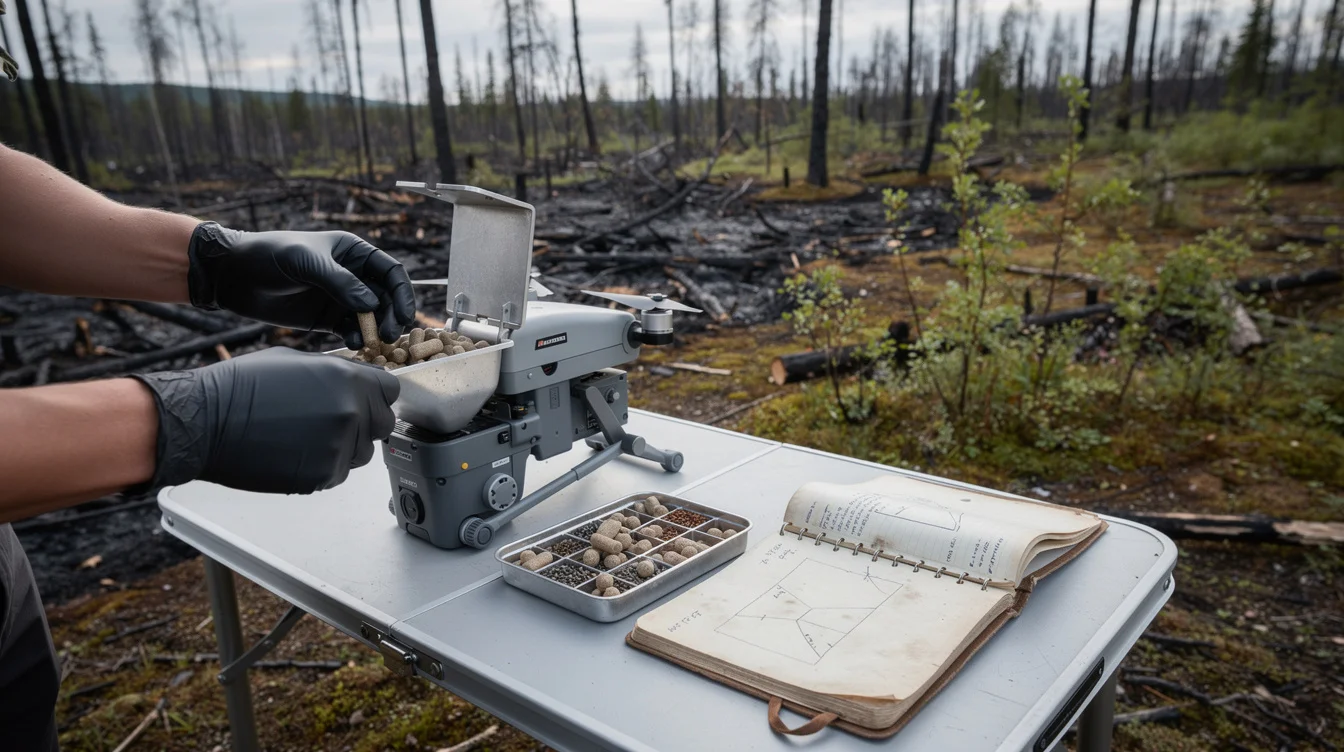
The case for automation begins with geography. Burned boreal landscapes can be remote, difficult to traverse and hazardous for crews working among unstable standing trees. Aircraft do not remove every operational constraint, but they can reach ground that would take people considerable time and effort to access. Where assessment identifies insufficient natural regeneration, that reach can make intervention feasible rather than merely cheaper.
Timing matters, too. Seeds need suitable moisture, temperature and contact with a receptive seedbed. A drone fleet capable of covering dispersed sites during a favorable operational window could support those requirements. Speed is useful when it answers ecological timing, not when it simply satisfies an annual deployment target.
Flash Forest’s capsule approach also recognizes that dropping bare seeds is not the whole task. Biodegradable packaging and fungal additions attempt to address the conditions surrounding germination. Their effectiveness will depend on formulation, species and site, but the design ambition is legitimate: engineer the delivery system around a living organism’s needs. Automation is not inherently anti-ecological. Indifference to context is.
PRO: Precision Could Replace the Plantation Grid
The most interesting future for drone reforestation is not a faster version of uniform planting. It is selective intervention. A burned site contains different slopes, moisture regimes, surviving vegetation and levels of fire severity. Some patches may regenerate abundantly; others may lack nearby seed sources. Treating that mosaic as one empty surface is poor design, regardless of whether the planting tool is a shovel or an aircraft.
Satellite programs such as Landsat and Copernicus Sentinel-2 can help characterize disturbance and subsequent vegetation change. Combined with field surveys and finer-resolution mapping, such information can guide where seeding deserves a trial and where leaving the ground alone is preferable. These are available assessment tools, not proof that Flash Forest uses every component of this workflow.
The opportunity resembles landscape architecture more than industrial broadcasting: read the site before specifying the intervention. The Restoration Opportunities Assessment Methodology, developed by IUCN and the World Resources Institute, similarly treats restoration as a landscape decision rather than a universal planting prescription. Drones could become one implement within that larger intelligence, delivering different treatments to different places instead of imposing a single pattern.
PRO: Machines Can Extend Human Work
The lazy opposition is drones versus people. A better division of labor assigns machines repetitive deployment while reserving human expertise for ecological diagnosis, seed sourcing, ground verification and long-term care. As with the human work behind household robots, the people supporting automation should remain visible. Foresters and restoration practitioners should not have to prove their commitment by doing every physically demanding task manually. Mechanization can be a practical ally.
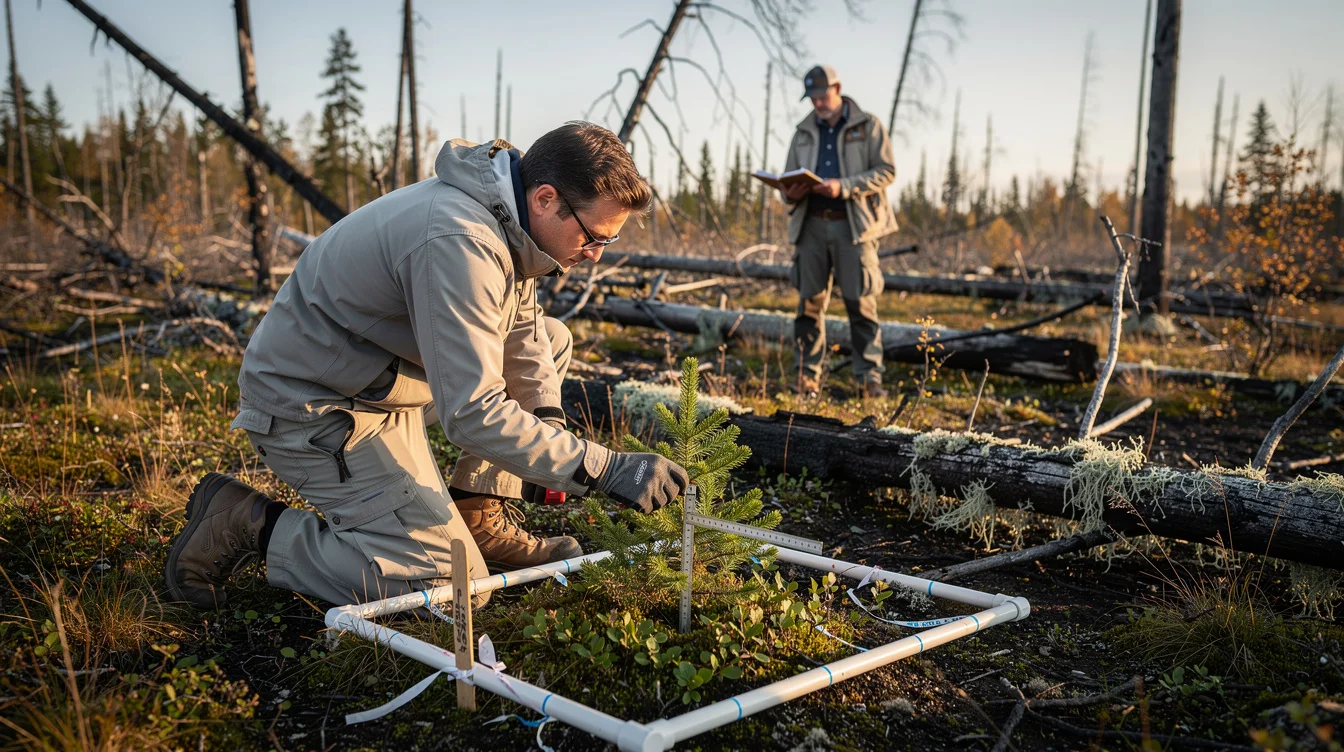
It could also make comparative experimentation easier. A restoration program might establish replicated plots with different native seed mixtures, capsule treatments and deployment densities, alongside untreated controls and conventionally planted seedlings. Tracking the results would reveal where aerial seeding earns its place. This is a proposed standard of practice, not a claim about published outcomes from the Quebec operation.
The capsule itself is a useful design proposition: a temporary manufactured object intended to disappear while supporting a longer-lived system. That reverses the familiar product economy, in which durable waste outlasts short-term utility. If trials demonstrate ecological benefit, drone deployment could help scale it. The defensible ambition is not to automate the forest. It is to automate a limited task well enough that skilled people can concentrate on everything the machine cannot do.
CONTRA: Deployment Numbers Disguise the Hard Part
Millions of seeds can produce a powerful press release and a disappointing stand of trees. Between dispersal and establishment lie predation, drought, unsuitable temperatures, competition and failure to reach a viable germination site. A capsule may improve some conditions without overcoming the others. Calling its fungal contents beneficial does not establish that every fungal association will work for every host or soil.
The relevant denominator is therefore not just seeds released. It includes viable seeds deployed, seedlings established and trees surviving across clearly defined monitoring periods. Results should be reported by species, site condition and treatment, with uncertainty visible. A low-cost deployment can become an expensive restoration method if repeated failure demands repeated intervention.
The Society for Ecological Restoration’s international standards offer a more demanding frame: recovery involves ecosystem attributes, not simply the presence of planted vegetation. For Flash Forest and its competitors, the credible scoreboard would include survival through multiple growing seasons, recruitment beyond the initial sowing and comparisons with untreated sites. Without a baseline, a company risks claiming credit for recovery that the forest would have achieved without its aircraft.
CONTRA: A Burned Forest Is Not a Blank Site
Fire is not automatically an ecological failure. In boreal systems, it has long shaped renewal, habitat and species composition. Black spruce can retain seeds in cones that release them following fire; jack pine’s serotinous cones are another familiar fire-related adaptation. These mechanisms do not guarantee recovery after every burn, especially when severe or repeated fires interact with a changing climate. They do mean that blackened ground should not automatically trigger a planting contract.
Deadwood, surviving trees, unburned refuges, soil organisms and emerging understory vegetation are part of the recovery system. An intervention that counts only future canopy trees can overlook the very structures that make a forest more than a timber inventory. Native status alone is insufficient: seed provenance, species proportions and suitability under future conditions also matter.
The same caution applies to importing celebrated design recipes. Akira Miyawaki’s dense planting approach has influenced urban forest projects worldwide, but its visibility does not make dense planting a universal prescription for northern Quebec. Neither a fashionable method nor an advanced machine substitutes for site-specific ecology. The first restoration decision may be to protect natural regeneration and do less.
CONTRA: Resilience Takes Longer Than a Funding Cycle
A forest that survives its first summers has not necessarily recovered its capacity to withstand disturbance. Resilience includes what happens after another fire: whether seed sources remain, whether species can regenerate and whether soils and hydrology still support recovery. No responsible restoration program can promise fireproof landscapes. It can investigate whether its interventions improve the prospects of persistence or renewal.
That investigation requires more than canopy greenness. Satellite imagery can detect vegetation recovery without fully revealing which species are present or whether planted seedlings survived. Field plots should assess species composition, structural development and recruitment. Monitoring intervals might include years one, three, five and ten, with longer commitments where possible. Those intervals are proposed accountability checkpoints, not a timetable for declaring a boreal forest finished.
Governance belongs inside this assessment. In northern Quebec, restoration decisions should involve the affected Indigenous Nations and communities, whose priorities may extend beyond tree cover to habitat, access and culturally important species. Contracts should fund stewardship and verification, not just flights. The scale differs from a home, but the responsibility question echoes that of smart homes that still need someone to run them: who remains accountable after the technology arrives? Drones can be excellent delivery infrastructure. They become a dangerous substitute for restoration when the invoice closes before the ecological questions even open.
FAQ: What Should Drone Reforestation Have to Prove?
How does Flash Forest’s drone reforestation work?
As described in designboom’s report, drones disperse biodegradable capsules containing native seeds and beneficial fungi across wildfire-damaged landscapes in northern Quebec. Delivery is the intervention; successful establishment and ecological recovery still require assessment over time.
Are drones better than planting seedlings by hand?
Not universally. Drones can offer reach and rapid deployment, while nursery-grown seedlings begin at a different developmental stage and can be placed individually. Comparisons should measure cost per established tree and ecological outcomes under comparable site conditions.
Why not reseed every burned forest?
Many burned forests regenerate naturally, and fire can support important ecological processes. Surveys should identify where regeneration is genuinely limited before adding seeds. Unnecessary intervention can waste resources and complicate evaluation of natural recovery.
Which measures matter more than seeds dispersed?
Priorities include multi-year survival, species diversity, appropriate provenance, natural recruitment, habitat development and the capacity to recover after further disturbance. Monitoring should compare treated and untreated areas and include locally defined ecological and cultural goals.
If restoration funding rewarded a forest’s condition ten years later rather than the number of seeds deployed today, how differently would we design the machines—and the institutions behind them?
Watch the Mainifesto Short
Get the Mainifesto weekly — curated design debates, speculative ideas and the week's best articles every Saturday.
Editorial Perspectives
Questions and counterpoints developed by the Mainifesto editorial desk to extend the discussion.
Perspective 1
I’m for drones as restoration tools, but the spectacular aerial footage isn’t evidence of a forest. A ten-year funding horizon could push the technology toward something genuinely exciting: machines that help local stewards see what’s surviving and respond, rather than just stage a bigger seed drop.
Perspective 2
I’m against drone-first restoration: it makes procurement look like progress while land rights, grazing pressure and long-term care remain unresolved. Pay for forest condition after ten years, yes—but fund local institutions upfront, or only firms with deep pockets will survive long enough to collect.
Perspective 3
A ten-year target changes the product brief: seed placement, species flexibility and repairability start to matter more than payload alone. I’d want survival data by species and site before scaling production; otherwise we’re manufacturing the same mistake faster.
Perspective 4
Could the flight plan become a revisable ecological model, using field surveys to adjust where and what gets planted? I’d also question the ten-year snapshot: are we designing for a forest that passes an inspection, or one that can regenerate without our machines?