
The Human Behind the Household Robot
The Human Behind the Household Robot
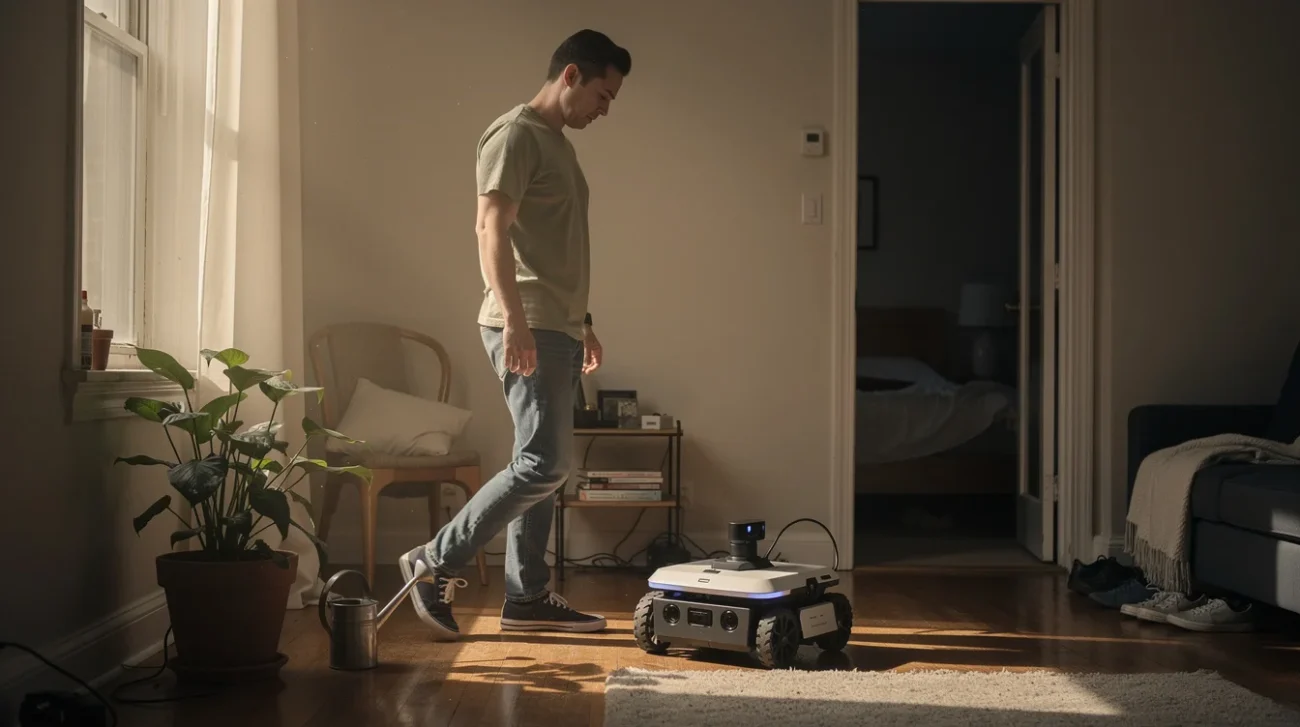
The most consequential feature of a household robot may be the person you cannot see. According to Dezeen’s October 22 report, New York technology company Tuesday Labs has debuted Voxel Series-1, a semi-autonomous robot that combines autonomous intelligence with teleoperation to perform chores including watering plants and sweeping crumbs. Its deliberately non-humanoid appearance sidesteps one familiar design argument. The more urgent argument concerns the threshold: when does buying an appliance become admitting a remotely mediated service into domestic life?
The supplied reporting does not establish Voxel’s detailed permissions, operator arrangements or data practices. What follows is a design brief for this emerging category, not a claim about undisclosed product features. Its central demand is simple: human involvement must be an interface state, not a contractual footnote.
PRO: Human Help Can Make Automation More Honest
There is a persuasive case for keeping people in the loop. Homes are not warehouses. A plant moves from its usual position; a rug curls at the edge; yesterday’s clear route becomes today’s obstacle course. Human assistance can bridge the distance between a successful demonstration and useful everyday work. Insisting on complete autonomy before offering any assistance risks making technological purity more important than residents’ needs.
Telepresence systems such as Beam and Double offer a useful comparison: remote human participation is their premise, rather than an embarrassing exception. Household robotics should borrow that legibility without borrowing a face on a screen. Voxel need not become humanoid to make the presence of an operator unmistakable.
Don Norman’s work on feedback and conceptual models supplies the relevant design test. Can a resident understand what the system is doing and anticipate what happens next? A robot that pauses and announces, “I need remote assistance to continue watering this plant,” offers a more truthful model than one that silently changes control modes.
For someone with limited mobility, a disclosed intervention could be preferable to retrieving a stranded machine. The benefit is not that humans disappear behind automation. It is that their contribution becomes available when useful. Hybrid intelligence deserves support when it sells a clearly bounded capability, not a fiction of total independence.
PRO: Permission Can Become a Domestic Design Material
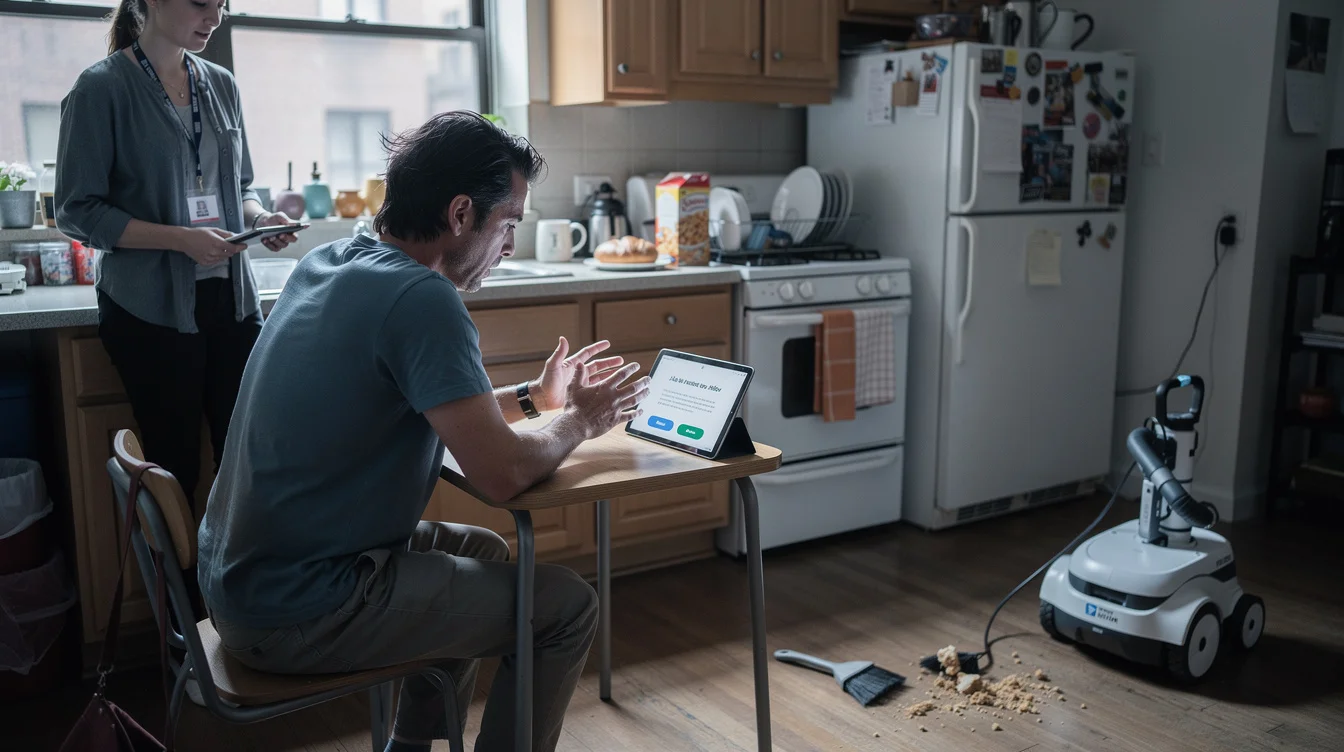
The strongest version of household robot teleoperation would treat permission as something residents compose, not something manufacturers collect once. A person might allow autonomous sweeping in the kitchen while requiring approval before any remote assistance. Another might authorise a brief supervised session for plant watering but exclude bedrooms entirely. These are proposed controls, not documented Voxel features.
Consider a specific handover. The robot stops beside a plant because it cannot confidently complete the task. A local signal announces the request; a screen explains what information would become available remotely, what actions an operator could take and when access would end. The resident approves that task alone. Completion closes the session automatically. Doing nothing leaves the robot safely paused, not silently connected.
Existing robot-vacuum mapping and keep-out zones provide a familiar starting point, but spatial boundaries are insufficient. Permission also needs a clock, a purpose and a visible status. “Kitchen access” should not mean indefinite access to everything happening in the kitchen.
Architects understand thresholds as negotiated transitions: a porch, a vestibule, a doorbell. A remote-assistance interface can perform a comparable role. It should announce arrival, establish the reason for entry and make refusal ordinary. Paired visual, audible and accessible tactile cues would avoid making consent dependent on checking a phone. Done properly, this is not friction obstructing the product. It is the mechanism that makes the service welcome.
CONTRA: A Good Interface Cannot Make Every Entry Legitimate
The opposing case begins where permission design becomes too self-congratulatory. A beautifully phrased request can still ask for more access than a household should have to surrender. Sweeping crumbs is a modest benefit. Depending on the system’s sensing and transmission arrangements, enabling remote assistance could expose information far beyond the crumbs. The reporting supplied here does not specify what Voxel’s operators receive; that uncertainty is precisely why disclosure matters.
Helen Nissenbaum’s concept of contextual integrity offers a sharper standard than the usual privacy toggle. Information should flow in ways appropriate to a particular setting and relationship. Permission to help with a plant does not automatically justify retaining a view of a medicine packet nearby or making domestic footage available for another purpose.
Products such as Ring cameras and Alexa speakers have already made networked sensing an everyday household question. A mobile manipulator adds a further dimension: where a design permits it, remote participation can involve action as well as observation.
Nor is the purchaser the household’s only stakeholder. A cleaner, guest, teenager or flatmate may encounter the machine without having accepted its terms. An owner-approved session does not settle their interests. The home is shared territory, not a single-user account. Any system that treats the buyer’s consent as universal domestic permission has mistaken a billing relationship for a social mandate.
CONTRA: Control Must Survive Beyond the Consent Screen
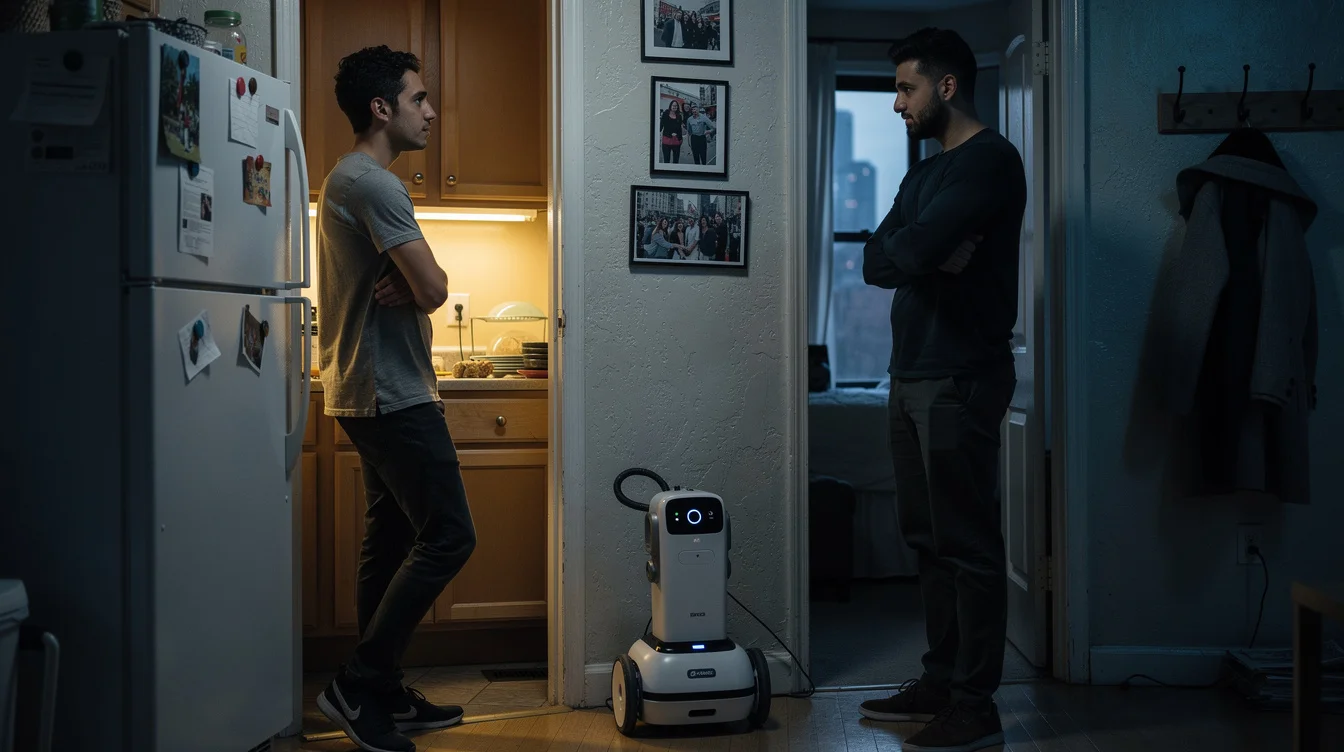
The harder objection concerns power after purchase. If useful performance depends on a remote service, ownership includes a continuing dependency: connection quality, staffing, subscription terms and the provider’s survival. This is a category-level risk, not an established description of Voxel’s commercial model. Nevertheless, it belongs in the purchasing decision as prominently as battery life.
Mark Weiser’s vision of computing receding into everyday life becomes troubling when disappearance conceals who can intervene. Calm technology must not mean silent changes of authority. Residents need to distinguish autonomous operation, a request for assistance and active remote control without studying an activity log after the event.
A credible specification would therefore include a readily accessible stop control, clearly defined offline behaviour, automatic session expiry and a record of remote interventions. Revoking access should trigger a safe stop, not an abrupt movement that drops an object. The provider should also explain whether information is retained, for how long and for which purposes. A glowing indicator cannot substitute for enforceable limits.
There is a labour question too. Calling a service “intelligent” can obscure the people doing exception handling and the conditions under which they work. Residents deserve accountability without receiving operators’ private identities; workers deserve protection without becoming invisible. If a manufacturer cannot explain both sides of that relationship, its minimal exterior is not elegant restraint. It is an attractive enclosure around unanswered questions.
FAQ
What is Tuesday Labs’ Voxel Series-1?
Voxel is a semi-autonomous household robot from New York company Tuesday Labs. The supplied Dezeen report describes tasks including watering plants and sweeping crumbs, performed through a combination of autonomous intelligence and teleoperation. Its appearance deliberately avoids humanoid resemblance.
Does teleoperation mean someone is always watching?
No. Teleoperation means a person can operate a system remotely; it does not establish continuous observation. The supplied source does not specify Voxel’s connection schedule, operator inputs or recording practices. Those details require explicit disclosure rather than assumptions.
What should a household robot disclose before remote assistance?
It should explain why assistance is needed, what information the operator will receive, which actions are permitted, how long access lasts and whether information is retained. Residents should be able to decline without accidentally authorising a broader session.
How can residents retain meaningful control?
Through task-specific permissions, room restrictions, unmistakable operating-state signals and an accessible way to end a session safely. Meaningful control also requires clear service terms and respect for other occupants. These are recommended design standards, not verified Voxel capabilities.
If a robot needs a remote human to finish the housework, what must it reveal—and let every resident refuse—before that help earns a place in the home?
Get the Mainifesto weekly — curated design debates, speculative ideas and the week's best articles every Saturday.
Editorial Perspectives
Questions and counterpoints developed by the Mainifesto editorial desk to extend the discussion.
Perspective 1
I’m for remote assistance if residents can define its boundaries as precisely as the robot maps a room. Show when an operator connects, what they can see, and which spaces are off-limits—and give every resident a veto. Could those permissions follow the household’s changing routines rather than freeze at setup?
Perspective 2
I’m against making remote access to the home the price of getting the housework finished. That connection crosses labor markets and legal jurisdictions, not just a Wi-Fi network; who employs the operator, where does the footage go, and who answers when something goes wrong? One buyer accepting terms cannot authorize surveillance of everyone under the roof.
Perspective 3
A robot that asks for human help could be more useful—and stay useful longer—than one sold on the fantasy of total autonomy. But let’s design for refusal: if someone blocks the camera or declines an operator, it should offer a simpler task or stop safely, not badger them into consent. Then show whether that support actually extends the machine’s service life.
Perspective 4
Before polishing Voxel’s shell, I’d want task-by-task numbers on how often an operator takes over and for how long. A visible connection indicator and a physical control that cuts remote access should be product requirements, not settings buried in an app. Every resident needs to know what that control stops, what it leaves running, and whether any footage is retained.