
Can a Museum Turn Critique into Another Attraction?
Can a Museum Turn Critique into Another Attraction?
A museum does not need to silence criticism to neutralize it. Sometimes it only needs to give criticism a magnificent room. Barbara Kruger’s monumental intervention at the Bourse de Commerce in Paris puts that possibility under pressure: language declaring that life is not a spectacle occupies an architectural setting exceptionally capable of making language spectacular.
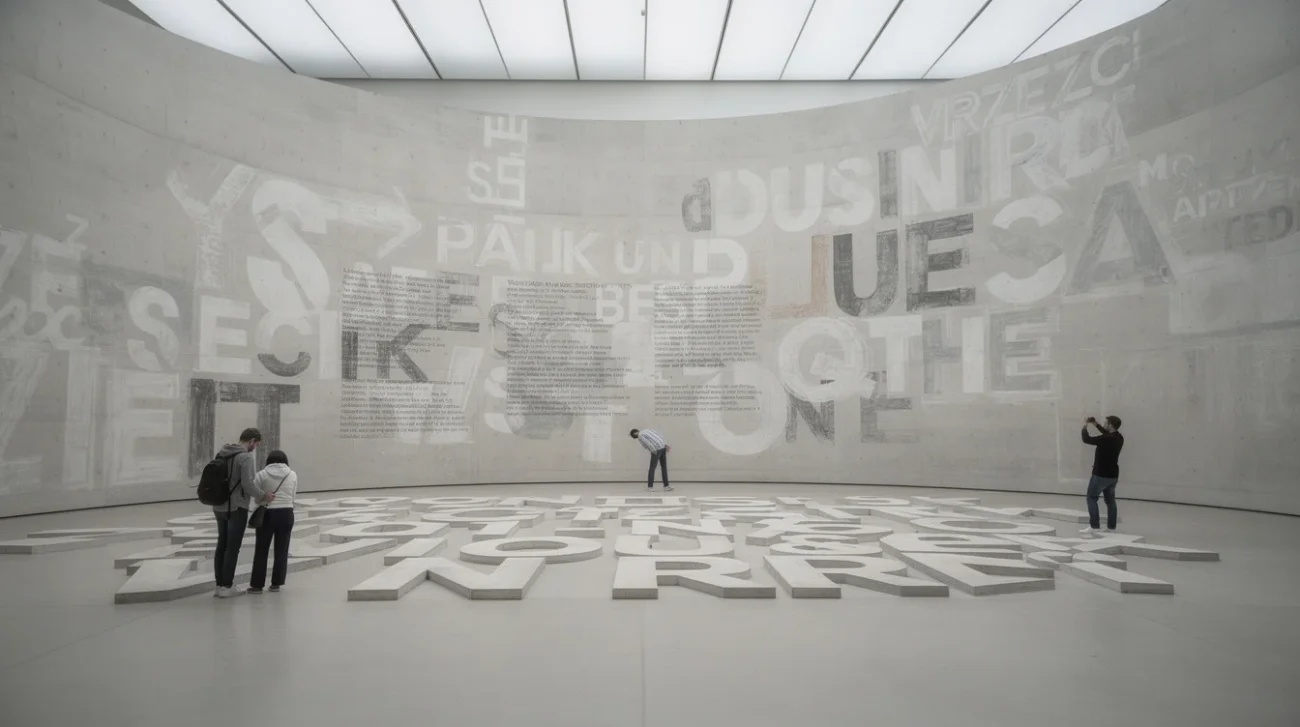
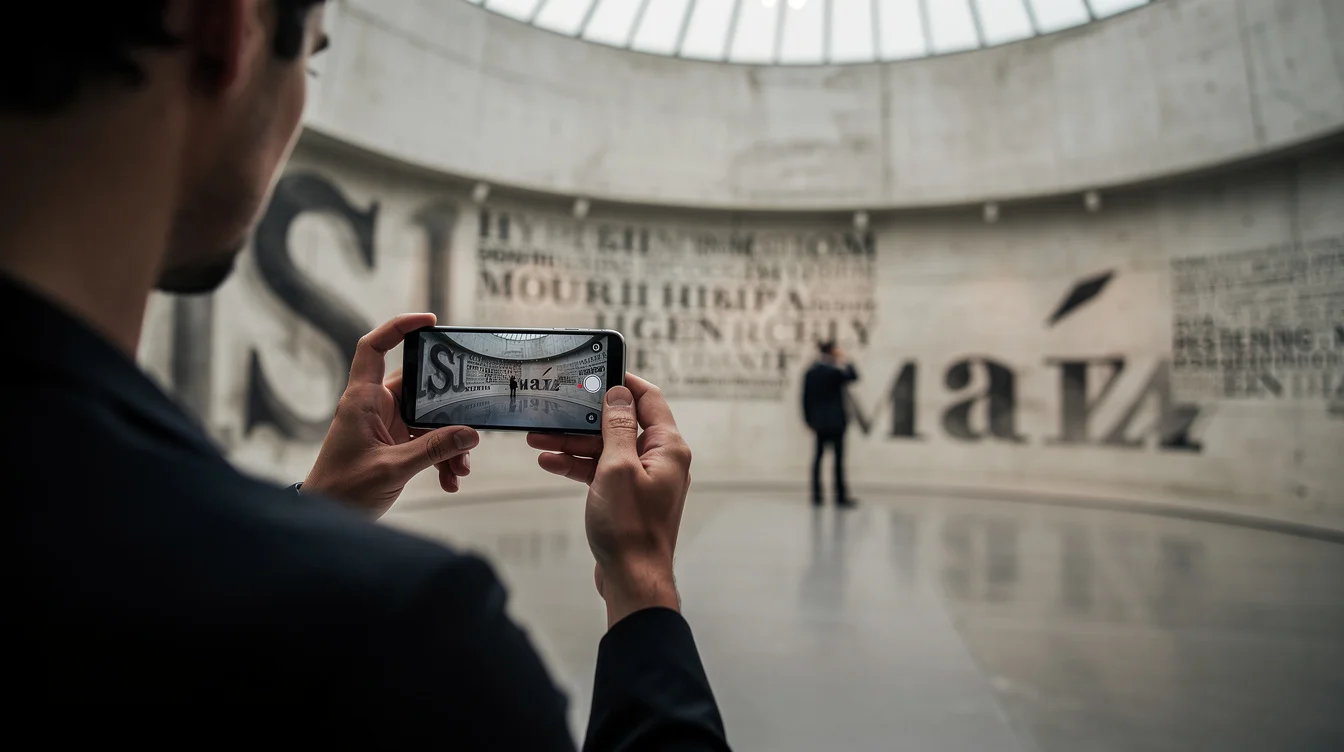
As reported by designboom, the American artist’s texts cover the curved walls and floor of Tadao Ando’s concrete rotunda, extending into twenty-four display cases in the surrounding passage. This is not a discreet statement encountered between other artworks. It is an environment that commands bodies, sightlines and attention. The visitor enters the argument rather than simply standing before it.
That is precisely the opportunity—and the trap. Kruger’s visual magnetism can make an abstract critique physically unavoidable. It can also supply a privately funded museum with another compelling reason to visit, photograph and share. The decisive question is not whether criticism looks spectacular. It is whether its spectacle leaves the institution’s authority intact.
The Rotunda Is Not an Innocent Container
Ando’s intervention makes the exhibition setting an active participant. A concrete cylinder inserted within a historic Parisian building establishes an encounter between architectural restraint and inherited grandeur. Its curved surface is already an instrument of attention: it gathers visitors, regulates views and gives whatever occupies it an unusually concentrated presence.
Kruger turns that instrument into a reading surface. Text on a wall can be approached as a statement; text across a floor changes the relationship. Visitors stand inside its scale, obscure parts of it with their bodies and must negotiate between reading and moving. The twenty-four display cases extend the work beyond a single commanding view, potentially interrupting the assumption that one photograph can capture the installation.
Yet architectural force cuts both ways. Ando’s work for the Pinault Collection at Punta della Dogana in Venice demonstrates how powerfully contemporary exhibition architecture can reframe a historic setting. At the Bourse de Commerce, the room does not disappear when Kruger speaks. It lends her language its prestige.
The museum therefore participates in every sentence without adding a word. It determines the conditions of encounter and receives cultural credit for hosting the confrontation. A wall can carry an accusation while still advertising the sophistication of its owner.
Kruger Knows That Seduction Is a Weapon
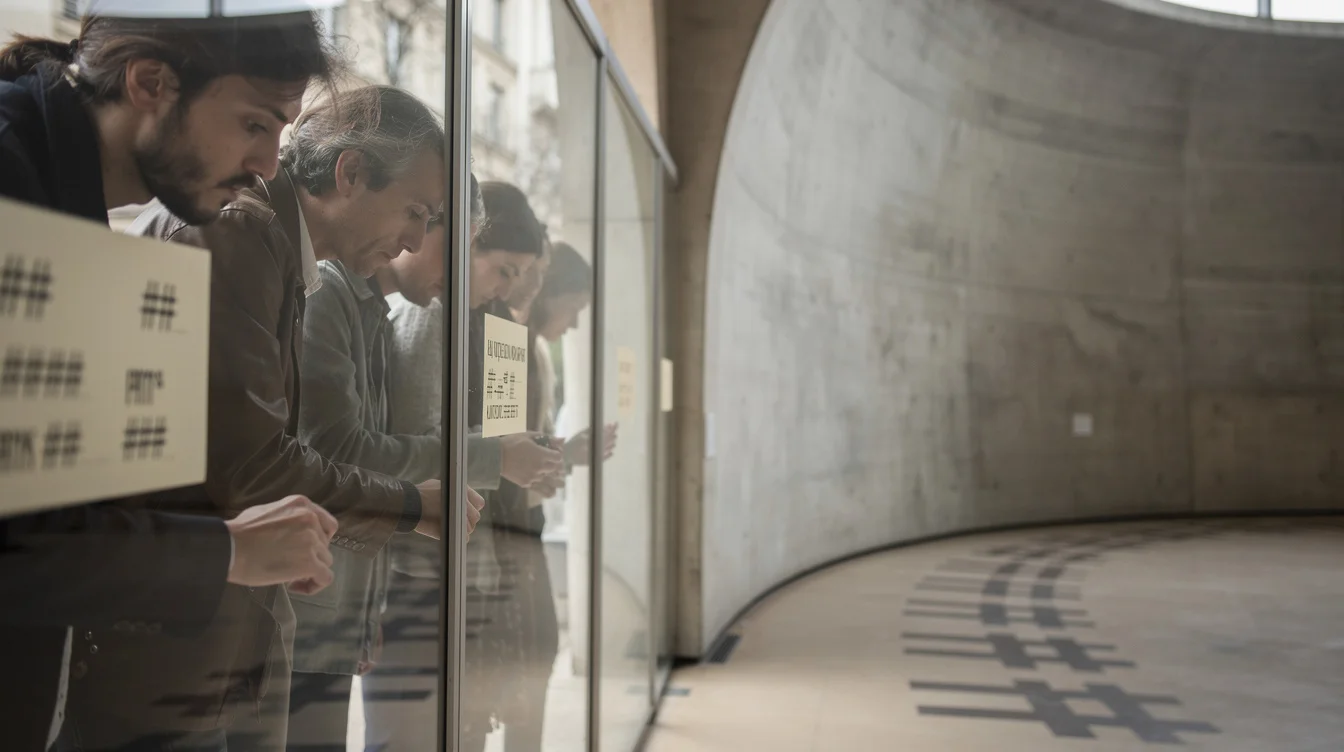
It would be a mistake to treat visual attraction as something the museum has imposed on an otherwise austere practice. Kruger has long worked through the force of graphic address. Her background in magazine design matters: compressed language, forceful typography and the collision of image and statement are tools for catching attention before attention moves elsewhere.
Consider Untitled (I shop therefore I am), from 1987. Its power lies partly in how efficiently it behaves like the consumer messaging it attacks. Or Untitled (Your body is a battleground), produced in 1989 for the March for Women’s Lives in Washington, D.C. Its divided face and declarative text do not politely explain a political position. They mobilize visual recognition.
The Paris installation belongs to that larger strategy. Monumentality need not dilute the message; it can deny the visitor the comfortable distance associated with reading a label. Language becomes a demand on the body as well as the eye.
But familiarity changes the stakes. A visual language developed to interrupt mass communication can eventually become a recognizable cultural signature. The visitor may identify “a Kruger” before engaging with what it says. At that moment, recognition threatens to replace reading. The brand of critique arrives faster than the critique itself.
A Photograph Is Not the Same Thing as a Defeat
The easiest response is to blame the camera. Visitors photograph an attack on spectacle; therefore, the argument goes, spectacle has won. That conclusion is too convenient. It confuses the circulation of an image with the disappearance of its meaning.
Guy Debord’s account of spectacle was not simply a complaint about an excess of attractive pictures. It concerned social relations mediated by images. Applied here, the problem is not that someone takes a photograph. It is that a confrontation with power might be reorganized as a display of personal taste: proof of attendance, cultural fluency or access.
Olafur Eliasson’s The weather project at Tate Modern in 2003 offers a useful comparison. Its artificial sun and mirrored ceiling produced extraordinary images, but visitors also used the Turbine Hall collectively, lying down and observing themselves as a temporary public. Photogenic experience did not automatically exclude reflection.
The same distinction matters for Kruger. A photograph that preserves a pointed statement may carry it beyond the museum. A photograph that turns lettering into an impressive backdrop may strip away its demand. Neither outcome is guaranteed by the medium. The meaningful distinction is between an image that circulates an argument and an image that merely circulates the prestige of having encountered it.
Who Profits from Being Criticized?
The Bourse de Commerce presents the Pinault Collection. That institutional identity matters because this encounter takes place within a museum associated with private collecting and wealth, not outside the systems of ownership and distinction that critical art can interrogate.
This does not establish hypocrisy on the artist’s part. It establishes a conflict worth keeping visible. The museum can accommodate a forceful statement and emerge looking open-minded, adventurous and culturally indispensable. Dissent becomes evidence of the institution’s generosity rather than a challenge to its terms.
Hans Haacke’s Shapolsky et al. Manhattan Real Estate Holdings, a Real-Time Social System, as of May 1, 1971 provides a sharper historical reference. Its documentation of property ownership was included in his planned Guggenheim exhibition, which the museum canceled. That episode exposed institutional boundaries because the work’s proposed presentation generated a concrete conflict over what could be shown.
Kruger’s installation need not repeat that model to matter. But it does invite a harder test than whether a museum permits confrontational language. Does the exhibition’s interpretation connect the language to collecting, patronage and institutional authority? Or does it leave power safely abstract? A museum can enthusiastically condemn manipulation in general while declining to examine the particular mechanisms that sustain its own prestige.
The Test Is What the Museum Lets the Work Disturb
Visual magnetism strengthens critique when it draws viewers into a contradiction they cannot immediately resolve. It weakens critique when the institution packages that contradiction as an experience already understood and safely completed. “Provocative” can become a service category, as predictable as immersive lighting or a well-positioned café.
A more demanding presentation would make the museum itself available for examination. Interpretation could connect Kruger’s language to the economics of attention and the authority of collectors. Public discussions could include independent critics willing to question the host institution. Exhibition photography could retain difficult statements rather than reducing the work to sweeping architectural views. These are tests to apply, not claims about what this exhibition currently provides.
The display cases suggest another possibility: sustained looking beyond the rotunda’s immediate visual impact. If visitors move from the commanding ensemble to particular statements, the work can resist becoming one consumable image. The route through the installation matters as much as its most dramatic viewpoint.
Kruger does not need to make an unattractive installation to escape absorption. That would surrender the communicative weapon she has spent decades refining. The museum, however, should not receive automatic credit for giving dissent room. Hosting criticism is easy compared with allowing it to change the terms of the encounter.
FAQ
What does Barbara Kruger’s installation at the Bourse de Commerce occupy?
The installation covers the curved walls and floor of Tadao Ando’s concrete rotunda, as well as twenty-four display cases in the surrounding passage, according to designboom’s report.
Why is the architecture central to the work’s meaning?
The rotunda magnifies the text and places visitors physically within it. Its architectural prestige also creates tension: a critical statement can become an attraction that enhances the museum’s image.
Does photographing the installation undermine its critique?
Not necessarily. Photographs can circulate its language beyond the museum. The risk arises when the statement becomes decorative evidence of attendance rather than an argument viewers engage with.
How can a museum avoid turning dissent into branding?
It can connect the work’s questions to its own structures of collecting, funding and authority, while giving independent critics space to challenge the institution rather than merely celebrate the exhibition.
If a museum gains prestige by exhibiting a critique of spectacle, what would that critique have to disrupt before we could call it more than another attraction?
Get the Mainifesto weekly — curated design debates, speculative ideas and the week's best articles every Saturday.
Editorial Perspectives
Questions and counterpoints developed by the Mainifesto editorial desk to extend the discussion.
Perspective 1
A Paris museum can exhibit an attack on power without surrendering any of its own. The test is whether the critique changes who controls the budget, whose histories get space, or who can afford entry—not whether it makes the institution look fearless.
Perspective 2
Being photogenic doesn’t automatically neutralize Kruger’s work; a memorable image can carry an argument beyond the museum. But why stop at circulation? Let that argument shape the shop’s sourcing and the exhibition’s afterlife, so visitors encounter a different model of consumption rather than just a warning about it.
Perspective 3
I’d want to see what the museum counts as success: attendance, image shares, or something its sponsors might find uncomfortable. If every response feeds the same marketing dashboard, even outrage is a useful output. The critique needs to change a decision, not just improve the exhibition’s performance.
Perspective 4
I’d start with what it takes to make those monumental texts, and what happens to the materials afterward. Reuse wouldn’t prove the critique works, but a museum willing to reduce its exhibition churn—even at the cost of fewer headline events—would be taking the argument seriously.