
Beyond the Parking Lot, Still Inside the Car
Beyond the Parking Lot, Still Inside the Car
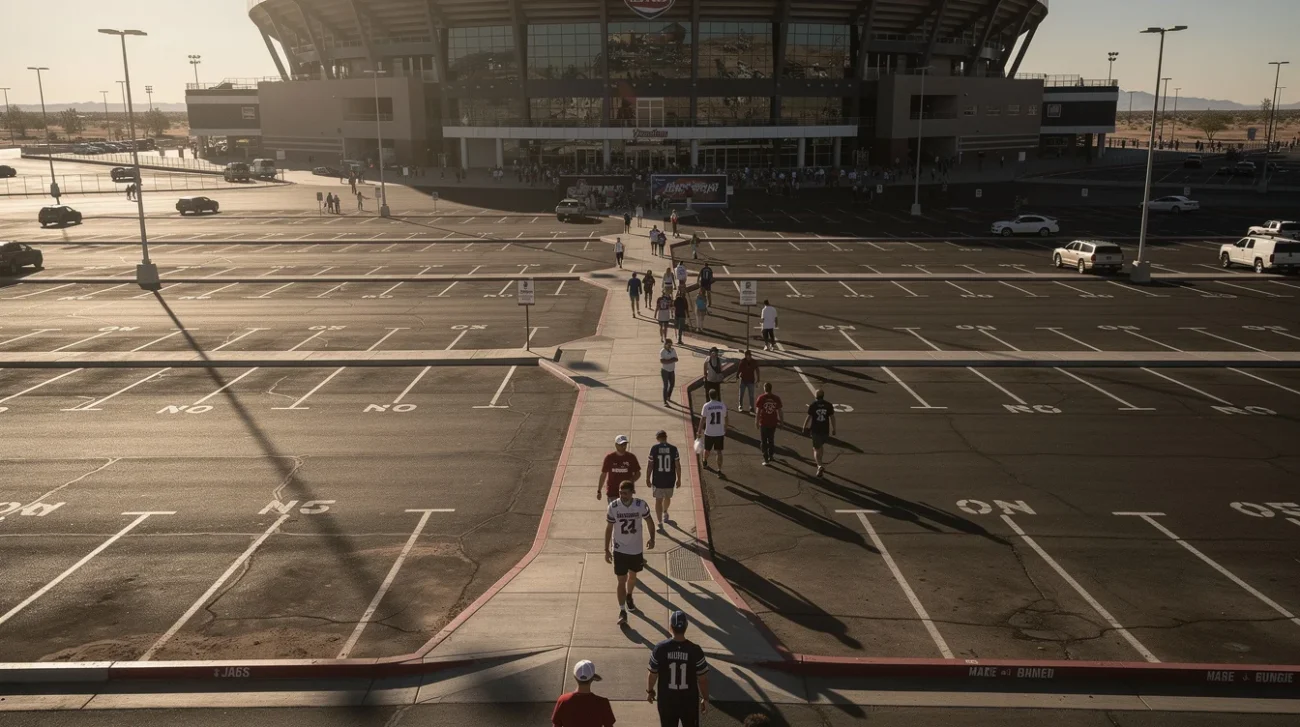
A parking lot is not public space waiting for better landscaping. It is a decision about who gets land, how people arrive and what happens between destinations. Grimshaw’s proposed redesign of the entry plaza at Allegiant Stadium in Las Vegas revisits that decision, replacing parking areas with walkways and transport infrastructure, including a Boring Company station integrated into an elevated plaza. As reported by Dezeen on 15 September 2026, this is a proposal, not a completed transformation. Its architectural promise is nevertheless clear: give the stadium a more pedestrian-oriented threshold. Its political ambiguity is equally clear: people may leave the parking lot behind without leaving car-based transport behind.
PRO: Removing parked cars is a substantial urban gain
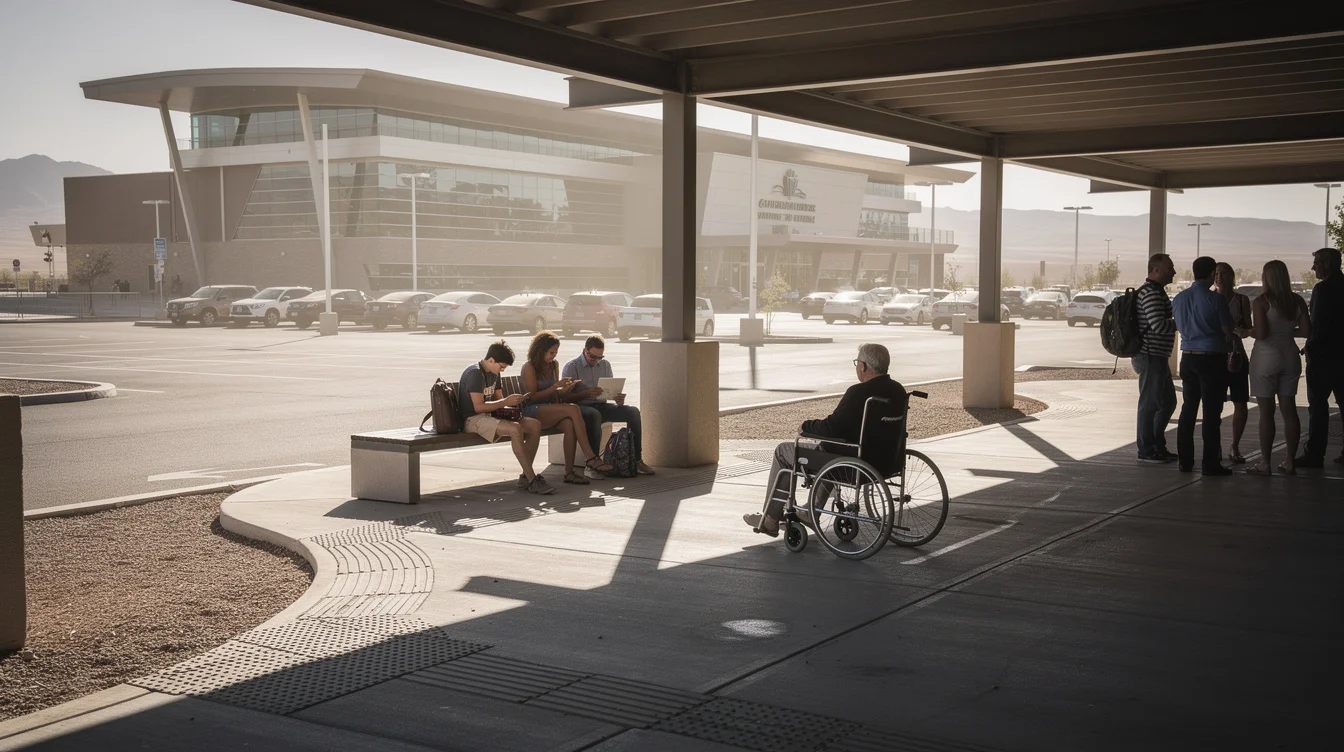
Start with the land, not the vehicle technology. Surface parking consumes extraordinary amounts of space while offering remarkably little beyond vehicle storage. Around a stadium, that imbalance becomes especially stark: enormous arrival areas serve concentrated bursts of demand, then revert to asphalt expanses. Reallocating some of that ground to walking and gathering is a material improvement, not merely an exercise in branding. A family approaching an entrance, a wheelchair user navigating a crowd and friends waiting after a match all need something a parking bay cannot provide: continuous space organised around people.
There is a useful precedent in the pedestrianisation of Times Square, first tested through temporary interventions and later consolidated in Snøhetta’s permanent redesign. Its achievement was not the abolition of motor traffic throughout Manhattan. It was the conversion of contested road space into somewhere people could occupy. The lesson for Las Vegas is that local gains need not wait for metropolitan perfection.
The proposed Allegiant Stadium plaza deserves that same first-order assessment. Does it reduce encounters between pedestrians and moving vehicles? Does it make the route to the doors more legible? Does it create places to pause without blocking circulation? The supplied project description does not establish the detailed answers. But replacing parking with connected pedestrian territory opens possibilities that an asphalt storage field structurally excludes. Less land devoted to stationary cars is already a meaningful architectural outcome.
PRO: A transport threshold can become civic space
Grimshaw’s strongest opportunity is to make transport infrastructure do more than process arrivals. The studio’s work on London Bridge station demonstrates the value of treating circulation as architecture: connections, concourses and the relationship to surrounding streets shape the experience as much as the transport machinery. The Las Vegas proposal operates in a very different setting, but the relevant ambition is similar. A station entrance should contribute to the place around it rather than puncture the ground as an isolated utility.
An elevated plaza could organise different movements while preserving a generous pedestrian surface. That possibility matters at a venue where event-time surges can turn poorly resolved edges into queues, bottlenecks and improvised waiting rooms. Integrating a station from the outset offers a chance to design those interfaces together, rather than attach transport access after the landscape has been finished.
In Las Vegas, however, usable space requires more than visual openness. Shade, drinking water, seating, accessible gradients and protection from radiant heat should be treated as infrastructure, not accessories. These are criteria for judging the proposal, not confirmed features of its design. BIG’s Superkilen in Copenhagen offers a broader reminder that an urban landscape becomes valuable through opportunities to sit, play and meet—not through circulation alone. If the stadium forecourt supports comfortable occupation, including beyond the arrival rush, the project could deliver an authentic public-space dividend even while its transport model remains imperfect.
CONTRA: Cars underground do not equal car independence
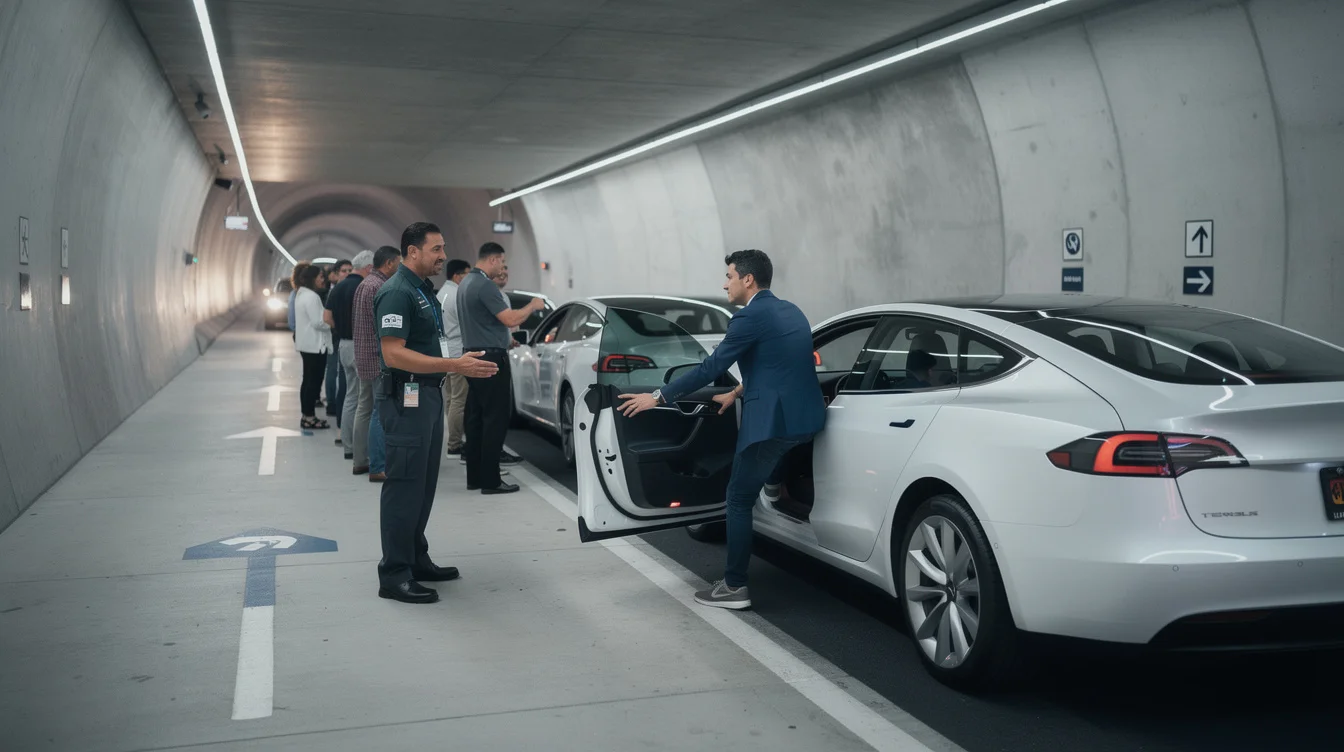
The counterargument begins where the seductive aerial view usually stops: below the pedestrian surface. A Boring Company station connects the plaza to a system based on cars travelling through tunnels. That is not the same operating proposition as a metro carrying large numbers of passengers in trains. Removing vehicles from view changes their spatial relationship to pedestrians; it does not, by itself, resolve questions of capacity, access or the wider network.
Stadium transport is an unforgiving test because demand is sharply concentrated. After a major event, thousands of people may want to depart within a narrow window. The relevant measure is not how futuristic a tunnel looks or how quickly one car can travel between stations. It is how many people the whole system can move, including boarding, loading, dispatching and connections at the other end. Small vehicles require repeated boarding movements to serve a crowd. Any claim of successful substitution needs credible peak-period performance, not a demonstration ride.
Compare the planning logic around Wembley Stadium, where substantial pedestrian approaches connect spectators to rail and Underground services. Those systems are not immune to queues, but they organise departure around shared, high-capacity movement. The Las Vegas proposal should face the same people-per-hour scrutiny. A pedestrian plaza above car tunnels can improve the surface while leaving the underlying mobility bargain largely intact. Architecture cannot answer an operational question with a more elegant station entrance.
CONTRA: A polished forecourt can conceal a narrow bargain
The deeper issue is what this investment makes easier to choose next. Infrastructure establishes expectations, destinations and future spending priorities. Integrating a car-tunnel station into a major stadium can strengthen the case for further expansion of that network. This does not automatically preclude buses or other alternatives. It does, however, risk making car-based transport the default framework within which subsequent improvements must fit.
Los Angeles offers a cautionary comparison. HKS’s SoFi Stadium sits within a development containing substantial landscaped pedestrian areas, yet the region’s difficult stadium-access problem is not solved by the quality of those spaces. Attractive grounds and convenient, broadly accessible transport are separate achievements. Las Vegas should resist treating the first as evidence of the second.
Nor is a stadium forecourt necessarily public in the fullest sense. Its civic value depends on opening hours, event security, permitted activities and whether someone without a ticket has a reason—and permission—to stay. An elevated pedestrian surface can connect routes, but it can also channel visitors through a tightly managed destination. The available description does not settle those questions.
The burden of proof therefore has two parts: demonstrate a comfortable, accessible landscape and demonstrate transport that expands meaningful choices. Connections to buses, safe routes from surrounding streets, transparent fares and workable peak-event operations should count alongside architectural renderings. Without those tests, the project risks offering liberation from the appearance of the car rather than from the necessity of using one.
FAQ: What should readers look for?
What is proposed for the Allegiant Stadium plaza?
According to the supplied Dezeen report, Grimshaw proposes reworking the stadium’s entry area in Las Vegas, replacing parking lots with walkways and transport infrastructure. A Boring Company station would be integrated into an elevated plaza. The report describes plans, not a finished project.
Is a Boring Company tunnel equivalent to a metro?
No. Its car-based operation differs from rail systems that carry passengers in trains. A useful comparison must examine actual passenger capacity, boarding arrangements, waiting times, accessibility and network reach—not simply whether both systems run underground.
Can removing parking reduce car dependence?
It can contribute, especially when paired with reliable alternatives. But removing parking at one destination might also shift vehicle storage elsewhere or encourage different forms of car travel. The decisive issue is whether more visitors can complete their journeys without needing a private car.
What would make the plaza genuinely successful?
Comfortable pedestrian routes, effective shade, accessible station connections and welcoming places to wait would establish its spatial value. Its larger success would require credible crowd-handling performance, useful connections to other transport and public access that extends beyond ticketed event circulation.
If the pedestrian surface improves while the transport system remains organised around cars, should we call that progress—or a more persuasive version of dependence?
Get the Mainifesto weekly — curated design debates, speculative ideas and the week's best articles every Saturday.
Editorial Perspectives
Questions and counterpoints developed by the Mainifesto editorial desk to extend the discussion.
Perspective 1
I’d call the added pedestrian space progress; cities have always changed in layers, not through a clean break with everything that came before. The car dependence still needs undoing, but reclaiming surface space matters—provided people can use it without buying a ticket or being treated as unwanted guests.
Perspective 2
A better plaza is welcome, but I wouldn’t call this progress on transport if the alternative to arriving by car is riding in another car underground. Show me passenger capacity, accessible connections and a credible reduction in car trips; renderings of pedestrians don’t establish any of that.
Perspective 3
This recalls the modernist promise that separating pedestrians from traffic would reconcile the city with the automobile. The Boring Company station gives that bargain a technological gloss: we get to feel liberated from cars precisely because we no longer have to look at them.