

Who Gets to Override the Perfect City?

Who Gets to Override the Perfect City?
The perfect city has a permissions problem. Its trains arrive, its energy loads balance, its waste disappears. But can a resident change anything that its designers did not anticipate? Can a neighbourhood reject a sensor network, occupy an underused square or demand a slower street when the traffic model recommends speed?
In 1971, the Italian radical architecture collective Superstudio imagined twelve ideal cities in which architecture and technological systems organised everyday life with disturbing completeness. As the designboom account of the project highlights, their subject was the price of a perfectly designed existence. These were not straightforward proposals for better settlements. They pushed the promise of comprehensive design towards its coercive limits.
Today’s smart-city pitch is less surreal but often shares the ambition: remove uncertainty through coordination. The dispute is not whether cities need functioning systems. They do. It is whether those systems serve residents or quietly redefine residents as variables to be managed.
PRO: Coordination Is a Public Good, Not an Original Sin

The strongest defence of intelligent infrastructure begins somewhere less glamorous than an innovation district: the pumping station. Water networks, electricity grids and public transport cannot operate through permanent individual improvisation. A household cannot exercise an unrestricted right to contaminate a shared supply. A driver cannot claim agency as permission to block a tram.
Singapore’s integrated water strategy, including NEWater reuse and extensive catchment management, demonstrates the value of treating infrastructure as an interconnected system. Copenhagen’s district heating similarly makes collective provision tangible. Neither depends on the fantasy that every resident should manage a private technical universe. Their lesson is that coordination can expand practical freedom by making essential services dependable.
Digital monitoring can strengthen this work. Detecting a leak before it becomes a burst main is not inherently authoritarian. Forecasting demand can reduce waste and help utilities plan maintenance. For residents who experience outages, unreliable buses or unsafe crossings, efficiency is not an aesthetic preference. It is time, money and physical security.
Superstudio should make us suspicious of total design, not indifferent to competent government. Romanticising urban breakdown is easiest when someone else waits for the bus or carries water upstairs.
PRO: Better Systems Can Give People More Room
The strongest smart-city argument is not that technology eliminates friction. It is that infrastructure can remove involuntary burdens, leaving more capacity for chosen activities. A reliable, accessible transport network gives a teenager, an older resident or someone who cannot drive a larger effective city. Information about lift outages matters more to wheelchair users than another dashboard celebrating municipal innovation.
Barcelona’s superblocks offer a useful adjacent example. They are primarily a street-planning intervention, not a triumph of artificial intelligence. By reorganising through-traffic, they make space for walking, resting and play. Their relevance is precisely that systems thinking can redistribute freedom: less convenience for vehicles cutting through a neighbourhood can mean more independence for children living there.
Jan Gehl’s attention to public life supplies an important corrective to technology-led evaluation. Count people staying, meeting and using a street, not simply vehicles passing through it. Sensors and models can help collect evidence, but the public objective must come first.
A coordinated city need not maximise obedience. It can make ordinary life less administratively exhausting. The test is whether an efficiency gain becomes a public dividend—more time, space and access—or merely a better-looking performance report.
PRO: The Override Can Be Designed Into the System
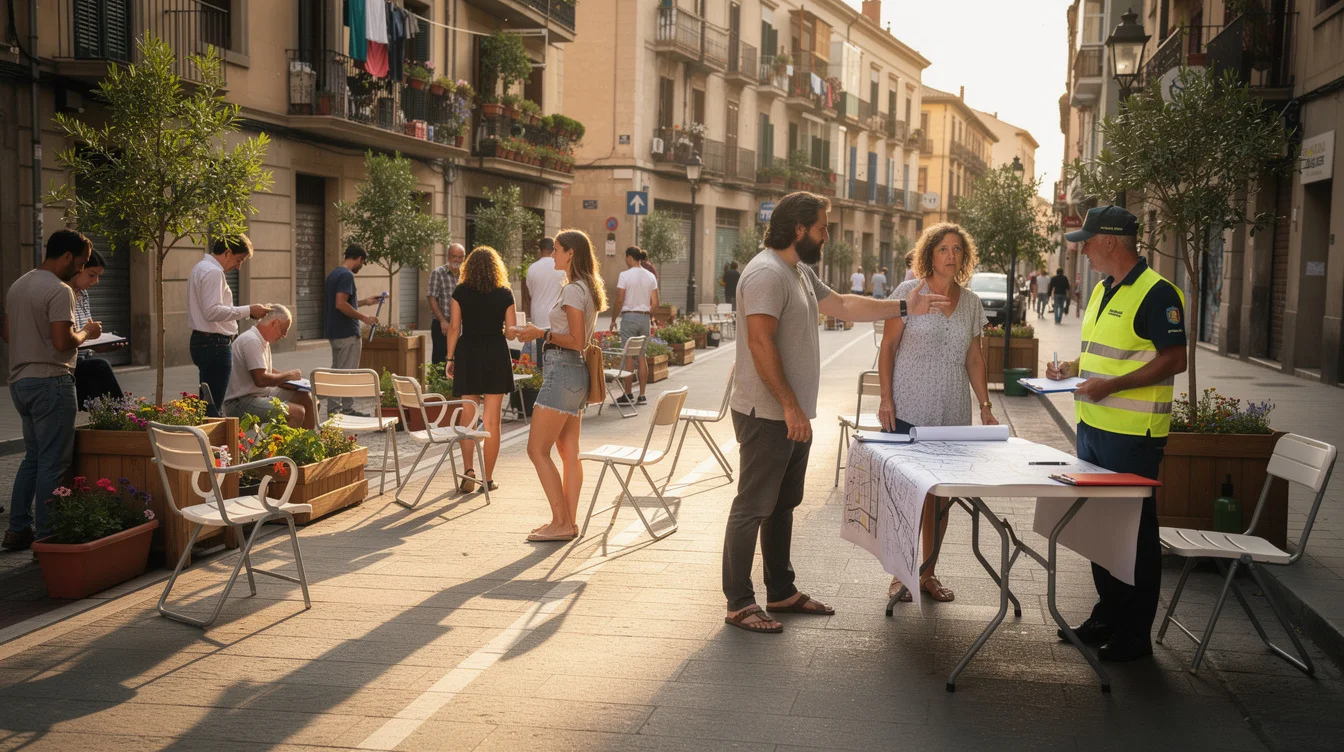
There is no technical law requiring urban intelligence to be centralised, opaque or privately owned. Procurement rules can require interoperable systems, limited data collection, independent audits and workable alternatives when digital services fail. A city can purchase useful software without granting its supplier permanent control over the public interface.
Barcelona’s Decidim participatory platform offers a concrete reference for a different institutional imagination. Its open-source approach makes digital participation something that public institutions and civic groups can adapt, rather than a proprietary channel residents merely consume. Amsterdam’s public algorithm register points towards another necessary practice: making municipal uses of algorithms visible enough to question. Neither guarantees democratic power, but both reject invisibility as the default.
Architecture has a parallel in John Habraken’s distinction between durable supports and changeable infill. Shared structures can be coordinated while leaving occupants meaningful scope to alter their surroundings. The urban equivalent is a stable public framework with negotiable local arrangements.
The affirmative case therefore deserves to be stated boldly: a well-designed system can distribute agency more fairly than an unmanaged one. Informal bargaining already privileges property owners, insiders and people with spare time. Transparent rules and accessible participation can give others leverage they previously lacked.
CONTRA: Optimisation Conceals a Political Choice
The trouble begins with the word “optimal”. Optimal for whom, over what period, and according to which losses? A transport model that rewards vehicle throughput may classify street markets, demonstrations and long pedestrian crossing times as obstacles. Nothing in the mathematics decides whether those activities are nuisances or the point of having a city.
Superstudio’s twelve cities expose this danger by treating comprehensive order as a condition to interrogate rather than admire. Their force lies in the gap between systemic consistency and a life worth living. A system can fulfil its own specification while making resistance unthinkable.
Songdo, the planned district in Incheon, South Korea, is a real-world reference for the ambition to integrate urban services through networked infrastructure. Its pneumatic waste collection and digitally enabled systems are not proof of dystopia. They do, however, sharpen a practical question: when everyday arrangements depend on specialised networks, how easily can inhabitants change the terms?
A resident who cannot inspect a decision, appeal it or organise an alternative has not received a neutral service. They have entered a governing relationship. The dashboard does not abolish politics; it can move politics somewhere the public cannot reach.
CONTRA: Consent Is Not a Checkbox on the Pavement
In a building, refusing a service may sometimes mean choosing another provider. In a street, meaningful refusal is harder. People must move through public space to reach work, school and care. Calling surveillance voluntary because a notice has been posted confuses disclosure with consent.
Sidewalk Labs’ proposed Quayside development in Toronto made this tension unusually visible. The project promised digitally coordinated urban services but provoked sustained debate over data governance, private influence and public accountability. Sidewalk Labs withdrew in 2020, citing economic uncertainty. It would be inaccurate to reduce that outcome to a simple popular defeat of surveillance. The controversy nevertheless demonstrated that governance cannot be attached to a technologically ambitious masterplan as an afterthought.
The quieter danger is dependency. When a city relies on proprietary software, undocumented integrations or a single maintenance contractor, elected officials may retain formal authority while losing practical bargaining power. Residents inherit that weakness. Replacing a supplier can become prohibitively disruptive.
Data minimisation, open standards and exit provisions are consequently architectural concerns, not just legal housekeeping. They determine whether the city’s operating arrangements remain alterable. A beautifully designed public realm is not genuinely public if the conditions for using it are effectively locked inside a commercial contract.
CONTRA: A City Must Permit Unauthorised Possibility
Even transparent, publicly owned systems can become overbearing if they recognise only activities that already fit their categories. Jane Jacobs defended the street as an intricate social order that planners could not fully script. The point was not that every spontaneous use is benign. It was that urban knowledge also emerges through occupation, observation and adjustment.
Aldo van Eyck’s postwar Amsterdam playgrounds made a related architectural proposition: relatively open-ended forms could invite children to invent uses rather than follow a single prescribed sequence. Alejandro Aravena and ELEMENTAL’s incremental housing likewise places adaptation within the design argument, although residents’ ability to build safely still depends on resources and support. Neither example licenses government to withdraw. Both challenge the assumption that completion means eliminating future authorship.
The right to improvise must also be bounded by other people’s rights. Blocking an accessible route is not emancipatory merely because it is informal. The alternative to total control is negotiated change, not domination by whoever occupies space first.
Judge urban quality by the control residents can actually recover: the cost of contesting a decision, the feasibility of replacing a system, and the room to propose an unforeseen use. Efficiency without those capacities is merely well-maintained dependency.
FAQ
What were Superstudio’s twelve ideal cities?
They were a 1971 speculative project by the Italian radical architecture collective Superstudio. Through extreme urban scenarios, the project examined what happens when architecture and technological organisation extend their control across everyday life. Read them as critical provocations, not a catalogue of cities intended for construction.
Does protecting residents’ agency mean rejecting smart-city technology?
No. Leak detection, accessible transport information and energy management can deliver real public benefits. Agency depends on the surrounding rules: who sets objectives, what data is collected, how decisions are challenged and whether residents have usable alternatives.
What would a meaningful urban override look like?
It could include an accessible appeal against an automated decision, a neighbourhood process for changing street use, or a municipality’s ability to replace a technology provider. It should not mean an unrestricted individual veto over shared safety, accessibility or essential services.
How should cities measure whether they give control back?
Track the time and expense required to challenge decisions, the outcomes of resident proposals, the availability of non-digital access and the practical ability to alter contracts or infrastructure. Count whose demands succeed, not just how many people attend a consultation.
If a city works perfectly only while its residents follow the script, who should have the power to rewrite it?
Watch the Mainifesto Short
Get the Mainifesto weekly — curated design debates, speculative ideas and the week's best articles every Saturday.
Editorial Perspectives
Questions and counterpoints developed by the Mainifesto editorial desk to extend the discussion.
Perspective 1
I’m for smarter infrastructure: fewer leaks and reliable transport matter more than whether the city looks radical on paper. Residents should set the priorities and have a route to challenge decisions, but operators need room to do their jobs without a referendum on every maintenance schedule.
Perspective 2
I don’t buy the perfect-city promise; in restoration, the supposedly messy alterations often tell you how a building became useful. In Mexico City, calling a neighbourhood inefficient can be the prelude to pricing out the people who made it work. Any power to rewrite the script has to include tenants and street vendors, not just property owners.
Perspective 3
We’ve put enough clever controls into hotels to learn that if guests keep asking staff for help, the interface has failed. A city needs an accessible way to override the system and someone accountable when it goes wrong; otherwise the efficiency savings just become somebody else’s unpaid work.
Perspective 4
In a parametric model, a tiny change to the objective function can produce a completely different ‘optimal’ city. Could residents have the power to change those objectives, rather than just choose between options the model generates? I’d want to know how that process protects a small group whose needs barely register in the aggregate data.