

The Floating City Wants to Be Infrastructure
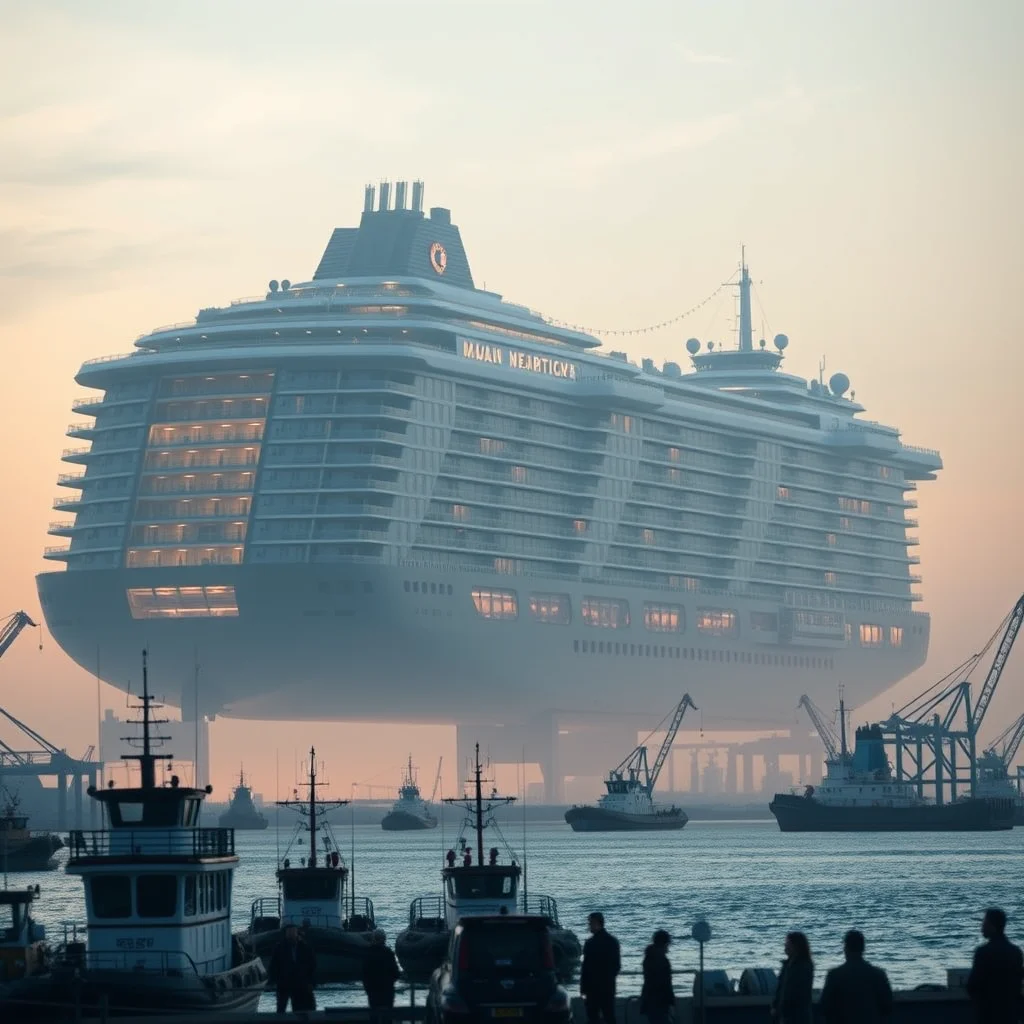
The cruise ship grows a civic ambition
The floating city is back, but it has changed its sales pitch. The old fantasy promised escape: a permanent holiday, a self-contained paradise gliding beyond the reach of ordinary cities. The new version wants to sound more serious. It calls itself infrastructure.
That shift is visible in Freedom Ship, the long-circulating concept by Schopfer Associates presented as a hybrid of city infrastructure and long-distance transport. Rather than treating the vessel as a cruise liner with extra amenities, the proposal imagines a colossal floating settlement: homes, offices, schools, hospitals, parks, retail, civic facilities, and hospitality stitched into a mobile urban body. Its residents would travel globally without abandoning the routines of urban life.
The idea is spectacular because it collapses categories architecture normally keeps separate. A ship is a vehicle; a city is a jurisdiction; an airport is a threshold; a building is an address. Freedom Ship proposes one object that performs all four roles. It is not simply a building that moves. It is a claim that movement itself can become a form of urban permanence.
That claim deserves more attention than the familiar renderings of decks, glass facades, and endless blue water. The real question is not whether engineers could construct a very large vessel. It is whether a mobile city could produce a legitimate public realm—or merely float above the political and ecological failures it refuses to solve.
From utopian vessel to traveling metropolis

Freedom Ship belongs to a long lineage of floating fantasies. In the 1960s, Buckminster Fuller imagined autonomous systems capable of reorganizing life at planetary scale. Japanese Metabolists including Kiyonori Kikutake proposed marine megastructures that could grow, adapt, and support new forms of collective life. Archigram’s plug-in cities and Peter Cook’s walking architectures turned mobility into an architectural principle rather than a logistical inconvenience.
The cruise industry commercialized a diluted version of that dream. Contemporary vessels operate as vertical resorts, concentrating restaurants, theaters, swimming pools, hotels, swimming pools, and entertainment into a single moving machine. Freedom Ship intensifies the model until the resort becomes a city. The difference is not merely size. It is duration and ambition: the ship is conceived as a place where people might live, work, educate children, and conduct business while crossing oceans.
This makes the project an important thought experiment about long-distance travel. Instead of flying from city to city and sleeping in a different hotel each time, residents could carry their domestic and professional infrastructures with them. A global itinerary becomes the urban plan. Ports become temporary edges, while the vessel’s internal streets, decks, and institutions become the stable civic framework.
Yet a city cannot be reduced to its program. Urban life depends on friction, proximity, informal encounters, shared maintenance, and contested space. Jane Jacobs understood streets as social instruments, not just circulation corridors. The floating city would have to invent its own version of the sidewalk: a public sequence where residents are not simply consuming leisure but negotiating difference. Otherwise it risks becoming a luxury condominium with a maritime view, not a city at all.
Architecture after the address
The most radical consequence of the floating-city concept is administrative rather than formal. If architecture is no longer fixed to land, what exactly anchors its obligations? A building’s relationship to a municipality, a tax system, a utility network, and a legal jurisdiction is usually invisible until it breaks down. On a mobile vessel, those relationships become the central design problem.
Freedom Ship raises immediate questions of governance. Which country registers it? Which laws apply to labor, housing, education, healthcare, and criminal justice? How are elections held? Who owns the water beneath it, and who controls access to the ship? The proposal’s global travel itinerary sounds liberating only if one overlooks the regulatory systems that make mobility possible.
There are precedents, though none are simple. Cruise ships already operate through flags of convenience, allowing companies to register vessels in jurisdictions with favorable tax and labor regimes. Offshore platforms create similarly ambiguous zones of work and responsibility. Special economic zones and charter cities promise administrative experimentation, but they often invite a familiar bargain: reduced public oversight in exchange for investment.
A mobile city could therefore become an architectural loophole. Its residents might enjoy international connectivity while workers, contractors, and service staff remain subject to opaque contracts. A city that can leave its jurisdiction may also be a city that can evade it. The fantasy of freedom has a shadow vocabulary: exemption, privatization, and selective accountability.
Climate escape is not climate resilience
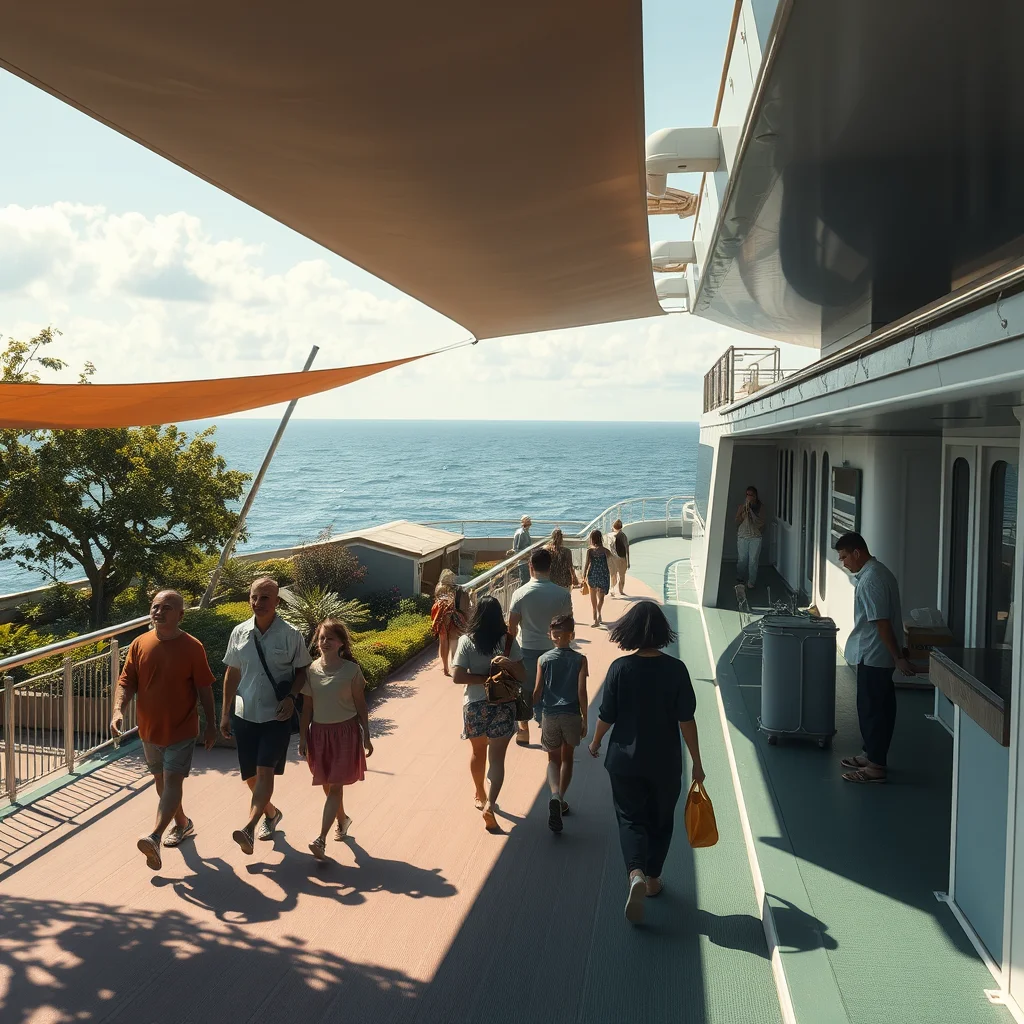
Supporters of floating urbanism often position it as a response to rising seas, coastal crowding, and land scarcity. Projects such as the Oceanix City proposal, developed with BIG, frame modular floating districts as adaptable habitats for a climate-altered world. Experimental platforms, floating farms, and amphibious housing explore how communities might remain functional amid flooding and unstable shorelines.
These projects are valuable because they force architecture to confront water as a living condition rather than a picturesque backdrop. But adaptability is not the same as escape. A city that can sail away from a storm may protect its investors while leaving fixed communities to absorb the damage. The ability to move is unevenly distributed, and that inequality would become spatially literal.
There is also a material contradiction. A vessel on the scale imagined by Freedom Ship would require enormous quantities of steel, concrete, glass, fuel, mechanical equipment, and continuous maintenance. Its energy demand would not disappear because its foundations are liquid. Desalination, waste processing, food supply, propulsion, and cooling would all become permanent infrastructural burdens. The floating city may be resilient for its occupants while remaining environmentally expensive for everyone else.
Climate architecture should not be judged only by whether it survives a flood. It should be judged by what it consumes, whom it protects, and what it asks other communities to endure. A floating city is compelling when it works as a shared adaptation strategy; it is troubling when it becomes a lifeboat for the affluent.
The public realm on a private hull
Freedom Ship’s most provocative promise is that it could combine mobility with a full civic life. Imagine schools opening onto shaded decks, clinics operating beside logistics hubs, workshops facing the ocean, and public gardens suspended above the machinery of transport. The vessel could test new relationships between infrastructure and everyday life, much as historic railway stations, port districts, and market halls once fused movement with collective space.
But the public realm is not created by adding amenities to a master plan. It depends on access, ownership, and the right to remain. Who can enter the ship? Can a resident protest its management? Can an independent newspaper publish criticism? Are public spaces genuinely public if security teams can close them, ticket them, or remove undesirable users?
These questions connect the concept to contemporary debates about whether waterfronts can still belong to everyone, privately owned public spaces in London, master-planned districts in the Gulf, and branded urban developments across Asia. In each case, the language of public life can conceal a carefully managed environment. The floating city would amplify that condition: its perimeter would be both shoreline and property line, its elevators and corridors both streets and controlled access systems.
Designers should therefore stop presenting decks as democratic simply because they are open-air. Civic architecture requires institutional guarantees as much as spatial generosity. A floating city worth building would need transparent governance, collective ownership models, enforceable labor rights, and meaningful participation by the people who maintain it. Without those conditions, its parks are scenery and its plazas are customer-service zones.
What the concept gets right
Despite its contradictions, the Freedom Ship proposal identifies a real architectural frontier. Much of the world’s critical infrastructure is already mobile or semi-mobile: data centers, hospital ships, emergency shelters, construction camps, floating terminals, and modular energy systems. The question is no longer whether architecture can move. It is whether mobility can be organized as a durable social system.
The concept also challenges the land bias of architectural practice. Conventional planning treats solid ground as a permanent neutral platform, even though coastlines erode, permafrost melts, rivers change course, and urban land is increasingly financialized. Designing for the day the landscape moves means developing architectural systems that acknowledge instability rather than treating it as an exception.
Designing for water could produce new expertise in buoyancy, repair, marine ecology, distributed energy, and reversible construction.
Projects such as amphibious houses in the Netherlands and floating solar installations show that water-based infrastructure need not be science fiction. They are smaller, more accountable, and often more useful than the megaship fantasy. Their lesson is not that every city should float, but that architecture can become less brittle by accepting change as a baseline condition.
The strongest version of the floating city is therefore not a billionaire ark sailing between tax havens. It is a public utility: a platform for disaster response, regional connection, research, housing, and ecological repair. It would dock with existing cities rather than replace them, share resources rather than hoard them, and remain answerable to the people and ecosystems along its route.
Infrastructure, or privilege in disguise?
Freedom Ship remains unlikely as a literal city at sea, but its value lies precisely in the arguments it makes before construction begins. It asks architecture to imagine buildings that are not anchored, populations that are not stationary, and urban systems that can relocate. Those are useful provocations in an era of mass displacement and infrastructural fragility.
They are also dangerous provocations when mobility is treated as an unquestioned good. The capacity to move can mean resilience, but it can also mean withdrawal from shared obligations. A floating city may protect people from rising seas while making the political work of protecting shorelines seem optional. It may offer a new public realm while placing that realm behind a corporate hull.
The editorial challenge is to refuse both easy celebration and easy dismissal. The floating city should be judged as infrastructure, not as an extravagant rendering. That means asking who finances it, who repairs it, who governs it, who is allowed aboard, and what happens when the ocean is no longer a scenic frontier but a stressed ecological system.
If architecture is to leave the land, it must carry the public with it—not just the paying passenger. Otherwise the city at sea is merely an exclusive building with an unusually large moat.
FAQ
What is Freedom Ship?
Freedom Ship is a concept by Schopfer Associates for a very large floating vessel intended to combine urban infrastructure with long-distance global travel. It is envisioned with residential, commercial, civic, educational, medical, and recreational functions.
Is Freedom Ship a real operating city?
No. It is a speculative architectural and engineering proposal rather than an operational floating city. Its importance lies in the questions it raises about mobility, infrastructure, governance, and life at sea.
Could floating cities help address climate change?
Floating infrastructure could support flood adaptation, emergency services, research, and housing in selected contexts. However, large vessels would have major energy, material, waste, and ecological impacts, so floating does not automatically equal sustainable.
Who would govern a floating city?
Governance would depend on maritime registration, national jurisdiction, contracts, and the vessel’s ownership structure. Without strong public oversight, a floating city could operate like a privately controlled enclave with limited democratic accountability.
Would a floating city become a genuinely shared civic infrastructure—or simply the most luxurious form of escape ever designed?
Get the Mainifesto weekly — curated design debates, speculative ideas and the week's best articles every Saturday.



Tom Brightwell August 31, 2026
The romance is easy; the operating budget is not. A floating city only becomes infrastructure if it can prove reliable maintenance, insurance, energy supply, and access at a cost ordinary residents can actually bear.
Elena March August 31, 2026
Calling it a city does not make it urbanism. Without a clear governance model, links to existing communities, and evidence that it can withstand climate and ecological pressures, Freedom Ship looks more like a privately managed enclave than civic infrastructure.
Marcus Reed August 31, 2026
People will pay for novelty once, but they return for convenience, safety, and a sense of belonging. If the ship cannot offer dependable services and a compelling everyday experience beyond luxury consumption, the business model is fantasy dressed as hospitality.
David Lim September 1, 2026
The most interesting question is not whether the platform can float, but how it adapts over time. A real civic system would need modular housing, redundant infrastructure, and transparent rules for changing density, ownership, and access as conditions shift.
Karim Haddad September 1, 2026
A floating city does not escape politics; it concentrates them. Whoever controls the port agreements, data systems, security, and emergency response controls the city, so without public accountability this is likely to be a luxury jurisdiction at sea, not shared infrastructure.